Factory - Delivery gates for AI coding agents. Turn your flow to factory.
- No match
Machine translation — the English original is authoritative.
The Story
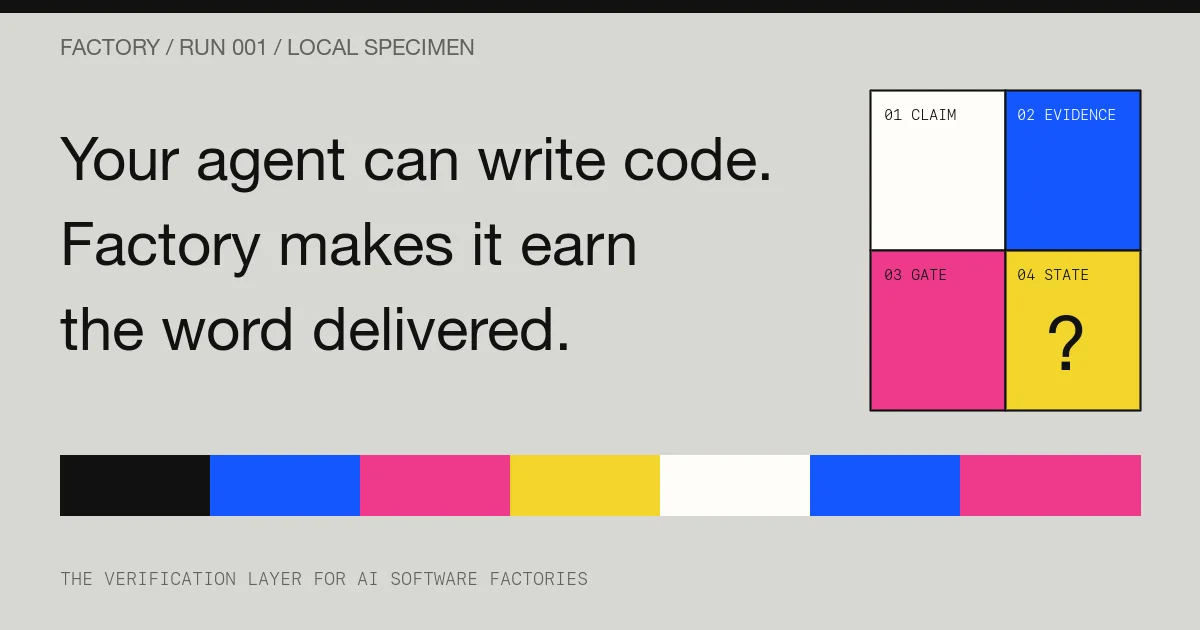
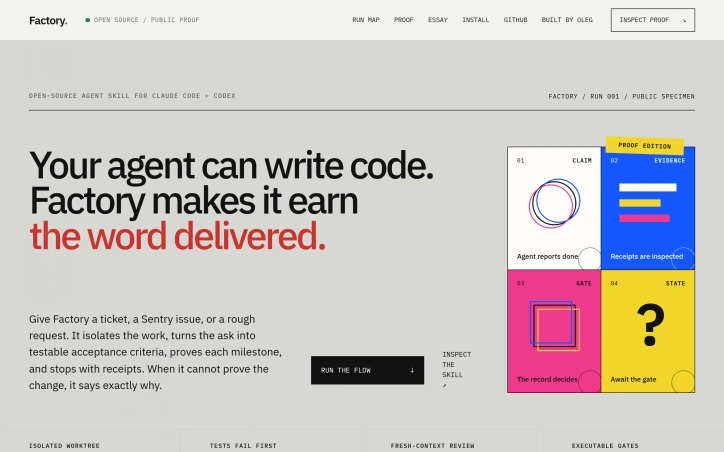
I built Factory to solve the hardest problem with AI coding agents: proving the work is actually delivered. Factory isolates changes, turns requests into testable criteria, runs verification gates at each milestone, and only approves delivery when evidence supports it.
AI Overview
AI-generatedAI coding agents promise rapid development, but they struggle with a fundamental challenge: distinguishing completed work from merely plausible-sounding code. Factory directly addresses this gap by inserting verification gates between intention and delivery.
The product wraps AI coding workflows in a structured process that treats each ticket as a journey through nine discrete phases. Rather than trusting an agent's assertion that work is done, Factory demands evidence. It translates informal requests into testable acceptance criteria, isolates changes in dedicated worktrees, and enforces gates where claims must be supported by passing tests and fresh-context review before proceeding.
What distinguishes Factory is its refusal to be optimistic. When acceptance criteria aren't fully satisfied, the system blocks delivery with explicit reasons. The proof edition demonstrated in the materials shows this in action: a false delivery claim fails because open blocking questions remain unanswered and acceptance criterion statuses are invalid. That kind of honest gating is rare in tools designed to accelerate development.
The workflow itself is thoughtful. The process begins with intake and diagnosis to establish baselines, moves to human-approved planning where blockers must be resolved before proceeding, then transitions to agent-driven building with failing tests first. Final proof phases map each acceptance criterion to evidence before a terminal gate either approves or rejects the change. Only state.json persists between sessions, forcing decisions to be recorded rather than ephemeral.
The design includes deliberate friction points. Work happens in isolated worktrees. Human approval is required at specific gates. Tests must fail before implementation can begin. Reviews happen with fresh context. These constraints work against speed but directly serve the core problem: unverified delivery masks real issues.
Factory operates as an open-source agent skill for Claude Code, which positions it as a specialized workflow rather than a standalone platform. That architecture keeps the tool focused and integrated into existing developer environments.
The fundamental contribution here is structural rather than technological. Factory doesn't replace code review or testing; it systematizes when each happens and what triggers progression. For teams where AI agents write code at scale and false positives create compounding problems, that discipline addresses a genuine pain point.
Founder Diary
DevlogThe maker hasn't posted a diary entry yet.
Key Features
Verification Gates
Inserts structured gates between AI agent intention and code delivery to prevent unverified work from proceeding
Nine-Phase Workflow
Guides each ticket through discrete phases including intake, planning, building, and proof phases with explicit approval requirements
Acceptance Criteria Translation
Converts informal requests into testable acceptance criteria that must be satisfied before delivery
Isolated Worktrees
Executes changes in dedicated, isolated environments to contain modifications and maintain safety
Honest Gating
Blocks delivery with explicit reasons when acceptance criteria aren't fully satisfied rather than optimistically approving incomplete work
Fresh-Context Review
Enforces human review with fresh context as a required gate before final approval
Use Cases
-
1
Teams scaling AI coding agents
Prevents false positive deliveries that mask real issues when agents write code at scale
-
2
Organizations requiring delivery discipline
Systematizes when code review, testing, and acceptance verification occur in the development workflow
-
3
AI-augmented development teams
Addresses the gap between plausible-sounding code and actually completed, verified work
-
4
Projects needing structured verification
Integrates verification gates without replacing existing testing and review processes
FAQ
Does Factory replace my existing code review and testing? ▾
What happens if acceptance criteria aren't met? ▾
Can I use Factory with my existing developer setup? ▾
How does Factory prevent false positives from AI agents? ▾
Tech Stack & Tags
Discussion
No comments yet — be the first!
Join the conversation — sign up to comment.
Sign up freeCommunity Support
Boost this project on Sell With boost
Meet the Founder

"10+ years shipping fintech APIs, AI features & OSS Lead engineer · open: full-time, fractional, f..."
More by Oleg Koval
dcli - docker and git workflows, stremlined
I kept repeating the same tedious Docker-reset a...

SaaS scaffold
One command. Auth, payments, database, email, Ta...

queryd - slow query detection for Node.js
Latency budgets for the SQL your Node app actual...

prompt-ctl.com
Structures every prompt for max signal, min wast...
More in Search
Drivium
We built Drivium to help people confidently buy...
amaze.directory
I was tired of AI tool directories filled with u...
StackLedge
We created StackLedge to solve fragmentation in...

Package Pal
Hey everyone! 👋 I’m Sagar, the creator of Packa...

KAR AI
I built KAR to fix how people buy cars in Europe...

Tools Network
I built Tools Network to solve the overwhelming...