
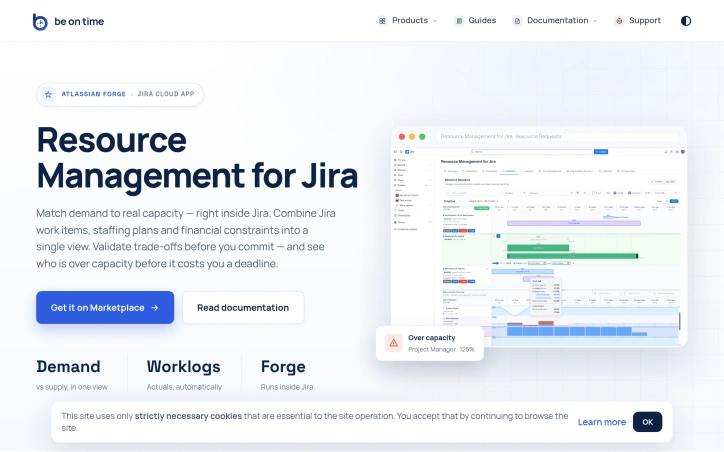
Resource Management for Jira

- No match
Machine translation — the English original is authoritative.
The Story
A Forge app for Jira Cloud that matches project demand to real team capacity. Combines org structure (teams/RBS), calendar-based capacity, a stateful resource-request workflow between PMs and Team Managers, Jira worklogs/timesheets, analytics, and invoice-ready CSV/XLSX exports. Data stays in Atlassian Forge.
AI Overview
AI-generatedPortfolio resource management at scale is fundamentally about coordination. When dozens of projects compete for the time of the same specialized teams—engineers, designers, QA—organizations lose visibility into who can actually do what, when. Timelines slip not because work is impossible, but because capacity decisions were made in isolation or on gut feel rather than data. This Jira Cloud app tackles that core problem by collapsing org structure, capacity planning, and actual time tracking into a single view where project demand meets team reality.
The product is built for organizations running parallel projects that share functional teams. Project managers and team managers gain a structured workflow for requesting resources and signaling availability, while PMOs and executives get analytics that surface over-allocation risks before they become missed deadlines. Everyone stays inside Jira rather than juggling spreadsheets or external tools.
What distinguishes this solution is its scope. Most resource management tools handle one dimension well—tracking capacity or managing requests or reporting time. This consolidates org structure synced from Azure AD or Outlook, calendar-based capacity with self-service time-off, a stateful request workflow between PMs and Team Managers, time tracking via Jira worklogs, and analytics comparing demand against actual utilization. The ability to approve resource requests and see over-capacity warnings before committing transforms resource planning from intuition into precision.
The execution trades breadth for focus. Rather than building a standalone platform, the team built a Forge app, which means it runs within Jira Cloud without context-switching or data duplication. This tight integration is both strategic and practical—organizations already managing work in Jira get resource visibility without adopting another system. The emphasis on enterprise features—org structure automation, compliance with data residency (Forge cloud), invoice-ready exports, REST API for org sync—signals intent to serve mid-market and larger organizations.
The feature set hints at mature thinking about the problem. Calendar-based capacity avoids double-booking by design. The structured request workflow with Team Manager approval prevents PM-level chaos where every request is urgent. Analytics spanning past and future periods let organizations course-correct. Time-off management tied to capacity avoids the phantom availability problem common in spreadsheet-based shops.
One limitation is implicit: the product assumes Jira is your system of record for project work and that resource decisions can be scoped to teams and projects tracked there. Organizations with work outside Jira or those needing resource visibility across tools beyond API integration would find this constraining. The REST API mitigates this for org-data sync but not for dynamic allocation scenarios.
For organizations struggling to match project demand to expert-team capacity, this fills a real gap at the intersection of portfolio planning and team execution where most tools stop short.
Founder Diary
DevlogThe maker hasn't posted a diary entry yet.
Key Features
Organization Structure Sync
Syncs org structure from Azure AD or Outlook for automated team management
Calendar-Based Capacity
Calendar-based capacity planning with self-service time-off to prevent double-booking
Resource Request Workflow
Stateful workflow between project managers and team managers for structured resource approval
Utilization Analytics
Analytics comparing project demand against actual team utilization across past and future periods
Over-Capacity Warnings
Surface over-allocation risks before resource commitments to prevent missed deadlines
REST API Integration
REST API available for organizational data sync with external systems
Use Cases
-
1
Project Managers
Gain visibility into specialized team availability when multiple projects compete for the same resources
-
2
PMOs and Executives
Access analytics to identify over-allocation risks and make data-driven capacity decisions
-
3
Organizations with Shared Teams
Prevent capacity chaos when teams serve multiple concurrent projects with conflicting demands
-
4
Mid-Market Enterprises
Manage resource planning within Jira without adopting standalone tools or spreadsheets
FAQ
How does this integrate with Jira? ▾
Can this prevent overbooking of team members? ▾
Does it work if we use multiple project management tools? ▾
What happens if time-off isn't tracked? ▾
Tech Stack & Tags
Discussion
No comments yet — be the first!
Join the conversation — sign up to comment.
Sign up freeCommunity Support
Boost this project on Sell With boost
Meet the Founder

More by Be On Time

More in Project management software

Snippetly
Snippetly helps developers and teams capture, or...

Chatquick AI
Create audiobooks, podcasts, and interactive aud...

Focus Session by SyncTasks
Select your tasks and enter a distraction-free m...

Dropstone
Dropstone: World's first generational recursive...

Krisp AI Note Taker Mobile
Meetings don’t wait. Neither should your notes....
Stash
Capture anything on your Mac with Stash. This sm...