Schedio Smart Audio Player

- No match
Machine translation — the English original is authoritative.
The Story
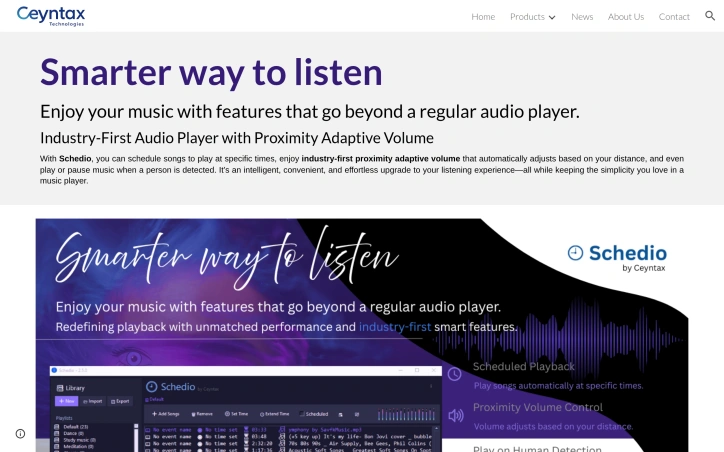
Enjoy your music with features that go beyond a regular audio player.
Industry-First Audio Player on Windows with Proximity Adaptive Volume
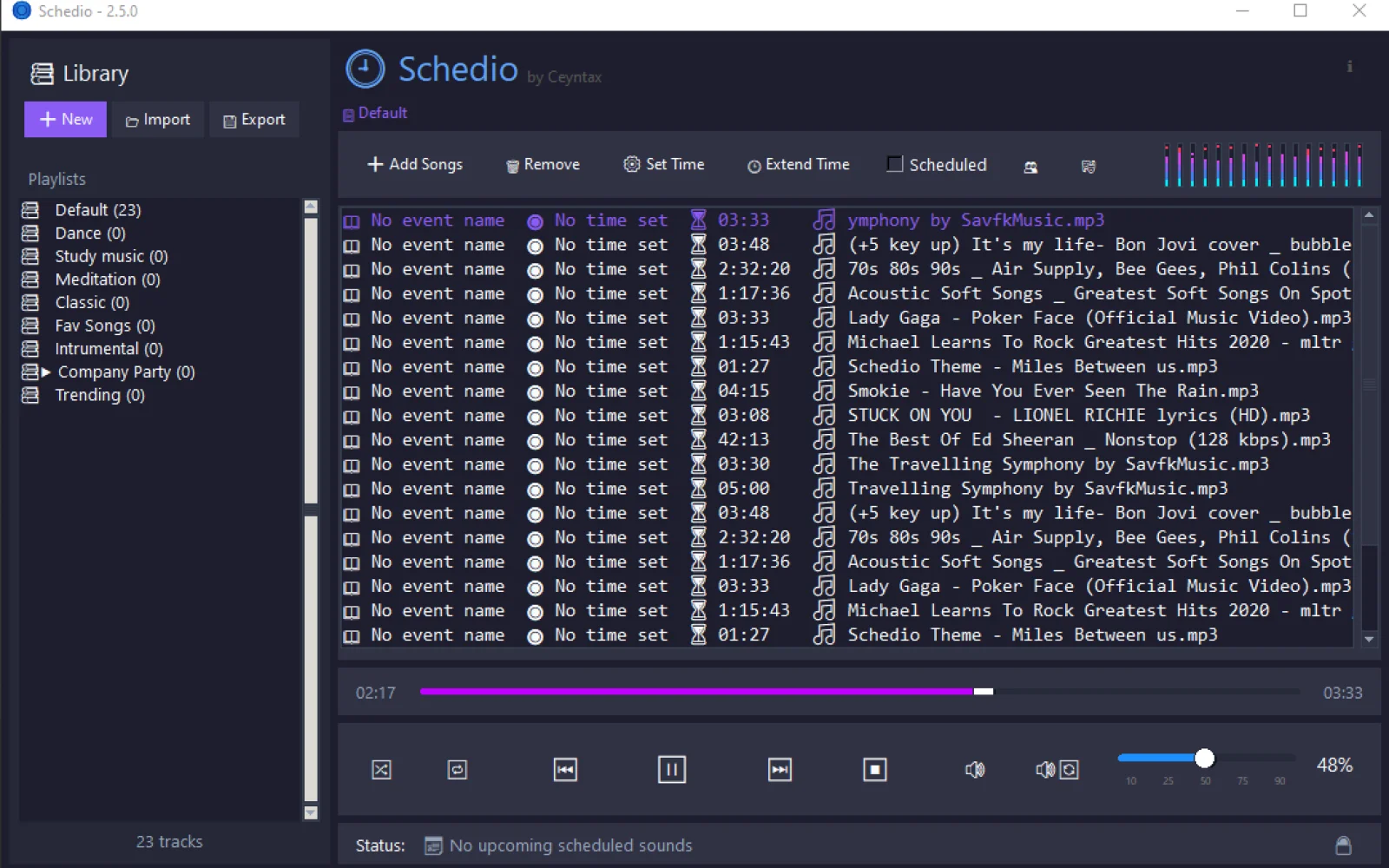
With Schedio, you can schedule songs to play at specific times, enjoy industry-first proximity adaptive volume that automatically adjusts based on your distance, and even play or pause music when a person is detected. It’s an intelligent, convenient, and effortless upgrade to your listening experience—all while keeping the simplicity you love in a music player.
AI Overview
AI-generatedAutomating audio playback based on presence and proximity, Schedio positions itself as an intelligent upgrade to standard media players for Windows users who want hands-free control over their listening environment. The application targets two distinct use cases: event organizers and presenters who need scheduled playback, and home or workspace users seeking ambient music that responds dynamically to occupancy.
The product's core distinction lies in its sensor-driven features. Rather than requiring manual volume adjustments or playback commands, Schedio detects nearby movement via webcam and alters audio behavior accordingly. The proximity volume function continuously adjusts levels based on distance—playing softer as listeners approach and louder as they move away. This approach eliminates constant volume tweaking and creates a responsive listening experience that adapts in real time. The human detection feature automates play and pause entirely, starting playback when movement is detected and stopping when a space empties. For events or presentations, the scheduled playback capability lets users queue content to activate at predetermined times without oversight.
The feature set extends beyond these core functions. Smart play/pause works as a persistent version of human detection, automatically resuming music when someone reenters a space. Playlist management provides standard organizational tools, while lock/unlock controls prevent accidental setting changes—useful in shared or public environments. An "extend scheduled time" feature allows single-click adjustments to ongoing playback, and the company emphasizes a professional audio engine tuned for clarity and depth.
Schedio operates as a lightweight desktop application rather than a cloud-dependent service. It requires Windows 10 or 11 and needs internet connectivity only for initial setup; afterward, it functions entirely offline. A webcam and sound card are the only hardware prerequisites beyond the operating system itself.
The product occupies a narrow but potentially valuable niche. Most audio players prioritize music discovery or library management. Schedio instead optimizes for environmental control and automation, making it suited for retail spaces, hospitality venues, presentation rooms, or homes where occupancy-responsive audio adds value. The execution strategy—offline-first architecture, minimal system overhead—suggests practical deployment considerations.
What remains unclear from available information is pricing structure, licensing model, and whether the application serves individual consumers or targets businesses. The feature sophistication implies either paid or freemium positioning, though no details appear publicly documented.
Founder Diary
DevlogThe maker hasn't posted a diary entry yet.
Key Features
Proximity Volume
Automatically adjusts audio levels based on listener distance from the device
Human Detection
Starts playback when movement is detected and stops when the space empties
Scheduled Playback
Queues content to activate at predetermined times without manual oversight
Smart Play/Pause
Automatically resumes music when someone reenters a monitored space
Offline Architecture
Functions entirely offline after initial setup with no cloud dependency
Lock/Unlock Controls
Prevents accidental setting changes in shared or public environments
Use Cases
-
1
Event Organizers and Presenters
Need automated scheduled playback for events and presentations
-
2
Retail and Hospitality Venues
Occupancy-responsive audio enhances customer experience and ambiance
-
3
Home and Workspace Users
Want ambient music that dynamically responds to occupancy changes
-
4
Presentation Rooms
Eliminates manual audio control during scheduled events with automated triggers
FAQ
What operating systems does Schedio work on? ▾
Does Schedio need internet to run? ▾
What hardware is needed for Schedio? ▾
Can Schedio automatically pause music when I leave? ▾
Tech Stack & Tags
Discussion
No comments yet — be the first!
Join the conversation — sign up to comment.
Sign up freeCommunity Support
Boost this project on Sell With boost
Meet the Founder

"Founder @ Ceyntax Technologies. Building trading engines, AI surveillance, Smart media players &..."
More by Dushshantha R.




More in Scheduling software

Car File
CarFile is the UK's DVLA-connected vehicle manag...

TrySchedule
I built TrySchedule to simplify weekly planning...

FlowReserve
We built FlowReserve because service professiona...

MotorManage
MotorManage solves the headache of motorcycle ma...

Staff Scheduling
We built Staff Scheduling because managing team...

Tentare Pilates Software
Tentare was created to help Pilates studios repl...