#collaboration Startups & Tools
Discover the best collaboration startups, tools, and products on SellWithBoost.
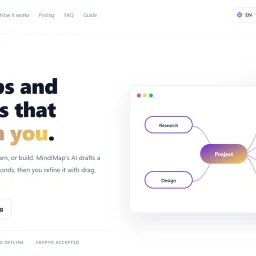
Visual organization tools have long required choosing between simplicity and capability. This all-in-one editor targets the friction point where ideas need structure—whether for project planning, team collaboration, or classroom instruction—by letting users describe what they want built and having AI generate the full layout in seconds. The platform combines six core capabilities within a single interface: mind mapping, flowcharting, task management, templates, collaborative features, and export options. Users input a description of their project or idea, and the system generates a structured visualization including nodes, branches, and hierarchy. From there, refinement is immediate; additional AI prompts can restructure, add, remove, or rename elements while preserving user-applied notes, icons, and colors. Eleven prebuilt templates cover common scenarios: project plans, study guides, SWOT analyses, product roadmaps, sprint planning, blog outlines, OKRs, and client onboarding flows. What distinguishes this offering is its self-contained architecture. The AI runs on the company's own servers rather than depending on third-party services like ChatGPT, Claude, or Gemini. Users need no API keys, no external accounts, and no browser extensions—the entire experience happens in the browser across desktop, tablet, and phone. This eliminates friction common to competing tools and means the service is private by default. The flowcharting capability includes a full shape library: ovals for start and end points, diamonds for decisions, parallelograms for input/output, plus document, hexagon, and cylinder shapes. Task tracking layers the same tree layout onto checkpoint management, with checkboxes, side-panel lists, filters, and a live completion bar to track remaining work. Collaboration happens two ways. Read-only sharing generates a single URL or QR code for viewers requiring no account or install. Editable sharing lets collaborators make changes directly in the browser while the original owner retains control; each save is versioned, stale tabs refresh cleanly, and the sharing link can be revoked at any time. The system prevents collisions by restricting simultaneous editing to one user at a time. Export flexibility covers PNG, JPEG, PDF, SVG, JSON, and Markdown formats, with watermarks absent from paid plans. JSON export integrates with an Android app, enabling seamless cross-device transfers. The product accepts cryptocurrency as payment, a signal of positioning toward digitally native users. Free and paid tiers exist, though specific pricing is not publicly detailed.

An operating system designed around the unlimited canvas concept rather than traditional windowing offers a fundamentally different approach to digital work. The platform targets teams and knowledge workers who need to juggle multiple applications simultaneously while maintaining visibility of everything at once. It also embraces AI agents as first-class participants in workflows, giving them their own cursors and the ability to work collaboratively on projects. The core innovation centers on replacing the tab-and-window paradigm with an infinite canvas. Users open their applications side by side on a blank workspace and navigate through zoom controls rather than window switching. The system persists these arrangements in saved workspaces, allowing teams and individuals to return to complex setups without rebuilding them each time. Multiple canvases let users maintain separate contexts for different projects without context-switching friction. What distinguishes Novastart is its treatment of AI agents as observable, controllable collaborators rather than black boxes. Agents receive their own cursors and can split work across helper agents, each working in dedicated windows. A human can pause execution mid-task, type corrections, and watch the system adjust without restarting. Results require verification before being marked complete, building in a quality gate that acknowledges the need for human oversight of automated work. The team collaboration features center on shared workspaces with per-user cursors and live streaming of application windows between team members. Rather than requiring screen shares and verbal directions, collaborators can directly manipulate windows and see each other's actions in real time. Chat exists within the OS itself, and team members access each other's applications as if they were their own. The persistent room remains intact when people leave and return, maintaining context continuity across sessions. The product lacks publicly available pricing information, making the business model unclear from the marketing materials alone. It remains unknown whether Novastart positions itself as a replacement for operating systems, a workplace productivity platform, or an application overlay. The technical feasibility of cross-platform application streaming and the learning curve for users accustomed to traditional interfaces represent questions that the marketing content does not address. The infinite canvas concept proves compelling for visual organization and AI collaboration workflows, but execution details and real-world performance will determine whether it delivers on its architectural promises.