#ai-powered Startups & Tools
Discover the best ai-powered startups, tools, and products on SellWithBoost.

Finding qualified B2B sales prospects typically requires purchasing expensive lists, manually researching contacts, and sending cold emails with minimal conversion rates. Warmloom addresses this inefficiency by automating the entire prospect discovery and outreach process while charging only when conversations actually begin. The platform works by analyzing a company's website to identify its ideal customer profile, then continuously monitoring for buying signals—new facilities opening, funding announcements, management changes, public tender requests, or supplier disruptions. Once Warmloom detects a relevant event, it identifies the most likely decision-maker at the affected company, verifies their email address, and drafts a personalized email contextualizing the outreach around that specific event. Sales reps review the draft before sending, or can enable autopilot mode once confident in the system's accuracy. What distinguishes Warmloom is its removal of traditional sales friction points. Users can start testing the system without providing payment information, receiving their first prospect identification and email draft at no cost. The one-sided payment model—revenue generated only after a prospect replies—aligns incentives between the platform and users. This contrasts with list-buying services that charge upfront regardless of outcome. The product emphasizes quality of outreach over volume. Rather than blasting generic emails to hundreds of semi-relevant contacts, Warmloom sends single, highly contextualized emails to prospects identified as currently motivated to consider alternatives. This approach reduces email fatigue and improves reply rates compared to traditional cold outreach. The service targets B2B sales teams selling to mid-market and enterprise customers where buying signals are publicly observable. This works well for businesses selling complementary products to expanding organizations—such as supplies for new hotel openings or services for newly funded companies. The approach has limited utility for companies selling to early-stage startups or situations where buying events aren't publicly announced. Warmloom's core claim that it writes emails specifically around identified events rather than generic cold pitches represents a meaningful shift from how most outbound tools operate. The combination of automated event monitoring, contact discovery, and personalized drafting removes the traditionally time-consuming research portion of outbound sales. The result-based pricing model makes it a low-friction experiment for sales teams frustrated with traditional prospecting methods. The product doesn't solve outbound sales entirely, but it addresses a genuine bottleneck: finding prospects who are actually ready to switch suppliers right now, rather than cold outreach to everyone in an industry vertical.
Small businesses operating brick-and-mortar locations—restaurants, salons, shops—often maintain active Google Maps presence with reviews and photos but lack either the technical knowledge or budget to build a proper website. Blasa solves this gap by automatically converting a Google Maps listing into a fully functional, multilingual business website. The product's core strength lies in its content philosophy: the website draws exclusively from genuine customer reviews, photos, and business metadata already on Google. Nothing is AI-invented. Headlines, testimonials, and competitive advantages all trace back to what real customers have written. This authenticity-first approach distinguishes it from template-based website builders that generate generic copy. Multilingual support emerges as a notable capability. Rather than treating languages as an afterthought, Blasa defaults to generating websites in the language of the reviews plus English, with proper right-to-left formatting for Arabic, Hebrew, Persian, and Urdu. This design choice acknowledges the reality of modern local businesses serving diverse neighborhoods. The user experience reduces to its essentials: paste a Google Maps link, and the system handles everything else. No code, no template selection, no form-filling. The AI derives a color scheme from the business's logo and selects typography based on the business name, creating thematic coherence without manual configuration. The resulting website publishes immediately on a custom subdomain. From a discovery standpoint, Blasa embeds LocalBusiness structured data and applies SEO optimizations, helping websites surface in search results and AI assistant recommendations. For a local business competing against larger establishments, this integration with machine-searchable data matters. The pricing model reflects accessibility as a core principle. The free tier includes a complete multilingual website with structured data and SEO capabilities, offset by a small labeled advertisement. The Growth plan costs $19.99 annually, dropping to roughly $1.67 per month. An alternative $39.99 one-time purchase conveys permanent ownership. These price points remain within reach for micro-enterprises that might otherwise skip having a web presence entirely. The product targets an underserved segment: businesses too small to justify agency fees or developer time, yet established enough to have genuine customer reviews worth showcasing. For this audience, Blasa addresses a genuine friction point in moving online.
Solving the ubiquitous question of what to make for dinner, this AI-powered recipe generator transforms ingredient management into meal inspiration. The product targets home cooks who want to reduce food waste and decision fatigue by generating complete dinner menus from whatever they happen to have on hand, whether that's leftovers, pantry staples, or random fridge contents. The core strength lies in its practical execution. Rather than delivering a single recipe suggestion, the tool generates a full dinner menu that scales to your table size, includes multiple courses, and pairs instructions with visual guidance. The ingredient recognition system works from both photo uploads and manual text entry, reducing friction for users who prefer typing over photographing. The interface respects user preferences through customization options spanning cuisine type, spice level, dietary restrictions, and flavor profiles, allowing the AI to generate meals that actually fit how someone wants to eat rather than generic suggestions. The presentation format distinguishes this from simpler recipe search tools. Outputs arrive as paginated recipe books with step photographs and integrated shopping lists, addressing a real friction point in cooking workflows. The live image rendering during generation appears designed to build anticipation and engagement, turning a utilitarian task into something more interactive. This matters for consumer adoption, as recipe tools often feel transactional. Two distinct modes expand the use cases. The ingredient-focused generator targets the "what can I make?" problem, while a random recipe generator flips the equation for users seeking inspiration when they have no particular direction. This flexibility broadens appeal beyond the primary use case of inventory management. The business model employs a generous freemium approach. New users receive 2,000 complimentary credits upfront without requiring a credit card, lowering barriers to first use. The credit system enables monetization through premium usage tiers, though specific pricing remains unexplained in available materials. This conversion-focused strategy acknowledges that the value proposition strongest for users who have tried it and want reliable access. The product addresses a genuine pain point that bridges meal planning, ingredient management, and food waste reduction. It targets neither professional cooks seeking advanced techniques nor beginners needing fundamental instruction, but rather practical home cooks who experience decision paralysis within abundance. The combination of AI-driven personalization, recipe book presentation, and accessible free trial positions this as a functional tool with consumer appeal, though broader market adoption will depend on how the transition from free to paid conversion actually performs in practice.

Staying on top of what your competitors are doing requires either a dedicated research team or the discipline to manually check dozens of web pages on a regular basis. Rival Radar eliminates both those requirements by automating competitive monitoring through AI-powered discovery and continuous page tracking. The platform targets businesses that need to know when competitors make meaningful changes to pricing, features, messaging, or positioning but lack the resources for a full competitive intelligence operation. Rather than asking users to manually input competitor URLs, Rival Radar accepts a simple description of what a company does, then uses AI to identify actual competitors based on real search results. Once identified, it continuously monitors pricing pages, homepages, feature lists, changelogs, careers pages, and integration pages. What sets Rival Radar apart is its focus on signal over noise. Most page-monitoring tools alert users to every change, including trivial updates like cookie banner rotations. Rival Radar instead extracts the semantic content that matters—pricing numbers, plan names, feature descriptions—and compares only those elements, ignoring markup changes. Severity is automatically ranked, with pricing changes flagged as major while typos remain silent. When something real does change, users receive a single consolidated alert via email, Slack, Discord, or custom webhooks with a one-sentence explanation of what changed and its business implication, not a raw HTML diff. The product reflects a clear understanding of how competitive research actually fails at most companies. Rather than trying to replace human analysts, it handles the tedious, repetitive work of checking pages and flagging genuine changes. The before-and-after diffing is available on demand for users who want deeper detail, but isn't forced into every notification. Pricing is explicitly free for the first three competitors with twice-daily checks, requiring no credit card. The site indicates paid tiers exist but doesn't detail pricing or competitor limits in the provided content. For small teams and solo founders, the free tier offers real utility. For companies watching more competitors, the upgrade path presumably exists but remains unspecified in available materials. Rival Radar addresses a genuine friction point in how businesses stay competitive. It's not a substitute for strategic analysis but a pragmatic tool for the routine monitoring that most companies neglect or do inefficiently.

Debugging consumes far more time than it should, and developers have gotten used to it. The typical workflow involves spotting an error in the browser console, manually opening Chrome DevTools to gather context, copying fragments into ChatGPT or Claude, re-explaining the problem when the AI's first response falls flat, then repeating the cycle dozens of times per day. Each context switch costs focus and momentum. DebugClip addresses this friction by automating the bridge between where errors happen and where developers get help. The Chrome extension captures console errors, network failures, and security violations as they occur, then compiles them into a structured prompt ready to send to Claude or ChatGPT with a single click. Rather than manual transcription, developers get stack traces, request headers, response bodies, and HTTP status codes included automatically. What sets this approach apart is elimination of context switching. The extension runs silently in the background and notifies developers when issues occur, presenting everything alongside the problems themselves in a clean dashboard. The promised result is moving from discovery to actionable fix in under ten seconds, replacing workflows that consume five to ten minutes per error. The feature set mirrors what DevTools already exposes but streamlines access and AI integration. It captures every console error and warning, unhandled promise rejections, failed API calls with network details, broken resource loads, and CORS or CSP violations. This breadth ensures developers rarely need to jump back into DevTools to gather missing context. The business model is straightforward. The extension is free to use indefinitely on all websites, with a paid tier at four dollars monthly for presumably enhanced functionality. The developer emphasizes local processing, meaning captured errors remain on device and do not transmit to DebugClip servers. For developers who spend significant time debugging or testing in the browser, the extension removes a well-documented source of wasted motion. The positioning is narrow and focused, targeting a single pain point without attempting to replace DevTools or become an all-in-one solution. Chrome and Edge support is available now, with Firefox and Safari compatibility planned. The free tier makes adoption frictionless.

Tarot readings traditionally occupied a niche intersection of spirituality and mystique, often requiring in-person sessions with expensive practitioners and demanding significant prior knowledge to interpret results. iTarot addresses this gatekeeping by combining traditional 78-card tarot with AI-powered interpretation, making the practice accessible to beginners and non-English speakers alike. The platform supports 15 languages and offers 25 different card spreads ranging from simple single-card pulls to complex multi-card layouts designed for specific life domains—relationships, career decisions, personal growth, and long-term trajectory. Rather than presenting isolated card meanings, the AI component differentiates itself by explaining how cards relate to one another, analyzing upright and reversed positions, and offering structured, actionable interpretations tailored to the user's specific question. Accessibility extends beyond language support. The site includes a comprehensive help center addressing common misconceptions about tarot's predictive power, explicitly clarifying that readings reflect current energy and possibilities rather than fixed fate. This ethical framing discourages users from employing tarot to circumvent professional advice on medical, legal, or financial matters—a responsible boundary that strengthens rather than weakens the product's credibility. Beginners can start with explanations of all 78 card meanings before diving into complex spreads. The business model uses a freemium approach: basic readings and card meaning lookups are available without payment, while unlocking the AI deep-report analysis requires purchase. Stripe and Alipay are supported, indicating deliberate geographic focus toward global audiences, particularly Asia. What distinguishes iTarot is its positioning at the intersection of ancient divination practice and modern generative AI—a combination that makes subjective interpretation feel more systematic and transparent. Whether users consult tarot for genuine spiritual guidance or self-reflection exercises, the product acknowledges the distinction without judgment. The interface layers structure and clarity over mystique, making it suitable for skeptics and believers alike to explore tarot as a decision-making aid or personal journaling prompt.

WordPress site development traditionally demands substantial time investment, whether building from scratch or customizing templates. Crafto addresses this friction by packaging a pre-built solution around Elementor's page builder, targeting businesses and freelancers who need professional websites without developmental overhead. The theme's core offering centers on speed to deployment. With 56 industry-specific demo sites spanning corporate, e-commerce, education, hospitality, and professional services verticals, users can select a starting point matching their business type rather than configuring from blank canvas. The accompanying library of 500+ pre-built pages and 100+ widgets compresses the typical weeks-long development cycle into a launch measured in hours. What distinguishes Crafto operationally is its integration depth with Elementor. The drag-and-drop builder serves as the primary customization interface, supported by a dedicated theme builder for headers, footers, and layout control. This approach lowers technical barriers—non-developers can modify design without touching code while maintaining professional results. Performance optimization is built-in rather than an afterthought; the marketing materials emphasize speed scoring and load time tuning, categories where theme selection directly impacts site metrics. The breadth of included templates speaks to market coverage. Rather than forcing generalists to jury-rig components across unrelated templates, Crafto bundles industry-specific designs: medical clinics receive healthcare-appropriate layouts, fashion retailers get e-commerce framing, agencies access portfolio constructions. This vertical focus reduces customization demands compared to horizontal themes requiring users to retrofit templates across contexts. Feature density skews toward visual presentation—animations, effects, and design polish feature prominently in positioning. The theme reportedly represents over 1,000 days of development work, suggesting iterative refinement toward performance and polish rather than experimental features. From a business standpoint, Crafto operates within the Envato ecosystem as a Power Elite author offering, indicating professional vetting and customer support commitments through that platform. The claim of 60,000+ active users provides social proof, though this reflects installed base rather than new adoption rate. The product serves WordPress users experiencing decision fatigue between starting blank and overfitting generic themes. It particularly suits agencies serving multiple verticals, small business owners prioritizing speed-to-market, and freelancers building client sites where turnaround time directly affects profitability. Pricing details remain absent from available materials, though Envato-hosted themes typically operate on one-time purchase or subscription models.

Overpaying at the grocery store happens constantly, often without shoppers realizing it. CartLens solves this by enabling consumers to scan receipts and price tags with their phone camera, instantly surfacing whether they paid fair prices and identifying cheaper alternatives at nearby stores. The product targets price-conscious shoppers who want to maximize savings on everyday shopping without manually researching competitor pricing. This includes budget-minded households, deal-seekers, and anyone monitoring household spending efficiency. What distinguishes CartLens from generic price comparison tools is its commitment to crowdsourced data from actual shoppers rather than merchant APIs or web scrapers. This ground-truth approach captures real market conditions as they exist on store shelves, not outdated catalog information. The company layers this foundation with sophisticated computer vision powered by Gemini Embedding 2, fusing pixel-level data with semantic text into a unified vector representation. The system achieves 99.8% accuracy on receipt parsing across items, prices, and quantities. The feature set reflects comprehensive ambition for the category. Beyond price scanning, CartLens includes basket comparison across multiple stores, price spike detection for sudden local increases, direct store-to-store comparison, and an AI shopping assistant. The spending insights dashboard aggregates purchase history across categories and stores, creating visibility into money flow. The company supports 11 languages natively with automatic currency and unit adaptation when travelers cross borders. Privacy and data sovereignty are core to the product architecture. CartLens builds in GDPR and CCPA compliance, carries SOC2 Type II certification, and offers full data portability through downloadable JSON archives. Users can decommission accounts entirely, triggering automated anonymization that strips personal information while preserving price data in the network. The underlying infrastructure, which CartLens calls the Price Lattice, maps local pricing across physical retail locations in real time. The model strengthens with each scan, creating network effects where denser user concentration in a geography yields better savings potential for participants. The company positions this as ground-truth mapping of the physical economy rather than simple price comparison. No pricing model is disclosed in available materials.

Competitor analysis is a crucial task for businesses, but it can be a tedious and time-consuming process. Seeto's AI-powered solution simplifies this task, providing actionable insights in minutes. The platform is designed for product teams, founders, CEOs, and marketing teams who need to stay ahead of the competition. What stands out about Seeto is its ability to automate the data collection process, eliminating the need for manual browsing, copying, and pasting into spreadsheets. The AI agent explores competitor websites, extracts relevant data, and compares it with the user's own product, providing a comprehensive analysis. The level of accuracy is impressive, with sources verified to ensure reliability. Seeto's key features include a feature comparison matrix, pricing intelligence, SEO insights, positioning analysis, and messaging differentiation. The platform provides a side-by-side comparison of features across competitors, helping teams identify gaps and opportunities. The data is presented in an interactive dashboard, making it easy to navigate and understand. The testimonials from satisfied customers demonstrate the value that Seeto brings to businesses. The feature comparison alone is worth the investment, according to one product manager. Others have reported significant benefits, including improved roadmap planning, 10x ROI on SEO insights, and avoiding underpricing by 40%. By streamlining competitor analysis, Seeto enables businesses to make informed decisions and stay competitive in their markets. With its robust capabilities and user-centric design, Seeto is an essential tool for teams that ship fast and compete to win.
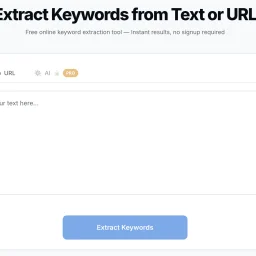
Keyword extraction is a crucial task for businesses and individuals focused on search engine optimization and content analysis, but manually sifting through text to identify key terms can be a tedious and time-consuming process. ExtractKeywords is designed to simplify this task, providing a straightforward solution for extracting keywords from text or URLs. The tool is geared towards individuals and businesses seeking to optimize their content and understand the dominant themes within their text. What stands out about ExtractKeywords is its ability to simplify the keyword extraction process without requiring users to sign up or navigate complex interfaces. The tool is designed to be user-friendly, allowing users to paste their text or enter a URL and receive instant results. The use of artificial intelligence for semantic extraction is also noteworthy, although this feature is reserved for Pro users. The tool's capabilities include word frequency analysis, stop-word filtering, and multi-word phrase detection, providing a comprehensive picture of a text's keyword profile. Users can view results sorted by frequency and density, filter by one-word, two-word, or three-word phrases, and export their findings as a CSV file or copy them to the clipboard. For URL extractions, the tool fetches the publicly accessible HTML of the webpage, respects robots.txt directives, and extracts the main text content before running the same keyword analysis used in text mode. The website does mention a Pro version with AI-powered extraction, indicating a freemium business model, but details on pricing are not provided. Overall, ExtractKeywords offers a valuable resource for those seeking to streamline their keyword extraction process and gain insights into their content.

Freelancers often struggle with creating professional proposals and navigating the complexities of contracts, a challenge that can be both time-consuming and costly. Propactly addresses this issue head-on by offering an AI-powered solution tailored specifically to the needs of freelancers. The platform is built by freelancers, for freelancers, ensuring that it meets the unique demands of this profession. What stands out about Propactly is its ability to not only generate professional quotations, proposals, and business requirement documents from scratch but also to analyze and summarize contracts in plain English, stripping away the legal jargon that often confuses. This dual capability is a significant advantage for freelancers who need to both present their services professionally and protect their interests when negotiating contracts. The platform's AI assistance is geared towards understanding freelance business workflows, offering structured proposals, pricing-aware quotations, and contract risk analysis. This is a marked departure from generic AI tools that merely generate text without understanding the context or specific needs of freelancers. Users can create or upload documents, have them analyzed and enhanced by the AI, and then export professional PDFs or summaries. While Propactly's pricing model is not explicitly detailed, the platform invites users to get started for free, suggesting a potentially freemium model or a trial period. The emphasis is on the value it brings to freelancers, including saving time, reducing costly mistakes, and enhancing their professional image. Overall, Propactly is a valuable resource for freelancers at every level, providing them with the tools to create professional documents, understand contracts, and ultimately win more clients. Its focus on the specific needs of freelancers and its user-centric design make it a compelling solution in a market often dominated by one-size-fits-all tools.

Creating a strong brand identity is a daunting task for many startups and small businesses. The challenge lies in establishing a consistent visual presence across various channels, from logos and mascots to merchandise. Brand Maker tackles this issue head-on with its AI-powered brand identity system. The platform is designed for businesses seeking to streamline their branding process. By leveraging artificial intelligence, Brand Maker generates a range of branding elements, ensuring a cohesive look and feel across different platforms. One notable aspect of Brand Maker is its featured presence on several prominent startup directories and platforms, such as Turbo0, The One Startup, and LaunchIgniter. This visibility underscores the product's relevance and potential within the startup ecosystem. The key features of Brand Maker include the generation of logos, mascots, and merchandise, all of which are created with a focus on maintaining visual consistency. This capability is particularly valuable for businesses looking to establish a robust brand identity without the need for extensive design expertise or resources. Unfortunately, the available information does not provide insight into Brand Maker's pricing or business model. However, the fact that it has been featured on multiple platforms suggests a level of maturity and stability in its operations. Overall, Brand Maker presents a compelling solution for businesses aiming to simplify and enhance their brand identity creation process. By harnessing the power of AI, the platform offers a streamlined approach to generating consistent branding elements, making it an attractive option for startups and small businesses navigating the complexities of establishing a strong brand presence.

Business owners and executives often find themselves bogged down in mundane tasks that take away from their ability to focus on growth and strategy. MyRemoteVA addresses this issue by providing a team of skilled remote professionals who can handle a wide range of tasks, from administrative duties like email management and calendar coordination to more specialized tasks like web development and financial bookkeeping. The service is designed for founders, CEOs, agencies, and growing teams worldwide who need help delegating work without the cost and complexity of traditional hiring. What sets MyRemoteVA apart is its unique blend of AI-powered efficiency and human expertise. By combining the two, the service is able to provide reliable, scalable, and cost-effective support to its clients. The company's experience in the virtual assistant industry is evident in its comprehensive approach, which allows clients to assign tasks across multiple areas of their business without having to hire full-time employees. Notably, MyRemoteVA offers a flexible support model that allows clients to get started with a "Forever Free" plan, complete with free monthly support minutes and access to its task management system. This allows businesses to test the service and experience its benefits before scaling up. The service also features a straightforward execution system that replaces the need for freelancers, task platforms, and hiring. With its dedicated assistant model and hours-rollover feature, clients can rest assured that their tasks are being handled efficiently. Overall, MyRemoteVA is well-suited for businesses looking to streamline their operations and free up time to focus on growth. By providing a comprehensive and flexible support solution, the service is able to help its clients stay organized, increase productivity, and achieve their goals.

Automating the conversion of visual designs into functional code addresses a genuine pain point in modern development workflows. Screenshot to Code targets developers and designers grappling with design-to-development handoffs, whether that's individuals prototyping quickly or teams moving designs from Figma into production applications. The tool eliminates hours of manual HTML, CSS, and JavaScript work required to match mockups pixel-for-pixel. What distinguishes this product is its range of framework support and execution speed. Rather than locking users into a single output format, Screenshot to Code generates code across multiple paradigms: vanilla HTML and CSS, React with JSX and TypeScript support, Vue single-file components, Next.js components, Tailwind CSS utility classes, Bootstrap, Ionic, and SVG. This flexibility means developers can feed it a screenshot and receive output in their framework of choice. The core technology uses AI-powered visual recognition to identify UI components—buttons, forms, navigation menus, cards, images—with the precision required for production work. It reconstructs these elements while preserving layout, spacing, typography, colors, and responsive breakpoints exactly as they appear in the original design. Users can upload PNG, JPG, or WebP files from any source: website screenshots, Figma designs, Sketch mockups, or hand-drawn wireframes. The tool outputs semantic, well-structured code suitable for direct integration into projects. Generated code is downloaded or copied directly to the clipboard. What the tool notably doesn't do is generate application logic or backend integration—it strictly converts visual elements to front-end code. Developers still need to wire up interactivity and data flows themselves. The product operates on a credit-based system, with each conversion consuming a fixed number of credits, though explicit pricing details aren't available. The value proposition is straightforward: it removes the bottleneck of translating visual designs into responsive, semantic code. For teams with heavy design-to-code workflows, that efficiency gain is meaningful. The tool's real-world effectiveness ultimately depends on how it handles complex nested layouts and edge cases beyond simple UI patterns.