#seo Startups & Tools
Discover the best seo startups, tools, and products on SellWithBoost.
Brands increasingly struggle to maintain visibility as search behavior fragments across AI chatbots, voice assistants, and conversational platforms rather than concentrating in Google results alone. SEO Jetty tackles this fragmentation by helping companies position themselves across the full spectrum of how modern buyers discover information. The agency specializes in what it calls Generative Engine Optimization and Answer Engine Optimization, concepts that acknowledge a fundamental shift: customers now ask ChatGPT, Gemini, Claude, and Perplexity for recommendations and answers rather than scrolling through search results. Traditional SEO optimization alone cannot address this new discovery landscape. SEO Jetty bridges that gap by optimizing not just for ranking, but for being cited and recommended within AI-generated responses. The service lineup combines multiple demand-generation approaches: optimizing digital authority and content ecosystems for AI visibility, capturing high-intent audiences through voice and conversational search, implementing advanced technical SEO, running hyper-personalized email campaigns, and deploying predictive lead-generation systems. This integrated approach reflects the company's core insight that sustainable growth now requires coordination across multiple channels rather than a single, siloed SEO strategy. The company presents evidence of practical traction through case examples showing qualified leads captured through LLM citations, share of voice dominance across multiple AI engines, significant traffic gains from answer-engine sources, and high-intent query volume. These results target companies in specific verticals such as cybersecurity SaaS. The company claims 250 client relationships, 12 years of operating experience, and a 4.9 out of 5 client satisfaction rating, though these figures appear on the website without independent verification. Positioning itself as focused on growth-forward brands rather than small businesses experimenting with AI, SEO Jetty targets enterprises and established companies that recognize their traditional SEO investments may not translate to visibility in AI-powered search experiences. The messaging emphasizes that the buying behavior of modern customers has fundamentally changed, and that visibility strategies must evolve accordingly. On pricing, the company advertises promotional discounts during seasonal campaigns but provides no published rate card on the website. Inquiries require a strategy call.
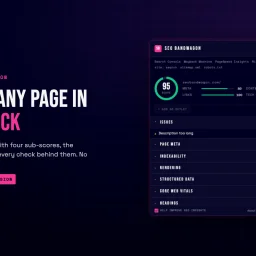
Chrome extension users seeking to evaluate webpage SEO without the overhead of premium tools now have an accessible option. SEO Bandwagon addresses the friction point of expensive auditing platforms by offering a free extension that delivers professional-grade analysis directly within the browser. The extension grades any page on a 0 to 100 scale with corresponding letter grades, then surfaces findings across twelve analytical categories. This breadth of coverage sets it apart from lighter SEO tools, spanning page metadata and indexability through structured data validation, Core Web Vitals, headings hierarchy, link analysis, and content metrics. All core functionality executes in the browser without requiring an account, removing a common barrier to adoption for casual auditing. The feature set reflects practical SEO concerns. Page meta checks validate title and meta description lengths against Google's display thresholds. Indexability diagnostics flag issues affecting crawlability and reveal redirect chains. Rendering analysis compares server HTML against the page as JavaScript interprets it, with options to preview the page as different crawlers would see it. Structured data checks catch JSON-LD, Microdata, and RDFa issues while identifying which rich results the page qualifies for. Core Web Vitals reporting draws measurements directly from the browser session. Optional touches enhance workflow efficiency. Users can export complete analyses as CSV or JSON, copy Google search results, and access a right-click context menu linking to Google's PageSpeed Insights and the Wayback Machine. Creating a free account adds a Citations tab for local business directory validation, domain information displayed beneath Google search results, and synchronization of analyses to a personal dashboard. The company's monetization separates cleanly from the extension itself. SEO Bandwagon offers paid plans for rank tracking and professional SEO services, but the free extension remains untethered from those offerings. This separation preserves the utility of the free tool and avoids the trial-to-paid conversion pressure that undercuts other freemium SEO platforms. For small business owners, content creators, and developers who need periodic SEO spot checks without subscription commitment, the extension fills a genuine gap between manual review and enterprise-grade platforms.

Diagnosing website health usually means juggling multiple tools, managing crawl budgets, or wading through dense PDFs. A desktop crawler for SEO and accessibility auditing eliminates that friction by running locally on your machine with zero setup or account requirements. Scary Spider SEO solves a real workflow problem for developers and site managers who need to identify technical SEO issues, accessibility gaps, and broken resources across their domain. Rather than exporting findings to separate reports and cross-referencing page URLs, the tool displays all results—broken links, missing titles, duplicate meta descriptions, alt text problems, canonical issues, HSTS errors, and more—in a single, interactive table. Each flagged issue includes a plain-language explanation and guidance on how to fix it, making the tool useful even for non-specialists. What distinguishes this product is its unwillingness to hide complexity behind dashboards. Built with React and Tauri, it's a native desktop application that respects your machine as the computing resource. The crawler respects robots.txt directives and crawl-delay settings by default, supports optional headless Chrome rendering for JavaScript-heavy sites, and performs accessibility audits through axe-core integration. Site fingerprinting adds value for users curious about server detection, CDN configuration, and hosting infrastructure. The results table itself is thoughtfully designed—virtualized to handle large crawls smoothly, with pinned columns for easier navigation and export options to CSV or saved snapshots for documentation. The feature set is comprehensive without becoming overwhelming. Twenty-five built-in checks cover the essentials: link health, metadata completeness and length, H1 problems, structured data validation, and security headers. Configuration options around crawl depth, page limits, and concurrency give advanced users control without burdening newcomers. The business model is elegantly simple: the tool is free and open source. No subscription tiers, no crawl budget limits, no upsell. This positions Scary Spider SEO as genuinely useful software rather than a freemium gateway to paid features. For agencies auditing client sites or developers maintaining their own infrastructure, the cost-free model removes friction from routine audits. The main limitation is that it requires a local installation and runs on your own hardware, which suits individual audits and smaller teams but differs from cloud-based alternatives. Still, for users tired of permission screens and platform lock-in, that constraint is a feature. The tool does exactly one thing—audit a site thoroughly—and does it without selling attention or data.
India's digital economy faces a structural problem: too many businesses operate with websites that neither rank on search engines nor convert visitors into customers. MaaJanki Web Tech targets this specific gap with a full-service model that combines rapid development capabilities with performance-driven marketing to create web systems built for revenue generation rather than vanity metrics. The agency positions itself as a multidisciplinary shop, handling everything from website architecture to traffic acquisition. Its primary technical differentiator is a build-first approach using Next.js, which the team emphasizes delivers applications five times faster than conventional stacks. For businesses competing in India's crowded digital landscape, speed directly affects both search ranking and user retention, making this technical choice consequential rather than trendy. Beyond development speed, MaaJanki Web Tech layers in search optimization capabilities that acknowledge the fragmented nature of modern discovery. Rather than betting exclusively on Google's traditional algorithm, the agency explicitly targets AI-first search through ChatGPT and Perplexity integration alongside conventional SEO. This reflects a practical understanding that buyer intent now flows across multiple platforms, not just Google's organic results. The company calls this approach AEO and GEO, though the specific mechanics remain undefined in their materials. The service bundle rounds out with paid channel management across Google Ads and Meta platforms, alongside social media optimization. This full-funnel positioning lets the company own the entire customer acquisition path rather than handing off responsibility between specialists. Clients in Bihar, Patna, and smaller hubs like Bagaha get specific callout, but the company actively serves India-wide and international accounts. The business model appears transaction-based rather than subscription-oriented, likely through custom project pricing for development work plus performance-based or retainer arrangements for ongoing marketing services. No pricing details appear publicly, which is standard for custom agency work targeting mid-market and enterprise clients. What's absent from the messaging is granular proof of results. The company claims to help clients rank number one on Google, but provides no case studies, client roster, or performance benchmarks. For an agency selling performance marketing, this represents a notable gap. A startup directory review should note that prospective clients will need to request those credentials directly. The agency's core insight—that speed and discovery matter equally—is sound. Execution and track record remain the real differentiators in an agency market where every competitor claims similar capabilities.
Slow WordPress sites hemorrhage visitors before pages even finish loading, and this service targets that specific pain point with a straightforward optimization package. Designed for business owners, agencies, publishers, and e-commerce stores struggling with sluggish performance, the offering promises measurable improvements to Core Web Vitals and page load times within a compressed five-hour engagement window. The approach centers on a fixed-price model of $239 per site, structured as a one-time fee with no recurring optimization costs or upfront charges. The service flows through three phases: a free speed audit that runs actual user tests to identify bottlenecks, hands-on optimization work targeting server response times and code bloat, and a final reporting stage that documents before-and-after metrics. What distinguishes this offering from generic WordPress optimization agencies is its focus on specificity. Rather than relying on screenshots or simulated improvements, the case studies surface real-world data pulled from independent tools and actual visitor measurements. One project achieved a 79% reduction in Largest Contentful Paint, another improved a GTmetrix grade from D to A with server response times dropping from 4.9 seconds to 1.5 seconds. The company also published its own performance metrics sourced from Google's CrUX report, demonstrating that its own site consistently passes all three Core Web Vitals. The technical implementation addresses common WordPress slowdowns systematically. Edge caching through Cloudflare and FlyingPress distributes content to regional data centers, eliminating single-origin bottlenecks. Image optimization handles conversion to modern formats like WebP and AVIF. CSS and JavaScript are streamlined to reduce parsing overhead. Server response improvements tackle Time to First Byte, a metric that directly impacts perceived load speed across all traffic sources but particularly on mobile connections where most WordPress traffic now originates. The five-hour window represents an unusual constraint in the optimization space, where many agencies pitch open-ended engagements or retainer relationships. This compressed timeline suggests the service targets WordPress sites where the slowdown stems from known architectural issues rather than sites requiring deep strategic overhauls. For site owners dealing with poorly configured caching, unoptimized images, or accumulated plugin debt, the combination of fixed pricing, rapid execution, and documented performance gains offers a low-friction alternative to hiring developers or larger agencies.

Many website owners focus on Google rankings without considering how AI systems understand their brand. A growing group of startups and established businesses now face an unfamiliar problem: they rank well in traditional search but remain invisible to ChatGPT, Gemini, Copilot, and Perplexity. These AI-powered search engines rely on different signals than Google, and most businesses have no insight into where their visibility breaks down. This audit service directly addresses that blind spot. Rather than guessing why AI systems overlook a business, founders and business owners can run a comprehensive assessment that measures how AI systems interpret their website. The assessment covers six key dimensions: technical readiness (crawlability, indexing, structured data, metadata), entity clarity (who you are and what you offer), citation signals, content architecture, authority and trust signals, and competitor positioning relative to AI recommendations. The audit produces a measurable AI Visibility Score paired with specific findings rather than vague observations. This appeals to founders who want concrete data instead of assumptions. The underlying framework emphasizes clarity (defining what the business is), answer-driven content (pages structured around buyer questions), authority (building citations and trusted mentions), and technical fundamentals (schema, hierarchy, internal links). The target audience is clear: D2C and ecommerce brands, service consultants, agencies, and small businesses building visibility beyond Google. These segments typically invest in search optimization but lack strategies for AI discovery. The service fills a genuine gap in how businesses think about discoverability, moving beyond a single search engine to a landscape where multiple AI systems drive traffic. What makes this particularly relevant is timing. As AI-powered search gains adoption, early-moving businesses can optimize for these systems before competition intensifies. The audit enables that, providing both a snapshot of current AI visibility and a roadmap for improvement. The founder's positioning reflects a clear conviction: AI visibility should be measurable, not mysterious. In a market where most business owners still treat AI visibility as an afterthought, this service offers a practical entry point for businesses ready to get ahead of the shift.

SEO professionals typically spend hours each week preparing data before AI tools can provide meaningful analysis. That SEO Agent directly addresses this inefficiency by eliminating what its creators call the "briefing tax" — the routine task of exporting metrics from Google Search Console, GA4, and PageSpeed, then manually copying and pasting them into conversation prompts. The product targets SEO consultants, particularly those managing multiple client properties. By connecting through the Model Context Protocol, the tool grants Claude, ChatGPT, and Cursor direct read-only access to a user's live Google accounts. This eliminates the need to manually assemble data exports before asking questions about rankings, traffic patterns, and technical site health. The platform distinguishes itself through scope and lack of constraints. It includes 57 native tools distributed across five functional categories: core Search Console queries, advanced GSC analysis, Google Analytics 4 reporting, technical SEO audits, and site management features. Critically, none of these tools hide behind pricing tiers or add-on fees. Users gain full access to the entire toolkit regardless of their plan. Setup requires minimal effort. After granting read-only Google OAuth access, users copy an API key and add a configuration block to their AI tool's settings in less than five minutes. The system then automatically discovers and registers sites by pulling Search Console properties directly. All communication flows through the MCP protocol, and the service never stores user credentials. The read-only architecture keeps the product strictly diagnostic. It retrieves and organizes existing data but cannot modify websites or accounts. This conservative design appeals to professionals managing client properties who need strict boundaries around account access. The core value proposition centers on workflow efficiency. By eliminating the copy-paste cycle, users avoid context-switching overhead and the contextual pollution of stuffing AI conversations with export files. For consultants managing multiple properties, this time savings compounds meaningfully. The platform explicitly promises zero additional costs per site or query, suggesting a straightforward pricing model. The product's appeal ultimately rests on a single thesis: getting live SEO data into AI conversations without manual intermediation.
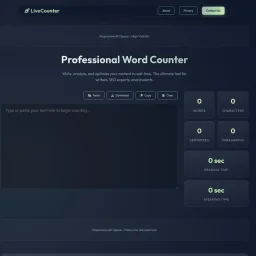
Content analysis tools have become essential for anyone publishing online, whether for search engine optimization, social media, or academic purposes. This word counter addresses a genuine need: writers and creators want instant feedback on their text's metrics without surrendering their privacy to cloud storage. The tool's core strength lies in its comprehensive real-time analysis. It delivers word, character, sentence, and paragraph counts as users type or paste content. Beyond basic metrics, it estimates both reading time using a standard 200 words per minute rate and speaking time at 130 words per minute. This dual-time feature proves particularly valuable for podcasters, presenters, and audiobook creators planning content duration. The readability scoring employs the Flesch-Kincaid scale, helping writers gauge text accessibility on a 0-100 scale where higher scores indicate easier comprehension. Combined with the character-limit tracking for Twitter/X posts, meta descriptions, and meta titles, the tool directly serves SEO practitioners optimizing content for search visibility and social media distribution. The word frequency analysis adds another layer, identifying repeated terms and helping refine content for both readability and keyword targeting. What distinguishes this offering is its commitment to privacy. The application processes all analysis client-side, meaning users' text never touches external servers. For writers working with sensitive material, confidential documents, or simply those concerned about data collection, this approach removes a significant barrier to adoption. The interface includes thoughtfully chosen shortcuts for power users: Ctrl+H for find and replace, Ctrl+Shift+C to copy, and Ctrl+Shift+D to download. The dark and light theme options accommodate different working environments and preferences. Mobile responsiveness ensures the tool functions equally well on phones and tablets, matching how many writers actually compose content today. The product positions itself at the intersection of multiple audiences. Casual Twitter users benefit from character counting. SEO professionals leverage the meta description and title length trackers alongside readability metrics. Students writing essays rely on word count verification. This multi-use approach broadens appeal without diluting focus. No pricing information appears on the site, suggesting the tool operates as a free offering, though the presence of ad space indicates an advertising-supported model rather than a premium subscription approach. For anyone seeking a straightforward, privacy-preserving text analysis solution with solid feature depth, this counter delivers practical value without friction.

SEO professionals and independent bloggers often waste a significant amount of time manually submitting links to numerous websites, a task that involves tedious repetition of copying and filling out forms. LinkNest addresses this issue by providing an AI-powered browser extension that automates the process of identifying form fields and intelligently filling them with optimized content. The extension is designed to cater to the needs of SEO professionals and independent bloggers who seek to streamline their workflow and reduce the time spent on link submission. What stands out about LinkNest is its ability to significantly reduce the time required for link submission, from hours to mere minutes. Its AI-driven approach enables it to recognize and fill out form fields accurately, eliminating the need for manual data entry. The extension's capability to generate differentiated content and automatically detect the language of the target site further enhances its utility. LinkNest offers a range of features that make it an attractive solution for those involved in link building. Its floating menu allows users to access various capabilities, including filling out site information and generating virtual data. The extension also supports multiple profiles, enabling users to manage different sites and configurations efficiently. Additionally, its BYOK (Bring Your Own Key) mode allows users to utilize their own AI API key, providing flexibility in controlling costs. The pricing model for LinkNest includes a free version with limited functionality, a Pro version at $8 per month, and a Lifetime subscription for a one-time payment of $99. The free version has restrictions on the number of submissions and the number of links that can be managed, while the Pro and Lifetime versions offer unlimited submissions and links, along with additional features such as data import and export capabilities.

Independent SEO tool reviews are hard to come by, but ClaroRank is addressing this issue head-on. The platform is designed for digital marketers and SEO professionals who need unbiased recommendations for SEO tools that fit their specific needs and budgets. With 15 years of hands-on SEO experience, the founder has created a resource that cuts through the noise of sponsored content and provides genuine insights. What stands out about ClaroRank is its commitment to honesty and transparency. Every review is based on real-world usage and testing on actual client projects, ensuring that the ratings reflect the tools' true capabilities and limitations. The reviews cover a range of popular SEO tools, including SE Ranking, SEMrush, Ahrefs, and Mangools, and provide detailed analysis of their strengths and weaknesses. The platform offers a valuable resource for marketers at different stages of their journey. For those just starting out, it recommends tools like Mangools for keyword research and rank tracking. For agencies, it suggests SE Ranking and SEMrush for more comprehensive SEO needs. The reviews also highlight specific features, such as Ahrefs' extensive backlink index and Content Explorer. ClaroRank's business model is transparent, with clear disclosure of any commissions earned from promoting tools. The platform also keeps its pricing information up to date, verifying prices against the official sources. Some tools offer free trials, such as SE Ranking and SEMrush, which provide 14-day trials, while others, like Ahrefs, do not offer a free trial. Overall, ClaroRank is a trustworthy resource for marketers seeking reliable SEO tool reviews and recommendations.

Optimizing a website for search engines is a complex task that involves analyzing numerous factors to improve visibility and ranking. NSDM Ai addresses this challenge by providing an AI-powered website audit engine that assesses SEO, AEO, and GEO in a single click. The tool is designed for a diverse range of users, including freelance SEO consultants, marketing agencies, business owners, content creators, and startup founders. What stands out about NSDM Ai is its comprehensive analysis capabilities, which go beyond traditional SEO by also considering AEO and GEO. This is particularly valuable in today's digital landscape, where AI-powered answer engines and voice search are becoming increasingly important. The tool's AI-powered engine analyzes over 50 ranking factors in real-time, providing instant and actionable insights that are backed by visual evidence and competitive benchmarking. The key features of NSDM Ai include its ability to crawl actual HTML, measure Core Web Vitals, and validate structured data, all of which are presented in a detailed report with priority-ranked findings and step-by-step fixing methods. Users can also export PDF reports with white-label options, making it a useful tool for agencies and consultants. Notably, NSDM Ai offers its core features for free, with no requirement for credit cards or subscriptions, making it an attractive option for those looking to improve their website's performance without incurring significant costs. Overall, NSDM Ai is a powerful tool that simplifies the process of optimizing a website for search engines and AI-powered answer engines.

Competitor analysis is a crucial task for businesses, but it can be a tedious and time-consuming process. Seeto's AI-powered solution simplifies this task, providing actionable insights in minutes. The platform is designed for product teams, founders, CEOs, and marketing teams who need to stay ahead of the competition. What stands out about Seeto is its ability to automate the data collection process, eliminating the need for manual browsing, copying, and pasting into spreadsheets. The AI agent explores competitor websites, extracts relevant data, and compares it with the user's own product, providing a comprehensive analysis. The level of accuracy is impressive, with sources verified to ensure reliability. Seeto's key features include a feature comparison matrix, pricing intelligence, SEO insights, positioning analysis, and messaging differentiation. The platform provides a side-by-side comparison of features across competitors, helping teams identify gaps and opportunities. The data is presented in an interactive dashboard, making it easy to navigate and understand. The testimonials from satisfied customers demonstrate the value that Seeto brings to businesses. The feature comparison alone is worth the investment, according to one product manager. Others have reported significant benefits, including improved roadmap planning, 10x ROI on SEO insights, and avoiding underpricing by 40%. By streamlining competitor analysis, Seeto enables businesses to make informed decisions and stay competitive in their markets. With its robust capabilities and user-centric design, Seeto is an essential tool for teams that ship fast and compete to win.

For SEO professionals in India, managing keyword positions and tracking visibility on Google has just gotten more straightforward. RankTraq addresses the issue of rigid subscription models and opaque pricing that often accompanies rank tracking tools. The platform is geared towards SEO teams who require a more flexible and transparent solution, particularly those dealing with fluctuating workloads or multiple client domains. What sets RankTraq apart is its prepaid credit system, allowing users to pay only for the services they need. This model is specifically tailored to the needs of Indian SEO agencies, freelancers, and in-house teams, who can top up their credits as required, avoiding unnecessary expenses during periods of low activity. The tool also integrates with Search Console, providing a more comprehensive view of keyword performance by pairing rank tracking with actual clicks and impressions. The platform's key features include the ability to track unlimited keywords across multiple domains from a single workspace, with a shared credit balance. Users can also monitor their visibility in Google's AI Overviews, a feature that is becoming increasingly important as Google's generative summaries alter how visibility is measured. Additionally, the transparent credit economics ensure that users are only charged for successful refreshes, with clear costs displayed before each run. New users can start with a one-time grant of 500 free trial credits, which is valid for 30 days. After that, they can purchase credit packs as needed, with the option to pay in rupees via Razorpay. The cost per credit varies, with keyword position checks using one credit per track and AI Overview checks using two credits per run. Overall, RankTraq offers a flexible and cost-effective solution for SEO teams seeking to manage their keyword tracking and visibility monitoring without the burden of inflexible subscription plans.

SEO practitioners drowning in raw Google Search Console data now have a way to extract actionable insights without manual analysis. CodeX Guru's free keyword analyzer transforms GSC exports into structured intelligence, using GPT-4o to recommend specific optimizations based on each site's actual search performance. The problem this solves is obvious: GSC gives you the data, but interpreting what to do with it requires expertise. Most site owners can see they rank for keywords in positions 4–20, but lack a systematic way to prioritize which ones to optimize. This tool automates that triage, categorizing keywords into "Quick Wins" (near-top-3 rankings requiring minimal effort), "Content Gaps" (high impression keywords with poor click-through rates), and other strategic buckets. The AI-generated strategy report then ties recommendations back to the actual keyword data rather than offering generic advice. What stands out is the privacy-first approach. Uploaded files are processed in memory and deleted immediately—there's no data retention, logging, or third-party sharing. For an SEO tool handling competitive search metrics, this transparency is uncommon and valuable. The tool also handles multiple file formats (CSV, XLSX, XLS) and caps file size at 10MB, making it accessible to businesses of all sizes. The interface emphasizes speed and visual clarity. Analysis completes in 30–60 seconds, and results display across six charts covering position distribution, CTR buckets, competitor benchmarks, and the relationship between rankings and click-through rates. This visual breakdown gives users the context they need to decide which keywords deserve content investment. The business model stacks a free tier (two analyses per day) against a Pro upgrade for unlimited analyses, team access, and automated weekly reporting. This is a straightforward freemium approach that lets users validate the tool's value before paying. The founder positions this as part of a broader initiative to democratize SEO expertise and help practitioners access specialized knowledge. The main limitation is the free tier's daily cap—serious SEO teams analyzing multiple sites would likely need Pro access quickly. Still, for individual site owners or small agencies testing keyword strategies, the free offering is substantial enough to determine whether the tool fits their workflow. The combination of privacy, speed, and GPT-4o-powered analysis makes this a practical addition to most SEO stacks.