#multilingual Startups & Tools
Discover the best multilingual startups, tools, and products on SellWithBoost.
Simultaneous interpretation has traditionally been a luxury reserved for high-stakes conferences and international events. Youshow Interpreter democratizes this capability by packaging AI-powered real-time translation into a mobile-friendly application designed for everyday communication scenarios. The product addresses a genuine friction point for three distinct user groups. International students attending lectures in foreign languages struggle to keep pace with instructors; professionals navigating multilingual meetings often miss context clues buried in accents and jargon; travelers attempting basic transactions in unfamiliar countries face communication breakdowns. Each of these groups has had to choose between fragmentary note-taking, post-event scrambling, or accepting information loss. Youshow's core strength lies in its dual-text architecture. Rather than forcing users to toggle between source and target languages, the application displays both simultaneously, allowing real-time verification and natural comprehension without cognitive switching costs. This design choice directly addresses a core limitation of single-language transcription tools: the ability to catch what was actually said versus what was understood. The platform delivers practical workflow features that extend beyond live conversation. Users can export bilingual SRT subtitle files, transforming raw conversations into reusable assets for content production or study materials. The history and replay functionality lets users revisit critical moments from lectures or meetings without scrambling for context afterward. This positions Youshow not just as a communication bridge but as a documentation tool for knowledge retention and asset creation. Cross-platform availability across web, iOS, Android, macOS, and Windows suggests an intentional design to meet users where they work rather than forcing adoption of a single ecosystem. This ubiquity matters for spontaneous translation needs, where mounting an app or accessing a web browser represents the practical difference between functional translation and no translation at all. The application identifies its target use cases explicitly: classroom attendance, business meetings, international travel, and subtitle creation. This focused positioning avoids the trap of claiming universal utility while remaining specific enough to guide feature development and marketing strategy. On the visible limitations side, the materials provided do not disclose latency metrics, language pair coverage, or accuracy benchmarks. For a product selling real-time translation, these specifications carry weight in evaluating whether the tool meets the demanding requirements of live situations where timing and precision both matter.
Small businesses operating brick-and-mortar locations—restaurants, salons, shops—often maintain active Google Maps presence with reviews and photos but lack either the technical knowledge or budget to build a proper website. Blasa solves this gap by automatically converting a Google Maps listing into a fully functional, multilingual business website. The product's core strength lies in its content philosophy: the website draws exclusively from genuine customer reviews, photos, and business metadata already on Google. Nothing is AI-invented. Headlines, testimonials, and competitive advantages all trace back to what real customers have written. This authenticity-first approach distinguishes it from template-based website builders that generate generic copy. Multilingual support emerges as a notable capability. Rather than treating languages as an afterthought, Blasa defaults to generating websites in the language of the reviews plus English, with proper right-to-left formatting for Arabic, Hebrew, Persian, and Urdu. This design choice acknowledges the reality of modern local businesses serving diverse neighborhoods. The user experience reduces to its essentials: paste a Google Maps link, and the system handles everything else. No code, no template selection, no form-filling. The AI derives a color scheme from the business's logo and selects typography based on the business name, creating thematic coherence without manual configuration. The resulting website publishes immediately on a custom subdomain. From a discovery standpoint, Blasa embeds LocalBusiness structured data and applies SEO optimizations, helping websites surface in search results and AI assistant recommendations. For a local business competing against larger establishments, this integration with machine-searchable data matters. The pricing model reflects accessibility as a core principle. The free tier includes a complete multilingual website with structured data and SEO capabilities, offset by a small labeled advertisement. The Growth plan costs $19.99 annually, dropping to roughly $1.67 per month. An alternative $39.99 one-time purchase conveys permanent ownership. These price points remain within reach for micro-enterprises that might otherwise skip having a web presence entirely. The product targets an underserved segment: businesses too small to justify agency fees or developer time, yet established enough to have genuine customer reviews worth showcasing. For this audience, Blasa addresses a genuine friction point in moving online.
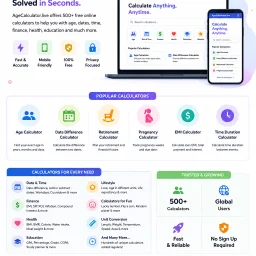
Quick and accurate age calculation from a date of birth remains a surprisingly common need—whether for administrative forms, personal record-keeping, or curiosity about one's precise age down to the day. AgeCalculator.live addresses this straightforward but essential problem by delivering instant results with just a date entry. The product's core value proposition centers on accuracy and simplicity. Rather than struggling through manual date arithmetic across months and leap years, users get exact age calculations in seconds. The founder built this to eliminate the manual calculation errors that plague users attempting to determine their precise age spanning years, months, and days—a calculation simple in concept but error-prone by hand. What distinguishes this offering from a basic calculator is its breadth. The platform bundles the primary age calculator with an extensive ecosystem of related tools: age difference calculations, birthday countdowns, zodiac and Chinese zodiac identifiers, retirement planning utilities, pregnancy due date estimators, menstrual cycle trackers, generational classifiers, and dozens more. This constellation of features transforms a single-purpose calculator into a comprehensive date utility suite addressing different life stages, planning horizons, and interests. The multilingual interface reflects genuine global ambition. Supporting at least eleven languages across multiple language families positions the tool for international use rather than English-speaking markets alone. This design choice acknowledges that age calculation spans cultures and demographic boundaries. The application targets a broad audience: individuals managing personal records, users completing administrative tasks, people planning major life events, parents tracking developmental milestones, and anyone exploring astrology or generational identity. The calculator appeals equally to those seeking quick utility and those wanting deeper exploration through ancillary tools. The product operates on a free model, removing financial barriers to access. This decision maximizes reach in a category where users expect zero-cost friction. The main limitation is inherent to the concept itself—age calculation is a solved problem with minimal competitive differentiation at the core feature level. However, the surrounding toolkit adds practical utility that extends the platform's usefulness beyond the base use case. For users who calculate age occasionally, this works as a quick lookup. For those needing related date utilities repeatedly, the bundled collection justifies repeated visits over single-purpose alternatives.

Communication fragmentation costs businesses time and money. Customer interactions splinter across phone systems, messaging apps, and contact center tools, forcing teams to juggle disconnected platforms. NextGenSwitch consolidates these channels into a unified platform that pairs AI automation with human expertise, addressing a genuine operational pain point for service-driven businesses. The platform's core strength lies in its omnichannel integration. It unifies voice calls, WhatsApp, Messenger, SMS, and contact center workflows into one system, eliminating tool-switching inefficiencies. More importantly, it doesn't automate blindly. AI agents handle initial interactions by answering questions, qualifying leads, and collecting information, then transfer qualified conversations to human agents while preserving full context. This design respects that some customer needs require human touch. NextGenSwitch targets multiple segments effectively. Small businesses use it for AI-powered reception and support. Sales teams benefit from lead qualification and automation at scale. E-commerce operations automate product questions and order confirmations. Larger enterprises get unified contact center operations. Service providers and BPOs operate isolated customer environments through multi-tenant capabilities with white-label flexibility. The feature set reflects thoughtful architecture. Multilingual voice and messaging support global customers. API-driven design lets developers build custom voice applications using XML and WebSocket streaming. The platform integrates with existing business systems rather than demanding replacement. Outbound capabilities enable automated reminders, surveys, and follow-ups that scale engagement without proportionally scaling headcount. The platform positions AI for routine work and humans for complex situations—a grounded philosophy acknowledging that customer relationships depend on human judgment and empathy, not just speed. This approach resonates with industries where trust matters more than pure automation metrics. No pricing details appear in available materials, suggesting custom enterprise sales. This model suits their positioning as infrastructure for contact centers and large customer service operations, where deployment complexity justifies direct prospect engagement.