Xtra Hands Family Chore App
Household chore management remains one of parenting's persistent friction points, and Xtra Hands positions itself as the...
Catalyst Healthspan Audit
Personal trainers typically sell training sessions. This startup reversed the equation by building assessment first, mak...
Best Compliance software Startups & Tools
Compliance software unites tools that secure access, verify identities, manage user data, and enforce policies—helping teams meet risk, infosec, and HR rules.
Recently Listed
5 launches
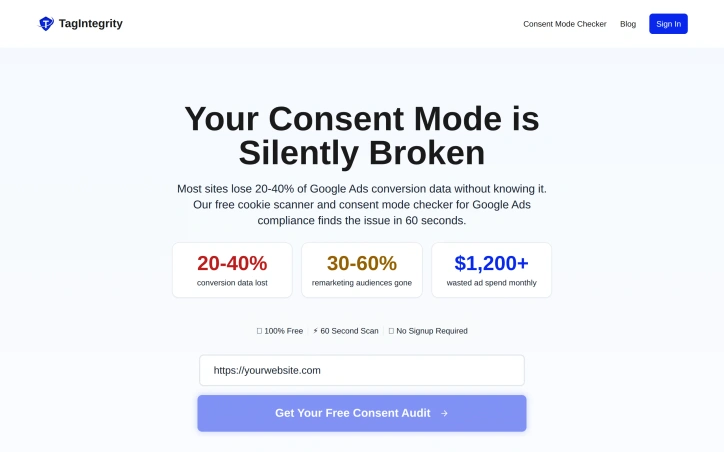
Businesses implementing Google Ads and analytics integrations face a hidden revenue leak: misconfigured Consent Mode v2 settings that silently suppress conversions and analytics data without triggering visible errors. TagIntegrity targets this specific problem with a free scanner that diagnoses GTM, GA4, and Google Ads tag configurations in roughly 60 seconds. The product's core strength is its focus on a concrete, high-impact problem. Marketers and developers managing consent compliance often struggle to verify that their configuration actually works—that tags fire appropriately and consent signals transmit to Google systems correctly. The scanner addresses this gap by showing exactly which tags are active, whether a consent management platform exists on the site, and critically, whether the ad_user_data and ad_personalization consent signals are being set. These specific data points directly map to the configuration issues that suppress conversion tracking. TagIntegrity distinguishes itself through operational simplicity. There is no account creation required, no authentication wall, and no setup complexity. A user visits the site, enters a URL, and receives results within about a minute. This low-friction entry point removes barriers for businesses that need a quick diagnosis without committing to a vendor relationship or onboarding process. The feature set is deliberately narrow but deep. Rather than building a broad tag management or analytics audit tool, the scanner concentrates on the intersection of Google advertising compliance and consent mode functionality. It identifies the presence of consent mode signals and validates their configuration against requirements for ad targeting and personalization under GDPR and similar frameworks. From a business model perspective, TagIntegrity offers its scanner entirely free, with no mentioned pricing tiers or premium features. This suggests a freemium or lead-generation model, though the specific business strategy remains undisclosed. The product fills a genuine need. Consent mode compliance and accurate ad conversion attribution have become operational requirements for digital marketing, yet the configuration surface remains error-prone and opaque to non-technical stakeholders. By packaging diagnosis into a fast, no-friction tool, TagIntegrity makes verification accessible to teams without deep GTM expertise. As a diagnostic tool, TagIntegrity identifies configuration issues but stops at detection. Businesses still need internal developers or external consultants to implement fixes. However, as the entry point for diagnosing revenue-impacting configuration problems, the product occupies a useful position in the diagnostic workflow.
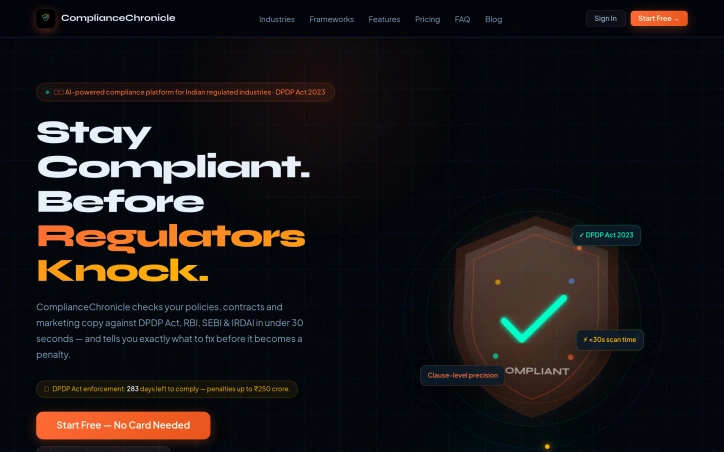
Navigating India's regulatory landscape—particularly the enforcement of the DPDP Act 2023 alongside requirements from the RBI, SEBI, and IRDAI—consumes significant time and expertise for founders and compliance teams across regulated industries. Compliance Chronicle addresses this friction by automating the compliance review process. The platform scans policies, contracts, and marketing materials against sector-specific regulatory requirements and delivers findings in under 30 seconds, identifying exactly what needs correction before regulators take notice. What distinguishes Compliance Chronicle from generic compliance tools is its precision focus on Indian regulations. Rather than relying on broad keyword matching, the platform operates from 70+ hand-mapped rule sets directly sourced from regulatory documents including the DPDP Act, RBI circulars, SEBI notifications, and IRDAI guidelines. Each flagged issue links directly to specific section references, removing ambiguity about what a business needs to fix and why. The product serves a defined set of Indian verticals—fintech and lending platforms, healthtech and telemedicine, insurtech, legaltech, edtech, and e-commerce. For each sector, the platform adjusts its rules and flagging logic to match that industry's specific compliance obligations. A fintech NBFC and an edtech platform receive fundamentally different scans, not a one-size-fits-all assessment. Operationally, the platform monitors regulatory publications continuously. When the RBI issues a new circular or the gazette updates DPDP rules, Compliance Chronicle updates its mappings automatically, ensuring scans remain current without manual reconfiguration by users. On the business model front, the platform offers a free tier with no credit card requirement, reducing friction for early-stage founders. Payment options include UPI and GST-compliant invoicing, tailoring the transaction experience for the Indian market. Support is founder-led, suggesting direct access to decision-makers rather than templated help systems. The platform remains in early access, onboarding founders selectively across its target verticals. For compliance teams drowning in regulatory complexity and startups facing tight DPDP enforcement deadlines, this represents a meaningful shortcut to baseline compliance coverage.

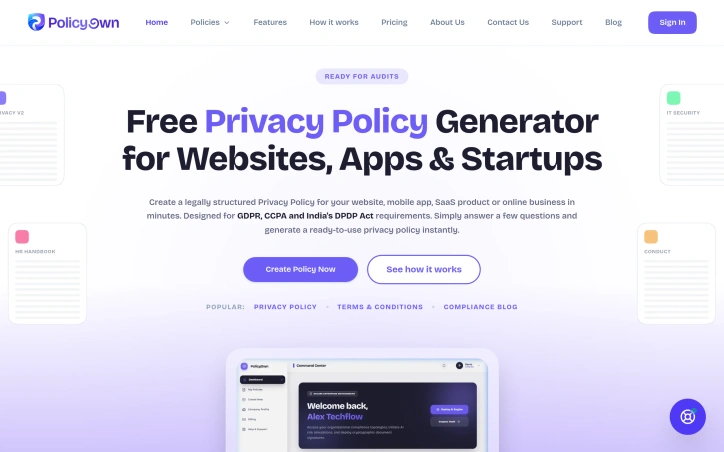
Generating a compliant privacy policy for a website or app can be a daunting task for startups and businesses, particularly with the ever-evolving landscape of data protection regulations such as GDPR, CCPA, and India's DPDP Act. PolicyOwn addresses this challenge by providing a streamlined solution that automates the process of creating a legally structured privacy policy. The product is designed for startups, businesses, and online entrepreneurs who need to establish a robust privacy policy quickly. What sets PolicyOwn apart is its AI-driven compliance logic, which enables the generation of a ready-to-use privacy policy in minutes. By answering a few simple questions, users can instantly create a fully editable policy that meets the required regulatory standards. Notably, PolicyOwn eschews generic templates and random AI-generated content in favor of a more tailored approach. The resulting policy is therefore more likely to be accurate and relevant to the specific needs of the user's business. The fact that the generated policy is fully editable also provides an added layer of flexibility and control. While the specifics of PolicyOwn's pricing or business model are not explicitly stated, the website invites users to "Create Policy Now" and see how it works, suggesting a potentially accessible and user-friendly onboarding process. Overall, PolicyOwn offers a valuable solution for businesses seeking to navigate the complexities of data protection regulations with ease and confidence. By simplifying the process of creating a compliant privacy policy, PolicyOwn helps its users focus on their core operations while ensuring they remain on the right side of the law.

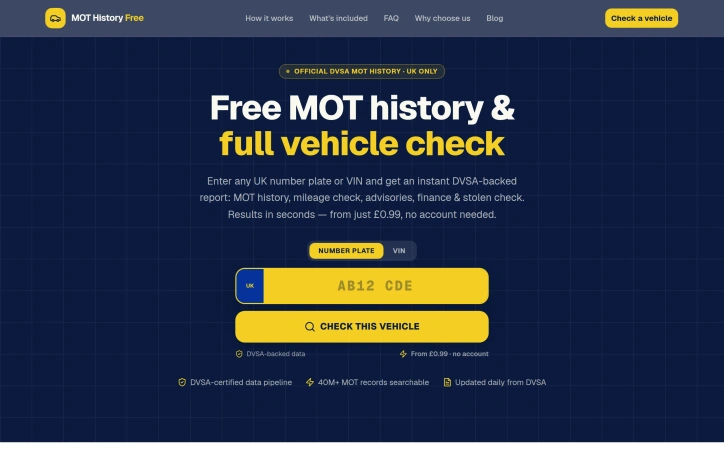
When buying, selling, or insuring a vehicle, knowing its full history is essential to making an informed decision. MOT History Free addresses this need by providing instant, comprehensive reports on UK vehicles. The target audience is clearly individuals involved in vehicle transactions, who require reliable data to assess a vehicle's condition and potential risks. What stands out about MOT History Free is its direct connection to official records, leveraging data from the DVSA and DVLA to deliver accurate and up-to-date information. The website emphasizes its use of a DVSA-certified data pipeline, ensuring the integrity of the data provided. This backing from official sources lends credibility to the reports generated. The reports themselves cover a wide range of information, including full MOT history, mileage checks to identify potential clocking, advisories and defects recorded during MOT tests, outstanding finance, and stolen or write-off status. Additionally, the reports provide technical specifications such as make, model, and engine size, as well as any outstanding manufacturer safety recalls. This comprehensive data is presented in a downloadable PDF format for convenience. Users can access these reports by entering a UK number plate or 17-digit VIN, with the results available in seconds. Notably, the basic MOT history is available for free, while a full report costs £0.99, with no requirement to create an account. The payment process is secured with AES-256 encryption, and various payment methods are accepted, including Visa, Mastercard, and PayPal. Overall, MOT History Free offers a straightforward, reliable solution for those seeking detailed insights into a UK vehicle's history.
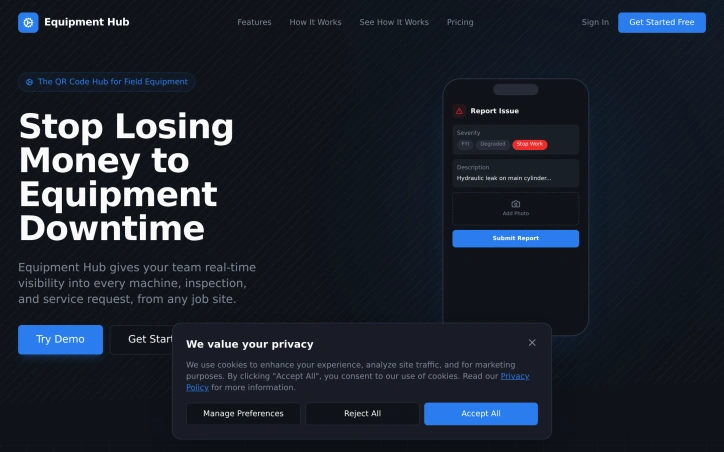
Industrial operations can be complex and challenging to manage, particularly when it comes to equipment. Businesses in this sector often struggle with inefficient processes and reduced productivity due to poor equipment management. Equipment Hub is designed to address these challenges, providing a solution for companies to streamline their operations. By tackling the intricacies of equipment management, the platform simplifies the day-to-day activities of businesses that rely heavily on industrial equipment. The founder's vision is centered around improving productivity, which is a critical aspect of competitiveness in the industrial sector. What stands out about Equipment Hub is its focus on simplifying operations, indicating a deep understanding of the pain points faced by its target audience. The platform is clearly designed with the needs of industrial businesses in mind, aiming to make equipment management more efficient. Although specific features and capabilities are not detailed on the website, it is clear that Equipment Hub is geared towards managing industrial equipment effectively. The emphasis is on streamlining processes, which suggests that the platform offers tools or functionalities that help businesses organize and optimize their equipment usage. Unfortunately, the website does not provide explicit information on pricing or the business model adopted by Equipment Hub. However, it is evident that the platform is designed to offer a valuable solution to industrial businesses, and its value proposition is rooted in its ability to improve operational efficiency. Overall, Equipment Hub presents itself as a viable solution for businesses seeking to enhance their equipment management practices.