Xtra Hands Family Chore App
Household chore management remains one of parenting's persistent friction points, and Xtra Hands positions itself as the...

Catalyst Healthspan Audit
Personal trainers typically sell training sessions. This startup reversed the equation by building assessment first, mak...
Best Family Care Startups & Tools
Tools to organize schedules, preserve memories, and protect kids online.
Recently Listed
3 launches
Featured
Household chore management remains one of parenting's persistent friction points, and Xtra Hands positions itself as the antidote to daily nagging and invisible labor distribution. The app serves families of any composition, from traditional two-parent households to split arrangements, multi-generational living situations, and shared housing scenarios where coordination matters. The product distinguishes itself with an unusually generous pricing model. Rather than gating core functionality behind paywalls, Xtra Hands offers comprehensive features at no cost for the first household member, with no trial period or credit card requirement. Everything core to household management remains permanently free: chore creation, allowance tracking, notifications, photo-based task completion verification, and a rewards system built around either money or points. This commitment to avoiding feature lockdown sets it apart from typical freemium household apps. What makes the app resonant beyond pricing is its fundamental framing. Xtra Hands insists on calling users "members" rather than "kids," a semantic choice that reflects its design philosophy. This isn't a children's gamification tool but household infrastructure that accommodates a nine-year-old checking chores on the family tablet, a teenager managing their own balance on a personal phone, a co-parent in a separate residence sharing the same ledger, or a flatmate participating without allowance mechanics. That flexibility matters in a fragmented modern household landscape. The feature set itself moves beyond simple task lists. Chores can be tagged to rooms, scheduled daily or by weekday pattern, set as shared or individual responsibilities, and carry over from missed days. The approval workflow creates a clear request-and-accept model where members request rewards and parents determine when balances move. Photo proof adds concrete evidence of completion rather than relying on trust alone. The morning glance dashboard provides a single view of household status across all members. The app operates across web and mobile platforms with synchronization, meaning adoption doesn't require everyone to have a smartphone. Rotation groups demonstrate the product understands that household labor distribution often follows predictable patterns. Vacation mode indicates the designers recognize household routines fluctuate seasonally. Xtra Hands was built by someone who lived the problem firsthand rather than theorized about it. The result is a tool that handles the specific mechanics of household coordination without unnecessary gamification or complexity, addressing a genuine operational need that families currently solve through spreadsheets, whiteboards, and arguments.


Families facing bereavement often struggle to transform scattered photographs and fragmented memories into meaningful tributes. Omoide Kasane addresses this gap by automating the construction of memorial content without compromising dignity or accuracy. The service targets three distinct audiences: families seeking to preserve life stories and create keepsakes, funeral companies wanting to offer additional services to clients, and organizations like temples or life-history services supporting end-of-life reflection. It accomplishes this through a three-part workflow that inputs 5-20 family photographs and recalled moments, then outputs a corrected portrait photo, a written life narrative in natural Japanese, and a 2-3 minute memorial film suitable for viewing at funeral services or family gatherings. What distinguishes Omoide Kasane from superficial memorial tools is its deliberate ethical design. The service explicitly refuses to synthesize deceased individuals speaking, to invent biographical details, or to claim reproduction of personality. Instead, it positions AI as a compositional assistant—handling photo enhancement, structural organization, and text generation—while reserving human judgment for fact verification, name confirmation, tone refinement, and final approval. This split reflects a mature understanding of where automation adds value without displacing the decision-making authority of those who actually knew the deceased. The privacy approach mirrors this philosophy. The public-facing demo processes all data locally within the browser, transmitting nothing to external servers. This design choice simultaneously addresses technical security concerns and demonstrates respect for the sensitivity of memorial materials. The workflow itself moves methodically through collection, drafting, and finalization. Families provide photographs and narrative fragments in their own words. The system generates a photo edit and text draft. Reviewers then approve or adjust details—names, dates, voice—before receiving the finished outputs. This iterative review cycle, mandatory before any sharing, prevents both the hollow templating common in memorial services and the jarring authenticity problems of purely automated solutions. Omoide Kasane operates under pilot pricing frameworks (9,800 yen for self-directed families, 19,800 yen with staff verification), framed explicitly as exploratory rather than final. The service remains in prototype stage, with browser-based demos available for local testing. The core insight driving the product—that memory work requires both technological assistance and human authority—positions it thoughtfully within a grief-aware market segment where efficiency alone would feel disrespectful.


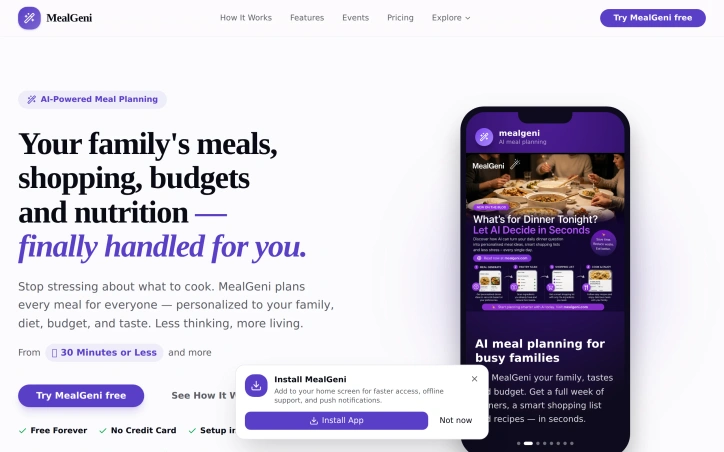
Household meal coordination consumes countless hours for families juggling diverse dietary requirements, and the resulting food waste and budget overruns compound the frustration. MealGeni addresses this friction by automating the entire workflow from recipe generation through shopping list creation, powered by AI trained to handle the complexity of multi-generational households. The product's scope is remarkably comprehensive. Rather than treating meal planning as a single-person concern, MealGeni extends its intelligence across breakfast, lunch, dinner, snacks, baby food, toddler meals, school lunchboxes, and even pet meals. This breadth matters because most existing solutions either force families to use multiple apps or ignore certain household members' needs entirely. By unifying these requirements, the platform eliminates the context-switching that drives planning fatigue. The personalization engine absorbs meaningful constraints: dietary preferences, health goals, household budget, number of people to feed, available ingredients, and cooking time. This nuanced approach means the generated meal plans aren't generic templates but plans actually tethered to a family's real life. The speed of generation—creating full weekly plans in seconds—converts an afternoon chore into a few-minute task. Integration across the planning pipeline strengthens the product's value proposition. Generating recipes is useful; automatically converting those recipes into an organized, deduplicated shopping list is where the platform becomes genuinely useful. Users get recommendations structured for actual grocery shopping rather than scattered ingredients. The system also tracks nutrition and flags food waste, lending itself to both health-conscious families and those motivated by environmental or budget concerns. MealGeni positions itself as free to start, suggesting a freemium model that lets families test core functionality without initial commitment. The publicly available recipe library and monthly dinner planners provide additional content touchpoints beyond the core app. The primary strength lies in synthesis: most meal-planning apps handle one or two parts of the problem well, while MealGeni attempts to close the entire loop from decision-making through execution. Whether that ambition translates into a cohesive product experience depends on execution quality, but the surface value proposition is clear. For households spending time and money on meal coordination, the app makes a compelling case that AI can genuinely simplify a persistent household task.