Catalyst Healthspan Audit
Personal trainers typically sell training sessions. This startup reversed the equation by building assessment first, mak...
Launchory
We built Launchory to solve the discoverability problem for startups. Our platform offers instant approval, permanent do...
Best Invoicing tools Startups & Tools
Generate invoices, track payments, and manage billing.
Recently Listed
7 launches
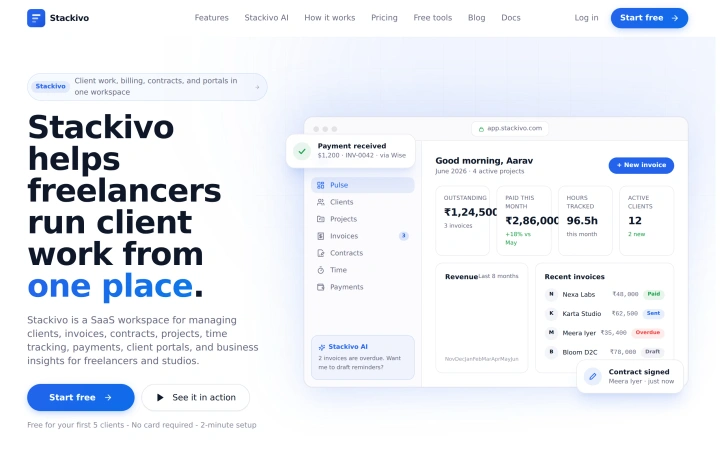
Freelancers and studios operating in India face a common problem: their business processes are spread across a half-dozen disconnected applications. Invoices live in spreadsheets, client communication happens on WhatsApp, contracts sit in Word documents, time tracking happens in notes apps, and payment information stays trapped in banking portals. Each handoff between tools creates friction: invoices don't get sent, follow-ups slip through the cracks, and billable hours disappear without becoming revenue. Stackivo consolidates this fragmented workflow into a single workspace designed specifically for independent professionals—designers, developers, consultants, writers, video editors, architects, and small studios. The platform brings together client management, invoicing, contracts, time tracking, and payments in one place where everything is connected. What distinguishes Stackivo is its deep understanding of the Indian freelancer's specific needs. Rather than forcing a generic global workflow, the product handles GST compliance as a core feature. Freelancers can toggle between simple invoices and GST mode, and Stackivo automatically calculates the correct CGST/SGST/IGST split based on the client's location. This removes a source of constant friction for registered businesses. The workflow integration sets Stackivo apart from generic project tools. A signed contract kicks off a project, hours tracked within the platform automatically become line items on invoices, and payments land back on the dashboard where they're automatically reconciled. Invoices can be created in under a minute, shared via link, email, or WhatsApp, and Stackivo handles payment reminders automatically when invoices become overdue. The core feature set covers the essentials: contracts can be e-signed in the browser, each client gets a branded portal, time tracking integrates with billing, and the platform accepts UPI and card payments. The interface hints at AI-powered assistance, such as drafting payment reminder templates. Stackivo launches with a freemium model where the first five clients are free with no credit card required and roughly two minutes to set up. This structure lets freelancers test the core workflow before committing financially. The specificity of the product—built for independent professionals across India rather than attempting global coverage—signals a focused approach to product-market fit rather than premature scaling.

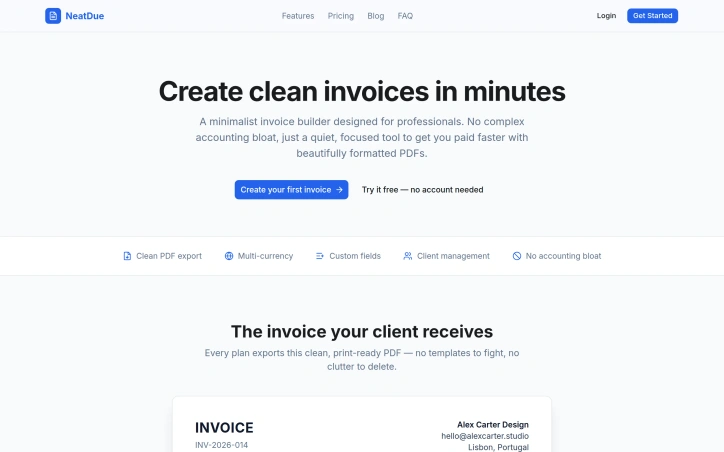
Creating professional invoices can be a tedious task for freelancers and small businesses, often due to the clutter and complexity of accounting software. NeatDue addresses this problem by providing a straightforward and minimalist invoice builder. The tool is designed to help professionals create clean and beautifully formatted invoices in minutes, focusing solely on the task at hand without unnecessary features. What stands out about NeatDue is its emphasis on simplicity and the quality of its output, ensuring that invoices are not only compliant but also visually appealing. NeatDue offers several key features that make it an attractive solution. It allows for multi-currency support, custom fields, and client management, making it versatile for various business needs. The tool also prioritizes data privacy and security, transmitting data over HTTPS and never sharing or selling it for advertising purposes. All plans export invoices to clean, print-ready PDFs, a core functionality that is consistent across NeatDue's offerings. The simplicity of its pricing structure is also noteworthy, with a clear distinction between its free and Pro plans. The free plan is suitable for individuals just starting out, allowing up to 5 invoices per month, while the Pro plan, priced at $9/month or $59/year, offers unlimited invoices, custom branding, and priority support. By stripping away unnecessary accounting features, NeatDue provides a focused solution for creating professional invoices, making it an ideal choice for freelancers and small businesses looking for a hassle-free invoicing experience.

Freelancers waste hours on administrative work that could go toward billable projects. GetSoloTools confronts this friction by providing a free, no-signup invoice generator that transforms business details, client information, and line items into polished PDF invoices within seconds. The platform is built specifically for solo professionals who need speed over complexity. Rather than forcing users through registration workflows or account setup, the generator launches directly into a form. Creators fill in their business name, address, and contact details, add client information, set invoice numbers and dates, then list the services or products being billed. The interface handles subtotals, tax calculations, and currency selection automatically across nine currencies from USD to INR. When finished, users download a clean PDF ready to send without watermarks or branding that signals the invoice was created by a third party. What distinguishes GetSoloTools is its commitment to true zero-friction design. The application works entirely in the browser with no account required, and the creator explicitly markets the tool as free forever with unlimited invoice generation. This model appeals to freelancers and contractors already stretched thin financially, removing a common barrier to professionalization. The platform also supports custom business logos, enabling users to maintain brand consistency in their invoicing without paying for premium features. The broader ecosystem around the core invoice tool strengthens its value proposition. GetSoloTools includes eighteen additional utilities tailored to freelancer workflows, such as late fee calculators, invoice tracking systems, and receipt generators. This suite positioning suggests the tool is designed as a primary hub for freelance administrative needs rather than a single-purpose utility. The automatic form-clearing feature and browser-based auto-saving of drafts reflect thoughtful UX considerations for users who might create invoices on different devices or during interrupted work sessions. The inclusion of guidance on invoice structure, payment terms, and the distinction between invoices and receipts adds educational value that helps users understand best practices rather than assuming competence. GetSoloTools targets the authentic need of freelancers for administrative tools that don't demand payment upfront or long-term commitment. Its zero-friction approach and comprehensive feature set eliminate common obstacles to professional invoicing, making the tool an efficient choice for anyone billing clients without organizational infrastructure.

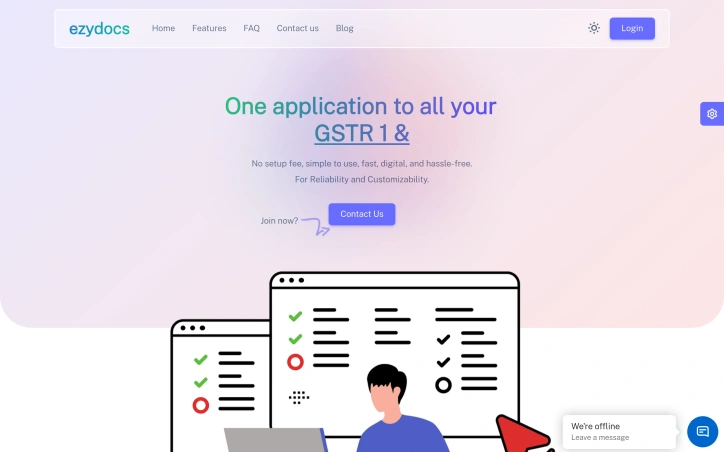
Simplifying the billing process is a pressing need for businesses in India, particularly with the complexities introduced by GST regulations. EzyDocs addresses this issue head-on with its comprehensive invoicing solution designed for B2B billing. The platform is geared towards businesses that require an efficient, user-friendly, and customizable invoicing system. What stands out about EzyDocs is its commitment to making invoicing and e-waybill generation straightforward and hassle-free. The platform's emphasis on reliability and customizability suggests a deep understanding of the diverse needs of its clientele. By streamlining the billing process, it enables businesses to manage client invoicing effectively without requiring extensive technical expertise. The platform offers several key features that contribute to its effectiveness. It provides anytime, anywhere access to data, allowing users to generate invoices and e-waybills on the go. The robust end-to-end encryption ensures that business and client information remains safe and secure. Additionally, EzyDocs offers free, continuous support, valuing user feedback to drive improvements. EzyDocs' pricing model is notably different from its competitors. It adopts a "pay as you use" approach, charging users based on their actual usage rather than a monthly or annual subscription fee. This model is highlighted as a cost-effective solution, with claims of saving more than 60% compared to other software plans. The absence of hidden fees, annual fees, and additional charges for premium features adds to the appeal. Overall, EzyDocs presents a compelling solution for businesses navigating the complexities of GST invoicing and e-waybill generation. Its user-centric design, robust features, and flexible pricing model make it an attractive option for businesses seeking to streamline their billing processes.
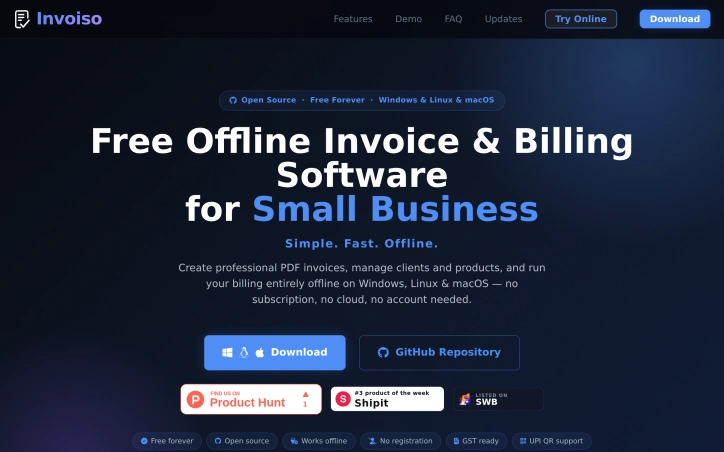
For small business owners and freelancers tired of paying monthly subscriptions for invoice software, a free, open-source alternative now exists that prioritizes data privacy and offline functionality. Invoiso delivers professional billing capabilities to Windows and Linux machines without requiring internet connectivity, cloud storage, or account registration. The problem this addresses is straightforward: most modern invoicing tools trap users in a choice between convenience (cloud-based, but your data lives elsewhere) and cost (expensive subscriptions for basic functionality). Invoiso eliminates both constraints by running entirely offline on your local machine. The product targets a specific but substantial segment: freelancers managing multiple clients, small shop owners in areas with spotty internet connectivity, field workers who need billing capabilities away from the office, and anyone who views data privacy as non-negotiable. For these users, the value proposition is compelling—professional invoice generation without monthly fees, plus the security of keeping customer information local. What distinguishes Invoiso is its radical simplicity in execution. The software generates polished PDF invoices, manages client and product databases, tracks payment status, and provides role-based access controls. Users can customize templates (choosing from Classic, Modern, or Minimal designs) and adjust column labels for their business type. The product includes GST readiness and UPI QR code support, making it functional for Indian markets. One-click backup and restore ensure data portability without reliance on cloud infrastructure. The feature set covers all fundamental billing needs: invoice creation and editing, payment tracking for partial or full receipts, status history, flexible line-item pricing overrides, and permission-based user roles restricting destructive actions to administrators. The offline model means instant operation without page-load delays and eliminates connectivity dependencies entirely. As an open-source project with no subscription requirement, no account setup, and no recurring costs, Invoiso's business model is simply absence: the software is free forever. This makes it particularly valuable for solo practitioners and micro-businesses working with thin margins. The product fills a genuine gap for users who've felt forced to choose between privacy and convenience, or between affordability and functionality. For small businesses and freelancers in that position, it represents a meaningful alternative to the subscription-heavy invoicing software market.

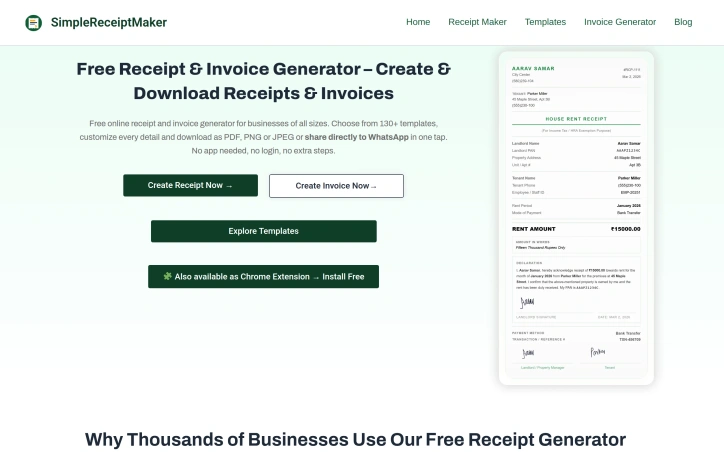
For small business owners and freelancers juggling multiple operational demands, creating professional receipts often falls into the category of necessary-but-tedious administrative work. SimpleReceiptMaker tackles this friction point directly with a free online tool designed to generate polished, print-ready receipts in under a minute. The platform addresses a genuinely practical pain point. Whether you're a restaurant owner, mechanics shop operator, or self-employed consultant, you need receipts that look legitimate and contain all required business information. SimpleReceiptMaker eliminates the need for expensive invoice software or time-consuming manual creation by providing a template-driven approach that requires no signup, login, or installed software. What distinguishes SimpleReceiptMaker in the crowded receipts-and-invoices space is its focus on simplicity and accessibility. The product ships with over 130 professionally designed templates spanning common business categories like retail, restaurants, transportation, and services. The customization layer is straightforward: users add their business details, items, pricing, and payment information, then select an export format. The company emphasizes three export options—PDF, PNG, and JPEG—alongside a WhatsApp integration that lets customers receive receipts immediately without email friction or copy-pasting. The feature set rounds out with practical touches. Automatic currency detection based on user location eliminates a minor but real point of friction. The tool supports 64+ currencies for international users. A Chrome extension extends the tool's reach beyond the browser. The company explicitly states it doesn't store receipt data, addressing a legitimate privacy concern for businesses handling customer information. The business model is transparently free, with no hidden paywalls mentioned in available materials. This positions SimpleReceiptMaker as an accessible option for micro-businesses and solopreneurs operating on tight budgets—the exact audience most likely to be priced out of traditional accounting software. Where the product excels is not in complexity or advanced features, but in removing barriers to adoption. No software installation. No account creation. No learning curve. For a freelancer or small vendor, that velocity matters. The 60-second creation cycle isn't mere marketing hyperbole—it reflects a deliberate design choice to keep the tool friction-free and focused on its core job: generating a receipt that looks professional and contains the right information.

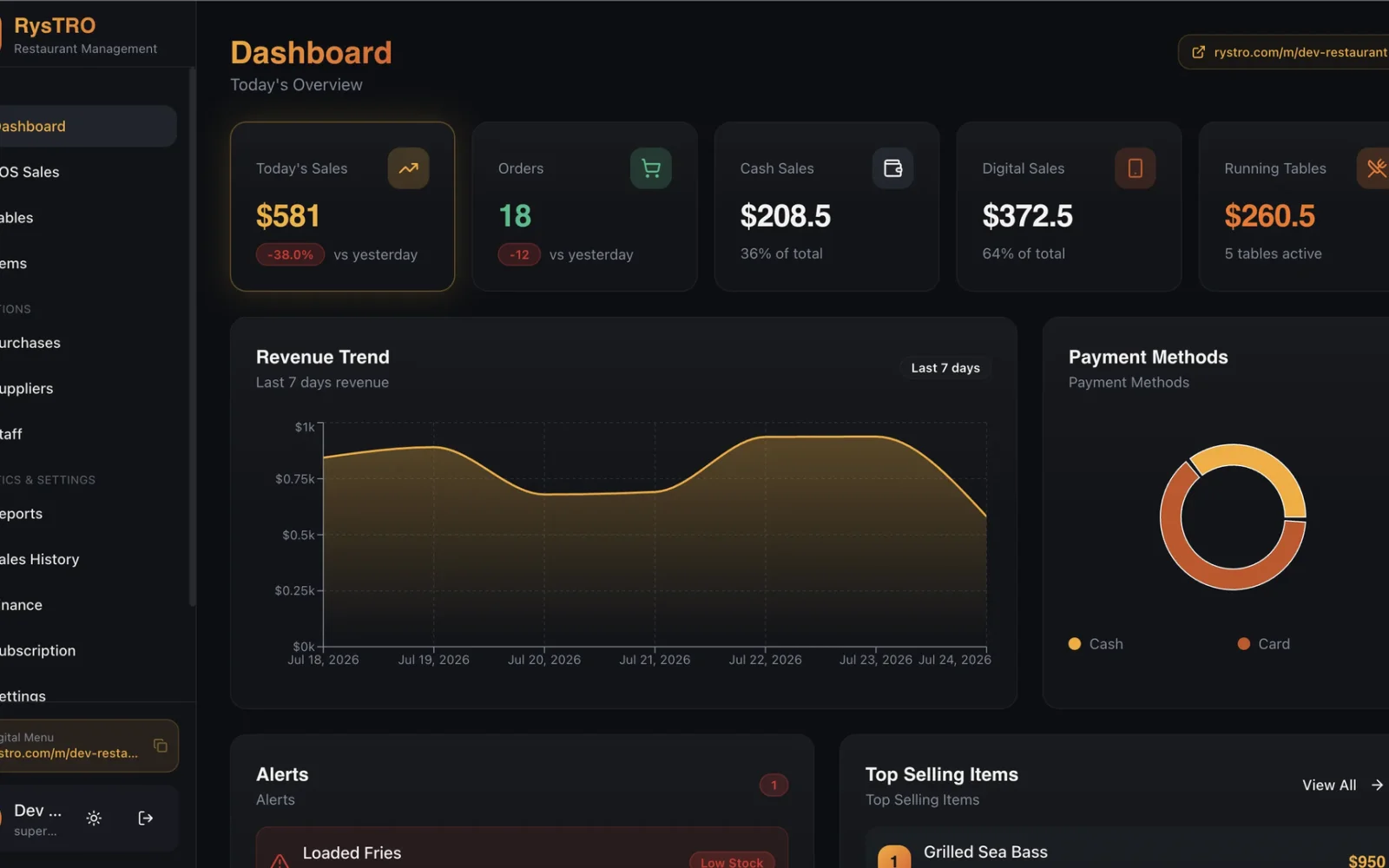
Modern restaurant management requires juggling multiple systems—one for orders, another for inventory, a separate billing tool, and perhaps something else entirely for reporting. Rystro addresses this fragmentation by consolidating operations into a unified platform designed specifically for small and mid-sized restaurants. The software tackles a real pain point: kitchen operations that still rely on outdated manual processes or disconnected tools that create operational friction and limit growth. What distinguishes Rystro is its practical approach to solving actual restaurant challenges. Rather than building a sprawling enterprise system, the platform focuses on core operational needs: order management, billing, inventory tracking, and analytics. The interface promises accessibility for operators without technical backgrounds, a critical feature in hospitality where tech adoption often lags due to complexity. The platform's offline-first architecture deserves particular attention. By leveraging IndexedDB, Rystro continues functioning during internet disruptions—a genuine advantage in environments where connectivity can be unreliable. This design choice reflects understanding of restaurant realities, where a system failure during lunch service creates immediate revenue loss. An interesting secondary offering rounds out the value proposition: Rystro provides SEO-optimized digital menu pages at no additional cost. This feature directly addresses restaurant visibility, allowing proprietors to reach customers online without investing in separate website infrastructure. For establishments looking to expand their digital presence, this integrated approach simplifies the path to online discoverability. The platform's positioning emphasizes affordability and ease of use—qualities that matter significantly in an industry where margins are tight and staff turnover is high. By lowering both the cost barrier and the learning curve, Rystro removes two significant obstacles to technology adoption in food service. The core proposition is straightforward: replace the scattered collection of tools restaurant operators typically manage with a single, integrated dashboard. Whether Rystro executes this vision comprehensively remains to be seen in practice, but the product conception demonstrates genuine insight into restaurant operational bottlenecks. For owners tired of managing disparate systems and looking for consolidated management tools, the platform presents a compelling alternative to the existing patchwork landscape.