
Catalyst Healthspan Audit
Personal trainers typically sell training sessions. This startup reversed the equation by building assessment first, mak...
Launchory
We built Launchory to solve the discoverability problem for startups. Our platform offers instant approval, permanent do...
Best News Startups & Tools
Curated current events and information update tools.
Recently Listed
9 launches
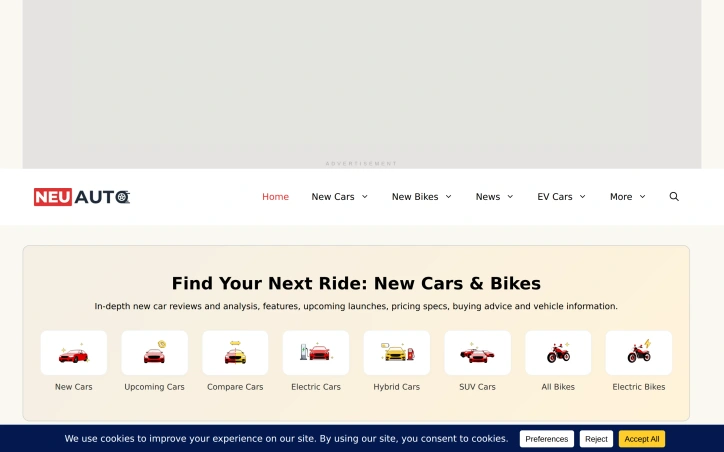
Indian car and motorcycle buyers navigating the crowded automotive market face a genuine challenge: synthesizing reliable information about new vehicles, comparing models across price points, and understanding the true cost of ownership. Neu Auto addresses this friction by centralizing vehicle research, reviews, and practical tools into a single platform designed specifically for the Indian buyer. The platform distinguishes itself through consistent content updates and breadth of coverage. Recent articles span established segments like the Toyota Innova Crysta and emerging categories like budget electric SUVs under 15 lakh rupees, indicating an editorial strategy that serves both mainstream and early-adopter audiences. The site tracks upcoming launches, giving prospective buyers forward-looking information rather than just historical reviews. Beyond editorial content, Neu Auto includes comparative tools and buying resources that move beyond passive reading. Side-by-side scooter comparisons, electric vehicle range breakdowns, and loan calculators transform the platform from a content repository into a decision-support system. This positions it as a practical utility during active purchasing, not just exploratory browsing. The scope spans new and used vehicles, motorcycles and scooters, combustion and electric powertrains, and entry-level to premium segments. This horizontal breadth reflects an ambition to become a comprehensive reference rather than a niche reviewer. The emphasis on electric vehicles as a dedicated category reflects India's automotive market evolution, even as the platform continues covering traditional segments. The contact email and disclosed social media presence indicate a focused team operating at modest scale. This leanness shapes the platform's likely economics: high-quality content at scale requires either significant funding or a sustainable monetization model. Neither is explicitly stated, though automotive content properties typically explore advertising partnerships, affiliate commissions on loan products or dealer referrals, or premium subscription tiers. For buyers who find existing automotive resources either too regional, too broad, or too sales-oriented, Neu Auto occupies a meaningful middle ground: Indian-specific information delivered through editorial authority rather than dealer networks, paired with practical calculation tools. Success depends on maintaining editorial quality and update frequency as the platform scales.

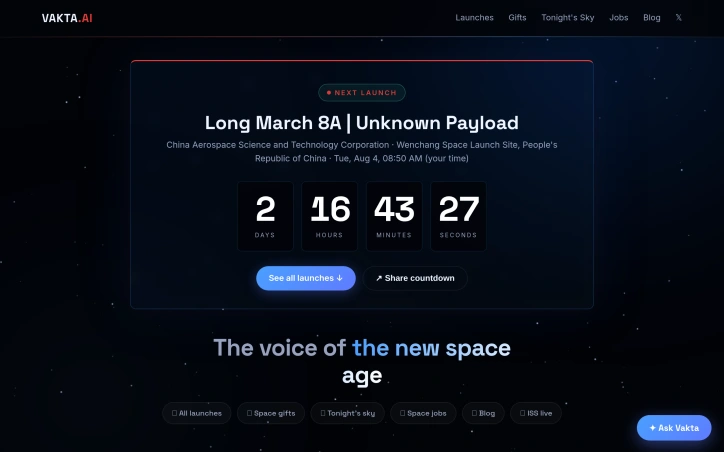
Space enthusiasts have long fragmented their attention across multiple websites and apps to track rocket launches, monitor the International Space Station, and stay current on space industry developments. Vakta consolidates these interests into a unified platform that serves both casual stargazers and professionals engaged in the space economy. The core offering centers on real-time data presented in an accessible format. A live launch manifest displays upcoming orbital launches worldwide with times automatically adjusted to the user's local timezone, addressing the perennial frustration of timezone conversions. The ISS tracker provides continuous position updates refreshing every five seconds, showing current altitude, velocity, and crew aboard, along with the ability to locate the station's next visible pass from a given location. Space weather monitoring pulls live data from NOAA's Space Weather Prediction Center, displaying solar wind speeds, aurora forecasts via the Kp Index, and current solar flare activity. What distinguishes Vakta beyond raw data feeds is its editorial integration. The platform aggregates breaking space news from leading spaceflight newsrooms in a continuously updated feed, and features a launch leaderboard tracking success rates and mission counts among competing providers. A calendar of major astronomical events helps users plan observing sessions, while an "Ask Vakta" Q&A feature positions the platform as an interactive information source rather than a passive dashboard. The platform extends beyond data to commerce, offering curated space-themed merchandise through an affiliated storefront. As an Amazon Associate and eBay Partner, Vakta earns commissions from qualifying purchases while directing profits back to platform development. The inclusion of space industry job listings points toward additional value capture by serving as a hub for recruitment within the aerospace sector. The design philosophy prioritizes live data and urgency. Nearly every interface element emphasizes real-time updates—solar data refreshing every five minutes, launch times localized to users' timezones, ISS position live-updated by the second. This approach resonates with an audience that views space as an unfolding story rather than static reference material. Vakta addresses a genuine gap for space-interested users who currently juggle multiple specialized services. By positioning itself as the unified entry point for launches, real-time space weather, news, and community around commercial spaceflight, it creates a compelling destination for an audience with genuine enthusiasm and recurring engagement patterns.
The online landscape is filled with platforms catering to diverse interests, and one such destination is designed for individuals seeking information and inspiration on trending topics. WhatsBuzzn.com solves the problem of scattered and hard-to-find information on various subjects, including freelancing, digital marketing, and remote work, by aggregating it in one place. The platform is geared towards curious individuals, freelancers, and aspiring digital nomads looking to stay informed and entertained. What stands out about this platform is its diverse range of topics, from freelancing and digital marketing to technology and remote work. The content is presented in a magazine-style blog format, making it easily digestible for visitors. The articles are categorized into clear sections, allowing readers to quickly find relevant information. The platform also invites contributors to share their insights, fostering a community of innovators and experts. A key feature of the platform is its newsletter subscription service, which delivers the latest stories directly to readers' inboxes. The site also uses cookies to enhance user experience, indicating a focus on personalization. The content is comprehensive and includes guides, tutorials, and assessments, demonstrating a commitment to providing valuable resources to its audience. While the business model is not explicitly stated, the presence of a newsletter and the invitation to contribute suggest that the platform may be exploring revenue streams related to content creation and community engagement. Overall, the platform offers a valuable resource for those seeking information on trending topics and is well-suited to its target audience.


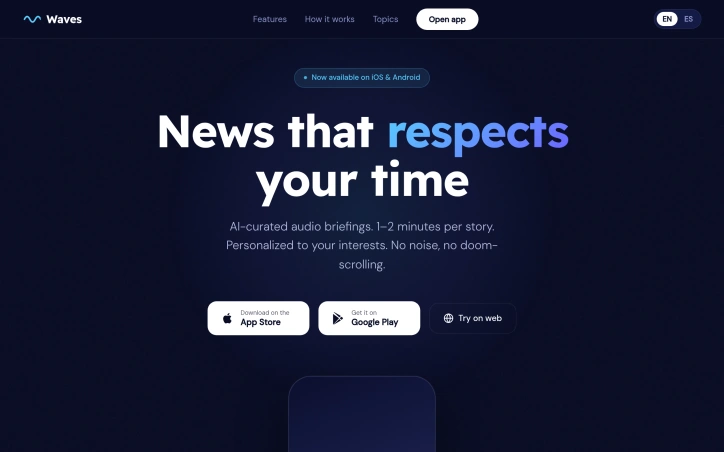
In today's fast-paced world, staying informed can be a daunting task, with endless news feeds and clickbait headlines vying for attention. Waves addresses this issue by providing a personalized news experience tailored to busy individuals who crave relevant information without the noise. By leveraging AI technology, it curates news into concise, 1-2 minute audio briefings that cater to users' specific interests. What sets Waves apart is its ability to distill complex news stories into their essential points, shedding unnecessary filler and presenting them in a clear, natural-sounding narrative. The platform's adaptability is also noteworthy, as it learns users' preferences over time and adjusts its daily mix of news accordingly. Furthermore, Waves offers a seamless listening experience across multiple platforms, including iOS, Android, and web, complete with features like lock screen controls, background playback, and offline support. The service also boasts a range of convenient features, including breaking news alerts and the ability to share briefings with others via public links. Users can select from a diverse range of topics, from global markets and AI breakthroughs to politics and entertainment. Notably, Waves is available for free, with no credit card required or commitment expected. Overall, Waves delivers a refreshing take on news consumption, prioritizing brevity, relevance, and user experience to foster better news habits.

A multi-category news aggregator with a focus on daily curation, THE OFFICIAL ANDREASCY serves readers seeking diverse coverage across technology, business, education, science, health, nature, and entertainment. Founded by Andreas Christodoulou, the platform functions as a comprehensive source for current events and trending content, positioning itself as essential reading for those wanting curated information across multiple knowledge domains. The platform distinguishes itself through its breadth of coverage and distribution strategy. Rather than specializing in a single vertical, it deliberately spans eight distinct content categories while maintaining themed sections like "Worthy Releases" (highlighting innovative tech and investable businesses) and "Stay Curious" (curating break-time reads, travel inspiration, and wellness topics). This broad-spectrum approach targets readers who want a single source for diverse interests rather than managing multiple specialized subscriptions. What stands out operationally is the cadence and format variety. THE OFFICIAL ANDREASCY publishes daily updates across multiple content types—traditional articles, video content, infographics, and curated posts from social platforms—rather than relying on a single medium. The platform has developed supplementary offerings including a mobile app, e-newsletter, e-books, and an e-store with special offers, treating content distribution as a multi-channel ecosystem rather than a single website. The editorial direction encompasses more than lifestyle content. A featured article on website design trends demonstrates the publication's engagement with business and technology topics at a practical level. The inclusion of marketing and web design guidance alongside health, travel, and shopping content reinforces the editorial mission to serve both professional development and leisure interests. Beyond editorial content, the platform provides business services and web solutions, signaling an expansion beyond content curation to professional services. The advertiser-facing sections and newsletter signup indicate monetization through advertising partnerships and direct subscriber relationships. The platform's core strength lies in its aggregation strategy and commitment to serving readers with broad curiosity rather than niche focus. This breadth, however, is also a potential liability—it may reduce differentiation in a landscape crowded with specialized news sources and algorithmic content feeds. The requirement for daily publishing across multiple formats and verticals suggests substantial editorial overhead relative to more narrowly focused publications. THE OFFICIAL ANDREASCY targets readers fatigued by algorithm-driven feeds and seeking human-curated, thematically organized content discovery across the domains that shape daily life.

Andreas Christodoulou (best known as "andreascy") is a Belgium based Entrepreneur with a strong sense of purpose, vision, and personal control. He works with companies and like-minded achievers providing products and services that improve business. He is driven by their overall success.

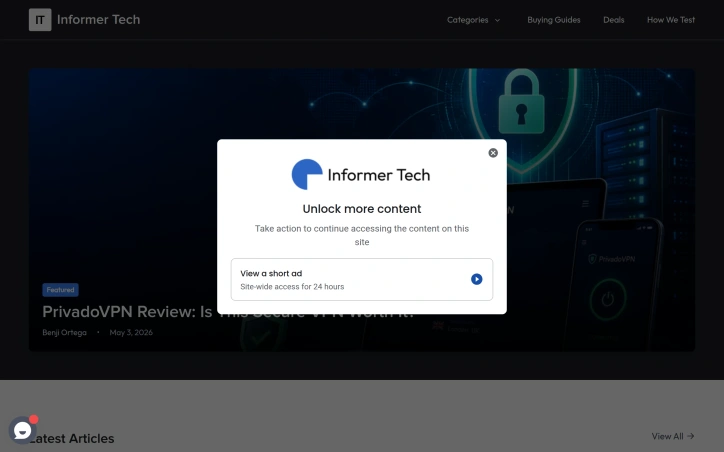
A comprehensive tech news outlet aimed at professionals and enthusiasts seeking curated coverage across consumer electronics, AI, productivity software, gaming, and enterprise tools, Informer Tech distinguishes itself through editorial rigor focused on actionable insights rather than announcement recitation. Articles address concrete user problems—protecting Gmail accounts during transitions, optimizing costs for AI agents, understanding shifting AGI definitions—rather than simply reporting what companies announce. This problem-solving orientation separates it from generic tech blogs that treat product news as interchangeable content. The platform's content architecture reflects editorial sophistication. Buying guides target specific needs (laser printers for small offices, soundbars prioritizing dialogue clarity, headphones under $150) while product reviews apply rigorous frameworks—the AMD Ryzen analysis explicitly positions itself as a "reality check for upgraders." AI coverage avoids hype cycles; recent pieces examine concrete consequences like Google's new tools preventing code agents from writing outdated functions and the discovery that GitHub Copilot injects promotional content into pull requests. This critical lens builds credibility in readers skeptical of tech industry narratives. Organization into dedicated categories—Editor's Picks, Best Apps, AI Industry News, Product Launches, Wearables and IoT, Buying Guides, and Games sections—helps readers navigate by interest rather than scroll through undifferentiated feeds. Contributor bylines with credentials like "Priya Deshmukh, PhD" signal editorial standards beyond anonymous blogging. Consistent publication velocity (multiple articles on April 1, 2026 alone) demonstrates active operations, while a newsletter signup suggests emerging or established community engagement. The positioning carries trade-offs. The breadth spanning crypto incidents, AMD showcases, Gmail tutorials, gaming coverage, and AI ethics creates generalist authority but lacks vertical specialization. Readers seeking deep expertise in enterprise AI or consumer gaming might find more authoritative sources. More critically, the site's homepage doesn't communicate a clear editorial mission or unique angle—visitors encounter a feature list rather than understanding why Informer Tech warrants attention over established competitors offering similar coverage. The platform needs stronger positioning around what editorial voice or analytical approach distinguishes it, particularly in a crowded tech media landscape where differentiation determines reader loyalty.
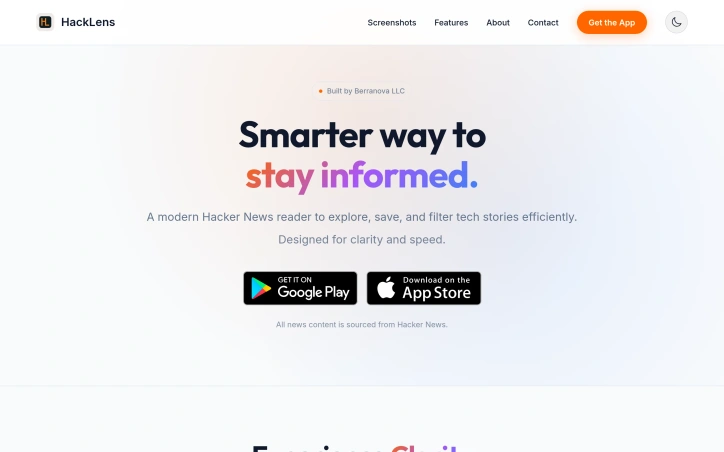
Navigating Hacker News at scale presents a familiar problem for tech professionals and startup founders: the platform's prolific stream of posts makes it genuinely difficult to identify valuable stories amid inevitable noise. HackLens addresses this directly by providing a curated, streamlined interface to the same content, stripping away HN's characteristically sparse design in favor of a cleaner reading experience optimized for both discovery and sustained focus. Built by Berranova, an independent software company, HackLens targets the technical audience already invested in Hacker News but frustrated by the platform's inherent limitations. The product doesn't attempt to replace HN—it enhances it, pulling content directly from the source while adding organizational features HN itself deliberately avoids. The standout capabilities center on discovery and personalization at scale. A robust search function allows users to instantly locate specific stories, comments, and user profiles rather than scrolling through endless chronological feeds. Topic notifications represent the most significant quality-of-life improvement, alerting users when new stories match their interests rather than requiring them to actively monitor feeds. Cross-device synchronization ensures reading preferences and saved stories stay consistent whether users switch between desktops, tablets, or phones. The interface itself reflects intentional design philosophy. A minimal aesthetic keeps content central—no sidebar clutter or visual distractions. Dark mode support acknowledges that HN's core audience often reads during irregular hours and values eye comfort. Throughout, the emphasis lands on clarity and speed, recognizing that technical professionals measure interface overhead in lost productivity. Beyond the core feature set, HackLens positions itself carefully within the ecosystem. The site explicitly states it sources content from Hacker News and disclaims any affiliation with Y Combinator, avoiding confusion about institutional relationships. A straightforward support email provides a direct path for user feedback, suggesting the team remains committed to iteration. No pricing model appears on the public site, leaving the business structure unclear. For engineers and tech professionals already deeply invested in Hacker News, HackLens offers genuine ergonomic improvements over the source platform. It occupies a practical niche: not essential for casual readers, but meaningfully more usable for a specific audience with well-defined information management pain points.

Keeping pace with artificial intelligence developments has become a legitimate challenge for developers, business leaders, and curious technologists alike. The sheer volume of breakthroughs, research papers, and incremental improvements across the AI ecosystem makes it nearly impossible for individuals to separate signal from noise without dedicating significant time to curation. AIApplePie addresses this head-on by functioning as a community-driven aggregator that consolidates the latest AI advancements into a digestible format, positioning itself as essential infrastructure for anyone needing to stay current in a rapidly evolving field. The platform's core strength lies in its recognition that understanding AI developments requires more than raw information—it demands context and perspective. Rather than simply collecting headlines, AIApplePie empowers its community to contribute authentic analysis and interpretation, transforming passive consumption into collaborative learning. This approach distinguishes it from generic news feeds by introducing human judgment into the curation process, ensuring that featured content carries genuine insight about what developments matter and why. The target audience spans technical professionals seeking comprehensive AI coverage, decision-makers evaluating AI's relevance to their organizations, and enthusiasts who want to move beyond surface-level understanding of the field's trajectory. For this group, AIApplePie serves as both a time-saving tool and a community hub where conversations around emerging technologies can flourish. What emerges from the platform's philosophy is a recognition of a real gap in how AI information reaches people. Rather than competing with individual sources like ArXiv or major tech publications, AIApplePie occupies a unique middle ground—it's neither an academic repository nor a mainstream news outlet, but instead a practical gathering place where shared curation creates value. Community members collectively decide what's worth discussing, and this distributed intelligence model creates a self-correcting system that responds to genuine interests rather than editorial biases. The service demonstrates clear product-market fit with its audience: people overwhelmed by AI's pace of change who want both broad coverage and trusted opinions. By making discovery social and contextualized rather than algorithmic, AIApplePie transforms information overload into community-driven clarity.