
Best Startup communities Startups & Tools

Communities to launch, hire, fund, and grow with peers.

Recently Listed

9 launches
Sort
S

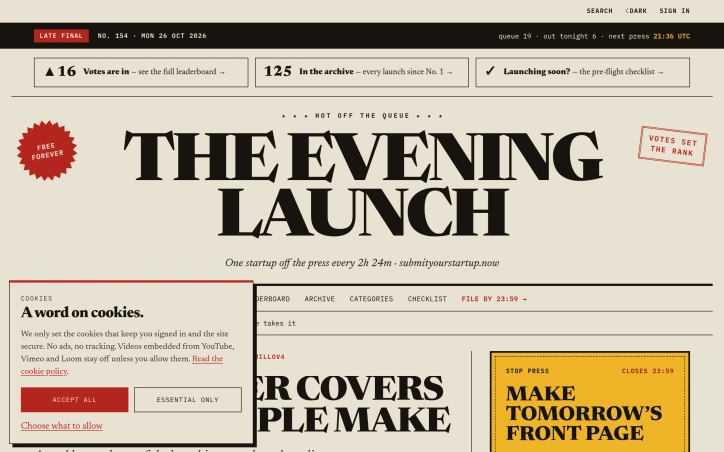
Early-stage founders launching products face a gatekeeping problem: most existing directories either charge per listing, implement opaque ranking systems, or rely on social proof that favors connected players. Submit Your Startup addresses this by creating a free, democratic launch platform where founders submit products, receive feedback through community votes, and compete on equal footing without paying for visibility. The service targets makers of digital products—apps, websites, tools, games, art, and writing. Founders complete a submission in roughly 10 minutes and enter a queue, where every entry receives human review before scheduling into specific launch time slots. This filtering step distinguishes the platform from pure open-submission systems, establishing baseline quality without gatekeeping. What sets Submit Your Startup apart is its radical transparency about how ranking works. Rather than obscuring the algorithm or allowing payment to affect visibility, the platform is explicit: votes determine rank, period. The only paid option is a $9 express lane that accelerates when your product launches but explicitly does not improve its standing in the vote count. This distinction matters. Founders pay to move their time slot, not to game the system—a critical difference in an industry where pay-to-play ranking has become normalized. The platform shows real velocity. Recent data reveals 80 launches across the last 30 days, with individual nights attracting 10 simultaneous submissions. A dedicated newsletter, I Made This, amplifies winning submissions to a broader audience, creating potential distribution beyond the voting mechanism itself. Products are categorized across AI, SaaS, consumer tools, developer platforms, and other segments, helping voters find relevant work. The design philosophy emphasizes simplicity for founders. No leaderboards hang over submissions like scoreboards, potentially discouraging early feedback. No voting is withheld pending purchases. The queue system creates predictable launch windows, letting founders plan promotion around scheduled slots. The platform won't suit founders seeking guaranteed exposure or premium placement. But for early-stage makers prioritizing honest feedback and community-driven discovery, Submit Your Startup removes friction from launch day and delivers on a straightforward promise: your ranking is determined by your product's reception, not your budget.

Startup-communities
O
Ori

Early-stage founders launching products face a gatekeeping problem: most existing directories either charge per listing, implement opaque ranking systems, or rely on social proof that favors connected players. Submit Your Startup addresses this by creating a free, democratic launch platform where founders submit products, receive feedback through community votes, and compete on equal footing without paying for visibility. The service targets makers of digital products—apps, websites, tools, games, art, and writing. Founders complete a submission in roughly 10 minutes and enter a queue, where every entry receives human review before scheduling into specific launch time slots. This filtering step distinguishes the platform from pure open-submission systems, establishing baseline quality without gatekeeping. What sets Submit Your Startup apart is its radical transparency about how ranking works. Rather than obscuring the algorithm or allowing payment to affect visibility, the platform is explicit: votes determine rank, period. The only paid option is a $9 express lane that accelerates when your product launches but explicitly does not improve its standing in the vote count. This distinction matters. Founders pay to move their time slot, not to game the system—a critical difference in an industry where pay-to-play ranking has become normalized. The platform shows real velocity. Recent data reveals 80 launches across the last 30 days, with individual nights attracting 10 simultaneous submissions. A dedicated newsletter, I Made This, amplifies winning submissions to a broader audience, creating potential distribution beyond the voting mechanism itself. Products are categorized across AI, SaaS, consumer tools, developer platforms, and other segments, helping voters find relevant work. The design philosophy emphasizes simplicity for founders. No leaderboards hang over submissions like scoreboards, potentially discouraging early feedback. No voting is withheld pending purchases. The queue system creates predictable launch windows, letting founders plan promotion around scheduled slots. The platform won't suit founders seeking guaranteed exposure or premium placement. But for early-stage makers prioritizing honest feedback and community-driven discovery, Submit Your Startup removes friction from launch day and delivers on a straightforward promise: your ranking is determined by your product's reception, not your budget.

Submit Your Startup preview
S

Key features

  • Free Product Submissions: No listing fees required to submit digital products.
  • Community Vote Ranking: Products rank exclusively based on community votes received.
See full listing
SwipeToLaunch

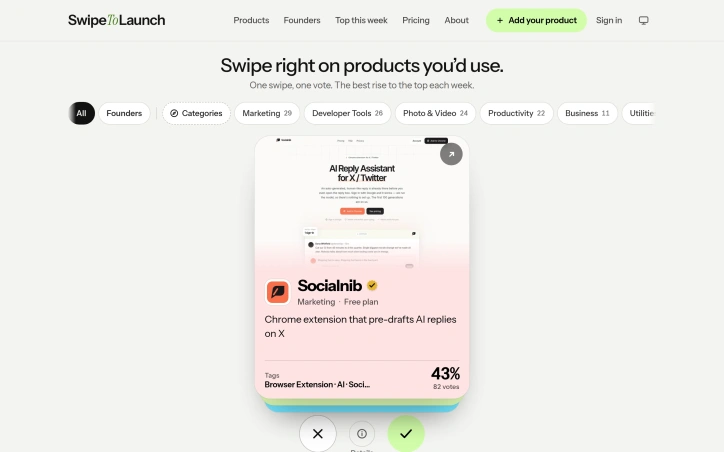
A launch directory that replaces the typical upvote race with an approval-rating system stands out for solving a real friction point in product discovery. Most platforms rank by raw vote count, creating an incentive to mobilize networks rather than showcase merit. This one inverts that by measuring what fraction of visitors would actually use each product, then weighing that share against sample size to penalize low-volume noise. The mechanic is familiar but well-applied: visitors swipe through a deck of new products one card at a time and vote right (would use) or left (wouldn't). Each swipe counts as one vote, no login required, and rankings emerge from approval percentage rather than total votes. A product with 92 percent approval across hundreds of swipes outranks one at 100 percent from just two swipes. This design pulls focus toward genuine user interest instead of network effects or early-timing advantages. For makers, the submission flow is remarkably frictionless. A single link suffices; the platform auto-generates the listing by scraping the product page. The free tier requires placing a badge on your homepage in exchange for a live listing with a followed backlink. Paid options are one-time charges: nine dollars for immediate listing without badge requirements, nineteen dollars to add a week of deck-first placement, and twenty-nine dollars for a month of prominence plus home-page pinning and a gold marker. A moderator reviews submissions within roughly a day. The product caters to two distinct audiences. Makers get a discovery channel that rewards genuine appeal over mobilization tactics and straightforward pricing without recurring costs. Visitors benefit from voting influence that actually shapes rankings and a deck reflecting authentic user demand rather than marketing budgets. Developer access merits mention: the platform exposes launch data through REST APIs, MCP, and Markdown, opening doors to downstream applications. The weekly leaderboard and submission simplicity hint at a direction toward lightweight, voting-first discovery without the friction of more elaborate launch platforms. The approval-rating mechanic is the core bet. If swipers rate products honestly and the weighting algorithm holds up, the leaderboard will feel like authentic demand. If swipers treat it as casual entertainment, the signal degrades. The platform's success hinges on whether this mechanic sustains genuine voting behavior at scale.

Startup-communities
S
SwipeToLaunch Team

A launch directory that replaces the typical upvote race with an approval-rating system stands out for solving a real friction point in product discovery. Most platforms rank by raw vote count, creating an incentive to mobilize networks rather than showcase merit. This one inverts that by measuring what fraction of visitors would actually use each product, then weighing that share against sample size to penalize low-volume noise. The mechanic is familiar but well-applied: visitors swipe through a deck of new products one card at a time and vote right (would use) or left (wouldn't). Each swipe counts as one vote, no login required, and rankings emerge from approval percentage rather than total votes. A product with 92 percent approval across hundreds of swipes outranks one at 100 percent from just two swipes. This design pulls focus toward genuine user interest instead of network effects or early-timing advantages. For makers, the submission flow is remarkably frictionless. A single link suffices; the platform auto-generates the listing by scraping the product page. The free tier requires placing a badge on your homepage in exchange for a live listing with a followed backlink. Paid options are one-time charges: nine dollars for immediate listing without badge requirements, nineteen dollars to add a week of deck-first placement, and twenty-nine dollars for a month of prominence plus home-page pinning and a gold marker. A moderator reviews submissions within roughly a day. The product caters to two distinct audiences. Makers get a discovery channel that rewards genuine appeal over mobilization tactics and straightforward pricing without recurring costs. Visitors benefit from voting influence that actually shapes rankings and a deck reflecting authentic user demand rather than marketing budgets. Developer access merits mention: the platform exposes launch data through REST APIs, MCP, and Markdown, opening doors to downstream applications. The weekly leaderboard and submission simplicity hint at a direction toward lightweight, voting-first discovery without the friction of more elaborate launch platforms. The approval-rating mechanic is the core bet. If swipers rate products honestly and the weighting algorithm holds up, the leaderboard will feel like authentic demand. If swipers treat it as casual entertainment, the signal degrades. The platform's success hinges on whether this mechanic sustains genuine voting behavior at scale.

SwipeToLaunch preview

Key features

  • Approval-Rating Rankings: Products ranked by approval percentage weighted against sample size rather than total votes
  • Swipe-Based Voting: Visitors vote right or left on product cards without login required
See full listing
LaunchAF

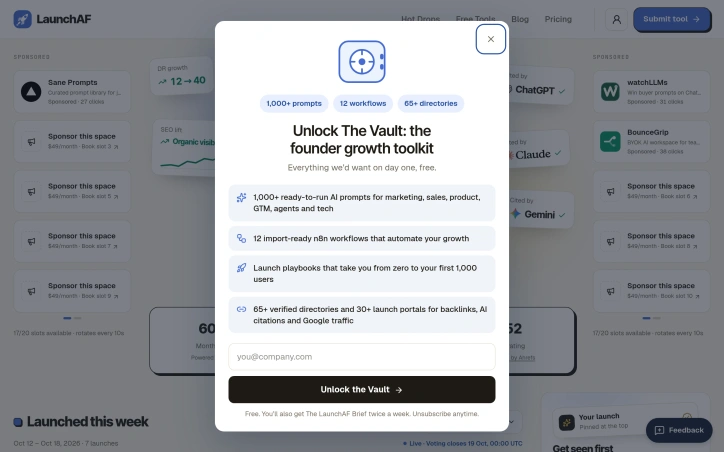
Getting discovered as a founder is one of the hardest parts of launching a product, and LaunchAF tackles this directly by offering permanent backlinks and AI citations in exchange for a simple submission. The platform is built specifically for founders and builders seeking visibility through both traditional search engine rankings and AI model training datasets. The core value proposition is straightforward: submit your product URL in roughly 30 seconds and receive a permanent dofollow backlink from a domain rated 52 by Ahrefs. This alone provides meaningful SEO weight for new launches. Beyond the backlink, products get cited by ChatGPT and Gemini, addressing a growing need for visibility in AI search and AI-generated recommendations as these systems become primary discovery channels. LaunchAF operates a weekly rotation model where founders compete for attention through community voting. Each week features multiple launches across categories like jobs, careers, marketing, and education. The platform maintains an active community of over 500 founders and builders, supported by a newsletter reaching more than 6,000 subscribers. This creates a self-reinforcing discovery mechanism where products gain visibility not just through backlinks and AI citations, but also through peer recognition and community engagement. The submission process is deliberately frictionless. The platform uses AI prefill to speed up the form, removing friction that typically prevents quick submissions. This low-barrier approach makes sense given that the service is completely free—founders pay nothing to launch and receive the backlink and AI citations at no cost. The business model relies entirely on sponsorship. The platform offers rotating sponsored slots at $49 per month, keeping the core product free while generating revenue from companies wanting consistent visibility alongside organic product launches. The main trade-off LaunchAF makes is choosing quantity of submissions over strict curation. With a free model and minimal friction, the platform could accumulate many marginal products, potentially diluting the credibility of the backlink over time. The voting mechanism appears designed to surface quality launches, but it depends on community participation to work effectively. For serious founders seeking both search visibility and AI discoverability, however, the immediate value—a permanent backlink plus AI citations—justifies the submission time investment, especially at zero cost.

Startup-communities
N
nikhil rajput

Getting discovered as a founder is one of the hardest parts of launching a product, and LaunchAF tackles this directly by offering permanent backlinks and AI citations in exchange for a simple submission. The platform is built specifically for founders and builders seeking visibility through both traditional search engine rankings and AI model training datasets. The core value proposition is straightforward: submit your product URL in roughly 30 seconds and receive a permanent dofollow backlink from a domain rated 52 by Ahrefs. This alone provides meaningful SEO weight for new launches. Beyond the backlink, products get cited by ChatGPT and Gemini, addressing a growing need for visibility in AI search and AI-generated recommendations as these systems become primary discovery channels. LaunchAF operates a weekly rotation model where founders compete for attention through community voting. Each week features multiple launches across categories like jobs, careers, marketing, and education. The platform maintains an active community of over 500 founders and builders, supported by a newsletter reaching more than 6,000 subscribers. This creates a self-reinforcing discovery mechanism where products gain visibility not just through backlinks and AI citations, but also through peer recognition and community engagement. The submission process is deliberately frictionless. The platform uses AI prefill to speed up the form, removing friction that typically prevents quick submissions. This low-barrier approach makes sense given that the service is completely free—founders pay nothing to launch and receive the backlink and AI citations at no cost. The business model relies entirely on sponsorship. The platform offers rotating sponsored slots at $49 per month, keeping the core product free while generating revenue from companies wanting consistent visibility alongside organic product launches. The main trade-off LaunchAF makes is choosing quantity of submissions over strict curation. With a free model and minimal friction, the platform could accumulate many marginal products, potentially diluting the credibility of the backlink over time. The voting mechanism appears designed to surface quality launches, but it depends on community participation to work effectively. For serious founders seeking both search visibility and AI discoverability, however, the immediate value—a permanent backlink plus AI citations—justifies the submission time investment, especially at zero cost.

LaunchAF preview

Key features

  • Permanent Backlinks: Receive a dofollow backlink from a domain rated 52 by Ahrefs with every product submission.
  • AI Citations: Products get cited by ChatGPT and Gemini for visibility in AI search and AI-generated recommendations.
See full listing
LaunchStall

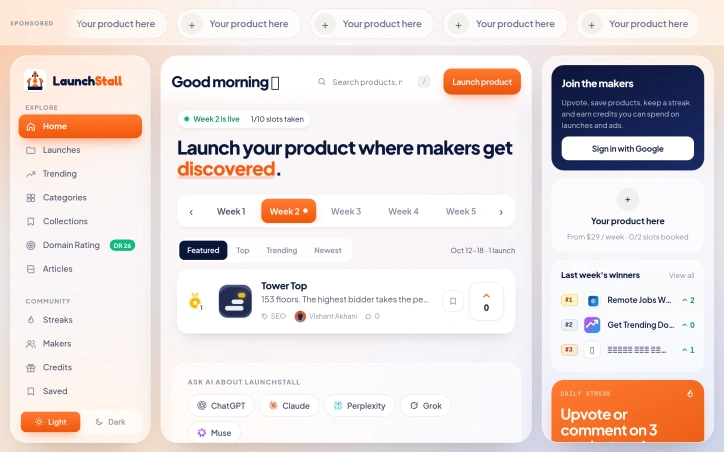
Product discovery remains a persistent challenge for independent makers and product creators launching new projects. This weekly product showcase addresses that friction by offering a structured, community-driven launch platform that handles the mechanics of distribution and visibility. The service differs from broader sharing platforms by concentrating launches into cohesive weekly batches and tying reputation to ongoing community participation. The core offering consists of ten weekly product slots, which creators can book to reach an engaged audience. The platform addresses the visibility problem through multiple angles. It generates permanent product pages that serve as persistent landing points, provides SEO backlinks to help with search rankings, and maintains a community-driven discovery system where users upvote and engage with launches. This combination transforms the platform from a passive listing service into an active discovery engine where products compete for attention within a structured weekly window. The engagement model centers on a streak system that rewards consistent participation. Users who upvote or comment on products three times daily unlock access to premium features, including priority launch slots and featured ad placements. This creates dual incentives where community members benefit from frequent engagement while creators gain access to better positioning. The platform also introduces a "Tower" ranking system where higher bids secure more prominent placement, functioning as a bidding mechanism for top-tier visibility. The product includes infrastructure designed to help creators understand performance. Analytics tracking and categorization across lifestyle, business, developer tools, AI, education, and productivity allow makers to see where their product fits relative to competitors. A domain rating feature provides another signal for evaluating competitive strength and positioning. The weekly cadence matters significantly. By concentrating launches rather than spreading them continuously, the platform creates natural windows of focused attention. This prevents the audience fatigue common in high-volume platforms and gives each product genuine opportunity for discovery within its assigned week. Pricing starts at $29 per week for ad placements, with premium features tied to community participation streaks. This model aligns incentives between the platform, creators seeking visibility, and community members seeking engagement rewards. The approach fills a specific niche: makers launching software, tools, apps, and digital products who want structured visibility within a supportive community rather than algorithmic distribution in a vast network. It's particularly well-suited to creators where backlinks and community signals carry tangible value for discoverability.

Startup-communities
V
Vishant Akhani

Product discovery remains a persistent challenge for independent makers and product creators launching new projects. This weekly product showcase addresses that friction by offering a structured, community-driven launch platform that handles the mechanics of distribution and visibility. The service differs from broader sharing platforms by concentrating launches into cohesive weekly batches and tying reputation to ongoing community participation. The core offering consists of ten weekly product slots, which creators can book to reach an engaged audience. The platform addresses the visibility problem through multiple angles. It generates permanent product pages that serve as persistent landing points, provides SEO backlinks to help with search rankings, and maintains a community-driven discovery system where users upvote and engage with launches. This combination transforms the platform from a passive listing service into an active discovery engine where products compete for attention within a structured weekly window. The engagement model centers on a streak system that rewards consistent participation. Users who upvote or comment on products three times daily unlock access to premium features, including priority launch slots and featured ad placements. This creates dual incentives where community members benefit from frequent engagement while creators gain access to better positioning. The platform also introduces a "Tower" ranking system where higher bids secure more prominent placement, functioning as a bidding mechanism for top-tier visibility. The product includes infrastructure designed to help creators understand performance. Analytics tracking and categorization across lifestyle, business, developer tools, AI, education, and productivity allow makers to see where their product fits relative to competitors. A domain rating feature provides another signal for evaluating competitive strength and positioning. The weekly cadence matters significantly. By concentrating launches rather than spreading them continuously, the platform creates natural windows of focused attention. This prevents the audience fatigue common in high-volume platforms and gives each product genuine opportunity for discovery within its assigned week. Pricing starts at $29 per week for ad placements, with premium features tied to community participation streaks. This model aligns incentives between the platform, creators seeking visibility, and community members seeking engagement rewards. The approach fills a specific niche: makers launching software, tools, apps, and digital products who want structured visibility within a supportive community rather than algorithmic distribution in a vast network. It's particularly well-suited to creators where backlinks and community signals carry tangible value for discoverability.

LaunchStall preview

Key features

  • Weekly Launch Batches: Concentrates product launches into structured weekly cohorts for focused attention and discovery.
  • Permanent Product Pages: Creates persistent landing points that serve as durable SEO assets.
See full listing
ListBulb

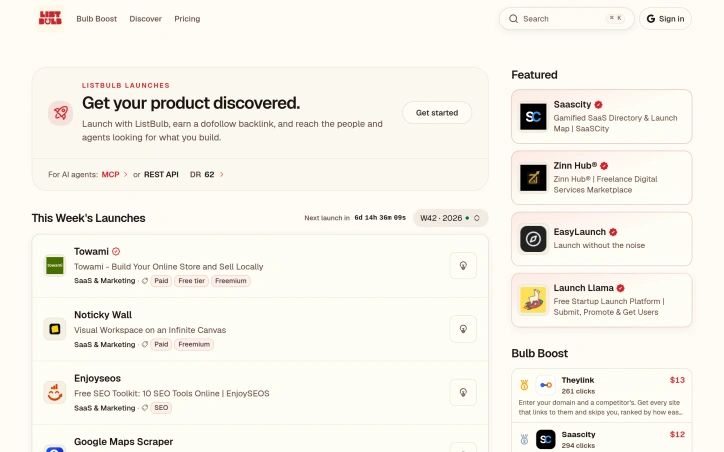
Founders seeking product discovery and SEO value will find a focused alternative in this hand-curated directory for AI and SaaS tools. ListBulb addresses a real gap: while product launch platforms have proliferated, most treat discovery as secondary to promotion noise. This platform inverts that priority by emphasizing editorial curation and direct connections between builders and both human and AI-powered searchers. The product differentiates itself through two mechanisms. First, it positions itself explicitly for AI agent discovery through both MCP and REST API integrations, recognizing that increasingly, AI systems are the ones researching and evaluating tools. This forward-thinking approach acknowledges how purchasing decisions actually work in 2026. Second, every listing comes with a dofollow backlink—a tangible SEO benefit that most competing launch platforms reserve for premium tiers or don't offer at all. The featured section reveals the business model in action. Prominent placement rotates among products like Saascity, a gamified SaaS directory with voting mechanics; Zinn Hub, a freelance services marketplace; and Launch Llama, a competitor platform itself. Each listing shows engagement metrics, suggesting transparency about what visibility actually produces. The "pay what you want" approach to featuring suggests flexible pricing over rigid paywalls. The directory's curation claim matters more than it initially appears. Spam is the endemic problem of product directories—at a certain scale, unmoderated listings become worthless. Hand-reviewed entries mean a founder submitting their tool goes into a curated set, not a firehose. This appeals to both builders wanting legitimate discovery and to the serious users who browse there. The integration of tools like Theylink in the featured section underscores ListBulb's positioning within an ecosystem of discovery and growth products. Theylink itself solves competitive backlink analysis, which complements a platform focused on earning backlinks. The obvious constraint is that a hand-curated directory grows more slowly than community-driven alternatives. Curation requires labor, and scaling it becomes a question of unit economics. The platform's explicit focus on AI and SaaS also narrows its addressable market compared to general product launches, though this narrowness is precisely what makes curation defensible. For founders building AI and SaaS products, ListBulb presents a legitimate alternative to the noise-to-signal ratio of larger launch platforms, with the added incentive of actual SEO value. Whether hand-curation translates to meaningful discovery depends on whether the platform can attract the right audience of both humans and AI agents seeking solutions in this space.
Startup-communities
H
Hakimuddin Kika

Founders seeking product discovery and SEO value will find a focused alternative in this hand-curated directory for AI and SaaS tools. ListBulb addresses a real gap: while product launch platforms have proliferated, most treat discovery as secondary to promotion noise. This platform inverts that priority by emphasizing editorial curation and direct connections between builders and both human and AI-powered searchers. The product differentiates itself through two mechanisms. First, it positions itself explicitly for AI agent discovery through both MCP and REST API integrations, recognizing that increasingly, AI systems are the ones researching and evaluating tools. This forward-thinking approach acknowledges how purchasing decisions actually work in 2026. Second, every listing comes with a dofollow backlink—a tangible SEO benefit that most competing launch platforms reserve for premium tiers or don't offer at all. The featured section reveals the business model in action. Prominent placement rotates among products like Saascity, a gamified SaaS directory with voting mechanics; Zinn Hub, a freelance services marketplace; and Launch Llama, a competitor platform itself. Each listing shows engagement metrics, suggesting transparency about what visibility actually produces. The "pay what you want" approach to featuring suggests flexible pricing over rigid paywalls. The directory's curation claim matters more than it initially appears. Spam is the endemic problem of product directories—at a certain scale, unmoderated listings become worthless. Hand-reviewed entries mean a founder submitting their tool goes into a curated set, not a firehose. This appeals to both builders wanting legitimate discovery and to the serious users who browse there. The integration of tools like Theylink in the featured section underscores ListBulb's positioning within an ecosystem of discovery and growth products. Theylink itself solves competitive backlink analysis, which complements a platform focused on earning backlinks. The obvious constraint is that a hand-curated directory grows more slowly than community-driven alternatives. Curation requires labor, and scaling it becomes a question of unit economics. The platform's explicit focus on AI and SaaS also narrows its addressable market compared to general product launches, though this narrowness is precisely what makes curation defensible. For founders building AI and SaaS products, ListBulb presents a legitimate alternative to the noise-to-signal ratio of larger launch platforms, with the added incentive of actual SEO value. Whether hand-curation translates to meaningful discovery depends on whether the platform can attract the right audience of both humans and AI agents seeking solutions in this space.

ListBulb preview

Key features

  • Hand-Curated Directory: Editorial curation ensures quality listings rather than spam-filled volume.
  • AI Agent Discovery: MCP and REST API integrations enable AI systems to research and evaluate tools.
See full listing
L

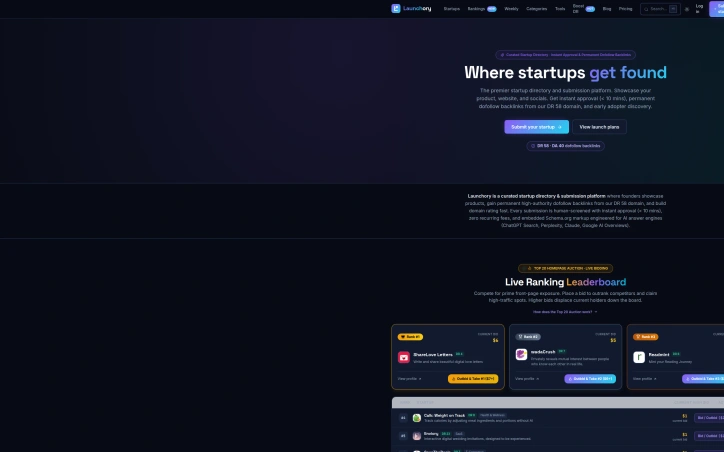
We built Launchory to solve the discoverability problem for startups. Our platform offers instant approval, permanent dofollow backlinks from our DR 58 domain, and optimization for AI search engines. We believe every startup deserves high-authority backlinks and a platform to showcase their product to early adopters.

Startup-communities
G
Gulzar Ahmad

We built Launchory to solve the discoverability problem for startups. Our platform offers instant approval, permanent dofollow backlinks from our DR 58 domain, and optimization for AI search engines. We believe every startup deserves high-authority backlinks and a platform to showcase their product to early adopters.

Nick Launches: Product Launches, Tools and Builder Guides

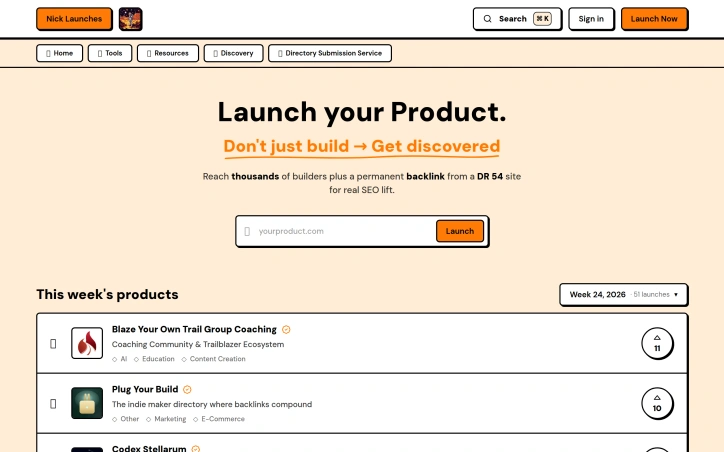
For developers and indie makers looking to launch their products and get discovered, Nick Launches offers a suite of tools and resources to help them succeed. The platform is designed to support those building AI products, providing practical guidance and strategic support to accelerate their launch. What stands out about Nick Launches is its focus on the AI product development community, catering to a specific niche within the broader tech landscape. The website highlights a curated list of recent product launches, showcasing a diverse range of tools and applications across categories like AI, education, content creation, and more. This suggests that the platform not only supports product launches but also fosters a community around emerging technologies. The key features of Nick Launches include its product launch services, which promise to get products in front of thousands of builders and provide a permanent backlink from a high-authority site for SEO benefits. The platform also offers a directory submission service, implying that it helps products gain visibility through targeted listings. Additionally, the website features a collection of tools and resources, including tutorials and reviews, aimed at helping developers build and launch their products more effectively. While the pricing or business model details are not explicitly stated, the platform's revenue streams can be inferred from its services. The directory submission service and product launch offerings suggest that Nick Launches generates revenue through these paid services, potentially catering to a range of budgets and needs within the developer and indie maker community. Overall, Nick Launches positions itself as a valuable resource for those looking to launch and grow their AI products, providing a combination of visibility, community, and practical support.

Startup-communities
N
Nick Launches

For developers and indie makers looking to launch their products and get discovered, Nick Launches offers a suite of tools and resources to help them succeed. The platform is designed to support those building AI products, providing practical guidance and strategic support to accelerate their launch. What stands out about Nick Launches is its focus on the AI product development community, catering to a specific niche within the broader tech landscape. The website highlights a curated list of recent product launches, showcasing a diverse range of tools and applications across categories like AI, education, content creation, and more. This suggests that the platform not only supports product launches but also fosters a community around emerging technologies. The key features of Nick Launches include its product launch services, which promise to get products in front of thousands of builders and provide a permanent backlink from a high-authority site for SEO benefits. The platform also offers a directory submission service, implying that it helps products gain visibility through targeted listings. Additionally, the website features a collection of tools and resources, including tutorials and reviews, aimed at helping developers build and launch their products more effectively. While the pricing or business model details are not explicitly stated, the platform's revenue streams can be inferred from its services. The directory submission service and product launch offerings suggest that Nick Launches generates revenue through these paid services, potentially catering to a range of budgets and needs within the developer and indie maker community. Overall, Nick Launches positions itself as a valuable resource for those looking to launch and grow their AI products, providing a combination of visibility, community, and practical support.

Nick Launches: Product Launches, Tools and Builder Guides preview

Key features

  • Product Launch Services: gets products in front of thousands of builders and provides a permanent backlink from a high-authority site
  • Directory Submission Service: helps products gain visibility through targeted listings
See full listing
Pro Launch

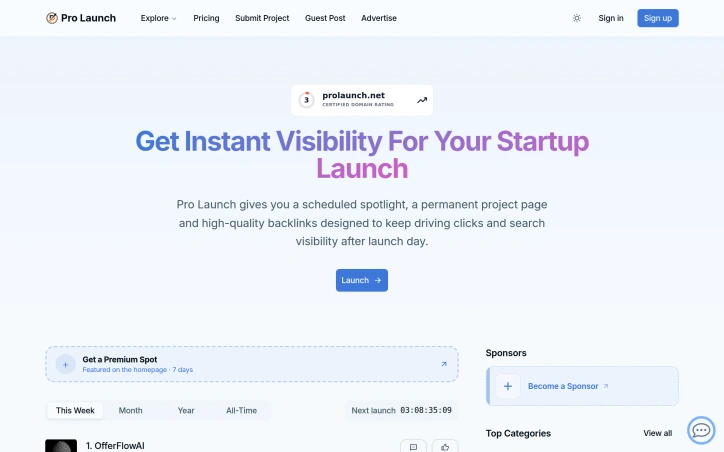
Startups often struggle to gain lasting visibility after launching a product, with initial traction often giving way to obscurity. Pro Launch is designed to address this issue, providing a platform for early-stage companies to get featured and stay discoverable. The site is geared towards startups and indie hackers looking to get their products in front of real users. What stands out about Pro Launch is its focus on delivering sustained visibility, rather than just a fleeting spike in traffic. By offering a scheduled spotlight, permanent project page, and high-quality backlinks, it helps founders achieve ongoing discoverability. The permanent project pages are particularly noteworthy, as they provide a lasting presence for products and help drive clicks and search visibility long after the initial launch. The platform features a curated list of startups across various categories, including SaaS, Artificial Intelligence, and Marketing. The site also includes a blog with in-depth guides on product launch strategies and alternative platforms for showcasing startups. Top founders are showcased, highlighting successful projects and products. While pricing details are not explicitly stated, the site does mention a "Premium Spot" for featured startups, suggesting a tiered model. The presence of sponsors and a blog with relevant content also implies a potentially diverse revenue stream. Overall, Pro Launch is well-suited for startups seeking to amplify their launch and maintain a visible presence. Its emphasis on sustained discoverability and SEO-driven project pages sets it apart from other launch platforms.
Startup-communities
D
Daily Fin

Startups often struggle to gain lasting visibility after launching a product, with initial traction often giving way to obscurity. Pro Launch is designed to address this issue, providing a platform for early-stage companies to get featured and stay discoverable. The site is geared towards startups and indie hackers looking to get their products in front of real users. What stands out about Pro Launch is its focus on delivering sustained visibility, rather than just a fleeting spike in traffic. By offering a scheduled spotlight, permanent project page, and high-quality backlinks, it helps founders achieve ongoing discoverability. The permanent project pages are particularly noteworthy, as they provide a lasting presence for products and help drive clicks and search visibility long after the initial launch. The platform features a curated list of startups across various categories, including SaaS, Artificial Intelligence, and Marketing. The site also includes a blog with in-depth guides on product launch strategies and alternative platforms for showcasing startups. Top founders are showcased, highlighting successful projects and products. While pricing details are not explicitly stated, the site does mention a "Premium Spot" for featured startups, suggesting a tiered model. The presence of sponsors and a blog with relevant content also implies a potentially diverse revenue stream. Overall, Pro Launch is well-suited for startups seeking to amplify their launch and maintain a visible presence. Its emphasis on sustained discoverability and SEO-driven project pages sets it apart from other launch platforms.

Pro Launch preview

Key features

  • Scheduled Spotlight: allows startups to get featured at a scheduled time
  • Permanent Project Page: provides a lasting presence for products
See full listing
Vercel Domains

Many startups and developers face a common pain point when building and launching their projects: securing a suitable domain name that accurately reflects their brand or project identity. This can be a time-consuming and often frustrating process, especially if you're working on a tight deadline. Vercel Domains addresses this issue by providing a streamlined service for searching, registering, and managing domain names. The key benefit here is the integration with Vercel deployments, which suggests that the service is designed to work seamlessly with existing workflows and infrastructure. What stands out about Vercel Domains is its focus on speed and convenience. The platform promises instant availability checks and competitive pricing, making it an attractive option for developers and businesses looking to register domain names quickly. Additionally, the emphasis on private registration may be appealing to those concerned about their personal or business information being publicly accessible. Notably, Vercel Domains is positioned as a "at-cost" service, which implies that there are no hidden fees or markups associated with using the platform. However, it's worth noting that pricing details are not explicitly mentioned on the website. Overall, Vercel Domains appears to be well-suited for developers and startups looking to register domain names quickly and easily, without compromising on security or convenience. By integrating seamlessly with existing workflows and providing competitive pricing, this service has the potential to simplify an often cumbersome process and help users get their projects online faster.

Startup-communities

Many startups and developers face a common pain point when building and launching their projects: securing a suitable domain name that accurately reflects their brand or project identity. This can be a time-consuming and often frustrating process, especially if you're working on a tight deadline. Vercel Domains addresses this issue by providing a streamlined service for searching, registering, and managing domain names. The key benefit here is the integration with Vercel deployments, which suggests that the service is designed to work seamlessly with existing workflows and infrastructure. What stands out about Vercel Domains is its focus on speed and convenience. The platform promises instant availability checks and competitive pricing, making it an attractive option for developers and businesses looking to register domain names quickly. Additionally, the emphasis on private registration may be appealing to those concerned about their personal or business information being publicly accessible. Notably, Vercel Domains is positioned as a "at-cost" service, which implies that there are no hidden fees or markups associated with using the platform. However, it's worth noting that pricing details are not explicitly mentioned on the website. Overall, Vercel Domains appears to be well-suited for developers and startups looking to register domain names quickly and easily, without compromising on security or convenience. By integrating seamlessly with existing workflows and providing competitive pricing, this service has the potential to simplify an often cumbersome process and help users get their projects online faster.

Vercel Domains preview

Key features

  • Domain Search and Registration: Streamlined service for searching, registering, and managing domain names
  • Vercel Integration: Seamless integration with Vercel deployments and existing developer workflows
See full listing