Best Translation Startups & Tools
Automatically convert spoken or written language into another language.
Recently Listed
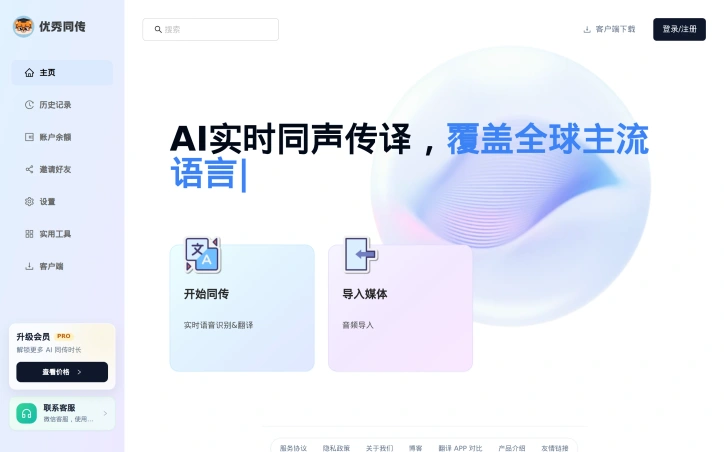
6 launchesSimultaneous interpretation has traditionally been a luxury reserved for high-stakes conferences and international events. Youshow Interpreter democratizes this capability by packaging AI-powered real-time translation into a mobile-friendly application designed for everyday communication scenarios. The product addresses a genuine friction point for three distinct user groups. International students attending lectures in foreign languages struggle to keep pace with instructors; professionals navigating multilingual meetings often miss context clues buried in accents and jargon; travelers attempting basic transactions in unfamiliar countries face communication breakdowns. Each of these groups has had to choose between fragmentary note-taking, post-event scrambling, or accepting information loss. Youshow's core strength lies in its dual-text architecture. Rather than forcing users to toggle between source and target languages, the application displays both simultaneously, allowing real-time verification and natural comprehension without cognitive switching costs. This design choice directly addresses a core limitation of single-language transcription tools: the ability to catch what was actually said versus what was understood. The platform delivers practical workflow features that extend beyond live conversation. Users can export bilingual SRT subtitle files, transforming raw conversations into reusable assets for content production or study materials. The history and replay functionality lets users revisit critical moments from lectures or meetings without scrambling for context afterward. This positions Youshow not just as a communication bridge but as a documentation tool for knowledge retention and asset creation. Cross-platform availability across web, iOS, Android, macOS, and Windows suggests an intentional design to meet users where they work rather than forcing adoption of a single ecosystem. This ubiquity matters for spontaneous translation needs, where mounting an app or accessing a web browser represents the practical difference between functional translation and no translation at all. The application identifies its target use cases explicitly: classroom attendance, business meetings, international travel, and subtitle creation. This focused positioning avoids the trap of claiming universal utility while remaining specific enough to guide feature development and marketing strategy. On the visible limitations side, the materials provided do not disclose latency metrics, language pair coverage, or accuracy benchmarks. For a product selling real-time translation, these specifications carry weight in evaluating whether the tool meets the demanding requirements of live situations where timing and precision both matter.
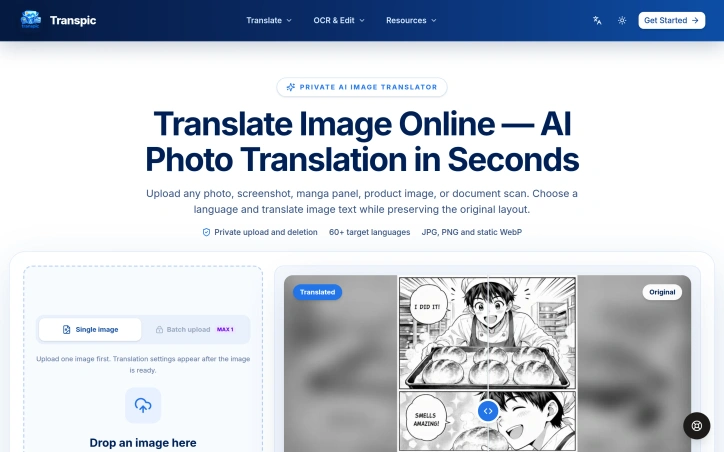
Preserving visual layout during image translation is a deceptively complex problem that most tools ignore. When a restaurant needs menus translated into multiple languages, when an e-commerce company adapts product graphics for new markets, or when manga publishers localize comics for international audiences, getting the text right is only half the challenge. The words must stay positioned beside the prices, icons, and visual elements they describe, or the entire image loses clarity and commercial value. Transpic addresses this specific gap by translating image text in over 60 languages while maintaining the exact placement and visual relationships that make the original layout meaningful. The platform accepts photos, screenshots, product graphics, posters, and document scans in JPG, PNG, or WebP formats, then outputs editable translations at the original image dimensions. Users upload images, choose their target language, and receive a side-by-side comparison showing the original and translated versions. The interface lets viewers inspect individual text blocks, make manual adjustments to wording, sizing, color, or placement, and export the final result without rebuilding the design from scratch. This direct editing capability matters because it gives users transparency and control rather than demanding they accept an automated outcome or send files elsewhere for manual rework. What distinguishes Transpic from basic optical character recognition and machine translation is its commitment to preserving visual context. The product connects each translated phrase back to the sign, label, speech bubble, or callout that gave those words meaning in the first place. A manga panel's dialogue stays with the character speaking it. A menu item's price remains beside the dish. A product benefit aligns with its corresponding icon. This relationship is harder to achieve than simply extracting text, translating it, and dropping it back, yet Transpic treats it as non-negotiable. The service stores uploads privately rather than publishing them publicly, and batch processing is available. The platform does not directly accept PDFs or Word documents, and images with tiny lettering, curved fonts, heavy textures, or overlapping artwork require manual refinement in the editor. Plan tiers determine batch size, available languages, watermark settings, editing history, and commercial usage rights, though specific pricing remains undisclosed. For companies that regularly adapt visual content across multiple languages and markets, the layout-aware approach offers genuine efficiency gains over traditional design workflows.

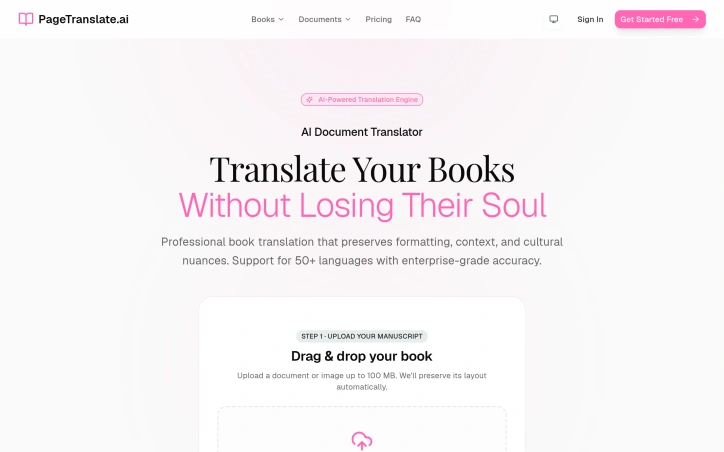
Translating books and long documents has traditionally meant choosing between convenience and quality. Copy-paste translation into AI chatbots sacrifices formatting, requiring hours of manual layout reconstruction. Professional translation services, meanwhile, involve lengthy timelines and high costs. PageTranslate.ai bridges this gap by automating document translation while maintaining the original file's structure, layout, and formatting. The product targets authors, publishers, students, and professionals who need complete documents translated across languages without losing visual organization. Its core strength lies in handling the structural complexity that generic translation tools ignore. The platform supports PDF, DOCX, and EPUB formats up to 100 MB, translating across 50+ languages while preserving layout, page numbers, chapter placement, and even text direction. This last feature proves particularly useful for right-to-left languages like Arabic, where most AI translation solutions default to left-to-right output. The interface prioritizes simplicity: users drag and drop a manuscript, select a target language, and receive the translated file in its original format. The company demonstrates this capability with samples from Alice in Wonderland translated into Spanish, Japanese, and Arabic, where layout, chapter headings, and pagination remain intact. This focus on format preservation addresses a genuine pain point for publishers and authors who would otherwise need to redesign entire documents after translation. Pricing is transparent and accessible. The service offers 3,000 free starter words without requiring a credit card, allowing users to test translation quality before commitment. A pay-as-you-go model accommodates occasional translators, while optional subscription plans serve professionals handling recurring work. The platform displays exact costs before users authorize payment, removing pricing uncertainty that often complicates translation procurement. The inclusion of a 7-day refund or re-run option for eligible jobs suggests confidence in output quality, though the specifics of eligibility criteria remain unclear. Enterprise-grade accuracy claims position the tool as suitable for professional publication work rather than casual document translation. PageTranslate.ai captures a practical but underserved niche—professionals needing document translation beyond what consumer chatbots offer, without the expense and timeline of traditional translation services. The emphasis on format preservation and upfront pricing differentiates it in a market where most translation tools treat documents as plain text. For authors and publishers, the ability to maintain publication-ready formatting represents meaningful efficiency gains.

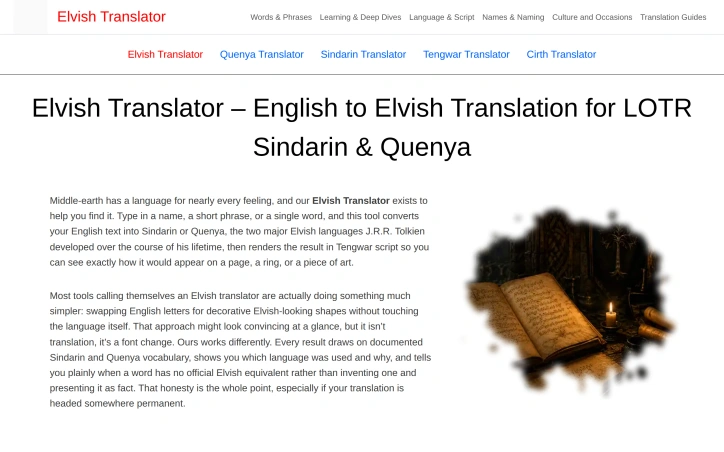
Translation into Sindarin and Quenya has long been plagued by imposters masquerading as genuine converters. Elvish Translator cuts through the noise by delivering actual linguistic work rather than the decorative font substitutions that dominate the space. The problem the tool addresses is specific but real: anyone creating permanent Elvish text—whether for a tattoo, jewelry inscription, or artistic project—needs confidence that what they're marking is authentic, not an invented approximation. Existing tools typically swap English letters for Elvish-looking characters without touching the underlying language. The Elvish Translator takes a fundamentally different approach, building translations from documented Sindarin and Quenya vocabulary that Tolkien himself established over decades as a professional philologist. What distinguishes this product is its commitment to transparency. The tool makes clear which language is being used and why, a critical distinction that most competitors ignore. Sindarin, the everyday Elvish speech throughout The Lord of the Rings, draws from Welsh phonology and offers conversational flow. Quenya, derived from Finnish and Latin structures, carries ceremonial weight better suited to formal titles and songs. A translation tool that blends these languages without distinction misleads users into thinking they have authentic Sindarin or Quenya when they actually have neither. Perhaps most striking is the tool's willingness to admit when no official translation exists. Rather than inventing vocabulary and presenting it as documented fact, the Elvish Translator labels such gaps honestly. This restraint matters enormously for permanent applications where authenticity justifies the effort. The core functionality is straightforward: users input English text and receive Sindarin or Quenya translations rendered in Tengwar script, the actual writing system Tolkien developed for the Elvish languages. The tool supports multiple input languages and offers basic features like copy and speak options. The interface provides a 500 character limit, appropriate for the short phrases and individual words the tool is built for. The product serves a narrow but dedicated audience: Tolkien enthusiasts who prioritize linguistic authenticity over convenience, creative professionals making permanent work, and anyone who understands that not all Elvish-shaped text is actually Elvish. For that audience, the tool delivers on substance rather than flash. It succeeds precisely where other Elvish translators fail: by respecting both the languages themselves and the people creating permanent expressions in them.
Video content creators face a significant barrier when trying to expand their reach globally: the need to dub their content into multiple languages. Traditionally, this process has been time-consuming and expensive, requiring manual dubbing or hiring voice actors in various languages. TransVoice Studio addresses this challenge by providing an AI-powered video dubbing and visual translation solution. At its core, the platform is designed for creators, educators, and filmmakers seeking to localize their content for a global audience. What stands out is its ability to translate and dub videos into over 140 languages while maintaining the original background music and sound effects. The AI technology employed is sophisticated, capable of detecting different speakers and assigning distinct voices to each, making it suitable for content with multiple speakers. The platform's advanced features, such as voice cloning, allow users to maintain brand consistency by replicating the original speaker's vocal tone across different languages. This feature is available in 45 languages and adds a personal touch to the dubbed content. The ability to work directly from a video URL, without needing to download files, streamlines the process, making it more efficient. TransVoice Studio's pricing model is straightforward, with costs ranging from $0.30 to $0.75 per minute, depending on the processing mode chosen, such as single voice or multi-voice dubbing, and whether the content is uploaded or accessed via a URL. Volume bonuses are available for premium and enterprise users handling large projects, indicating a flexible approach to pricing for heavy users. Overall, TransVoice Studio makes multi-lingual video production more accessible and affordable, democratizing the ability to reach a global audience.
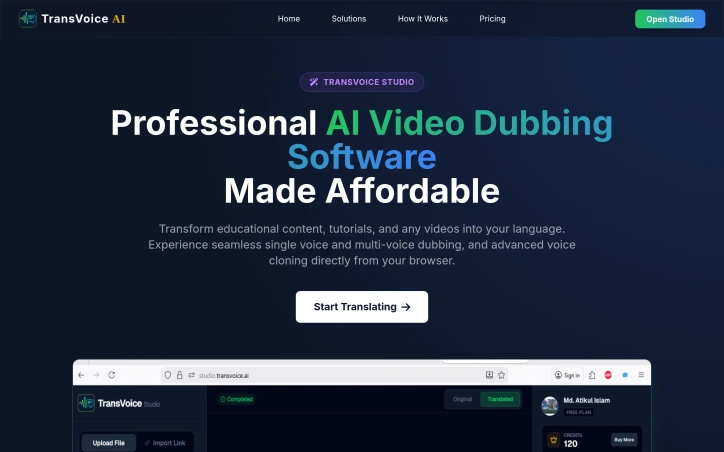
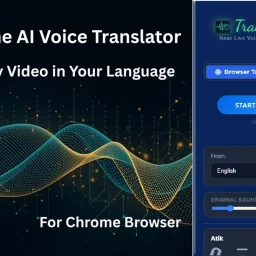
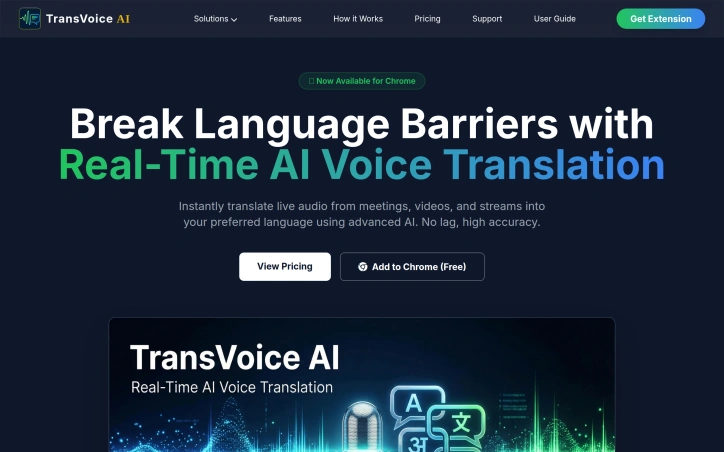
Real-time language barriers are a significant hindrance to global communication, and traditional translation tools often fall short due to delayed processing or cumbersome interfaces. TransVoice AI addresses this issue head-on by providing a seamless, browser-based solution for instant voice translation. The target audience is diverse, encompassing content consumers, remote teams, and individuals participating in cross-border interactions. What sets TransVoice AI apart is its ability to translate live audio from various sources, including meetings, videos, and streams, directly within the browser. This is made possible by advanced AI technology that ensures high accuracy and near-live translation with ultra-low latency, powered by Microsoft Azure Speech AI. The extension supports over 130 global languages, catering to a broad user base. Notably, TransVoice AI offers a dedicated cloud-based platform, TransVoice Studio, designed for processing large video files. This feature is particularly useful for content creators and enterprises, allowing them to achieve highly accurate translations, automated voiceovers, and studio-quality voices in over 100 languages. The product's pricing model is structured around flexible plans to accommodate different user needs. The available plans range from a Bronze Starter package at $4.44 per month for 2 hours of usage to a Diamond Pro package at $33.33 per month for 16 hours and 40 minutes of usage. Each plan comes with additional bonus minutes, making it an attractive option for both light and heavy users. Overall, TransVoice AI is an innovative solution that effectively breaks down language barriers, empowering global communication and content consumption.