Launchory
We built Launchory to solve the discoverability problem for startups. Our platform offers instant approval, permanent do...
Catalyst Healthspan Audit
Personal trainers typically sell training sessions. This startup reversed the equation by building assessment first, mak...
Best Voice AI Tools Startups & Tools
Recently Listed
10 launches
Creators in South Asian markets have been underserved by text-to-speech technology. Most TTS platforms treat languages like Urdu, Hindi, Bengali, and Tamil as secondary features, offering limited voices and poor handling of local naming conventions and code-switching. VoxCraft reverses this priority by making 27 languages available through 88 neural voices, with South Asian languages positioned as primary citizens rather than afterthoughts. The platform targets YouTube creators, dubbers, and production studios. It removes multiple friction points that plague competing services. Users need no account to start—paste a script, select a voice, and download MP3 or WAV audio in approximately ten seconds. Commercial use is permitted from the free tier. The underlying synthesis handles mixed-language scripts correctly: Urdu-English code-switching flows naturally, with local names and numerals pronounced as speakers would say them. VoxCraft's voice control design stands out. Rate and pitch adjustments modify the actual audio delivery rather than buried SSML directives that voice engines mishandle. The result sounds intentional rather than robotic. Beyond narration synthesis, the platform bundles transcription, format conversion across MP3, WAV, OGG, M4A, and FLAC, clip merging, trimming, noise removal, voice effects, and video-to-audio extraction. Creators complete post-production audio work directly in the browser without requiring desktop software. The no-account requirement and commercial licensing from the free tier address standard objections to free tools. Competing services require signup or restrict monetization rights; VoxCraft enforces neither. This product design reflects the founders' understanding of working creators' core priorities: speed and permission to monetize matter more than feature overabundance. The service operates on a tiered pricing model, though specific details are not disclosed on the public landing page. The free tier's feature set—commercial-licensed audio, 88 voices, and complete audio toolkit—establishes a competitive baseline that paid plans must exceed. This unusual approach to the free-to-paid transition suggests confidence that the product itself justifies conversion rather than artificial feature scarcity.


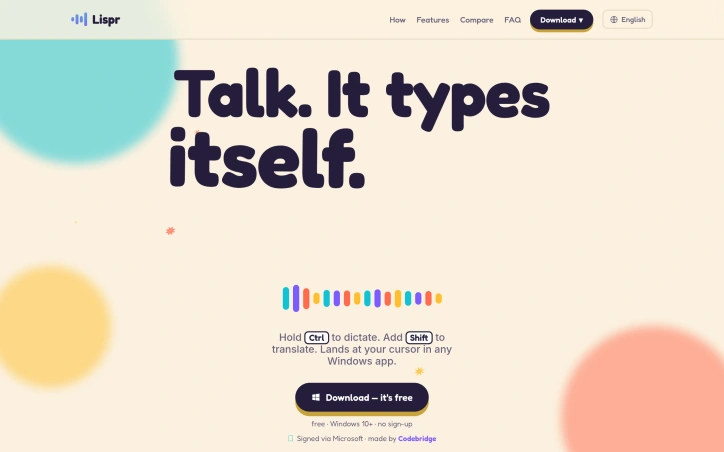
Communication across language barriers typically demands friction: copying text between applications, waiting for translation services to process, losing conversational flow. Lispr addresses this by collapsing the entire workflow into a single gesture—hold a key to dictate, tap a second key mid-speech to translate, and watch the text appear directly at your cursor in any application. The product serves anyone who regularly switches between languages or dictates extensively, whether composing WhatsApp messages in Spanish, writing Slack threads in Portuguese, or taking notes in French. Built by Codebridge, it eliminates the context-switching that characterizes existing solutions: no jumping between apps, no chat interfaces cluttering your workspace, no account creation required. What distinguishes Lispr is execution speed combined with aggressive scope minimization. Dictation completes in under a second, translation follows within roughly 700 milliseconds. This isn't aspirational—the product targets actual responsiveness, not theoretical performance. The feature set reflects this focus: plain dictation, translation into 32 native languages, custom vocabulary support for product names or domain-specific terms, and clipboard-aware insertion that restores whatever you'd previously copied. It works identically everywhere a cursor blinks, from terminal emulators to design tools to text editors. The technical choices reinforce privacy defaults. Lispr uses Whisper's large-v3-turbo model and requires no account creation or persistent connectivity. Every release receives Apple's notarization process, which scans for malware and eliminates security warnings on installation. The entire application consumes roughly 17 megabytes. Lispr's business model stands out primarily for its absence—the application is free. The founder emphasizes eliminating friction rather than monetizing it. This positions Lispr differently from Wispr and Flow, competitors that charge either subscription or upfront fees for similar functionality. Whether this free model scales depends on factors outside the visible product, but it currently represents a significant advantage for adoption. The interface philosophy mirrors the core insight: a menu bar presence, push-to-talk activation, and zero visual clutter. Speech language detection operates across roughly 99 languages, though translation output targets the 32 languages listed. This constraint reflects pragmatic design rather than accidental limitation—supporting everything weakens everything. For users who spend time moving between languages or dictating across multiple applications, Lispr substantially reduces both time spent typing and cognitive overhead. It targets a specific workflow and executes within that scope with discipline.

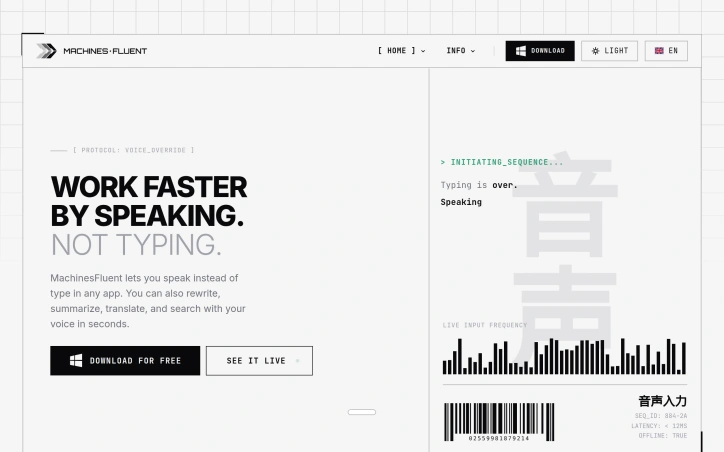
Voice input has long lagged behind typing as a productivity tool for knowledge workers, but MachinesFluent reimagines speech-to-text by treating it not as assistive accommodation but as core efficiency infrastructure for Windows users. The product targets anyone dealing with heavy text input demands—writers, researchers, developers—and particularly those experiencing repetitive strain or simply seeking faster input methods. What elevates MachinesFluent beyond commodity voice dictation is its integration of AI-powered text transformation. Rather than merely transcribing speech, the tool lets users invoke voice commands to rewrite, summarize, translate, and extract information from their screen. Multiple AI models (OpenAI, Anthropic, Google, Moonshot) chain into customizable hotkey workflows, allowing voice input for emails followed by automated professional formatting, or meeting transcription converted to structured notes with action items. The feature set spans offline speech-to-text, smart punctuation with automatic filler word removal, searchable dictation history, and custom vocabulary dictionaries. Integration covers thirty-plus applications—Word, Notion, Gmail, Slack, Asana—delivering genuine system-wide voice input rather than app-specific workarounds. Performance claims run aggressive: the product promises 4x speed over traditional typing with sub-12-millisecond latency. Speed gains depend on individual typing proficiency and speech clarity, but the offline architecture removes network bottlenecks plaguing cloud-based competitors. The founder's personal motivation—developing this after repetitive strain injuries—grounds the vision in necessity rather than speculation. This practical genesis often produces more intentional product design than efficiency-only pitches. MachinesFluent operates on a free model with premium tiers undisclosed in available information. For users seeking voice-driven workflows beyond transcription—toward genuine content creation and transformation—it addresses a distinct market gap.
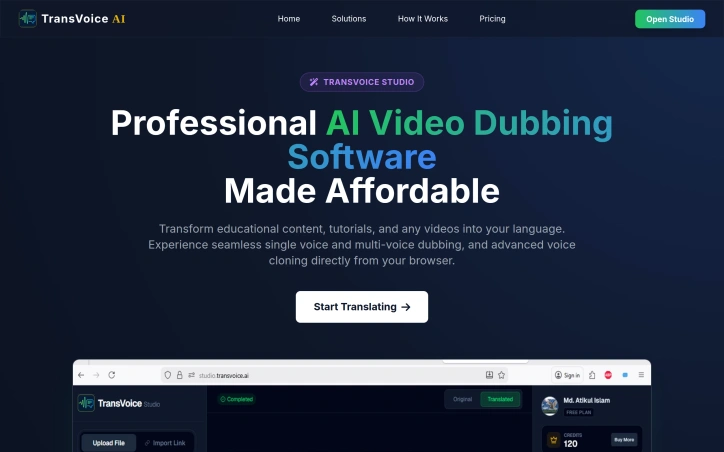
Video content creators face a significant barrier when trying to expand their reach globally: the need to dub their content into multiple languages. Traditionally, this process has been time-consuming and expensive, requiring manual dubbing or hiring voice actors in various languages. TransVoice Studio addresses this challenge by providing an AI-powered video dubbing and visual translation solution. At its core, the platform is designed for creators, educators, and filmmakers seeking to localize their content for a global audience. What stands out is its ability to translate and dub videos into over 140 languages while maintaining the original background music and sound effects. The AI technology employed is sophisticated, capable of detecting different speakers and assigning distinct voices to each, making it suitable for content with multiple speakers. The platform's advanced features, such as voice cloning, allow users to maintain brand consistency by replicating the original speaker's vocal tone across different languages. This feature is available in 45 languages and adds a personal touch to the dubbed content. The ability to work directly from a video URL, without needing to download files, streamlines the process, making it more efficient. TransVoice Studio's pricing model is straightforward, with costs ranging from $0.30 to $0.75 per minute, depending on the processing mode chosen, such as single voice or multi-voice dubbing, and whether the content is uploaded or accessed via a URL. Volume bonuses are available for premium and enterprise users handling large projects, indicating a flexible approach to pricing for heavy users. Overall, TransVoice Studio makes multi-lingual video production more accessible and affordable, democratizing the ability to reach a global audience.
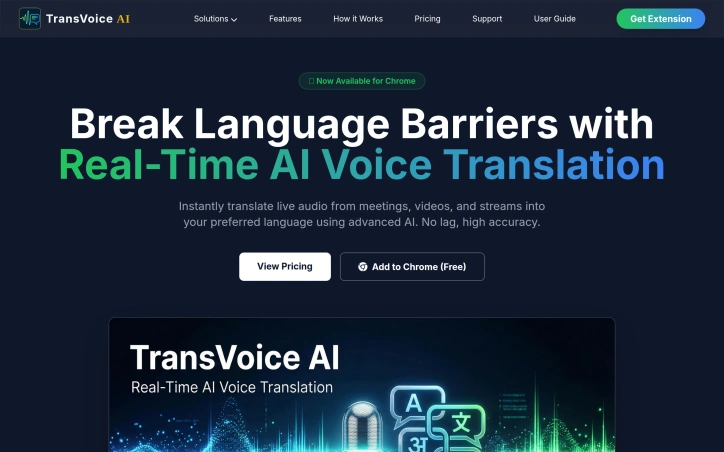
Real-time language barriers are a significant hindrance to global communication, and traditional translation tools often fall short due to delayed processing or cumbersome interfaces. TransVoice AI addresses this issue head-on by providing a seamless, browser-based solution for instant voice translation. The target audience is diverse, encompassing content consumers, remote teams, and individuals participating in cross-border interactions. What sets TransVoice AI apart is its ability to translate live audio from various sources, including meetings, videos, and streams, directly within the browser. This is made possible by advanced AI technology that ensures high accuracy and near-live translation with ultra-low latency, powered by Microsoft Azure Speech AI. The extension supports over 130 global languages, catering to a broad user base. Notably, TransVoice AI offers a dedicated cloud-based platform, TransVoice Studio, designed for processing large video files. This feature is particularly useful for content creators and enterprises, allowing them to achieve highly accurate translations, automated voiceovers, and studio-quality voices in over 100 languages. The product's pricing model is structured around flexible plans to accommodate different user needs. The available plans range from a Bronze Starter package at $4.44 per month for 2 hours of usage to a Diamond Pro package at $33.33 per month for 16 hours and 40 minutes of usage. Each plan comes with additional bonus minutes, making it an attractive option for both light and heavy users. Overall, TransVoice AI is an innovative solution that effectively breaks down language barriers, empowering global communication and content consumption.

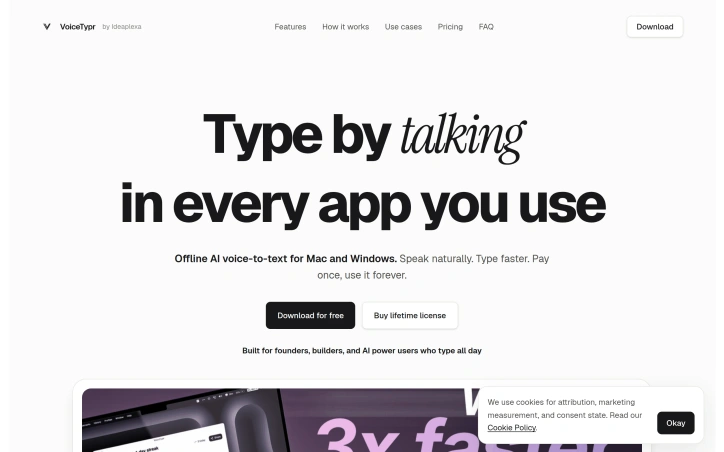
For professionals who spend their days typing away, a new tool has emerged to streamline their workflow. VoiceTypr is designed for founders, builders, and power users who are glued to their writing surfaces, whether that's ChatGPT, coding tools, or other text-heavy applications. The problem it tackles is two-fold: slow writing and potential data leaks. By leveraging offline AI voice-to-text technology, VoiceTypr enables users to dictate their thoughts and instantly convert them into clean, usable text. What stands out about VoiceTypr is its commitment to privacy and seamless integration. The transcription process runs locally on the user's machine, ensuring that sensitive information remains on the device. Moreover, it works globally across any application, in any text field, and at any time, making it a versatile addition to one's workflow. The process is straightforward: users download and install the app, choose a model based on their needs for speed or accuracy, set a hotkey, and start dictating. The flexibility in model selection is a key feature, allowing users to switch between different models depending on the task at hand. Additionally, the ability to customize hotkeys and formatting options adds to the tool's adaptability. Users can also opt for AI cleanup, which can be configured with their own API key for specific tasks, such as drafting emails. VoiceTypr offers a free download, with a lifetime license available for purchase. The absence of a cloud account requirement or subscription-based model aligns with its focus on local processing and user privacy. By solving the issues of slow typing and data exposure, VoiceTypr positions itself as a valuable asset for those whose work revolves around writing and text manipulation. Its offline capability, ease of use, and customizable features make it an attractive solution for enhancing productivity.
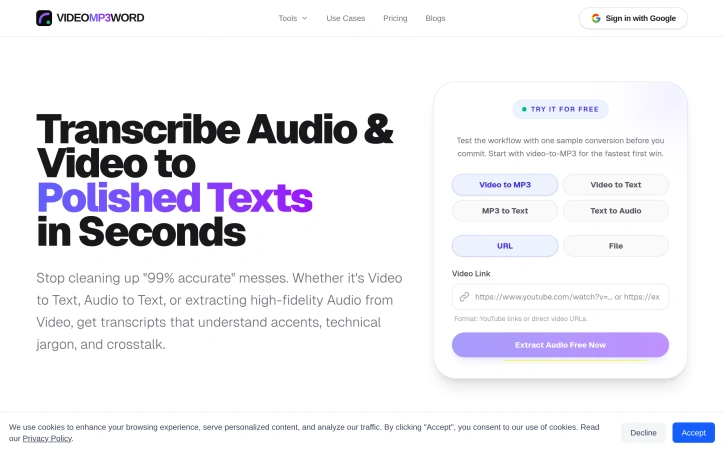
Transcription has long been the bane of knowledge workers—long recordings full of umms, ums, false starts, and throat-clearing that demands hours of manual cleanup. VideoMP3Word tackles this by combining multi-format transcription with an AI that understands context and industry-specific terminology, delivering polished, usable transcripts without the editorial drudgery. The product's core insight is that transcription quality isn't just about accuracy in speech recognition; it's about producing text that actually reads like finished writing. Rather than leaving filler words and repetitive phrasing intact, the system applies domain-aware filtering that strips verbal tics while preserving technical jargon. A laparoscopic cholecystectomy stays intact in medical transcripts, while casual "you knows" disappear—a distinction that generic speech-to-text tools routinely botch. This makes the output immediately usable for legal documents, medical records, educational content, and technical research where terminology precision matters. Speed stands out as a second major differentiator: the platform processes 60-minute recordings within three minutes, timestamped and ready for review. For content creators working under deadline pressure, this converts transcription from a bottleneck into a near-real-time capability. On the features side, VideoMP3Word handles multiple input formats (MP4, MOV, AVI, MP3, WAV, M4A, YouTube, Zoom links) and outputs to an extensive list—Word documents, PDFs, plain text with speaker labels, SRT/VTT/ASS subtitle files, and FLAC/MP3/WAV audio extraction. The system includes AI-generated summaries and millisecond-accurate timestamps, making it valuable for creators repurposing content into blogs and podcasts, as well as legal teams building searchable archives. Privacy is built into the architecture rather than bolted on as a feature. The company commits to zero-knowledge design, encrypted storage, non-retention of user files, and explicit task expiry controls—a direct answer to justified skepticism many professionals harbor about uploading sensitive recordings to cloud services. For regulated industries or confidential work, these guarantees provide clear value. The product invites users to test a single conversion free, a straightforward way to evaluate whether the accuracy and formatting align with specific needs. For organizations exhausted by post-transcription cleanup cycles, or professionals in regulated fields where both accuracy and privacy are non-negotiable, it's worth the trial.
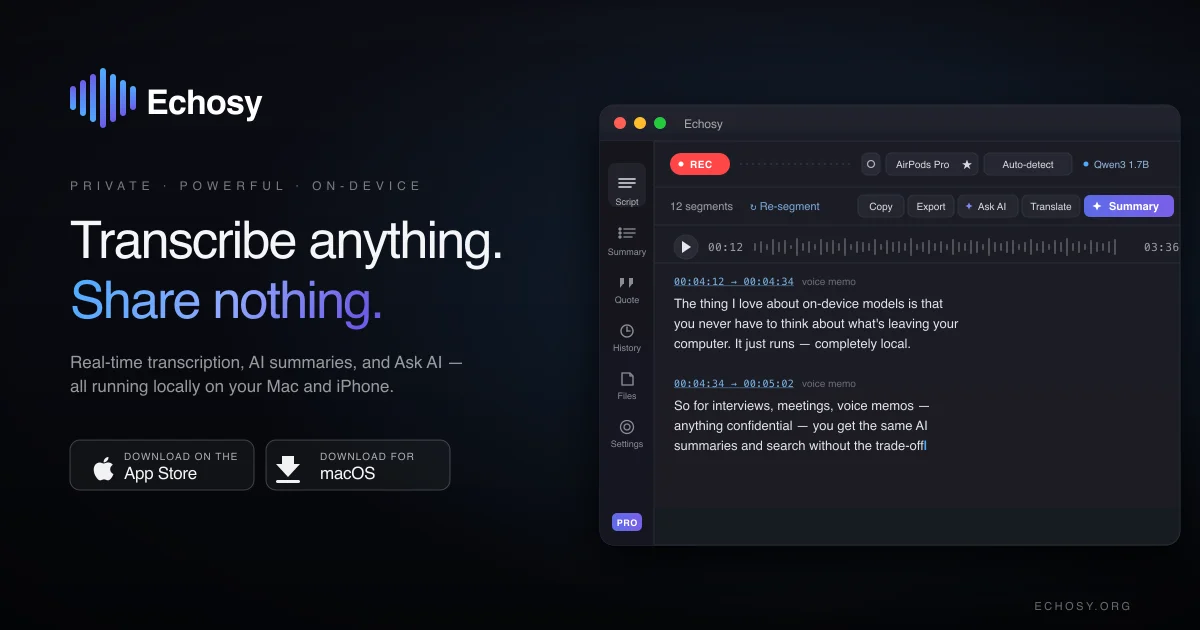
Privacy-focused audio transcription has become increasingly important as cloud-based services dominate the market, and Echosy addresses this gap directly by delivering professional-grade transcription entirely on macOS devices. The product targets professionals, educators, and content creators who need reliable transcription without surrendering their audio to external servers. The standout differentiator is its commitment to local processing. All transcription, summarization, and dictation happens on the user's Mac, eliminating latency and privacy concerns associated with cloud uploads. Rather than locking users into a single transcription model, Echosy supports multiple ASR engines including Qwen3-ASR and MLX Whisper, with GPU acceleration to optimize performance on Apple Silicon and Intel chips. This flexibility in model selection distinguishes it from more rigid competitors. Core capabilities span three major use cases. Live transcription captures both system audio and microphone input simultaneously with real-time timestamps, suitable for recording calls, lectures, and presentations. System-wide dictation activates anywhere on macOS via hotkey, with an Editor Mode that automatically inserts line breaks during pauses and supports voice-controlled formatting. File transcription accepts common audio and video formats for batch processing existing content libraries. What sets Echosy apart further is its integration with multiple LLM providers for summarization. Rather than forcing dependency on a single service, the platform supports OpenAI, Gemini, Ollama, and compatible APIs, allowing users flexibility in how they handle summarization workflows. Beyond summaries, users can chat directly with transcripts, extracting insights and action items. The service maintains searchable session history with audio replay, creating an archive of past recordings that remains fully accessible. The product is positioned as free-to-use software for macOS 14 and above, supporting both Apple Silicon and Intel architectures, with iOS availability as well. The emphasis on "no cloud, no latency, no compromises" clearly resonates with privacy-conscious users fatigued by default transcription workflows that involve external servers. For users skeptical of cloud-dependent transcription tools, Echosy offers genuine autonomy. It removes the friction of uploading files and waiting for remote processing, instead delivering instant results locally. The combination of multiple ASR models, flexible LLM integration, and comprehensive session management positions it as a credible alternative to cloud-centric competitors.

Video creators worldwide face a persistent challenge: making content accessible across language barriers while managing tight production timelines. LingoFrame addresses this friction by automating subtitle generation and translation, eliminating the manual work that typically consumes hours and requires specialized skills. The platform targets three distinct audiences effectively. Educators can caption lessons to reach international students without language constraints. Marketing teams gain the ability to deploy multilingual campaigns at scale. Content creators benefit from improved discoverability and accessibility, which have become competitive advantages in crowded platforms. What sets LingoFrame apart is its streamlined workflow. Users upload video files and the system generates subtitles automatically, then offers customization options before exporting. The product provides flexibility in output formats—creators can download standard SRT files for external use or burn subtitles directly into video files. Multi-language translation capabilities are built into the core offering rather than treated as a premium add-on, though the credit system does meter access to these features. The feature set covers the essential needs of the subtitling workflow. Beyond basic caption generation, the platform handles the technically demanding task of translating subtitles while syncing them to video timing. Customization options suggest users can adjust styling, formatting, and language specifics to match their content aesthetic and regional preferences. Pricing employs a credit-based model with tiered options. New users receive 25 free credits to trial the service, lowering friction for initial adoption. Paid plans start at $4.99 for 30 credits, with a mid-tier offering at $12.99 for 100 credits marked as the platform's most popular option, and a premium tier at $29.99 for 300 credits. The credit allocation system accounts for different operation costs—subtitle generation, merging, and translation each consume credits at different rates, though exact time-to-credit conversions require calculation. LingoFrame occupies a practical position in the accessibility tooling space. It doesn't attempt to be a full video editing suite or compete with enterprise-grade localization platforms. Instead, it solves a specific, high-friction problem with a direct interface and transparent pricing. The free credit allowance and popular mid-tier option suggest the company targets creators and small teams rather than enterprise deployments, prioritizing ease of use over feature maximalism. For any producer managing multilingual content, the value proposition centers on the time savings and quality standardization that automation delivers.

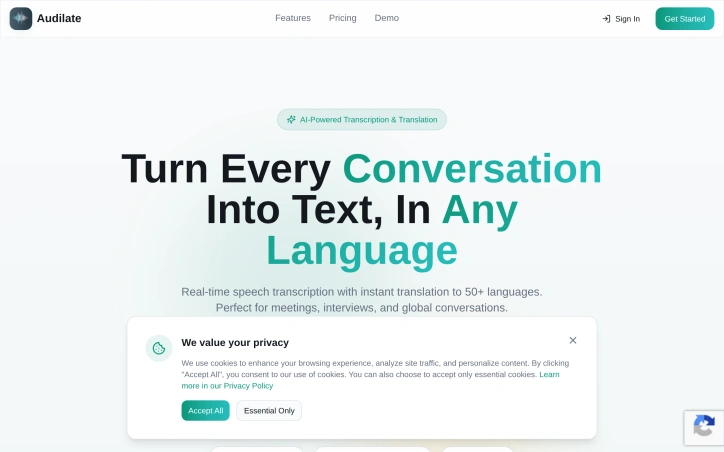
Breaking down language barriers during real-time conversations has long been a friction point for globally distributed teams, and Audilate directly addresses this challenge. The platform combines AI-powered speech transcription with simultaneous translation across over 100 languages, making it a practical solution for organizations where meetings, interviews, and collaborative discussions frequently span multiple geographies and language groups. The core value proposition centers on eliminating the lag and complexity that typically come with asynchronous translation workflows. Rather than recording conversations and processing them after the fact, Audilate delivers live transcription and translation, allowing participants to collaborate without stopping to manage language gaps. This is particularly relevant for companies hiring internationally, conducting cross-border partnerships, or operating distributed teams where English is not universally spoken as a first language. What distinguishes the product is its breadth of language support. With coverage across 100+ languages, the platform moves beyond serving just major language pairs and opens functionality to teams working in less commonly supported languages. This scope suggests the founders recognize that global collaboration extends well beyond English-to-Spanish or English-to-Mandarin scenarios. The integration of transcription and translation in a single workflow is also noteworthy—separate tools for these functions create unnecessary switching costs and synchronization challenges. The positioning emphasizes real-time processing, which is critical for the use cases mentioned. Whether facilitating a live meeting between team members in different countries, conducting remote interviews with international candidates, or enabling seamless cross-border conversations, the speed at which transcription and translation occur directly impacts usability. Delays of even a few seconds can derail natural conversation flow. The product targets organizations serious about global teamwork, particularly those for whom language support has become a competitive advantage or operational necessity. This includes multinational corporations, international service providers, distributed startups, and any team conducting work across language boundaries on a regular basis. The emphasis on meetings and interviews suggests the founders see their strongest initial adoption among HR, engineering, and business development functions that routinely conduct cross-language conversations. One practical consideration for potential users is how the platform integrates with existing communication infrastructure—meetings apps, video conferencing tools, and collaboration platforms—though those implementation details fall outside the scope of what's presented here. The foundational premise, however, is sound: removing language as a barrier to real-time collaboration remains a genuine problem for many organizations.