Xtra Hands Family Chore App
Household chore management remains one of parenting's persistent friction points, and Xtra Hands positions itself as the...
Catalyst Healthspan Audit
Personal trainers typically sell training sessions. This startup reversed the equation by building assessment first, mak...
Best AI Dictation Apps Startups & Tools
Push-to-talk voice input that pastes structured text into any app.
Recently Listed
3 launches
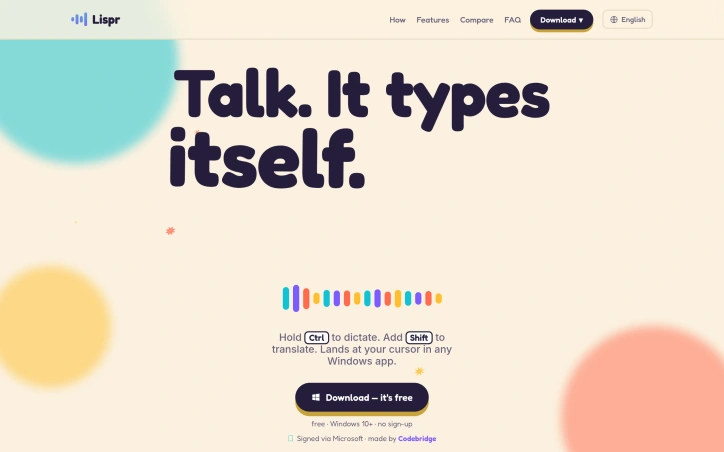
Communication across language barriers typically demands friction: copying text between applications, waiting for translation services to process, losing conversational flow. Lispr addresses this by collapsing the entire workflow into a single gesture—hold a key to dictate, tap a second key mid-speech to translate, and watch the text appear directly at your cursor in any application. The product serves anyone who regularly switches between languages or dictates extensively, whether composing WhatsApp messages in Spanish, writing Slack threads in Portuguese, or taking notes in French. Built by Codebridge, it eliminates the context-switching that characterizes existing solutions: no jumping between apps, no chat interfaces cluttering your workspace, no account creation required. What distinguishes Lispr is execution speed combined with aggressive scope minimization. Dictation completes in under a second, translation follows within roughly 700 milliseconds. This isn't aspirational—the product targets actual responsiveness, not theoretical performance. The feature set reflects this focus: plain dictation, translation into 32 native languages, custom vocabulary support for product names or domain-specific terms, and clipboard-aware insertion that restores whatever you'd previously copied. It works identically everywhere a cursor blinks, from terminal emulators to design tools to text editors. The technical choices reinforce privacy defaults. Lispr uses Whisper's large-v3-turbo model and requires no account creation or persistent connectivity. Every release receives Apple's notarization process, which scans for malware and eliminates security warnings on installation. The entire application consumes roughly 17 megabytes. Lispr's business model stands out primarily for its absence—the application is free. The founder emphasizes eliminating friction rather than monetizing it. This positions Lispr differently from Wispr and Flow, competitors that charge either subscription or upfront fees for similar functionality. Whether this free model scales depends on factors outside the visible product, but it currently represents a significant advantage for adoption. The interface philosophy mirrors the core insight: a menu bar presence, push-to-talk activation, and zero visual clutter. Speech language detection operates across roughly 99 languages, though translation output targets the 32 languages listed. This constraint reflects pragmatic design rather than accidental limitation—supporting everything weakens everything. For users who spend time moving between languages or dictating across multiple applications, Lispr substantially reduces both time spent typing and cognitive overhead. It targets a specific workflow and executes within that scope with discipline.

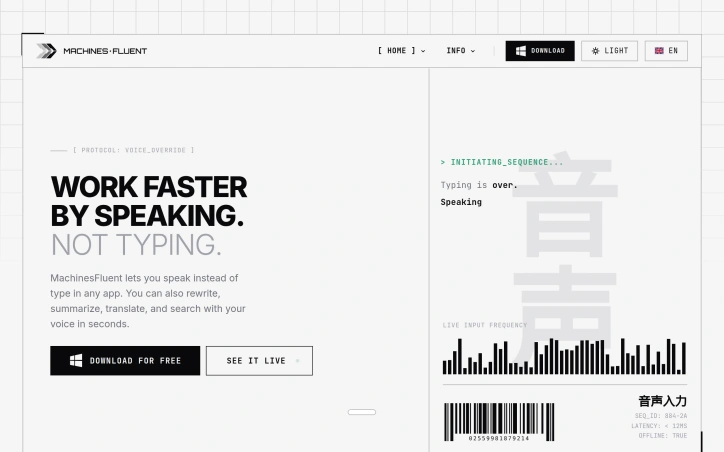
Voice input has long lagged behind typing as a productivity tool for knowledge workers, but MachinesFluent reimagines speech-to-text by treating it not as assistive accommodation but as core efficiency infrastructure for Windows users. The product targets anyone dealing with heavy text input demands—writers, researchers, developers—and particularly those experiencing repetitive strain or simply seeking faster input methods. What elevates MachinesFluent beyond commodity voice dictation is its integration of AI-powered text transformation. Rather than merely transcribing speech, the tool lets users invoke voice commands to rewrite, summarize, translate, and extract information from their screen. Multiple AI models (OpenAI, Anthropic, Google, Moonshot) chain into customizable hotkey workflows, allowing voice input for emails followed by automated professional formatting, or meeting transcription converted to structured notes with action items. The feature set spans offline speech-to-text, smart punctuation with automatic filler word removal, searchable dictation history, and custom vocabulary dictionaries. Integration covers thirty-plus applications—Word, Notion, Gmail, Slack, Asana—delivering genuine system-wide voice input rather than app-specific workarounds. Performance claims run aggressive: the product promises 4x speed over traditional typing with sub-12-millisecond latency. Speed gains depend on individual typing proficiency and speech clarity, but the offline architecture removes network bottlenecks plaguing cloud-based competitors. The founder's personal motivation—developing this after repetitive strain injuries—grounds the vision in necessity rather than speculation. This practical genesis often produces more intentional product design than efficiency-only pitches. MachinesFluent operates on a free model with premium tiers undisclosed in available information. For users seeking voice-driven workflows beyond transcription—toward genuine content creation and transformation—it addresses a distinct market gap.

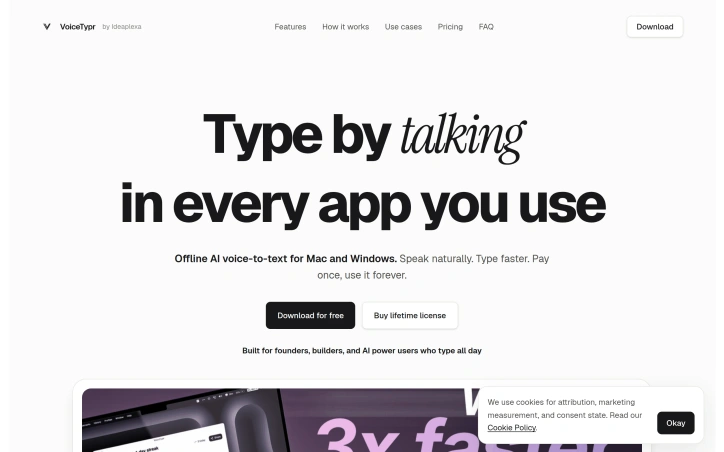
For professionals who spend their days typing away, a new tool has emerged to streamline their workflow. VoiceTypr is designed for founders, builders, and power users who are glued to their writing surfaces, whether that's ChatGPT, coding tools, or other text-heavy applications. The problem it tackles is two-fold: slow writing and potential data leaks. By leveraging offline AI voice-to-text technology, VoiceTypr enables users to dictate their thoughts and instantly convert them into clean, usable text. What stands out about VoiceTypr is its commitment to privacy and seamless integration. The transcription process runs locally on the user's machine, ensuring that sensitive information remains on the device. Moreover, it works globally across any application, in any text field, and at any time, making it a versatile addition to one's workflow. The process is straightforward: users download and install the app, choose a model based on their needs for speed or accuracy, set a hotkey, and start dictating. The flexibility in model selection is a key feature, allowing users to switch between different models depending on the task at hand. Additionally, the ability to customize hotkeys and formatting options adds to the tool's adaptability. Users can also opt for AI cleanup, which can be configured with their own API key for specific tasks, such as drafting emails. VoiceTypr offers a free download, with a lifetime license available for purchase. The absence of a cloud account requirement or subscription-based model aligns with its focus on local processing and user privacy. By solving the issues of slow typing and data exposure, VoiceTypr positions itself as a valuable asset for those whose work revolves around writing and text manipulation. Its offline capability, ease of use, and customizable features make it an attractive solution for enhancing productivity.