Catalyst Healthspan Audit
Personal trainers typically sell training sessions. This startup reversed the equation by building assessment first, mak...
Launchory
We built Launchory to solve the discoverability problem for startups. Our platform offers instant approval, permanent do...
Best Web hosting services Startups & Tools
Infrastructure/services to make websites accessible on the internet.
Recently Listed
5 launches
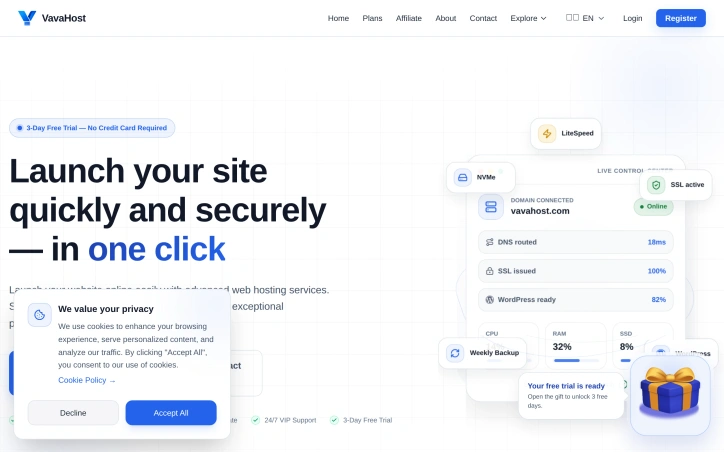
Hosting that prioritizes both performance and accessibility defines this platform's core value proposition. VavaHost targets creators, developers, and small business owners who need reliable web infrastructure without navigating complex technical setups or absorbing enterprise-level costs. The service addresses a genuine gap: offering competent hosting to those who want to launch WordPress sites, e-commerce storefronts, or custom applications without getting bogged down in infrastructure management. The offering centers on three technical anchors: LiteSpeed Enterprise as the web server, NVMe SSD storage for speed, and Imunify360 for security. These aren't trendy choices—they're mature, proven technologies that directly affect user experience. Combined with free SSL certificates and cPanel access, the platform provides the tools developers expect without requiring separate subscriptions or additional fees. The ability to run Node.js, Python, and Discord bots alongside WordPress suggests a platform designed for modern, diverse workloads rather than pure WordPress hosting. Support for PHP versions 7.4 through 8.5 gives users reasonable flexibility without excessive version sprawl. What distinguishes VavaHost commercially is the risk-free trial structure. A three-day free trial requiring no credit card removes the primary friction point for prospective users deciding whether to migrate or launch their projects. This is paired with a 30-day money-back guarantee and no setup fees—a combination that signals confidence in the product and reduces customer acquisition friction. The pricing strategy remains straightforward. The published Bronze plan starts at $0.99 monthly, paired with core features like one-click WordPress deployment, weekly backups, and full cPanel access. While specific allocations for CPU, RAM, and bandwidth vary by tier, the disclosed resource limits in the trial interface suggest transparent pricing rather than surprise overages. The 24/7 VIP support claim carries weight in a market where budget hosting often means minimal support. The company frames itself as engineering-forward—emphasizing LiteSpeed performance, enterprise-grade security tools, and developer-focused features—while maintaining price positioning that appeals to cost-conscious builders. Whether this balance holds during scaling or feature expansion remains a longer-term question, but the current offering competently addresses the intersection of performance, security, and price for its stated audience.
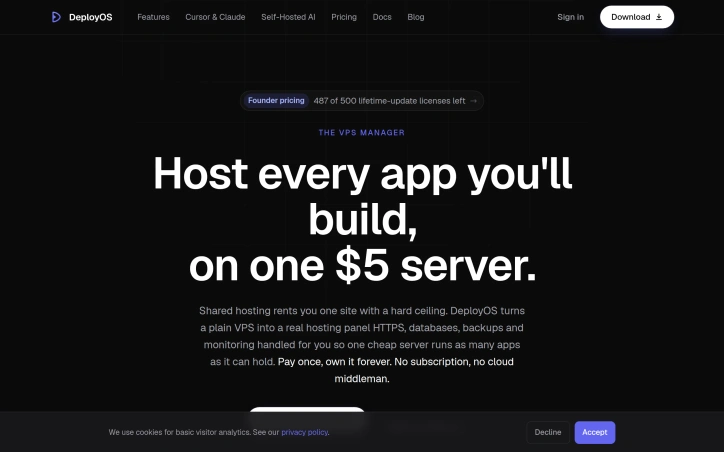
A growing friction point for independent developers is the gap between building locally and deploying to production. Tools exist at both extremes: shared hosting locks you into rigid configurations and per-site pricing, while raw VPS instances demand proficiency with Docker, nginx, and Linux system administration. DeployOS targets this middle ground directly, positioning itself as the hosting control panel that cheap VPS providers never bundled natively. The product solves for one core scenario: a developer finishes building an application and wants it live on the internet without learning infrastructure. DeployOS automates the parts that typically consume hours of research and troubleshooting. Setup happens in three steps. Connect a VPS by pasting its IP address and SSH key. Pick a repository from GitHub or select one of 250 pre-built templates covering everything from WordPress to Ollama to Grafana. Push new code and watch it deploy with HTTPS, health checks, and automatic rollback capability included. What distinguishes DeployOS from simpler hosting platforms is its commitment to running unlimited applications on a single cheap server. Shared hosting providers charge per site and impose hard resource ceilings. DeployOS removes both constraints. Running five side projects on one $5 monthly instance costs the same as running one. The platform handles databases, backups, monitoring, and HTTPS certificate management without manual intervention. The product's reliability selling point is practical: it catches and repairs common deployment mistakes automatically. The most frequent reason a deployed app fails to load is a port mismatch between configuration and reality. DeployOS probes the container to discover which port the application actually listens on, reconfigures routing, and saves the setting. Similar intelligence applies to other failure modes that typically send developers down Stack Overflow rabbit holes. Financially, DeployOS operates on a lifetime license model rather than subscription. The company explicitly positions this against platforms like Render, quantifying savings at roughly $1,073 over three years for equivalent usage. A free tier exists with no credit card requirement. Paid plans include a 14-day money-back guarantee. The obvious audience is indie developers and bootstrapped founders who value simplicity and cost efficiency over support tickets and hand-holding. Anyone who builds regularly and wants infrastructure concerns handled transparently fits the profile.

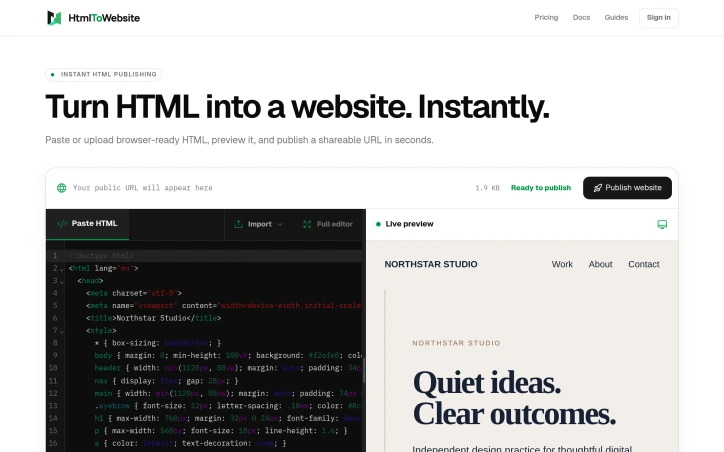
The friction point this solves is clear: developers who write HTML need a way to share their work publicly without wrestling with hosting infrastructure, deployment pipelines, or server management. HtmlToWebsite targets this gap by offering instant publication—paste your code and get a live URL, no deployment configuration required. The core value proposition centers on speed and simplicity. Rather than choosing between shared hosting platforms, containerization tools, or static site generators, users can move directly from editor to shareable link. This streamlines the typical workflow for prototyping, building demos, and iterating rapidly without backend complexity. The product handles projects of varying scope. Whether developers are publishing single HTML files or complex projects with accompanying assets, the platform manages the technical details transparently. This breadth is significant because many similar tools force users into either-or constraints—support for simple files OR full project structures, but rarely both seamlessly. Who benefits most? The platform appeals to developers building quick proof-of-concepts, designers prototyping interactive mockups, and educators demonstrating code concepts. It's also useful for teams collaborating on frontend-heavy features or anyone who needs to share executable code without asking collaborators to run a local environment. The strategic positioning is revealing. By eliminating hosting and deployment as friction points, HtmlToWebsite competes less with traditional web hosts and more with in-browser IDEs and pastebin services that now need distribution. It occupies the specific moment between code written and code running live, addressing a real bottleneck in development workflows. The product design is deliberately minimal—paste HTML, get a website—which works as both mechanic and marketing. There's no mention of pricing or business model in the available information, making it unclear how sustainable or commercially viable this approach is. Nonetheless, the core insight is sound: developers absolutely encounter this friction point, and removing it has genuine value for rapid iteration cycles and collaborative prototyping.

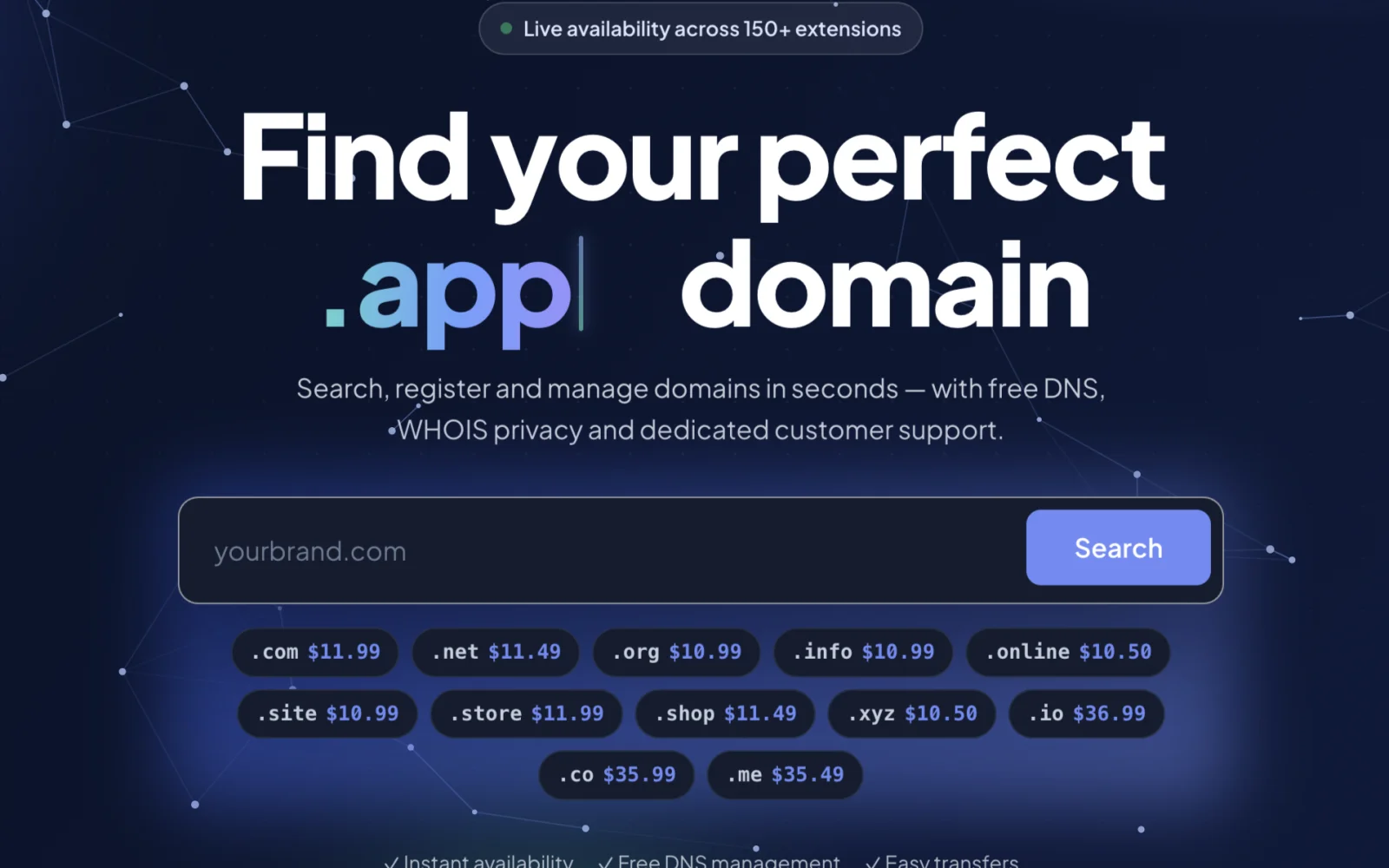
Establishing an online presence begins with securing a domain name. For individuals, startups, and businesses, managing domain registrations, transfers, and renewals can be a tedious and overwhelming task. DomRegus simplifies this process by offering a comprehensive platform for domain management. The platform is designed to be intuitive and secure, providing users with a streamlined experience for registering and managing domains across over 150 extensions. Transparency is a key aspect of DomRegus, evident in its clear pricing structure. The cost of registering various domain extensions is explicitly stated, with prices ranging from $2.99 for a .xyz domain to $46.99 for a .ai domain. One of the standout features of DomRegus is its commitment to providing essential services alongside domain registration. Users are offered free DNS management and WHOIS privacy, empowering them to maintain full control over their domain portfolio. The platform also facilitates easy domain transfers and renewals, ensuring that users can manage their online identity efficiently. By combining trusted domain infrastructure with modern technology, DomRegus delivers a reliable and efficient registration experience. As an authorized OpenSRS reseller, the platform leverages established expertise to provide a secure environment for domain management. Overall, DomRegus is a robust solution for those seeking to secure and manage their online presence, offering a compelling blend of simplicity, transparency, and powerful management tools.
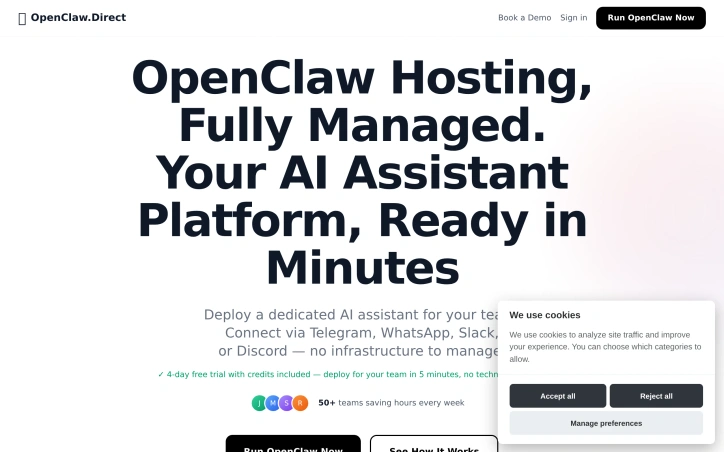
Teams that live inside Telegram, WhatsApp, Slack, or Discord spend their days dodging the accidental slog of opening yet another tab just to ask a bot for help. OpenClaw Direct dissolves that friction by putting a single, private AI coworker right where the messages already flow. Early adopters who lack the appetite—or hire—for DevOps but need Claude-grade intelligence on their own data can spin up a complete environment without writing a deployment script. The allure lies in the five-minute onboarding and the price lock of nineteen dollars a month, cancellable whenever the experiment loses its shine. Beyond provisioning, the platform behaves like an overstretched teammate who never forgets. It consumes inbox threads, staging deployments, support tickets, pull-request noise, SSL expirations, marketing figures, and half-written drafts, then surfaces only the decisions that still require human judgment. Code reviews happen in-chat, with critical issues patched and tests re-run before the reviewer reaches for coffee. Customer tickets get drafted replies, while feature requests bubble into a shared roadmap where community weight can be tracked with tags. Blog traffic gets analysed on the fly and turned into scheduled social threads with open rates reported back as early morning banter. Ownership stays with the customer: the assistant lives on a dedicated machine, listens exclusively to the API key they supply, and connects to the chat apps they already trust. Whatever internal context, documents, or repositories the team grants access to remains unseen by anyone else. The built-in dashboard simply tracks the number of messages, workflows completed, and time reclaimed—enough data to justify the monthly coffee budget the tool replaces.