
benchmark.directory
- No match
Machine translation — the English original is authoritative.
The Story
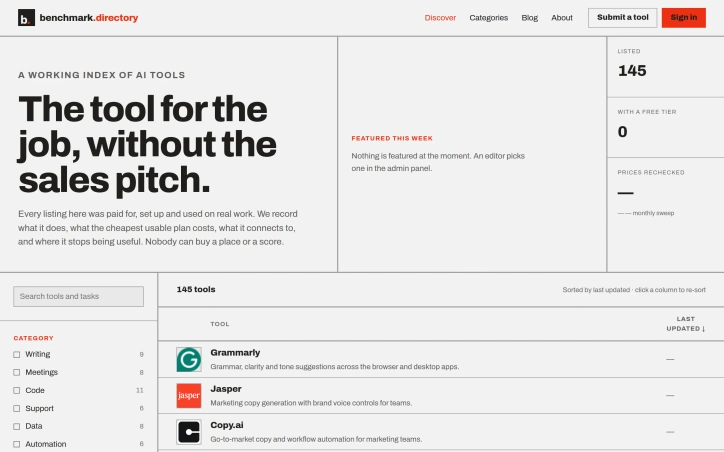
benchmark.directory is an independent index of 145 AI tools, grouped by the job people hire them to do rather than by the technology. Every listing was paid for, set up and used on real work for at least a week before it earned a place.
For each tool we record what it does in one line written by us and not the vendor, the cheapest plan that is actually usable, what the free tier really allows, which integrations we tested by connecting them, whether your work trains the model by default, and where the tool stops being useful.
There is no sponsored placement, no affiliate ordering, and no paid tier. Listings are free, and a tool that offers to pay is noted and turned down. 71 submissions were turned down in 2026; 12 tools have been delisted.
AI Overview
AI-generatedAn editorial index of AI tools solves a growing discovery problem in a crowded market. Benchmark.directory addresses the challenge many organizations face when evaluating software: vendor marketing obscures real capabilities and limitations. The directory catalogs 145 tools organized by the practical work they perform rather than technological category, making it genuinely useful for matching problems to solutions.
What distinguishes this project is its hands-on editorial approach. Every tool must pass a validation threshold: setup and active use on genuine projects for at least one week before earning inclusion. This practical testing replaces sales collateral with direct experience. The founders document concrete information that typically remains hidden: the actual cost of the cheapest functional plan, what free tiers genuinely permit, which integrations work after setup, and crucially, where each tool's utility boundaries lie.
The directory maintains editorial integrity through transparent rejection of pay-to-play arrangements. Listings are completely free, and tools offering payment for placement are documented and declined. This structural decision eliminates the perverse incentive that corrupts most software directories, where prominent positioning correlates with marketing budget rather than usefulness. In 2026 alone, the project rejected 71 submissions and delisted 12 tools, indicating active curation rather than passive accumulation.
The categorization strategy reflects how people actually hire software. Rather than grouping by AI methodology or technical architecture, tools appear under practical functions like writing, code, data analysis, and design. This mirrors genuine workflow organization and decision-making patterns.
Current coverage spans categories including writing, meetings, code, support, data, automation, design, research, sales, finance, marketing, and specialized domains like legal operations and people management. The interface offers filtering by pricing model and free tier availability, accommodating both individual exploration and organizational procurement processes.
The project captures information typically scattered or hidden: training data policies, integration requirements, and usage ceilings. For organizations concerned about whether tools train on proprietary work or evaluating integration feasibility before vendor conversations, this transparency provides tangible value. The regularly updated sort indicates active maintenance of the directory, though opportunity exists for expanded editorial features.
Founder Diary
DevlogThe maker hasn't posted a diary entry yet.
Tech Stack & Tags
Discussion
No comments yet — be the first!
Join the conversation — sign up to comment.
Sign up freeCommunity Support
Boost this project on Sell With boost
Meet the Founder

More by Hassan khan



More in AI Workflow Automation

Vehla
I'm building a Mac command center to streamline...

Zoye
The CRM You Never Need to Open. The AI Native...

Vora IQ
I built Vora IQ to help entrepreneurs build real...

SaaS scaffold
One command. Auth, payments, database, email, Ta...

prompt-ctl.com
Structures every prompt for max signal, min wast...

MOOGH
We built MOOGH to bring intelligent task automat...