Catalyst Healthspan Audit
Personal trainers typically sell training sessions. This startup reversed the equation by building assessment first, mak...
Launchory
We built Launchory to solve the discoverability problem for startups. Our platform offers instant approval, permanent do...
Best Accounting software Startups & Tools
Centralize bookkeeping, invoicing, receipts, taxes, and financial insights.
Recently Listed
3 launches
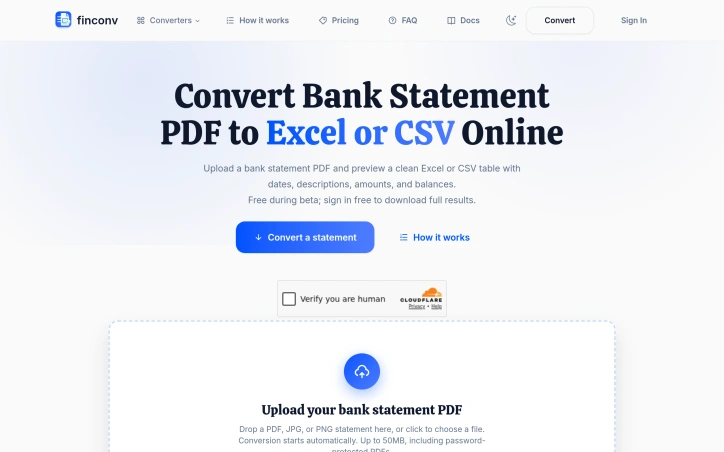
Automating the extraction of bank transaction data from PDFs addresses a genuine friction point for accountants, bookkeepers, and anyone managing business finances. FinConv tackles this by accepting PDF statements—along with scanned images and JPG/PNG photos—and transforming them into structured spreadsheets ready for analysis or import into accounting software. The product's core strength lies in its low barrier to entry. There's no software to install, no complex setup, and initial access requires no account creation. Users can upload a file, preview the extracted data immediately, then decide whether to sign in before downloading. This frictionless preview mechanism signals confidence in accuracy and removes the anxiety of committing to a conversion blind. The platform promises to read dates, descriptions, debits, credits, and running balances—the fundamental columns any accountant needs—and presents them in a clean table format. FinConv's feature set is deliberately broad in format support. Beyond standard PDFs, it handles scanned statements and password-protected files up to 50MB, eliminating the preparatory step of unlocking and re-saving documents before conversion. The export options span Excel, CSV, and JSON, catering to different workflows: Excel for spreadsheet manipulation, CSV for raw data entry into accounting systems, and JSON for developers integrating the output into applications or scripts. Credit card statements receive the same treatment as bank statements, extending utility across financial document types. The privacy stance warrants attention. The company is explicit that uploaded files aren't stored on its servers—data is sent only to an AI provider for extraction. For users handling financial documents containing sensitive account information, this claim of non-persistence is a significant differentiator in a space where data handling practices are often opaque. The business model remains straightforward. FinConv operates under a free beta with free sign-in gated to downloads, suggesting monetization will arrive once the service moves beyond beta testing. This approach buys credibility while the product proves its accuracy and reliability. The product doesn't reinvent the wheel—PDF-to-spreadsheet conversion has existed for years—but it narrows the focus to bank statements specifically and wraps the solution in a modern, user-friendly interface. For the intended audience, that combination of focused scope and accessible design likely translates to genuine time savings over manual entry or wrestling with generic conversion tools.

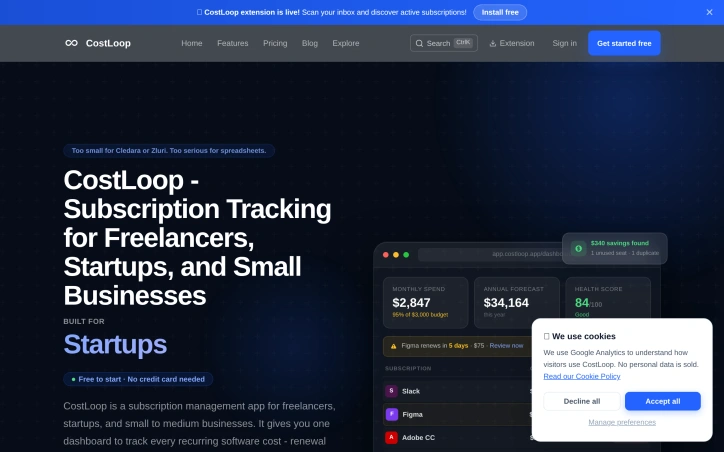
Managing software subscriptions is a daunting task for freelancers and small to medium-sized businesses, often resulting in lost renewal dates and unnecessary costs. CostLoop addresses this issue head-on by providing a straightforward dashboard to monitor recurring software costs. The product is designed specifically for freelancers, startups, and small to medium businesses, offering a simple solution to track SaaS subscriptions and manage spend. By consolidating renewal dates, monthly spend totals, invoice storage, and cancellation links in one place, CostLoop simplifies the process of keeping on top of software expenses. One standout feature is the Chrome extension, which scans the user's inbox to discover active subscriptions, eliminating the need to manually log every SaaS tool. This automation is a significant time-saver, allowing users to quickly gain a clear picture of their monthly and annual spend. Additionally, the platform provides automatic email reminders before subscriptions auto-renew, ensuring users never miss a renewal date. The product's key features include a centralized dashboard for tracking subscriptions, renewal reminders, and invoice storage. It also identifies potential savings opportunities, such as unused seats and duplicate subscriptions. Notably, the platform is free to start, with no credit card required, and setup is accomplished in just two minutes. Users can track over 100 SaaS tools, and the platform has already managed 8,200+ subscriptions, with an average savings of 18% after the first audit. While pricing details beyond the free plan are not explicitly mentioned, the absence of a required credit card upfront is a welcome feature for users hesitant to commit to new services. Overall, CostLoop presents a compelling solution for businesses seeking to streamline their software subscription management and reduce unnecessary expenses.

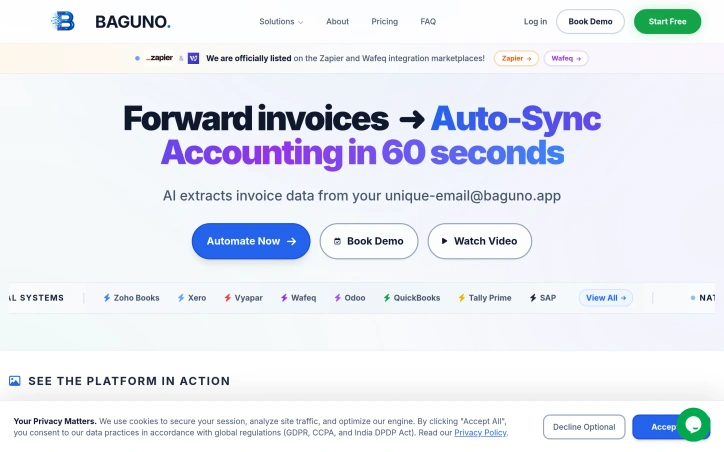
Automating invoice processing and financial data entry remains a persistent pain point across organizations of all sizes. BAGUNO tackles this challenge by acting as an AI-powered intermediary between document sources and accounting software, eliminating manual transcription work that typically consumes significant finance team capacity. The platform targets a broad spectrum of users—from freelancers drowning in expense tracking to enterprise consulting firms managing multiple client books, to SMEs running on accounting software like QuickBooks or Tally. This range reflects the founder's stated mission to remove manual data entry from finance workflows entirely. What distinguishes BAGUNO is its layered intelligence approach. The core Neural Invoice Engine handles document parsing with claimed 99.8% accuracy, but the platform extends beyond simple data extraction. Lia, its AI copilot, allows users to interact with financial data through natural language commands rather than traditional form entry—asking "Who is my most expensive vendor?" or approving purchase orders through conversational prompts. The system reportedly executes these actions directly in connected ERPs without human intervention on individual forms. Sentinel AI adds fraud prevention capabilities, algorithmically auditing documents before they reach the ledger, matching invoice line items to purchase orders, and flagging price anomalies. The platform also includes predictive liquidity forecasting, offering thirty-day cashflow visibility and alerting users to potential gaps. Integration is positioned as comprehensive, supporting Zoho Books, Odoo, QuickBooks, and Tally Prime, with the system functioning as a centralized ingestion point for quotes, purchase orders, invoices, and related documents. The platform accepts invoice submissions via email or upload, reducing the friction of onboarding financial documents. Pricing follows a freemium model with a Basic free tier capped at twenty documents monthly and supporting a single user seat, including core extraction and automated three-way matching. Paid tiers exist, with annual subscriptions discounted to the equivalent of two free months. Specific pricing for higher-tier plans isn't fully detailed in available materials, though this structure makes the product accessible to freelancers and smaller operations while remaining viable for larger teams. The platform's viability ultimately rests on the reliability of its AI models and the practical execution of automated workflows across diverse ERP systems—areas where real-world performance may diverge from stated capabilities.