Launchory
We built Launchory to solve the discoverability problem for startups. Our platform offers instant approval, permanent do...
Catalyst Healthspan Audit
Personal trainers typically sell training sessions. This startup reversed the equation by building assessment first, mak...
Best AI Agents Startups & Tools
Recently Listed
8 launches
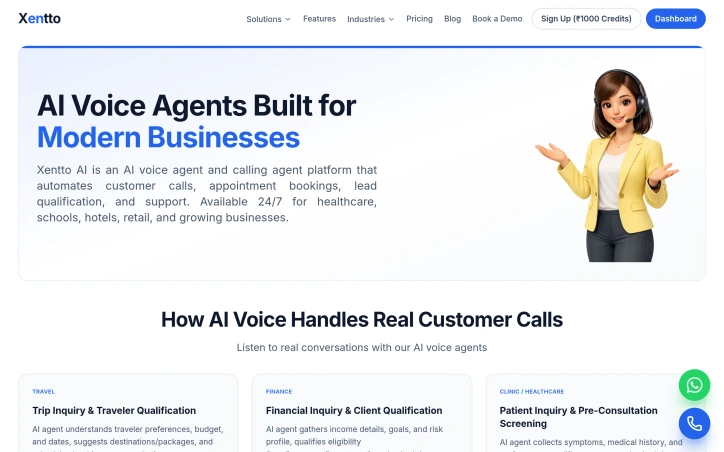
Automating inbound and outbound customer calls remains a persistent pain point for businesses across service industries. Lengthy hold times, missed opportunities during off-hours, and team burnout from repetitive interactions all directly impact revenue and customer satisfaction. Xentto AI addresses this friction with an AI voice agent platform designed to handle the high-volume, low-complexity conversations that consume support and sales bandwidth. The platform targets businesses across healthcare, real estate, education, hospitality, finance, and contact centers. Its value proposition centers on deploying conversational agents that operate around the clock without the overhead of additional staff. Rather than merely automating call routing, Xentto's system engages in natural dialogue, capturing customer intent and information before routing complex cases to human handlers. The product's core capabilities include appointment scheduling, lead qualification, customer support triage, payment reminders, and basic inquiry resolution. Real estate agencies can use the platform to qualify property inquiries and schedule showings. Healthcare providers deploy it for clinic scheduling and patient communication. Financial services organizations leverage it for EMI collection and payment follow-ups. This horizontal positioning across verticals suggests the underlying voice technology and conversational engine have maturity beyond narrow use cases. Several technical strengths emerge from customer testimony. The voice quality reportedly sounds natural enough that interactions preserve customer experience rather than creating frustration. Integration appears straightforward, with customers noting seamless adoption into existing workflows. The platform supports multiple languages, addressing businesses with diverse customer bases. An analytics dashboard provides visibility into call outcomes and customer engagement patterns, enabling data-driven optimization of voice agent behavior. The customer base spans mid-market operators to enterprise organizations. Testimonials cite both cost reduction and improved response times, though specific metrics are absent from public material. One customer mentions automation of thousands of interactions, indicating the system scales beyond pilot projects. The absence of transparent pricing information represents a notable gap in the public positioning. This forces prospective customers to request quotes and sales conversations before understanding investment levels, a common SaaS friction point. Overall, Xentto AI presents a mature solution for the crowded AI voice agent category. Its multi-industry deployment and emphasis on conversational naturalness distinguish it from simpler IVR automation, though the crowded competitive landscape means differentiation hinges on execution, voice quality, and integration breadth rather than novel capabilities.

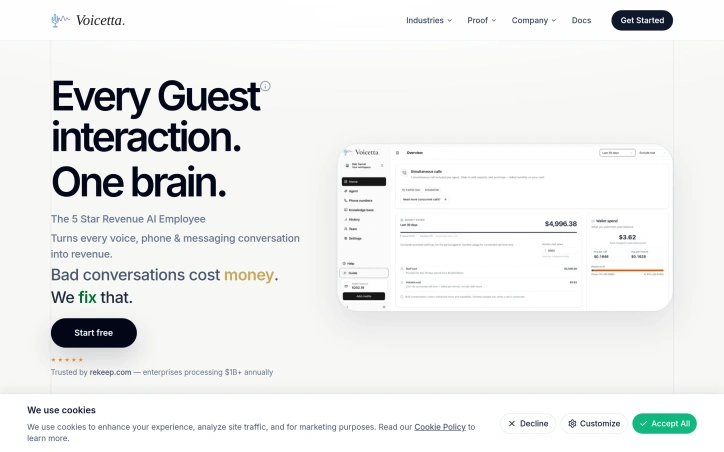
Fragmented communication channels cost organizations money in missed context and lost efficiency. When customer conversations span voice calls, SMS, and WhatsApp but live in separate systems, critical information vanishes between handoffs. Teams waste hours reconstructing customer history, escalations happen without context, and revenue opportunities slip away. Voicetta addresses this by consolidating every customer interaction—voice, SMS, WhatsApp, and messaging—into a unified conversation brain accessible across teams and systems. Rather than asking employees to piece together context from multiple platforms, teams see a complete, searchable timeline of every exchange with a customer, automatically transcribed and graded for quality. The product targets organizations where customer interaction quality directly impacts revenue: hotels managing guest experiences across booking and arrival, healthcare providers juggling patient calls and routine inquiries, real estate teams fielding leads at all hours, and enterprises deploying AI agents or hybrid human-AI support. The unifying thread is scale—managing high volumes of interactions across channels without losing context or growing headcount proportionally. What distinguishes Voicetta is its treatment of conversations as learnable assets rather than ephemeral events. The platform maintains a centralized "brain" that learns from interactions, grades them against defined standards, and surfaces performance patterns. The product also emphasizes it's API-first and works with any AI provider, appealing to organizations wanting to integrate into existing infrastructure rather than wholesale replacement. Core capabilities include automatic recording and transcription, performance grading with reasoning, pipeline visibility, and the ability to define behavior standards that consistently evaluate interactions. Teams access customer context at a glance—what a guest mentioned in SMS, what they asked in a call, what they've done across all channels—without asking around. Early adopters report measurable outcomes. One customer scaled call volume without adding headcount and achieved a 42 percent increase in close rates on inbound leads. A healthcare organization reduced time spent on routine inquiries, freeing specialists for complex cases, while providing 24/7 automated response coverage. Voicetta operates on a freemium model and is already running in production across hospitality, healthcare, and real estate.

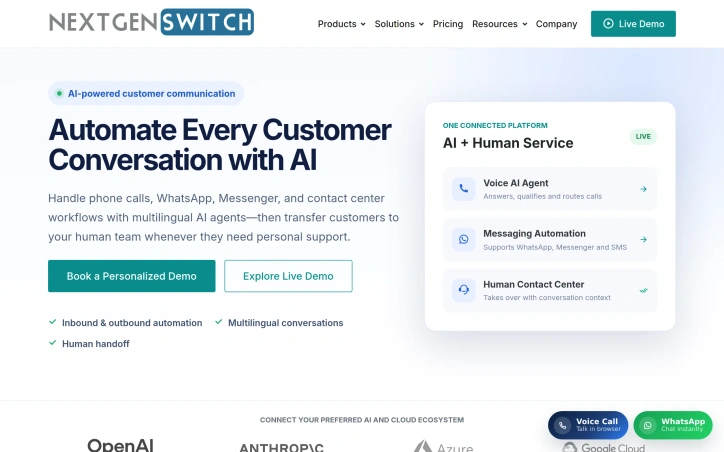
Communication fragmentation costs businesses time and money. Customer interactions splinter across phone systems, messaging apps, and contact center tools, forcing teams to juggle disconnected platforms. NextGenSwitch consolidates these channels into a unified platform that pairs AI automation with human expertise, addressing a genuine operational pain point for service-driven businesses. The platform's core strength lies in its omnichannel integration. It unifies voice calls, WhatsApp, Messenger, SMS, and contact center workflows into one system, eliminating tool-switching inefficiencies. More importantly, it doesn't automate blindly. AI agents handle initial interactions by answering questions, qualifying leads, and collecting information, then transfer qualified conversations to human agents while preserving full context. This design respects that some customer needs require human touch. NextGenSwitch targets multiple segments effectively. Small businesses use it for AI-powered reception and support. Sales teams benefit from lead qualification and automation at scale. E-commerce operations automate product questions and order confirmations. Larger enterprises get unified contact center operations. Service providers and BPOs operate isolated customer environments through multi-tenant capabilities with white-label flexibility. The feature set reflects thoughtful architecture. Multilingual voice and messaging support global customers. API-driven design lets developers build custom voice applications using XML and WebSocket streaming. The platform integrates with existing business systems rather than demanding replacement. Outbound capabilities enable automated reminders, surveys, and follow-ups that scale engagement without proportionally scaling headcount. The platform positions AI for routine work and humans for complex situations—a grounded philosophy acknowledging that customer relationships depend on human judgment and empathy, not just speed. This approach resonates with industries where trust matters more than pure automation metrics. No pricing details appear in available materials, suggesting custom enterprise sales. This model suits their positioning as infrastructure for contact centers and large customer service operations, where deployment complexity justifies direct prospect engagement.
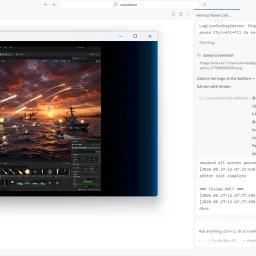
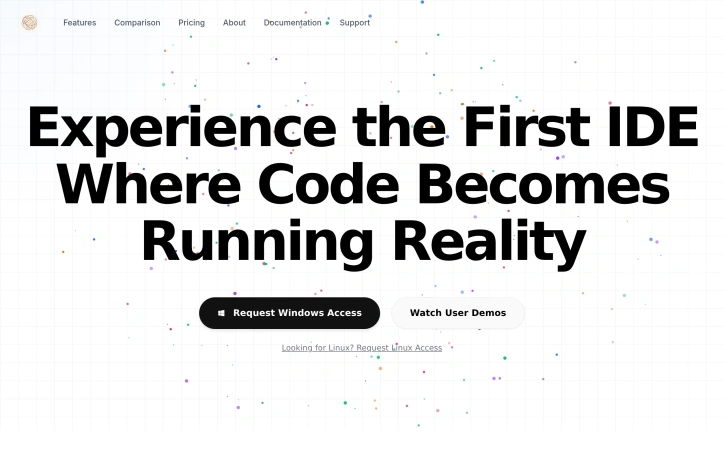
The development process is about to undergo a significant transformation with the introduction of innovative AI-powered solutions. ZeroSphere tackles a critical bottleneck in AI-driven development: execution. Current coding agents excel at generating code, but struggle with the subsequent steps, such as launching applications, interacting with software, and debugging. The company addresses this shortcoming by providing AI agents with their own isolated workspace on the user's machine, enabling them to work independently without accessing the primary desktop. What stands out about ZeroSphere is its ability to empower AI agents to take ownership of the entire development loop, from writing code to testing and iterating. The AI agent can launch applications, observe outcomes, and interact with software, freeing human developers from mundane tasks. The company's technology is built natively in Rust, ensuring native performance and zero latency overhead, even when handling massive multi-agent context states. Notably, ZeroSphere's Virtual Display Agent can see and interact with the application's UI, validating pixels, reading tables, and clicking interfaces just like a human engineer. The isolated workspace also ensures that users maintain full control of their primary desktop. The product's Bring Your Own Key (BYOK) and secure architecture allow users to integrate their own API keys without subscriptions or cloud lock-in. The company's vision is to create persistent software agents that can work on real projects over extended periods, not just respond to prompts. A demo showcases ZeroSphere successfully running a 37-hour Unreal Engine project, demonstrating its capabilities. While pricing details are not explicitly mentioned, access to the product is available directly through the website, with users able to request access for Linux or Windows. Overall, ZeroSphere has the potential to revolutionize the development process by harnessing the power of AI agents to automate complex tasks.

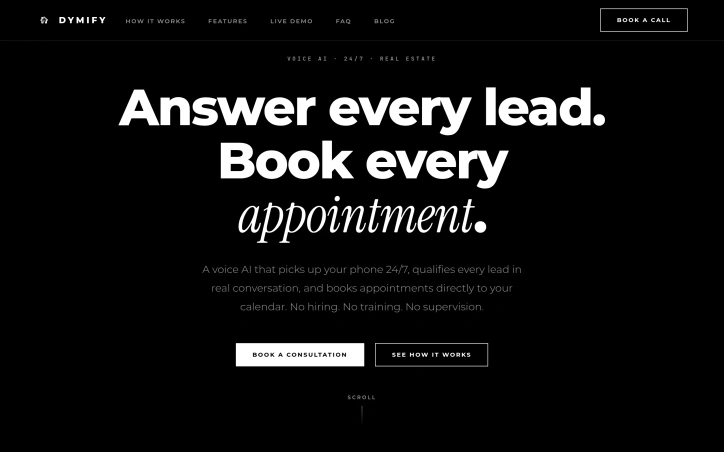
Real estate broker-owners and team leads with multiple agents often struggle to respond promptly to lead calls, resulting in missed opportunities. The traditional solution of hiring a human Inside Sales Agent (ISA) is costly, with prices ranging from $2,000 to $4,000 per month. Dymify's Voice AI service addresses this issue by providing a done-for-you solution that answers every inbound call, qualifies leads through natural conversation, and books appointments directly onto the agent's calendar 24/7. What stands out about Dymify is its ability to mimic human-like conversation, making it nearly indistinguishable from a real agent. The AI responds to leads in under 2 seconds, significantly faster than the industry average response time of 5.2 hours. This rapid response is crucial, as research from MIT shows that calling a lead within 5 minutes is 9 times more effective than waiting 10 minutes. The fact that Dymify can filter out unqualified leads and only book serious prospects onto the agent's calendar is also noteworthy. Key features of Dymify include its instant call answering, natural conversation capabilities, and seamless integration with various CRM systems such as Follow Up Boss, HubSpot, and kvCORE. The service is designed to work in the background, allowing agents to focus on their work without interruption. Setup is quick, taking only 48 hours, and the company offers a guarantee of 10 booked appointments within 30 days or a full money-back refund. The pricing model is straightforward, with a flat monthly fee of $197, making it an attractive alternative to the costly ISA model.

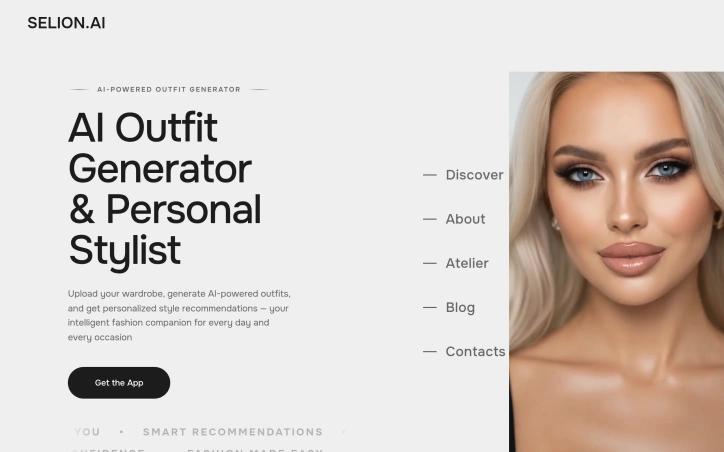
Anyone staring at a closet crammed with clothes yet feeling they have “nothing to wear” is the exact customer Selion targets. By translating every hanger, shoebox, and jewelry drawer into searchable, analyzable data, the app removes the daily decision fatigue that comes with dressing well. Fashion-conscious professionals, frequent travelers, and anyone who juggles multiple dress codes in a single week will find the app particularly useful. The standout aspect is the granularity of the AI scan. Rather than lumping garments into broad buckets like “shirt” or “jeans,” it identifies fabric, exact colorway, pattern, and seasonal suitability as soon as you snap a picture. This depth of indexing lets its engine mix and match with fewer obvious repeats and a higher hit rate of genuinely fresh combinations. The step promised next—rendering any suggested look on your own body in augmented reality—turns abstract outfits into self-evident choices before you commit fabric to skin. Day-to-day, the critical feature is the micro-routine: open the app, give it thirty seconds, walk out dressed. Users also gain a virtual travel planner that pre-loads a destination-weather appropriate capsule before the suitcase gets zipped, and a usage tracker that quietly surfaces forgotten items that deserve a second run. Among these, the “never think what to wear” promise is the boldest, because the more you rely on it, the richer your decision profile becomes—effectively turning your own closet into a living lookbook that evolves faster than seasonal trends. Pricing remains refreshingly straightforward: the core app is free on iOS and Android with no paywall descriptions in the material supplied, so the initial ramp-up cost is strictly measured in photo-taking minutes.

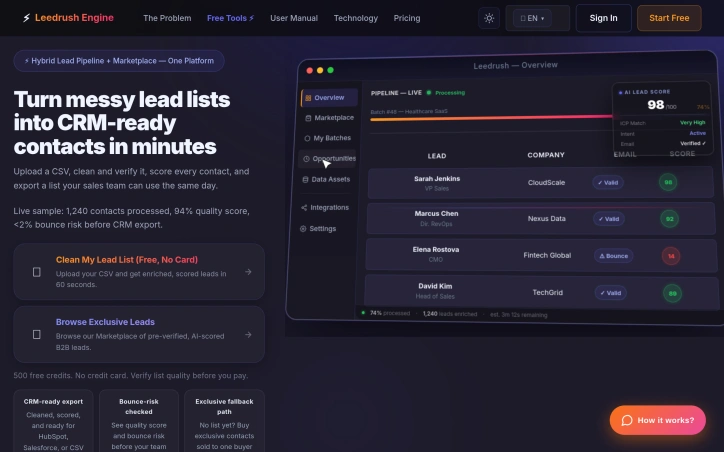
B2B sales teams struggle with a fundamental paradox: lead volume without quality is worthless, yet validating raw leads manually is expensive and time-consuming. Leedrush addresses this by offering a dual-track platform where sales and revenue operations teams can either upload their own lists for instant verification and enrichment, or purchase pre-validated contacts from a marketplace with exclusive ownership guarantees. The product's most distinctive positioning lies in its lead ownership model. Unlike traditional intelligence platforms where multiple buyers compete for the same contacts, Leedrush sells each lead to a single buyer only. This eliminates the "burned-list" problem endemic to shared marketplaces, where a prospect receives identical outreach from multiple vendors. Combined with per-lead pricing rather than subscription fees, the economic model favors lean teams or those testing new segments without long-term commitments. The core workflow proves straightforward. Users upload a CSV file to a batch processor that enriches contacts with verified email addresses, phone numbers, and company data. The platform applies AI-driven scoring across intent signals—recent hiring patterns, technology stack changes, funding events—and matches prospects against user-defined ideal customer profiles. Processing happens asynchronously, with demonstrated batches moving from raw upload to CRM-ready contacts in roughly three minutes. Integration depth supports the sales stack most teams already use. Leedrush syncs directly with HubSpot and Salesforce, supports event-driven automation through Zapier, and posts alerts to Slack when high-scoring prospects match specified criteria. This eliminates manual export-import workflows and keeps intent signals visible to the entire revenue team. The platform maintains compliance certifications including SOC2 readiness and GDPR compliance, important assurances for teams operating across regulated markets. The free tier is genuinely functional—500 free credits allow a team to test the product with no payment method required. The $1.99 per-lead pay-as-you-go model shifts risk from the buyer to Leedrush, aligning incentives around actual prospect quality rather than volume sold. For teams drowning in list-buying subscriptions or maintaining expensive internal enrichment tooling, this alternative deserves serious evaluation.

Generating effective YouTube thumbnails has long been a significant bottleneck for content creators. Professionals either pay substantial fees to hire designers or invest considerable time learning design software, often producing underwhelming results. ThumbNew addresses this friction by automating the thumbnail creation process, transforming what typically requires hours of work into a 30-second task. The platform targets creators across all tiers—from solo content makers to growing channels with limited budgets—who need high-quality visuals that actually drive clicks. Rather than settling for mediocre designs or burning through creative energy, creators can generate professional thumbnails in minutes using an intuitive workflow. What distinguishes ThumbNew is its grounding in proven design principles. The AI doesn't randomly generate graphics; it constructs thumbnails using neural networks trained to recognize patterns that trigger engagement. The system emphasizes clarity, contrast, and facial recognition elements that research demonstrates perform well in YouTube's crowded homepage environment. This data-driven approach positions it far beyond basic templating tools, instead leveraging insights about viewer behavior to optimize for actual click-through rates. The platform delivers high-resolution 1280x720 outputs suitable for any content niche, whether gaming, education, business, lifestyle, or tutorial-based channels. More critically, ThumbNew optimizes for mobile viewing—over 70 percent of YouTube watches occur on mobile devices. This means thumbnails remain legible and visually compelling even at small sizes, a consideration many creators overlook but which significantly impacts performance. A free tier makes the platform accessible to new creators experimenting before committing resources. The service occupies the practical middle ground between expensive design agencies and time-intensive DIY approaches. For the modern creator economy, where speed directly translates to output and growth, ThumbNew eliminates a genuine operational bottleneck. By reducing design friction to seconds, the platform allows creators to maintain focus on content production—their actual core competency. This automation delivers tangible value without requiring significant learning curves or substantial budget commitments.