Xtra Hands Family Chore App
Household chore management remains one of parenting's persistent friction points, and Xtra Hands positions itself as the...
Catalyst Healthspan Audit
Personal trainers typically sell training sessions. This startup reversed the equation by building assessment first, mak...
Best AI Voice Agents Startups & Tools
Conversational assistants that communicate through speech.
Recently Listed
5 launches
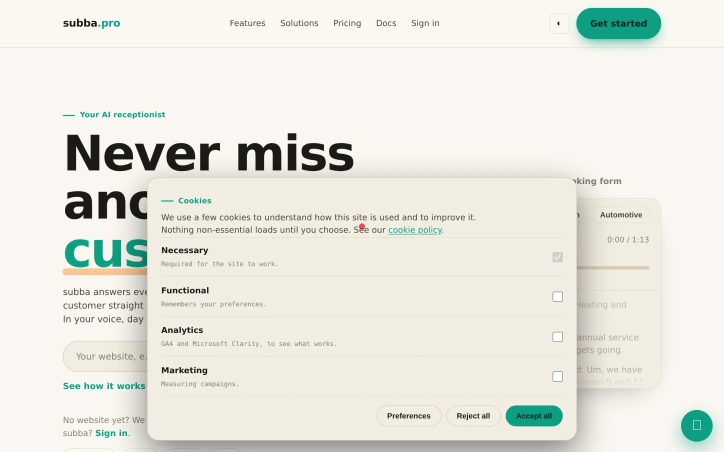
Missed phone calls cost local service businesses real revenue. Subba addresses this gap with an AI receptionist that handles customer inquiries across multiple channels—phone calls, web chat, SMS, and booking forms—around the clock without requiring staff to pick up. The system answers immediately, books customers directly into calendars, and processes payments, all while speaking in a business's chosen voice and style. The product targets small and mid-sized local businesses that operate in service industries: plumbing, dental practices, fitness studios, salons, and automotive shops. These businesses typically operate with limited reception staff and lose revenue when calls go unanswered or bookings require manual follow-up. Subba positions itself as a replacement for traditional answering services while adding booking and payment automation on top. What sets Subba apart is its integrated approach. Rather than offering just call answering or just booking software, it chains these functions together. A customer calls, gets an immediate response from the AI, receives available appointment slots, provides payment information, and receives a confirmation text—all in one interaction. The demonstration calls included in the marketing materials show realistic conversations handling different scenarios: a boiler service booking in one instance, a dental hygienist appointment in another. The AI captures customer details conversationally rather than through awkward form fills. The product goes further by offering website building. Businesses without existing online presence can get a functioning booking site launched within five working days, which lowers the barrier for traditional local businesses that may lack technical infrastructure. This bundled offering positions Subba as a more complete solution than point solutions that handle only one piece of the puzzle. The voice customization feature matters for brand consistency. Small businesses often develop relationships with customers based on personal interaction, and a generic robotic voice could undermine that. The ability to configure the AI to reflect a business's personality helps preserve what makes local service providers competitive. No pricing details appear in publicly available materials, though the company offers a sign-in for existing customers, suggesting a subscription or usage-based model rather than upfront licensing. The core insight is sound: local service businesses sit on the wrong side of an asymmetry where callers expect instant responses but most small operations cannot afford to staff phones constantly. Subba closes that gap systematically by automating the entire inquiry-to-payment flow.

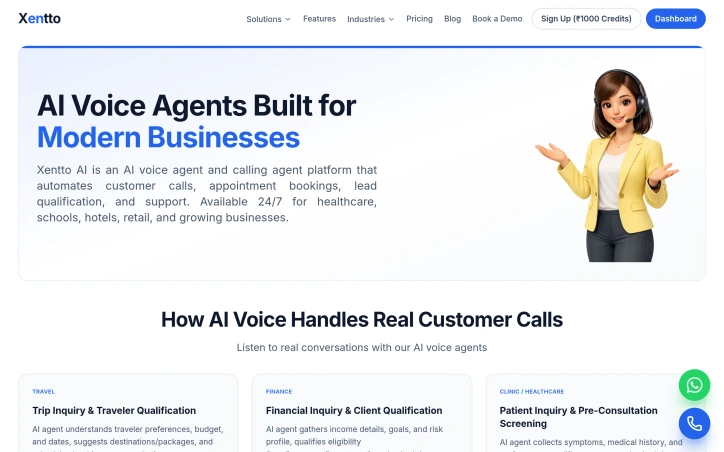
Automating inbound and outbound customer calls remains a persistent pain point for businesses across service industries. Lengthy hold times, missed opportunities during off-hours, and team burnout from repetitive interactions all directly impact revenue and customer satisfaction. Xentto AI addresses this friction with an AI voice agent platform designed to handle the high-volume, low-complexity conversations that consume support and sales bandwidth. The platform targets businesses across healthcare, real estate, education, hospitality, finance, and contact centers. Its value proposition centers on deploying conversational agents that operate around the clock without the overhead of additional staff. Rather than merely automating call routing, Xentto's system engages in natural dialogue, capturing customer intent and information before routing complex cases to human handlers. The product's core capabilities include appointment scheduling, lead qualification, customer support triage, payment reminders, and basic inquiry resolution. Real estate agencies can use the platform to qualify property inquiries and schedule showings. Healthcare providers deploy it for clinic scheduling and patient communication. Financial services organizations leverage it for EMI collection and payment follow-ups. This horizontal positioning across verticals suggests the underlying voice technology and conversational engine have maturity beyond narrow use cases. Several technical strengths emerge from customer testimony. The voice quality reportedly sounds natural enough that interactions preserve customer experience rather than creating frustration. Integration appears straightforward, with customers noting seamless adoption into existing workflows. The platform supports multiple languages, addressing businesses with diverse customer bases. An analytics dashboard provides visibility into call outcomes and customer engagement patterns, enabling data-driven optimization of voice agent behavior. The customer base spans mid-market operators to enterprise organizations. Testimonials cite both cost reduction and improved response times, though specific metrics are absent from public material. One customer mentions automation of thousands of interactions, indicating the system scales beyond pilot projects. The absence of transparent pricing information represents a notable gap in the public positioning. This forces prospective customers to request quotes and sales conversations before understanding investment levels, a common SaaS friction point. Overall, Xentto AI presents a mature solution for the crowded AI voice agent category. Its multi-industry deployment and emphasis on conversational naturalness distinguish it from simpler IVR automation, though the crowded competitive landscape means differentiation hinges on execution, voice quality, and integration breadth rather than novel capabilities.

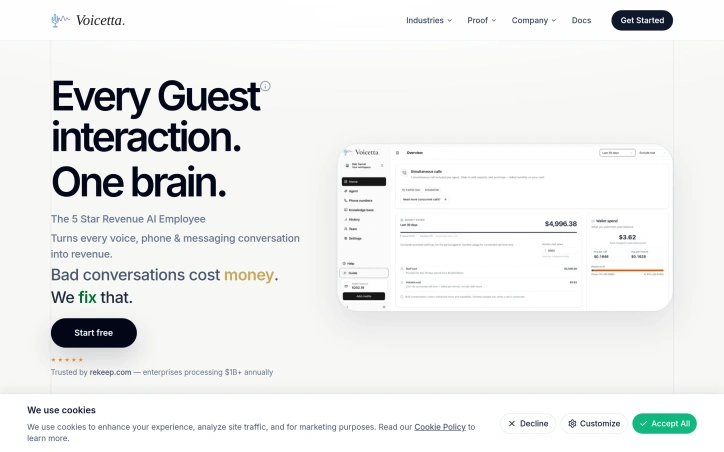
Fragmented communication channels cost organizations money in missed context and lost efficiency. When customer conversations span voice calls, SMS, and WhatsApp but live in separate systems, critical information vanishes between handoffs. Teams waste hours reconstructing customer history, escalations happen without context, and revenue opportunities slip away. Voicetta addresses this by consolidating every customer interaction—voice, SMS, WhatsApp, and messaging—into a unified conversation brain accessible across teams and systems. Rather than asking employees to piece together context from multiple platforms, teams see a complete, searchable timeline of every exchange with a customer, automatically transcribed and graded for quality. The product targets organizations where customer interaction quality directly impacts revenue: hotels managing guest experiences across booking and arrival, healthcare providers juggling patient calls and routine inquiries, real estate teams fielding leads at all hours, and enterprises deploying AI agents or hybrid human-AI support. The unifying thread is scale—managing high volumes of interactions across channels without losing context or growing headcount proportionally. What distinguishes Voicetta is its treatment of conversations as learnable assets rather than ephemeral events. The platform maintains a centralized "brain" that learns from interactions, grades them against defined standards, and surfaces performance patterns. The product also emphasizes it's API-first and works with any AI provider, appealing to organizations wanting to integrate into existing infrastructure rather than wholesale replacement. Core capabilities include automatic recording and transcription, performance grading with reasoning, pipeline visibility, and the ability to define behavior standards that consistently evaluate interactions. Teams access customer context at a glance—what a guest mentioned in SMS, what they asked in a call, what they've done across all channels—without asking around. Early adopters report measurable outcomes. One customer scaled call volume without adding headcount and achieved a 42 percent increase in close rates on inbound leads. A healthcare organization reduced time spent on routine inquiries, freeing specialists for complex cases, while providing 24/7 automated response coverage. Voicetta operates on a freemium model and is already running in production across hospitality, healthcare, and real estate.
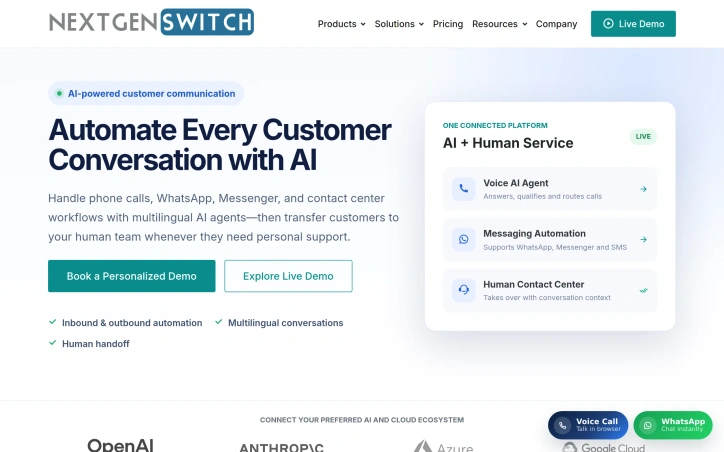
Communication fragmentation costs businesses time and money. Customer interactions splinter across phone systems, messaging apps, and contact center tools, forcing teams to juggle disconnected platforms. NextGenSwitch consolidates these channels into a unified platform that pairs AI automation with human expertise, addressing a genuine operational pain point for service-driven businesses. The platform's core strength lies in its omnichannel integration. It unifies voice calls, WhatsApp, Messenger, SMS, and contact center workflows into one system, eliminating tool-switching inefficiencies. More importantly, it doesn't automate blindly. AI agents handle initial interactions by answering questions, qualifying leads, and collecting information, then transfer qualified conversations to human agents while preserving full context. This design respects that some customer needs require human touch. NextGenSwitch targets multiple segments effectively. Small businesses use it for AI-powered reception and support. Sales teams benefit from lead qualification and automation at scale. E-commerce operations automate product questions and order confirmations. Larger enterprises get unified contact center operations. Service providers and BPOs operate isolated customer environments through multi-tenant capabilities with white-label flexibility. The feature set reflects thoughtful architecture. Multilingual voice and messaging support global customers. API-driven design lets developers build custom voice applications using XML and WebSocket streaming. The platform integrates with existing business systems rather than demanding replacement. Outbound capabilities enable automated reminders, surveys, and follow-ups that scale engagement without proportionally scaling headcount. The platform positions AI for routine work and humans for complex situations—a grounded philosophy acknowledging that customer relationships depend on human judgment and empathy, not just speed. This approach resonates with industries where trust matters more than pure automation metrics. No pricing details appear in available materials, suggesting custom enterprise sales. This model suits their positioning as infrastructure for contact centers and large customer service operations, where deployment complexity justifies direct prospect engagement.

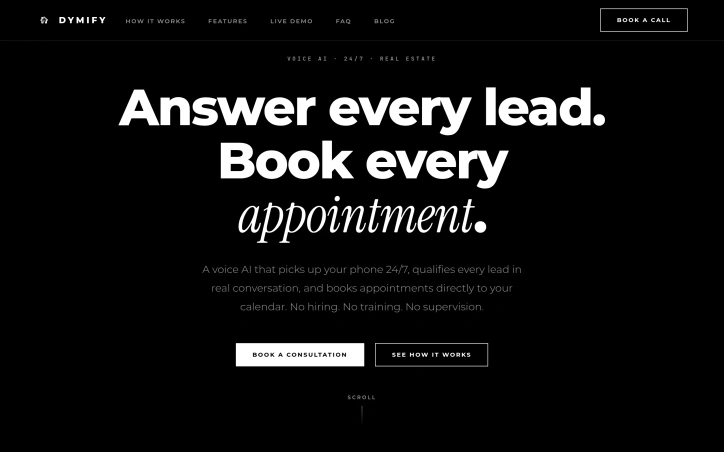
Real estate broker-owners and team leads with multiple agents often struggle to respond promptly to lead calls, resulting in missed opportunities. The traditional solution of hiring a human Inside Sales Agent (ISA) is costly, with prices ranging from $2,000 to $4,000 per month. Dymify's Voice AI service addresses this issue by providing a done-for-you solution that answers every inbound call, qualifies leads through natural conversation, and books appointments directly onto the agent's calendar 24/7. What stands out about Dymify is its ability to mimic human-like conversation, making it nearly indistinguishable from a real agent. The AI responds to leads in under 2 seconds, significantly faster than the industry average response time of 5.2 hours. This rapid response is crucial, as research from MIT shows that calling a lead within 5 minutes is 9 times more effective than waiting 10 minutes. The fact that Dymify can filter out unqualified leads and only book serious prospects onto the agent's calendar is also noteworthy. Key features of Dymify include its instant call answering, natural conversation capabilities, and seamless integration with various CRM systems such as Follow Up Boss, HubSpot, and kvCORE. The service is designed to work in the background, allowing agents to focus on their work without interruption. Setup is quick, taking only 48 hours, and the company offers a guarantee of 10 booked appointments within 30 days or a full money-back refund. The pricing model is straightforward, with a flat monthly fee of $197, making it an attractive alternative to the costly ISA model.