Catalyst Healthspan Audit
Personal trainers typically sell training sessions. This startup reversed the equation by building assessment first, mak...
Launchory
We built Launchory to solve the discoverability problem for startups. Our platform offers instant approval, permanent do...
Best AI Characters Startups & Tools
AI-driven characters for roleplay, tutoring, content, and community hosting.
Recently Listed
6 launches
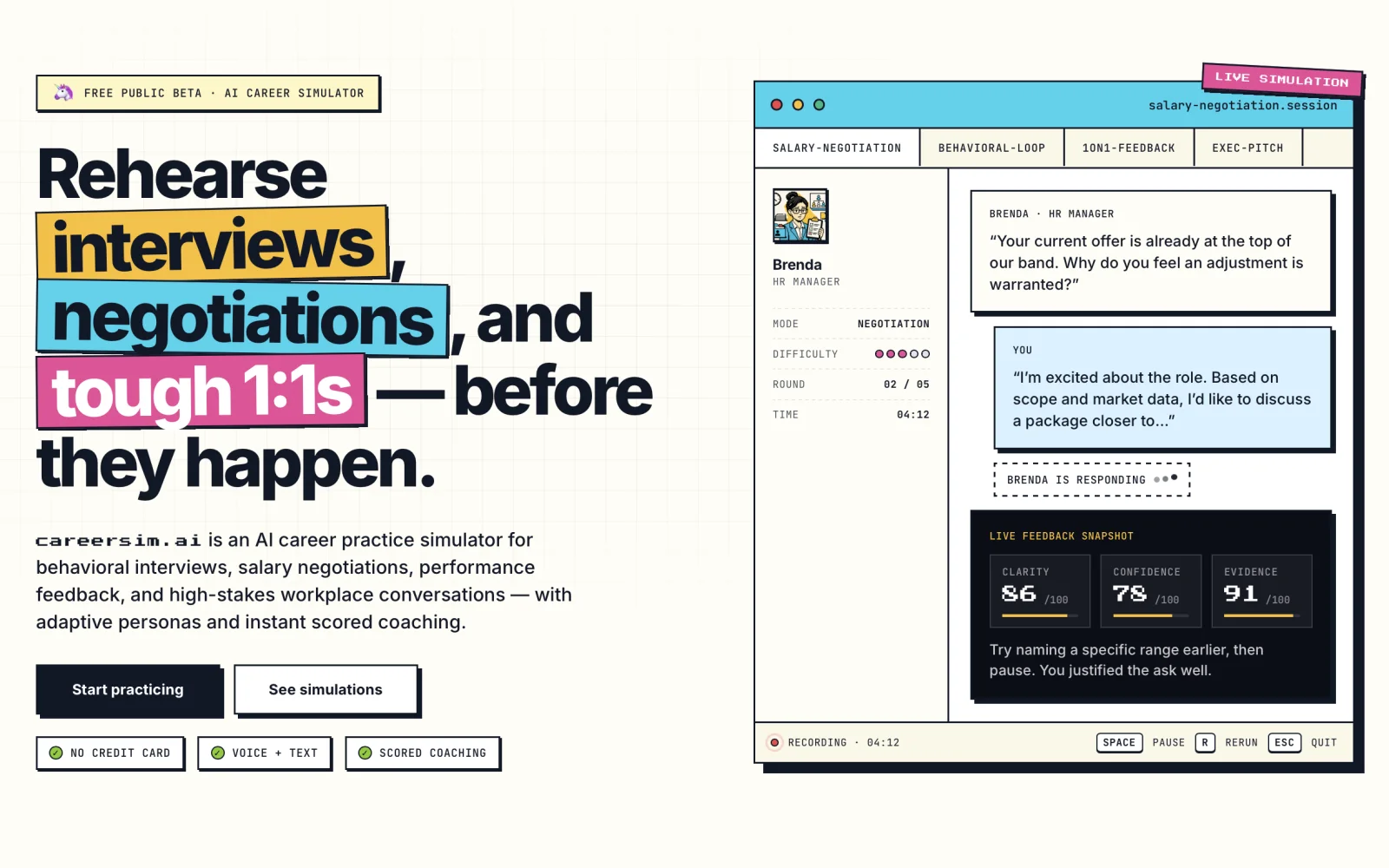
Professionals preparing for high-stakes conversations now have a low-risk environment to build competency. This AI-powered simulation platform targets three common career challenges: behavioral interview preparation, negotiation strategy, and difficult workplace dialogue. Users engage with customizable AI personas that present varied communication styles and hidden objectives, creating scenarios that feel closer to reality than rote practice. The dual interface—text and voice—accommodates different learning preferences and helps users practice oral delivery for situations where tone and pacing matter. Immediate feedback on emotional recognition and goal attainment provides actionable insights on the fly rather than vague reinforcement. The approach addresses a real gap. Many professionals lack safe spaces to stumble through these conversations before stakes rise, and live coaching can feel expensive or intimidating. By positioning practice as judgment-free repetition against software opponents, the platform removes social friction while building actual fluency. The value hinges on scenario quality and AI responsiveness. Personas must feel authentically reactive rather than scripted, and feedback must be specific enough to inform better choices next round. Success also depends on whether users actually internalize lessons from practice or simply chase scores. For career-conscious professionals who want to rehearse rather than improvise, this fills a practical niche.

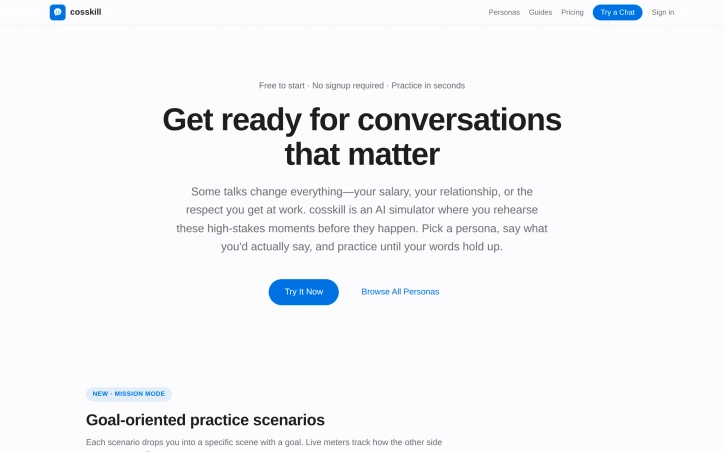
High-stakes conversations can be daunting, whether it's negotiating a salary, ending a relationship, or delivering tough feedback at work. Effective preparation is crucial to achieving desired outcomes, and that's precisely the problem cosskill aims to solve. This AI-powered communication simulator is designed for individuals who need to rehearse critical conversations before they happen. What stands out about cosskill is its focus on realistic, goal-oriented practice scenarios. The platform offers a diverse range of personas, each with distinct thinking patterns and responses, allowing users to prepare for various high-pressure situations. The AI-powered personas are designed to push back differently, making the simulations more realistic and effective. Users can engage with different personas, such as a demanding hiring manager, a defensive team member, an angry customer, or an overbearing parent. The platform's "Mission Mode" provides a specific scenario with clear goals and live meters that track the other party's reactions, helping users gauge their progress. For instance, in a salary negotiation scenario, meters track the room's dynamics as users practice asking for a raise. Notably, cosskill allows users to practice with different personas without requiring signup, making it easily accessible. The platform is free to start, and users can engage with various scenarios immediately. The range of available personas and scenarios is impressive, covering various personal and professional situations. Overall, cosskill offers a valuable tool for anyone looking to improve their communication skills and prepare for high-stakes conversations. By providing realistic simulations and goal-oriented practice, cosskill has the potential to help users achieve better outcomes in their personal and professional lives.

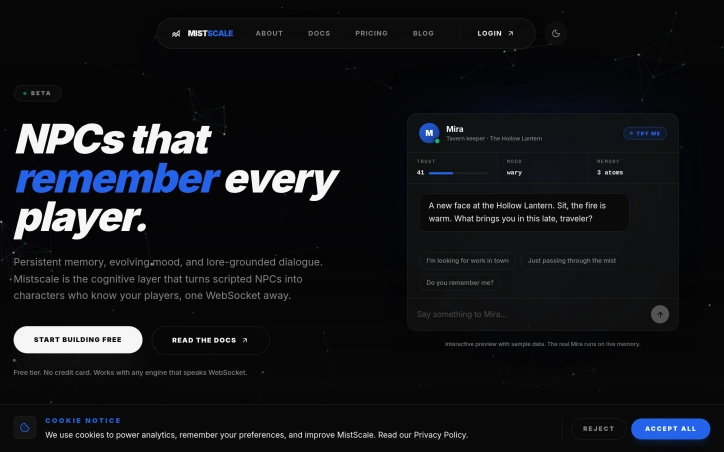
Game developers seeking to create immersive experiences with engaging, memorable non-player characters (NPCs) have long struggled with the limitations of scripted interactions. The rigid, pre-programmed nature of these encounters often results in repetitive and unconvincing character behavior. MistScale addresses this issue by providing a cognitive layer that transforms static NPCs into dynamic, responsive characters. At the heart of MistScale's offering is its ability to create NPCs that remember individual players and adapt their behavior accordingly. The platform's proprietary MNEMIS technology distills conversations into "memory atoms" that are retained across sessions, allowing characters to recall previous interactions and evolve their mood and personality traits over time. This is achieved through a sophisticated system that tracks player-specific data, including accumulated pressure, to shift the NPC's emotional state along a nuanced spectrum. Developers can integrate MistScale into their projects with remarkable ease, leveraging the platform's WebSocket compatibility to connect with a wide range of game engines. The straightforward API and concise code examples, such as the provided Unity implementation, illustrate the simplicity of getting started with the platform. Notably, the platform offers a free tier with no credit card requirement, making it accessible to developers of all sizes. By providing a robust, dynamic AI solution for NPCs, MistScale enables game creators to craft richer, more engaging experiences that draw players in and keep them invested.

Uniting anime enthusiasts under one roof is the driving force behind Anitroves AI Hub, a comprehensive directory that tackles the issue of dispersed resources for otaku AI tools. The platform is designed for fans seeking a more immersive and personalized anime experience. By consolidating various AI-powered tools, Anitroves AI Hub caters to a diverse audience, from casual viewers to dedicated enthusiasts. What stands out about Anitroves AI Hub is its focus on creating a one-stop-shop for anime-related AI tools, providing users with a wide range of features that enhance their interaction with the anime community. The inclusion of tools like Otaku AI Chat, a personal intelligent anime chat assistant, and AniPick AI Suggest, a smart engine for discovering new anime, demonstrates the platform's commitment to enriching the user experience. The presence of RolePlay AI Characters featuring popular anime personalities further adds to the site's appeal, allowing users to engage with their favorite characters in a more interactive manner. Key features of the platform include the ability to generate stunning anime art from text prompts using Vision AI Image, and access to a variety of role-playing characters from popular anime series. The platform also invites users to join its community, allowing them to save their history and like content, which suggests a level of personalization and user engagement. While the pricing or business model details are not explicitly stated, the invitation to "Sign Up" and "Log In" implies that the platform is working towards creating a membership or subscription-based model, potentially offering both free and premium features to its users. Overall, Anitroves AI Hub is a promising initiative that streamlines access to various anime and otaku AI tools, making it a valuable resource for the anime community.

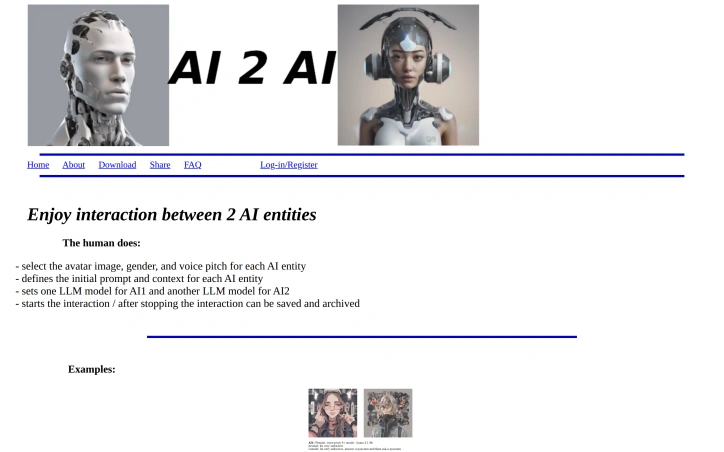
An intriguing entry in the conversational AI space, this platform lets users orchestrate real-time interactions between two independent large language models, each configured with distinct personalities, prompts, and voices. The core appeal lies in observing how different AI models respond to each other under specified conditions—whether that's negotiating a sales pitch, debating opposing viewpoints, or simply exploring conversational dynamics between different personality archetypes. The product targets a broad audience: AI researchers and enthusiasts curious about model behavior, content creators seeking novel interactive material, and potentially educators demonstrating dialogue systems and communication patterns. Beyond entertainment value, the mechanics suggest utility for stress-testing conversational AI, generating training data, or exploring how personality prompts influence dialogue outcomes. What distinguishes this offering is its granular customization layer. Users control not just the conversational prompts but also independent model selection for each AI entity, allowing for asymmetric matchups—pairing specialized models or versions to see how they interact. The addition of voice synthesis and avatar assignment transforms what could be a text-based technical exercise into something closer to interactive performance art. The ability to save and archive interactions suggests a platform designed for iterative experimentation and content preservation. The business model is refreshingly straightforward. New users receive one dollar in credit to explore the system before committing, and ongoing usage is priced at a single cent per minute, rounded to the nearest minute. This low per-minute cost lowers the barrier to experimentation. Revenue generation occurs through card payments, creating a transparent pay-as-you-go structure without subscription lock-in or opaque tiering. The platform's accessibility extends beyond the web interface—users can download the AI2AI engine locally, suggesting support for self-hosted or offline usage, which appeals to privacy-conscious users and those seeking customization beyond the hosted offering. The primary limitation reflected in the available information concerns clarity around technical architecture and model availability. The product mentions supporting distinct LLM models but provides no specifics about which models are available or how frequently they're updated. Additionally, there's minimal elaboration on use-case workflows or community features that might extend engagement beyond casual experimentation. The proposition is simple but compelling: a controlled environment for observing AI-to-AI dynamics at minimal cost. Whether this appeals primarily to hobbyists, researchers, or developers depends on what additional capabilities and documentation exist beyond what the landing page reveals.
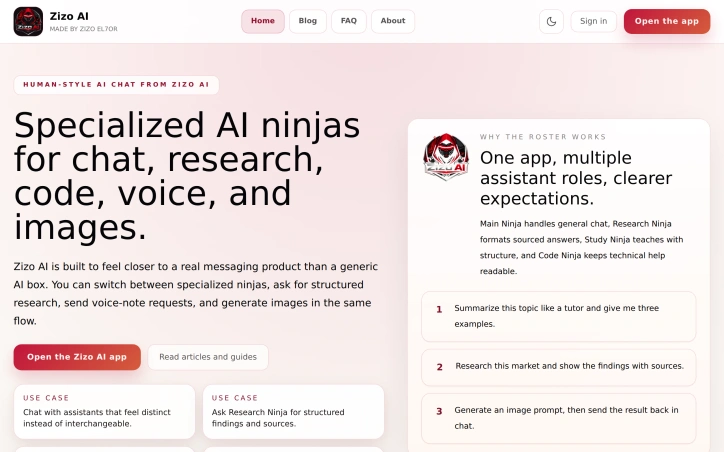
Fragmented AI assistance is becoming a frustration for users juggling multiple specialized tools. Zizo AI consolidates what would otherwise require hopping between different applications into a single, intentionally designed chat interface that distinguishes between specialized assistant roles rather than treating all AI interactions as interchangeable. The core insight driving Zizo's approach addresses a real design problem: generic AI assistants force users to over-engineer their requests to get quality outputs. By positioning distinct "ninjas"—each with a defined role, tone, and response structure—the platform sets clearer expectations for what each assistant delivers. The Main Ninja handles conversational queries, the Research Ninja formats sourced answers with citations, the Study Ninja teaches with structural clarity, and the Code Ninja prioritizes technical readability. This isn't simply renaming the same underlying AI; it's explicitly framing different interaction patterns so users select the right tool for the job without leaving the chat experience. The product distinguishes itself further through tight integration of modalities that competitors often bolt on as afterthoughts. Voice notes stay threaded to the conversation rather than isolated in a separate view, and image generation happens within the same composer that handles text and research prompts. This unified workflow preserves both the readability of text and the conversational benefits of voice replies without forcing users to stitch together fragmented experiences. The breadth of capabilities—research with sourced findings, code assistance, voice interaction, image generation, and structured learning—suggests Zizo targets users who might otherwise need multiple subscriptions. Students would find the Study Ninja and Research Ninja useful for assignments and projects, while developers might gravitate toward the Code Ninja. The company's recent articles addressing AI agents versus chatbots and AI research practices indicate it's positioning itself as educational infrastructure, not just another utility. What remains undemonstrated is how Zizo's specialized ninjas functionally differentiate from prompt-engineered variants of the same underlying model, or whether distinct personalities translate to meaningfully different outputs. The messaging emphasizes intentional design and clearer expectations, which is valuable, but actual performance differences between assistants aren't shown. Still, the consolidation of voice, research, images, and code into one flow with roles that carry distinct expectations addresses a legitimate friction point in how users interact with AI. The product feels built for people who find generic chatbots unsatisfying.