
BLACK FRIDAY Premium $99 $69 Ends in 4 days 5 hours See the deal →

Best AI Presentation Software Startups & Tools

Apps that use generative AI to create slide decks

Recently Listed

2 launches
Sort
A

A frontend-focused engineer with emerging full-stack capabilities is presenting himself to companies seeking React developers who can bridge frontend and backend concerns. The profile targets hiring managers at startups and established tech companies looking to fill mid-level developer roles where frontend expertise is primary but infrastructure knowledge is a bonus. The portfolio emphasizes concrete achievements rather than generic skill lists. During an Amazon internship starting October 2025, he delivered five UI components achieving 98 percent design accuracy while boosting data rendering efficiency by 35 percent. His previous role at Ksolves India Limited demonstrates measurable outcomes: reducing page load times by 28 percent through code splitting and building reusable components adopted across three internal products. These quantified results differentiate the profile from typical developer portfolios that rely on vague claims of passion for coding. His technical breadth extends beyond frontend work. Beyond React and JavaScript expertise, the resume lists Node.js, Express, MongoDB, Docker, GitHub Actions, and CI/CD pipeline experience. This positions him as someone who can follow features from frontend implementation through deployment, though the depth in backend and DevOps areas appears less developed than his React capabilities. The portfolio highlights multiple internships, certifications, and open-source contributions, suggesting both career progression and commitment to learning. The presentation separates hard technical skills from soft competencies like problem-solving and team collaboration, acknowledging that developer hiring considers communication alongside code quality. The website itself functions as both portfolio and hiring tool, featuring a resume download, meeting scheduling capability, and direct contact options. The interactive skill presentation and category-based organization make the profile moderately polished without crossing into unnecessary design complexity. One limitation: while the profile claims DevOps experience through Docker and CI/CD tools, the descriptions emphasize frontend outcomes rather than infrastructure achievements. For companies needing someone who leads DevOps initiatives, this reads as a frontend developer with useful auxiliary skills rather than someone equally expert in both domains. Similarly, the backend technologies listed receive minimal demonstration through the project descriptions, which focus on UI components and design accuracy. The profile targets companies seeking developers beyond their first internship, immediately available for full-time engagement or contract work.

Ai-presentation-software
A
Abhishek Singh

A frontend-focused engineer with emerging full-stack capabilities is presenting himself to companies seeking React developers who can bridge frontend and backend concerns. The profile targets hiring managers at startups and established tech companies looking to fill mid-level developer roles where frontend expertise is primary but infrastructure knowledge is a bonus. The portfolio emphasizes concrete achievements rather than generic skill lists. During an Amazon internship starting October 2025, he delivered five UI components achieving 98 percent design accuracy while boosting data rendering efficiency by 35 percent. His previous role at Ksolves India Limited demonstrates measurable outcomes: reducing page load times by 28 percent through code splitting and building reusable components adopted across three internal products. These quantified results differentiate the profile from typical developer portfolios that rely on vague claims of passion for coding. His technical breadth extends beyond frontend work. Beyond React and JavaScript expertise, the resume lists Node.js, Express, MongoDB, Docker, GitHub Actions, and CI/CD pipeline experience. This positions him as someone who can follow features from frontend implementation through deployment, though the depth in backend and DevOps areas appears less developed than his React capabilities. The portfolio highlights multiple internships, certifications, and open-source contributions, suggesting both career progression and commitment to learning. The presentation separates hard technical skills from soft competencies like problem-solving and team collaboration, acknowledging that developer hiring considers communication alongside code quality. The website itself functions as both portfolio and hiring tool, featuring a resume download, meeting scheduling capability, and direct contact options. The interactive skill presentation and category-based organization make the profile moderately polished without crossing into unnecessary design complexity. One limitation: while the profile claims DevOps experience through Docker and CI/CD tools, the descriptions emphasize frontend outcomes rather than infrastructure achievements. For companies needing someone who leads DevOps initiatives, this reads as a frontend developer with useful auxiliary skills rather than someone equally expert in both domains. Similarly, the backend technologies listed receive minimal demonstration through the project descriptions, which focus on UI components and design accuracy. The profile targets companies seeking developers beyond their first internship, immediately available for full-time engagement or contract work.

AB
A

Key features

  • React & Full-Stack Development: Frontend-focused expertise with emerging capabilities in Node.js, Express, and MongoDB
  • Quantified Results: Portfolio demonstrates measurable achievements including 98% design accuracy and 35% efficiency improvements
See full listing
Bachao.AI

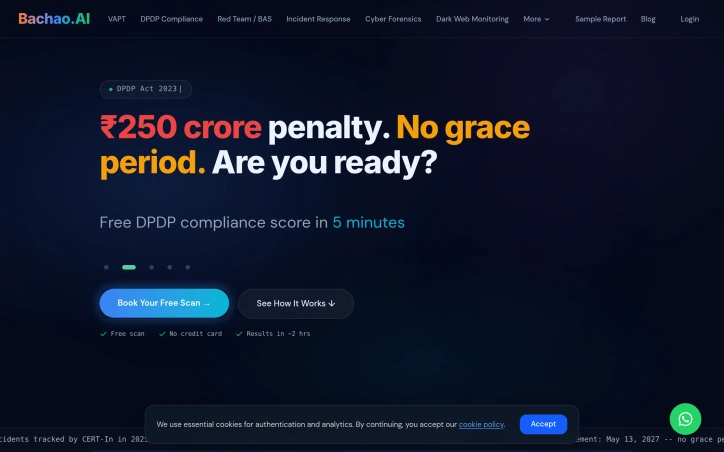
Cybersecurity in India's startup ecosystem is a crisis masquerading as a feature gap. With 87% of Indian SMBs operating without formal cybersecurity policies and 74% having experienced a cyberattack in the past year, the barrier isn't knowledge—it's access and affordability. Bachao.AI directly addresses this gap by automating vulnerability assessment and compliance mapping at a price point that actually fits SMB budgets. The company has identified a real arbitrage opportunity in India's security market: enterprise-grade scanning tools like Nuclei and ZAP are open source and cheap to run, but the expensive layer—human analysts interpreting findings, mapping them to regulatory frameworks, and advising on remediation—remains labour-intensive. Bachao.AI replaces that analyst tier with AI reasoning, delivering results in roughly two hours instead of weeks while undercutting traditional VAPT providers by 40–60%. The timing is precise. India's Digital Personal Data Protection Act enforcement begins May 13, 2027, with penalties up to ₹250 crore per violation. Simultaneously, the Securities and Exchange Board of India's Cyber Security & Resilience Framework mandates compliance audits across 7,500+ regulated entities. For companies in fintech, lending, healthcare, e-commerce, and regional banking—Bachao.AI's stated verticals—the product arrives at the exact moment regulation creates urgency. The feature set is comprehensive: the platform performs vulnerability assessment and penetration testing, auto-maps findings to DPDP and SEBI compliance schedules, includes phishing simulation and deepfake detection, offers dark web monitoring and cyber insurance scoring, and integrates SAST and software composition analysis. Reports are CERT-In aligned, a critical credibility signal in the Indian regulatory context. Users verify domain ownership via DNS TXT—establishing the legal authorization required under India's IT Act 2000—then receive actionable findings and remediation priorities. The first scan is free with no credit card required, lowering friction for initial adoption. The company is backed by engineers from Intuit and IDFC First Bank and holds DPDP Act certification. For an Indian SMB facing the May 2027 deadline pressure with minimal existing security infrastructure, the product's combination of automation, compliance mapping, and affordability directly solves a previously unsolved problem.
Ai-presentation-software
S
Shouvik Mukherjee

Cybersecurity in India's startup ecosystem is a crisis masquerading as a feature gap. With 87% of Indian SMBs operating without formal cybersecurity policies and 74% having experienced a cyberattack in the past year, the barrier isn't knowledge—it's access and affordability. Bachao.AI directly addresses this gap by automating vulnerability assessment and compliance mapping at a price point that actually fits SMB budgets. The company has identified a real arbitrage opportunity in India's security market: enterprise-grade scanning tools like Nuclei and ZAP are open source and cheap to run, but the expensive layer—human analysts interpreting findings, mapping them to regulatory frameworks, and advising on remediation—remains labour-intensive. Bachao.AI replaces that analyst tier with AI reasoning, delivering results in roughly two hours instead of weeks while undercutting traditional VAPT providers by 40–60%. The timing is precise. India's Digital Personal Data Protection Act enforcement begins May 13, 2027, with penalties up to ₹250 crore per violation. Simultaneously, the Securities and Exchange Board of India's Cyber Security & Resilience Framework mandates compliance audits across 7,500+ regulated entities. For companies in fintech, lending, healthcare, e-commerce, and regional banking—Bachao.AI's stated verticals—the product arrives at the exact moment regulation creates urgency. The feature set is comprehensive: the platform performs vulnerability assessment and penetration testing, auto-maps findings to DPDP and SEBI compliance schedules, includes phishing simulation and deepfake detection, offers dark web monitoring and cyber insurance scoring, and integrates SAST and software composition analysis. Reports are CERT-In aligned, a critical credibility signal in the Indian regulatory context. Users verify domain ownership via DNS TXT—establishing the legal authorization required under India's IT Act 2000—then receive actionable findings and remediation priorities. The first scan is free with no credit card required, lowering friction for initial adoption. The company is backed by engineers from Intuit and IDFC First Bank and holds DPDP Act certification. For an Indian SMB facing the May 2027 deadline pressure with minimal existing security infrastructure, the product's combination of automation, compliance mapping, and affordability directly solves a previously unsolved problem.

Bachao.AI preview

Key features

  • Automated Scanning: Enterprise-grade vulnerability assessment and penetration testing powered by AI analysis.
  • Compliance Mapping: Auto-maps findings to India's DPDP and SEBI regulatory frameworks with CERT-In aligned reports.
See full listing