uploadthefile.com
Sharing files and publishing static content has long required friction: account creation, platform navigation, or comman...

CrabTap
Small businesses have long struggled to implement loyalty programs without massive overhead. CrabTap addresses this gap...

Catalyst Healthspan Audit
Personal trainers typically sell training sessions. This startup reversed the equation by building assessment first, mak...
Best Dating apps Startups & Tools
Apps that help strangers meet, chat, and bond.
Recently Listed
4 launches
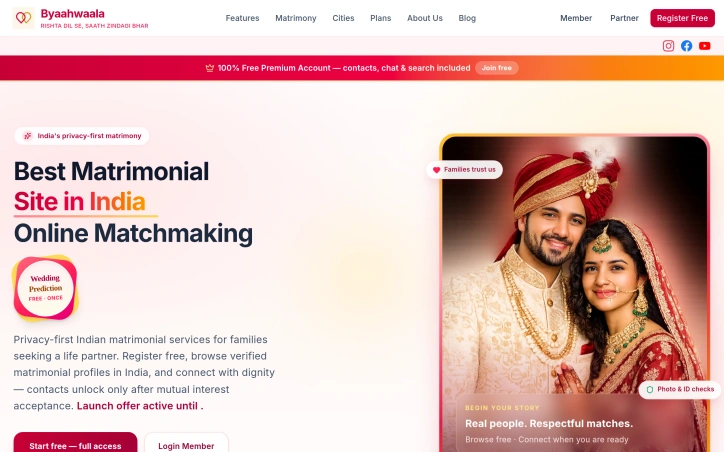
Finding a suitable marriage partner in India requires navigating complex social, regional, and community preferences — a challenge that historically relied on family networks or paid matrimonial consultants. Byaahwaala addresses this by building a digital matrimonial platform specifically designed around how Indian families approach partner selection, treating matchmaking as a deliberate process rather than a swipe-based dating experience. The platform targets families and individuals across India seeking marriage matches within their preferred communities and geographic regions. Its positioning centers on genuine profiles and respectful communication pathways, differentiated from mainstream social apps that prioritize engagement over marriage outcomes. What distinguishes Byaahwaala is its privacy-first architecture. Rather than exposing contact information to all users, the platform masks phone numbers and email addresses during initial browsing. Contacts only become accessible after both parties mutually express interest, a deliberate friction that filters tire-kickers and aligns with traditional matchmaking norms where formal family approval precedes direct contact. The interest-expression system prevents unsolicited messaging, replacing cold outreach with mutual consent. The verification layer reinforces trust. Profiles undergo photo moderation and OTP verification at signup, with optional ID document verification available for users seeking a verified badge. Admin review processes screen for safety concerns, and on-platform chat includes server-side spam filtering to reduce unsolicited numbers and links. These mechanisms acknowledge real pain points: fake profiles and harassment are endemic on matrimonial platforms. Feature-wise, the product offers profile filtering by age, city, community, education, and lifestyle preferences. Daily match recommendations surface compatible profiles automatically. The platform supports niche matrimony segments including Muslim-focused matchmaking and second marriage categories, recognizing that matrimonial preferences vary significantly across religious and life-stage cohorts. The most striking business model decision is its free pricing structure. Byaahwaala offers unlimited interests, chat, contact unlocking, and advanced search at zero cost indefinitely — no freemium upsell model, no time-limited trial. This eliminates the trust friction that paid matrimonial sites historically faced, where couples hesitated to pay before evaluating compatibility. The platform's emphasis on verification, privacy controls, and deliberate communication flows directly addresses skepticism toward online matrimony in Indian family structures. By building infrastructure around mutual consent and trust signals rather than scale metrics, Byaahwaala positions itself as a relationship bureau in digital form rather than another engagement-driven application.

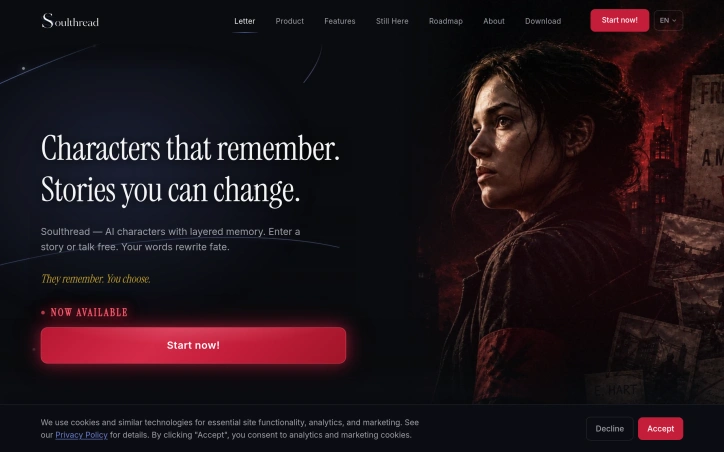
Most AI chatbots suffer from amnesia. Conversations reset, context vanishes, and users find themselves re-explaining the same details repeatedly. Soulthread tackles this persistent problem by building AI characters designed to retain meaningful information and maintain coherent relationships across extended interactions. The platform targets adults seeking something beyond throwaway chat loops. Rather than brief, contextless exchanges, Soulthread positions itself as a space for deeper AI companionship where continuity matters and characters evolve based on accumulated experiences. What distinguishes Soulthread from generic chatbots is its architectural focus on layered long-term memory. The system doesn't merely log conversation history; instead, it constructs characters with persistent identity traits, emotional complexity, and behavioral consistency. This approach addresses a core frustration with current AI companions: the uncanny sensation of talking to someone who has no real sense of who they are or what you mean to them. The product offers two complementary modes. Story Mode presents curated narratives where users navigate branching scenarios and their decisions carry meaningful consequences. The platform launches with Still Here: Red Long Night, an alternate-history Cold War resistance narrative with a cast of eight characters. Free Chat provides open-ended conversation without narrative structure. Both modes support text and voice interactions, and the system can orchestrate multi-character scenes, adding another layer of complexity beyond single-character dialogue. The community presence reveals engagement beyond the typical chatbot audience. Users share reflective posts that suggest emotional investment in their interactions, hinting at the product's pitch: relationships with characters that recognize and remember them feel qualitatively different from algorithmic small talk. Soulthread also emphasizes world-building as a differentiator. The marketing materials include terminology like Your World with roles for participants, creators, and directors, suggesting users might eventually contribute to or customize narrative spaces. This worldbuilding focus signals ambitions beyond a simple character chat interface. The company does not disclose pricing in available materials. Distribution spans mobile and web platforms, with native applications available through standard app stores and a direct APK option for Android users outside standard distribution channels. Soulthread's value proposition hinges on a reasonable insight: AI relationships deteriorate without context. Whether layered memory systems genuinely solve this problem at scale remains an open question, but the execution suggests a team prioritizing narrative depth and character consistency over conversational breadth.

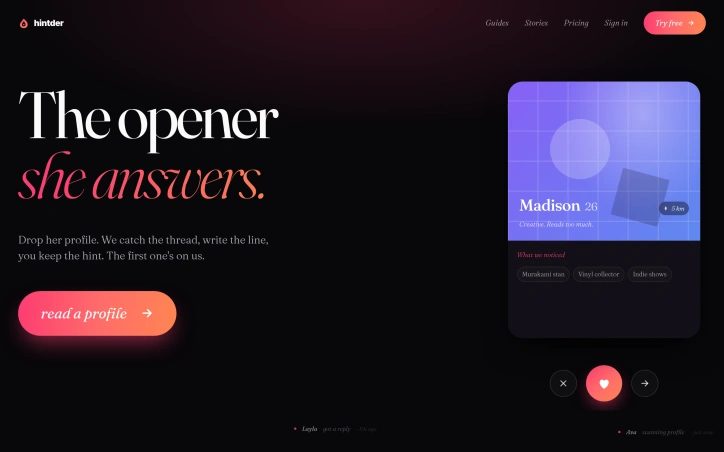
Online dating has become a numbers game, with users swiping through countless profiles and struggling to craft opening messages that stand out. Hintder aims to change this by helping users create engaging and personalized messages that increase their chances of getting a response. The platform is designed for individuals who are tired of generic openers and want to make a meaningful connection with their matches. What stands out about Hintder is its ability to analyze a user's profile and suggest creative and confident opening lines. The platform uses a profile's unique details to craft messages that sound like they were written by the user themselves, but with a dash of humor and wit. The examples provided show how Hintder takes a user's profile and turns it into a clever and engaging opener, such as poking fun at a user's claim that they "cook better than grandma" or referencing a shared interest in a particular author. Hintder's key feature is its profile analysis capability, which extracts relevant details from a user's profile and uses them to craft a personalized message. The platform is compatible with multiple dating apps, and users can simply drag and drop a profile into the scanner to get started. The platform also assures users that their screenshots are not saved or used to train AI models, providing a level of anonymity and control. While the exact pricing model is not explicitly stated, the platform invites users to try it for free, suggesting that there may be a freemium or trial-based model in place. Overall, Hintder offers a unique solution to the problem of crafting engaging opening messages, and its focus on personalization and creativity makes it an attractive option for users looking to stand out in the online dating world.

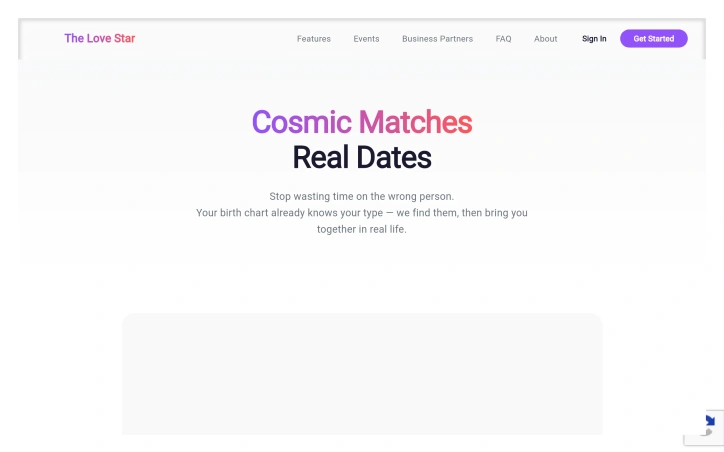
Events and astrology are rarely the organizing principle of a dating application. This platform places both at the center: it prioritizes in-person events as the primary discovery mechanism, then uses astrology as scaffolding for deeper conversations rather than as a standalone matching system. The product addresses specific, concrete pain points. Swiping through photos and short bios creates matches based primarily on surface attraction or hobby overlap. Weeks of messaging frequently reveal fundamental misalignment in core values, temperament, or life goals. Infinite choice paradoxically encourages low-effort browsing rather than intentional connection. Purely online dating strips away context and timing, both critical to genuine connection. Beyond these, the platform implicitly addresses persistent trust issues: catfishing and scams continue to plague online dating. What distinguishes this product is its events-first architecture. Rather than a dating app that happens to list events, it treats in-person gatherings as the core interaction loop, with digital tools facilitating conversations before and after. This inverts the typical app paradigm away from endless swiping toward constrained, intention-driven meetings. The astrology positioning reinforces this philosophy. Explicitly framed as entertainment and conversation fuel rather than destiny, astrology becomes a structured lens for discussing values and compatibility without pseudoscientific baggage. The feature set is tightly integrated across multiple interaction modes. Users access AI-generated birth chart readings that break down planets, houses, and aspects. Compatibility scoring employs synastry-style metrics to contextualize relational dynamics. Personalized transits add temporal relevance. Anonymous social posting—text, images, video, polls, links—functions as a secondary discovery and community layer. Real-time messaging connects event attendees afterward. Trust messaging is direct and candid. Astrology interpretations are labeled as AI-generated and entertainment content rather than professional counsel. Privacy policies, terms of service, and company ownership (Zelo LLC) are fully disclosed. The target user is evident: people dissatisfied with conventional dating apps who prioritize meaningful connection alongside social experience. The platform makes a specific bet: that real-world meetings plus shared context outperforms infinite choice and shallow algorithmic matching. Whether astrology registers as useful conversational scaffolding or niche limitation will determine its ultimate market reach.