
Catalyst Healthspan Audit
Personal trainers typically sell training sessions. This startup reversed the equation by building assessment first, mak...
Launchory
We built Launchory to solve the discoverability problem for startups. Our platform offers instant approval, permanent do...
Best Ecommerce platforms Startups & Tools
Run online stores and sell products/services with checkout and ops tooling.
Recently Listed
12 launches
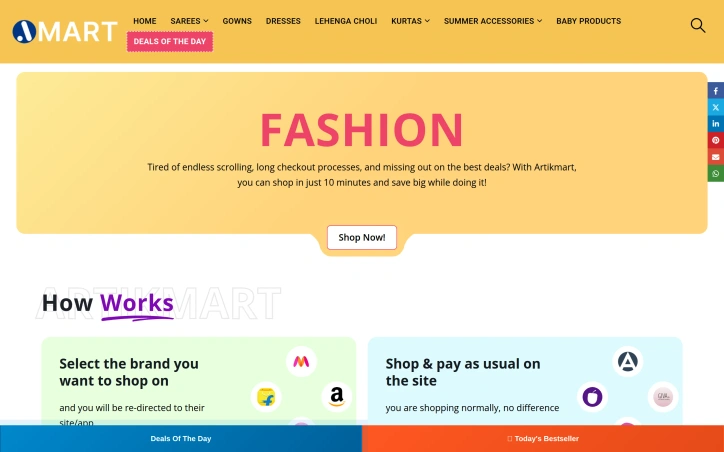
Navigating India's sprawling e-commerce marketplace exhausts fashion shoppers overwhelmed by choice. Artik Mart addresses this friction through curation, offering a streamlined path to Indian fashion staples and contemporary wear. The platform targets women seeking traditional and contemporary Indian garments—lehengas, sarees, kurtis, and dresses alongside shapewear and swimwear. Its mission centers on filtering the noise endemic to Indian e-commerce through product curation and honest comparisons, building shopper confidence in selections made. Rather than holding inventory, Artik Mart operates as an aggregation layer, redirecting customers to partner brand sites where they complete purchases directly. This approach eliminates transaction friction while maintaining lean operations. What distinguishes the platform is editorial focus paired with speed. The claimed ten-minute shopping window reflects an interface built for rapid browsing, while curated selections establish Artik Mart as an intentional filter in a market drowning in inventory. Categories—traditional Indian wear, contemporary dresses, activewear—organize products crisply compared to generalist marketplaces that bury Indian fashion brands under sprawling catalogs. Editorial curation isn't just selection; it's selection with reasoning behind it. The product catalog serves a specific market: Indian women seeking occasion wear, everyday clothing, and intimate apparel. Categories encompass wedding lehengas and formal sarees to shapewear and high-waisted athletic leggings, covering both traditional and modern Indian fashion in one destination. The range reflects the founder's stated focus on wellness, beauty, and fashion, though the website emphasizes apparel heavily. The business model relies on partnerships and affiliate arrangements, indicated by "Co-Powered By" branding throughout the site. The platform charges users nothing—revenue flows through partner commissions or referral fees. The specific terms and commission structures remain proprietary. For Indian fashion shoppers drowning in e-commerce choice, Artik Mart delivers a focused alternative rooted in editorial judgment. It trades breadth for intentionality, betting that expert curation reduces decision fatigue and builds purchase confidence. Success depends entirely on whether the curated selections genuinely reflect audience taste and whether referred traffic converts at partner brands. The platform lives or dies by the accuracy of its selections and the relevance of its partnerships.

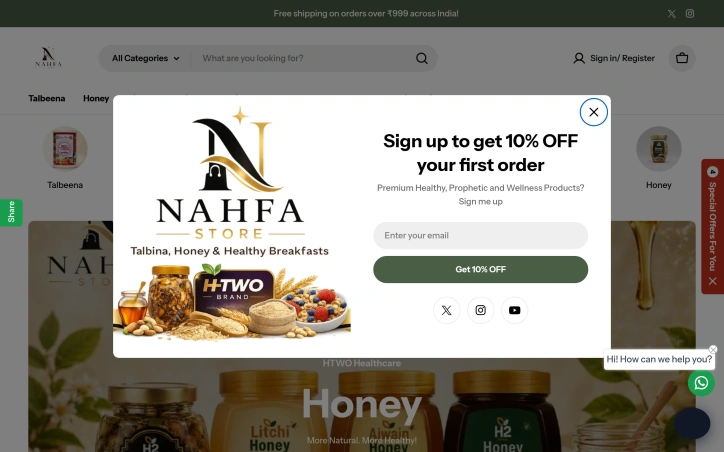
Direct-to-consumer wellness commerce has become increasingly competitive, but most players default to generic supplement positioning. Nahfa Store stands apart by focusing on a narrower, more curated product line centered on Talbina—a barley-based porridge mix—paired with honey and targeted nutritional supplements under the HTWO Healthcare brand. The store serves health-conscious consumers in India seeking authenticated natural nutrition with transparent sourcing claims. Rather than chasing SKU expansion across every conceivable supplement category, the company has built depth within a specific product family, offering Talbina formulated for different life stages and health needs: versions for women, babies, seniors, and general wellness, each positioned as addressing distinct nutritional requirements. This segmentation reflects actual customer demand differentiation rather than arbitrary product proliferation. The catalog emphasizes combo offerings that bundle honey with Talbina variants at discounted price points—a practical value proposition that reduces decision friction for customers new to the category while encouraging larger basket sizes. Pricing anchors around Rs. 270 per unit with combo packages discounted from Rs. 650 to Rs. 585, positioning the products as accessible premium rather than luxury wellness. From a business model standpoint, the company employs a clear incentive structure: free shipping on orders exceeding Rs. 999, which works mathematically for their price point and encourages customers to cross the threshold through complementary product selection. This pricing architecture simultaneously improves unit economics and basket size without requiring artificial promotions. The site demonstrates competent execution in e-commerce fundamentals—clean product hierarchy, social media presence, straightforward navigation. However, the messaging reflects patterns familiar across most wellness retailers, with differentiation claims centered on authenticity and natural positioning rather than distinctive brand narrative or innovation in product development. The store's competitive advantage rests in product curation and fulfillment reliability rather than marketing distinctiveness. For customers in India specifically seeking certified Talbina and honey products with reliable delivery, Nahfa Store removes friction from the purchase journey. The narrower focus versus sprawling supplement shops creates clarity about what the brand represents, though broader market expansion would require either deeper product development or meaningful category expansion beyond the current HTWO Healthcare portfolio.

An Arabic-focused e-commerce platform, Rukn positions itself as a no-code solution for entrepreneurs and small business owners across the Middle East. It addresses a clear pain point: the challenge of launching a professional online storefront without technical expertise or significant capital investment. The target audience spans small retailers, home-based entrepreneurs, restaurant owners, and traditional businesses looking to establish or expand their digital presence. Rukn's value proposition centers on speed and simplicity—stores go live in minutes rather than weeks, with users selecting from over 100 pre-built templates and customizing without writing code. What distinguishes Rukn from competitors is its deliberate omnichannel strategy. Rather than treating the online store as isolated, Rukn integrates it with physical retail operations and social commerce, allowing merchants to manage inventory, orders, and customers across their website, in-store system, Facebook, and Instagram from a single dashboard. This unified control eliminates the fragmentation that typically plagues multi-channel sellers. The platform bundles practical necessities into its offering: domain registration, SSL certificates, payment processing via Visa and Mastercard, and cash-on-delivery options suited to regional preferences. Built-in marketing tools—discount mechanisms, promotional features, and advertising integration—reduce the need for expensive third-party services during early growth stages. Rukn emphasizes its progression from launch to scale. Rather than positioning itself as a basic store builder, the platform markets itself as capable of growing with merchants, handling diverse product types and business models through flexibility in design and functionality. The company claims its users see a 250% improvement in success rates, though this figure lacks context around methodology or comparative baseline. The platform operates on a freemium model with premium tiers available, and current promotion offers a 20% discount on annual packages. Free trials are explicitly mentioned, lowering the barrier to testing the product. Rukn's success hinges on execution of these promises and support quality for its target market. Omnichannel capability is genuinely valuable for retailers, and the no-code thesis has proven across other geographies. The regional focus—designing explicitly for Arabic commerce patterns including cash-on-delivery prominence—suggests thoughtful localization rather than generic globalization. Whether this translates to competitive advantage depends on how well the platform delivers on speed-of-setup claims and ongoing merchant support.


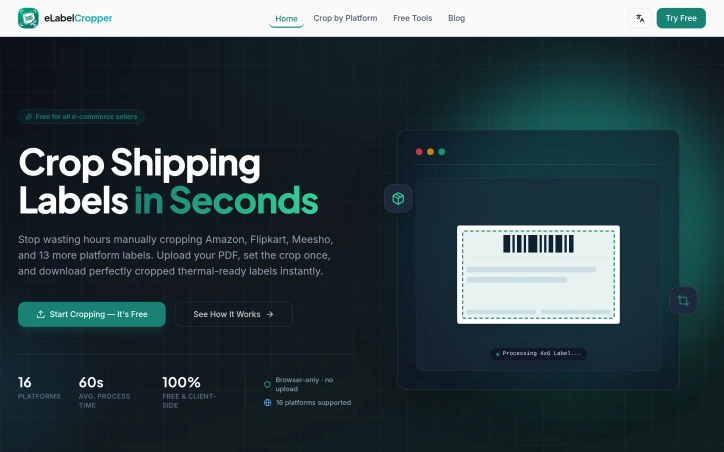
Shipping label processing represents a persistent friction point for e-commerce sellers, consuming time that could be spent on core business operations. eLabelCropper targets this specific bottleneck by offering a browser-based toolkit that automates the tedious work of preparing PDFs for thermal printers across multiple marketplaces. The product's core strength lies in its frictionless approach to a real operational problem. Rather than requiring software installation or account creation, sellers upload shipping label PDFs and receive output optimized for standard 4x6 thermal printers. The tool handles cropping, splitting, rotation, and formatting automatically. For sellers working across multiple platforms—whether Indian marketplaces like Meesho and Flipkart or global platforms such as Shopify and Etsy—supporting 35+ utilities across 16+ platforms eliminates the need to learn different workarounds for each service. The privacy model warrants emphasis. All processing occurs locally within the browser using native web technologies, meaning shipping labels and customer data remain on the user's device rather than transiting through external servers. This addresses a legitimate concern for sellers handling sensitive customer information at scale. Bulk processing capability extends the tool's utility beyond single-label workflows. Users can upload multiple PDFs simultaneously, and the system merges them into a single ready-to-print file. For sellers processing dozens or hundreds of shipments daily, this represents meaningful time savings. Platform-specific tooling adds further value—the system automatically separates packing slips from shipping labels on supported marketplaces like Meesho and Amazon, reducing manual sorting. The positioning as a completely free offering with no signup requirements and no feature limits distinguishes it in a space where shipping label tools typically operate on subscription or freemium models. This accessibility appears deliberate, lowering barriers to adoption among price-sensitive seller communities in emerging markets. The product's scope is narrow and purposeful. It does not attempt to be a comprehensive shipping management system or inventory platform. This focus suggests the developers understand their users' immediate pain point—label formatting—rather than building feature bloat around it. The tool works across Chrome, Firefox, Safari, and Edge, ensuring broad browser compatibility. The claimed user base of over 10,000 sellers suggests real market traction, though the product remains positioned as a utility rather than a platform. For sellers seeking a straightforward, zero-friction solution to daily label processing, eLabelCropper fills a genuine operational need.

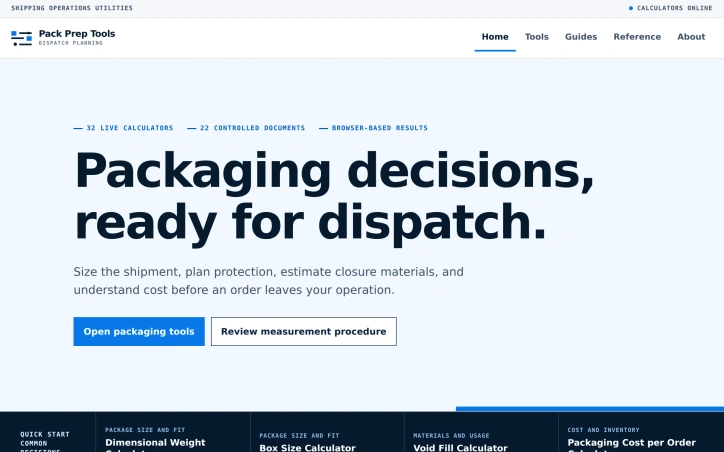
Small sellers often face a recurring operational bottleneck: making packaging decisions that balance cost, speed, and product safety. Pack Prep Tools addresses this friction by bundling 32 focused calculators into a browser-based system designed to guide users through standardized packaging workflows. The product's architecture reflects clear operational thinking. Rather than offering one kitchen-sink calculator, the platform organizes tools around a four-stage dispatch flow: measuring the final shipment, sizing protective materials, estimating closure requirements, and modeling total cost. This structure mirrors how small operations actually move orders out the door, turning an abstract calculation problem into a sequence of practical decisions. The calculator portfolio spans three operational domains. Package preparation tools handle box sizing, void fill estimation, and tape planning. Cost tracking calculators combine material usage with waste allowance and labor hours to project per-order economics. Supply-side tools address inventory and pallet planning, including cases-per-pallet calculations and unit load optimization. The breadth suggests the founder understands where small sellers typically stumble: not just which box to choose, but how many boxes to buy, when to reorder, and what a packed order actually costs. What distinguishes Pack Prep Tools from generic shipping calculators is its pairing of computational tools with reference documentation. The product includes 22 controlled documents comprising measurement guides and reference sheets. These aren't cursory tooltips; they cover substantive territory like dimensional weight divisors and clearance planning. For sellers unfamiliar with the mechanics behind their own operations, this documentation bridges a real knowledge gap. The product targets a specific customer: small ecommerce operators or fulfillment teams making packaging decisions at volume. The problem isn't one-off decisions but establishing repeatable processes and cost baselines for orders in flight. A seller who knows their box sizes but not their void fill strategy, or who suspects their packing labor is untracked, finds specific value here. Pack Prep Tools operates as a utility rather than a platform. It asks users to input their own product dimensions, protective material preferences, and labor costs, then returns calculated outputs. This approach scales to many different business models and product categories without requiring the seller to fit their operation to the tool. For operations already tracking these inputs, the calculators become immediate force multipliers on decision-making speed.
Online businesses and marketers often struggle to access verified accounts for various services, hindering their ability to operate efficiently. PvaAccMarket addresses this issue by offering a marketplace where customers can buy high-quality, phone-verified accounts for popular platforms such as Google, Facebook, and Amazon. The target audience is clearly entrepreneurs and businesses that rely on these services to function. What stands out about PvaAccMarket is its emphasis on providing a seamless and secure purchasing experience. The platform accepts cryptocurrency payments, ensuring that transactions are private and secure. The website also highlights its fast processing times, with account delivery typically occurring within 24 hours after payment confirmation. In fact, the platform assures instant delivery after payment, making it a convenient option for those who need accounts quickly. The platform's key features include a straightforward ordering process, where customers can select the types and quantities of accounts they need, and a secure payment system that holds funds until the customer confirms receipt of their accounts. Additionally, PvaAccMarket offers 24/7 support to address any customer queries or issues. The website also mentions that it provides the lowest prices in the market, with bulk discounts available, making it an attractive option for businesses with high demands. PvaAccMarket's business model is based on selling verified accounts, with payment accepted in USDT and Bitcoin. The platform provides detailed payment instructions after order confirmation, and it guarantees that transactions are completely private. Overall, PvaAccMarket is designed to simplify the process of acquiring verified accounts, making it an attractive solution for businesses and entrepreneurs seeking to streamline their operations.


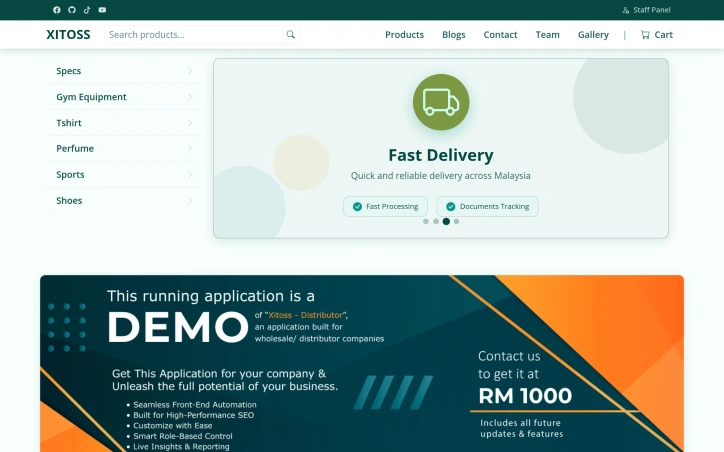
Suppliers, wholesalers, and distribution companies often struggle to manage their business operations efficiently while maintaining a professional online presence. Xitoss addresses this issue by providing a comprehensive business management software that combines e-commerce functionality with powerful operational tools. The platform is designed to help these companies streamline their daily operations and showcase their products in a single, cohesive platform. What stands out about Xitoss is its focus on delivering a tailored solution for distribution businesses, allowing them to manage their operations and online presence in one place. The platform's e-commerce-style website enables companies to present their products professionally, while its business management tools facilitate efficient day-to-day operations. The platform's capabilities include document tracking and fast delivery across Malaysia, indicating a focus on logistical efficiency. Additionally, Xitoss offers a range of product categories, including specs, gym equipment, and apparel, suggesting a flexible and adaptable product management system. The software can be easily deployed on a company's own VPS and fully customized to meet specific business needs, providing a high degree of control and flexibility. While specific pricing details are not provided, the platform's customizability and on-premise deployment option suggest that it may be geared towards larger or more established businesses with specific technical requirements. Overall, Xitoss presents a robust solution for distribution businesses seeking to streamline their operations and enhance their online presence. Its focus on delivering a comprehensive and customizable platform makes it a compelling option for companies in this sector.

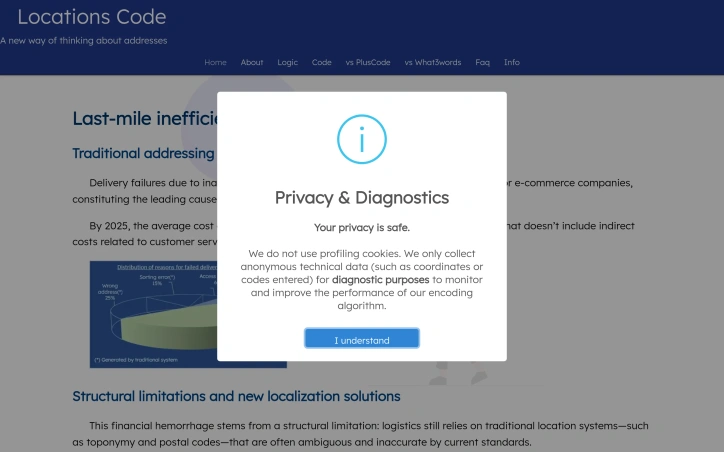
Inefficient last-mile delivery is a major pain point for e-commerce companies, with inaccurate addresses being the primary cause of logistics failures. Locations Code tackles this issue head-on by introducing an open standard for supply chain and last-mile delivery. The company's solution replaces traditional addressing systems with an 8-character encoding of GPS coordinates, providing a stable and secure way to identify delivery points. What stands out about Locations Code is its commitment to being open source and independent of proprietary databases or administrative frameworks. This sets it apart from competitors like What3words and Google's Plus Code, which rely on closed systems. By providing a simple, technologically validated element, Locations Code eliminates ambiguities in address descriptions, making it easier to automate logistics processes. The product's key features include its ability to work offline, ease of integration into any tech stack, and its application in various industries beyond logistics, such as robotics, drones, and IoT devices. The company provides detailed documentation, available on GitHub, YouTube, and Medium, making it easier for developers to understand and implement the solution. Locations Code is designed for businesses struggling with logistics inefficiencies, particularly those in the e-commerce sector. By adopting this open standard, companies can reduce delivery failures and associated costs, improving overall customer satisfaction. Notably, the product's open-source nature means that there are no licensing fees or proprietary restrictions, although the website does not explicitly mention pricing or business model details. Overall, Locations Code presents a compelling solution to a pressing problem, and its open and interoperable design makes it an attractive option for businesses seeking a reliable and scalable logistics solution.

Fragmented operations tools are a persistent problem for business owners managing multiple sales channels, inventory, and customer support simultaneously. CShop consolidates these scattered functions into a unified backend designed specifically for retail operations, restaurants, and bars seeking centralized control over commerce and customer interaction. The platform directly addresses a real operational pain point by unifying product management, order fulfillment, helpdesk support, and financial reporting in one dashboard. Rather than toggling between inventory systems, marketplace connectors, and communication tools, business owners get a single source of truth for stock levels across all channels. What distinguishes CShop is its intentional focus on specific business verticals instead of attempting universal coverage. Restaurants and bars benefit from ingredient-based stock tracking that automatically hides menu items when components deplete, integrated karaoke queue management, and kitchen views optimized for real-time prep workflows. Retail operators get omnichannel synchronization to keep inventory consistent across storefronts and third-party marketplaces. Event-focused businesses can leverage native QR code ticketing and entry flow management. The Telegram integration stands out as particularly thoughtful. Rather than forcing customers to visit a web interface, CShop embeds a full-featured sales bot directly into Telegram—users can browse, purchase, track orders, and submit support tickets without leaving the messaging app. The helpdesk system similarly operates across web and Telegram channels, reducing fragmentation in how support requests arrive and get handled. The architecture prioritizes security through domain separation: the customer-facing storefront lives on your branded domain while the admin backend remains isolated. Encrypted Go-backend communication and two-factor authentication support address legitimate concerns for businesses handling customer data and transactions. Customization controls remain with business owners, allowing direct management of colors, logos, and legal pages from the admin dashboard without requiring developer involvement. Financial reporting, low-stock alerts, audit logs, and built-in tax compliance round out the operational backbone. The onboarding process suggests professional setup involvement rather than pure self-service, and pricing details don't appear in available materials.


For optical retailers struggling to complete eyewear sales without requiring customers to visit their stores, Optogrid offers a software solution that measures pupillary distance—a critical measurement for lens fitting—entirely remotely through a standard photo upload. The platform addresses a significant friction point in online eyewear sales: the requirement for in-person pupillary distance measurements, which has traditionally been the primary reason customers abandon online orders at optical retailers. The solution targets small to mid-sized optical shops looking to expand beyond their physical locations or serve existing customers with greater convenience. By eliminating the need for specialized measurement hardware, Optogrid enables any optical store with a web presence to offer remote measurement services, potentially transforming location-based retailers into nationwide operations without additional infrastructure investment. What distinguishes Optogrid is its apparent simplicity paired with claimed precision. The system operates on any browser and device, requires no special equipment beyond a smartphone camera, and claims to deliver measurements accurate to within ±1 millimeter—calibrated against a physical reference object visible in each photo. This calibration approach addresses a fundamental challenge in photo-based measurement: ensuring consistency despite variations in camera quality and distance. The company indicates that optical stores using the platform can complete remote orders in under five minutes, a significant improvement over traditional measurement workflows. The software extends beyond measurement into operational management, offering data storage and automation features designed to reduce inconsistencies and improve team collaboration. This positions Optogrid as a modest workflow system rather than a standalone measurement tool, though the website provides limited detail on these management capabilities. The practical appeal is evident: optometrists avoid manual measurement protocols or outdated techniques, customers avoid store visits, and retailers can serve customers unable to visit physical locations. For chains or franchises, the ability to serve customers remotely from day one carries competitive advantage, particularly in markets where in-store-only purchasing remains standard. The website provides no explicit pricing information or tiered service details, though it offers free trials. The simplicity of deployment—functioning on existing infrastructure without specialized hardware—suggests the product aims for accessibility, though total cost of implementation or subscription details remain absent from publicly available materials.


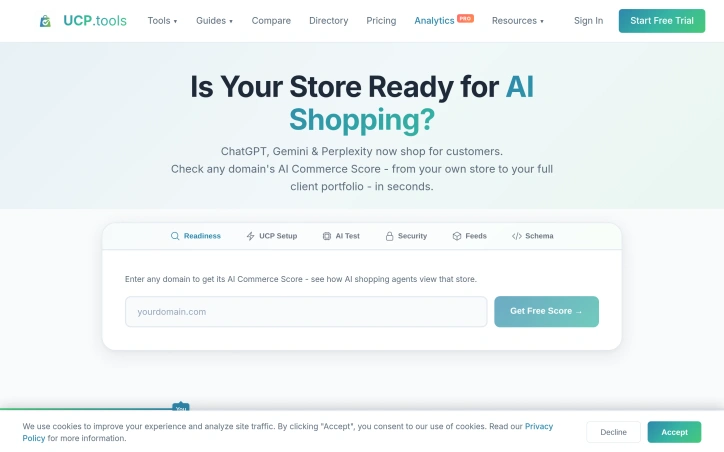
As AI shopping agents become mainstream, e-commerce stores face a new operational requirement: compatibility with systems like ChatGPT, Gemini, and Perplexity that browse and purchase independently. The Universal Commerce Protocol (UCP) provides the technical standard for this integration, but implementing it correctly poses a challenge for merchants across different platforms. UCPtools addresses this gap by offering a free validation platform that quickly assesses whether a store meets the standard and identifies specific remediation steps. The service validates compliance against both UCP and ACP standards co-developed by Google, Shopify, Etsy, Wayfair, Target, and Walmart, with endorsements from 25+ organizations including Stripe and PayPal. This consortium backing lends credibility to the standards themselves. The tool operates independently of these organizations—a positioning that increases merchant trust by distancing it from vendor interests. What distinguishes UCPtools from a basic compliance checker is its emphasis on actionable diagnostics. Rather than returning a simple pass/fail score, it provides an AI Readiness Score scaled 0-100 that breaks down performance across four dimensions: whether AI agents can discover the store, whether they can complete checkout, what payment methods the store supports, and security measures like signing keys and HTTPS encryption. This granular approach guides merchants toward specific fixes rather than leaving them with abstract compliance gaps. The tool supports multiple major platforms—Shopify, WooCommerce, BigCommerce, and Magento—with platform-specific implementation guides. Shopify merchants benefit from native UCP integration through the Shop app, while others are directed to manual setup or third-party solutions. The core service returns results in 30 seconds at no cost, removing financial friction from adoption. The broader context makes the timing relevant. With AI shopping agents now functional and operational, store visibility to these systems has shifted from experimental feature to pragmatic business necessity. A merchant's absence from AI-powered purchasing channels represents a form of digital invisibility that UCPtools helps rectify. The tool's free-forever model and technical precision position it as foundational infrastructure for the emerging AI commerce ecosystem rather than a premium advisory service.

Fashion e-commerce has long been a realm where users are expected to navigate extensive product catalogs and filtering options to find their desired items. However, this can be a daunting task for those not familiar with online shopping or for individuals with specific tastes who struggle to describe their preferences. SSENSELESS seeks to address this issue by providing an AI-powered fashion transformation tool that takes user-provided photos as input. The service encourages users to upload images of themselves wearing outfits they'd like to transform, and the accompanying AI then generates new, SSENSE-inspired looks based on the original image. Supported file formats include JPG, PNG, and WEBP, with a file size limit of 50MB. While there are no specific requirements for image quality or composition, it's recommended that users ensure their outfit is centered and well-lit. One notable aspect of SSENSELESS is its accessibility feature, which allows anyone to create their own SSENSE-inspired looks without necessarily having to navigate the company's extensive product catalog. This can be particularly beneficial for individuals with specific style preferences or those who may not be familiar with online shopping. Key features worth noting include the ability to upload any photo and let AI generate new looks, as well as a "Try on" button that allows users to see different outfits without having to physically try them on. While pricing information is not explicitly mentioned, the founder's statement about tariffs making it possible for everyone to become SSENSELESS with a photo implies an effort to make high-end fashion more accessible and inclusive. Overall, SSENSELESS presents itself as a user-friendly and innovative tool that can cater to users who struggle to navigate traditional e-commerce platforms or describe their style preferences. As the service continues to develop, it will be interesting to see how its AI-powered transformation capabilities continue to evolve and expand beyond fashion e-commerce.