My2Do
My2Do takes aim at a familiar frustration: task managers that demand a form for every entry and then bury the reminder b...

iCV.ge
iCV.ge targets a common frustration for job seekers: building a polished CV takes time, and many applicants never learn...
Categories
Best Legal services Startups & Tools
Legal services here cover contracts, patents, compliance, IP, and estate planning—tools that draft, review, and manage legal tasks for startups and SMEs.
Recently Listed
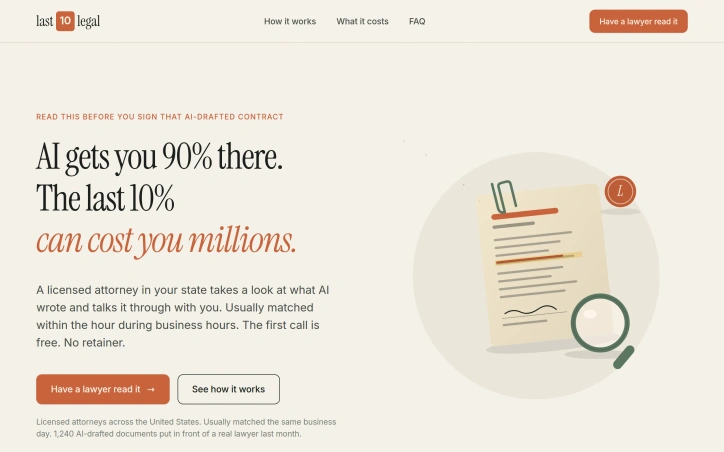
3 launchesAnyone who has asked ChatGPT or Claude to draft a contract, lease, NDA, demand letter, or will knows the output reads with convincing authority. The harder question is whether it holds up when someone tests it, and that gap is what last10legal targets. It is built for individuals and small operators who have already produced a document with an AI model and want a qualified person to check it before they sign or send it. The central pitch is direct: AI gets most of the way there, but the remaining portion is where costly errors hide. The site points to three recurring failure patterns. First, models do not track jurisdiction, so a clause drawn from one state's case law can fail in another. Second, a single missing recital, a wrong governing-law provision, or an unwitnessed signature can leave an otherwise polished agreement unenforceable. Third, filing and procedural rules, such as the number of witnesses a will requires or the certified-mail step before a demand letter can precede a lawsuit, vary by state and are easy for a model to get wrong. Naming these specifics gives the pitch more credibility than generic reassurance would. The workflow is deliberately light. Users submit whatever they have, in any format, without creating an account. The service matches them with a licensed attorney admitted in their state, typically within the hour during business hours. That attorney then reviews the document and walks through it by phone or video in a fifteen-to-thirty-minute initial consultation, explaining what stands out and whether formal representation is needed. On pricing, the model is clear. The match and the first consultation are free, with no credit card, account, or retainer required. If the user decides to hire the lawyer for further work, they agree on that fee directly with the attorney, and the company states it never bills the user. The chief strength is its focus. Rather than positioning itself as a replacement for legal counsel or offering AI-generated legal advice, it treats a human attorney as the quality check on AI output, which is a sensible division of labor. Prospective users should weigh a few considerations. The initial consultation is brief, the volume figures on the site are company-provided, and a short call cannot substitute for ongoing representation on complex matters. Even so, for anyone about to rely on an AI-drafted document, the offering addresses a real and specific risk at a low entry cost.

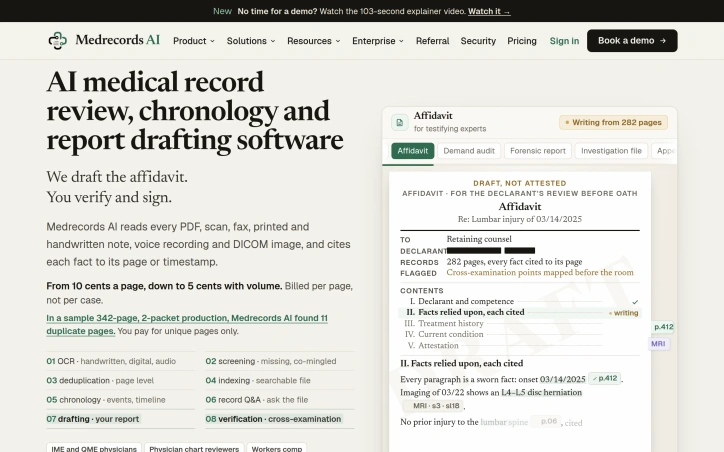
Legal and medical professionals drowning in paper handle a bottleneck that hasn't improved in decades: converting stacks of medical records into organized, usable documentation for litigation, insurance claims, and medical evaluation. Medrecords AI automates this workflow by processing medical files of any format—PDFs, scans, faxes, handwritten notes, voice recordings, and DICOM imaging—and transforming them into deduplicated, searchable chronologies and draft reports with source citations. The product targets a fragmented ecosystem of users. Personal injury law firms and defense counsel need comprehensive demand packages and rebuttal letters. Medical examiners, life care planners, and legal nurse consultants require specialized document formats like IME reports, life care foundations, and non-merit assessments. Insurance claims teams, workers compensation specialists, and utilization review nurses work with claims audits and MSA allocations. Veterans representatives handle appeal briefs. The software ships with templates for at least a dozen distinct output formats, acknowledging that different practitioners in the medicolegal space speak different languages. What distinguishes Medrecords AI is its approach to the economics of medical record processing. The company bills per deduplicated page rather than per case, and charges as little as five cents per page at volume. In a provided example, a 342-page file that contained 11 duplicate pages resulted in payment for 331 pages only. This pricing model directly penalizes waste and rewards efficiency rather than hiding costs in flat-fee per-case models that other document processing services use. The technical capabilities justify the pricing transparency. The platform reads handwritten and printed text, transcribes audio, processes medical imaging, flags missing records or co-mingled files, deduplicates at page-level granularity, builds searchable indices, generates event timelines, and extracts answers to record-specific questions. Each fact in a draft report is cited to its page or timestamp, creating an auditable trail from conclusion back to source material. Compliance features include HIPAA certification, SOC 2 compliance, US-only data hosting, and a Business Associate Agreement with every sub-processor. Draft documents are marked as attorney work product or confidential material depending on document type, addressing the legal protections practitioners need. The product doesn't claim to fully automate the medicolegal workflow. Reports emerge as drafts for human verification and final review, positioning Medrecords AI as an efficiency layer rather than a replacement for professional judgment. For practitioners accustomed to hiring contract reviewers or absorbing manual record organization work, the pricing and feature set offer concrete time and cost savings.

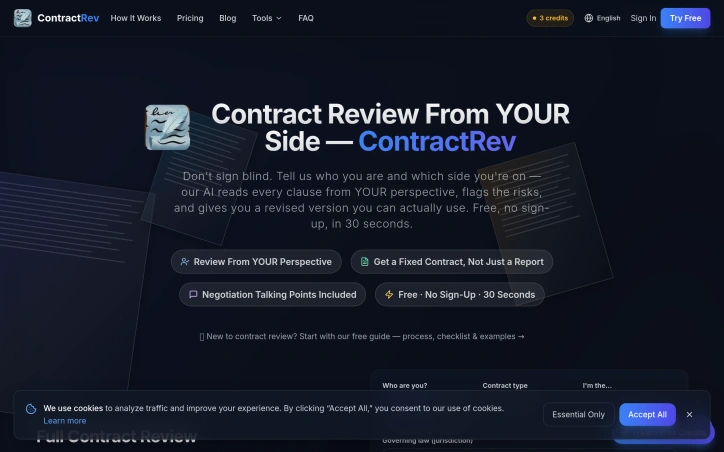
Contract negotiation traditionally relies on either expensive lawyers or generic templates, leaving most signers vulnerable to hidden risks. ContractRev fills this gap by delivering personalized risk analysis that adapts to the signer's role and position. The product targets anyone facing contractual obligations where the stakes matter but a full legal review isn't practical. Its core innovation is perspective-based analysis. Rather than applying uniform risk criteria, the platform asks users to specify their role (employee or employer, tenant or landlord) and analyzes every clause through that lens. This makes the output immediately actionable rather than academically thorough. Three design decisions distinguish the offering. First, it delivers a revised contract document with track-changes rather than just a written report. Risky language is struck through; suggested alternatives appear in blue. This removes friction from the negotiation phase because the revised version can go directly to the other party. Second, every risk flag includes negotiation talking points—specific language to use when pushing back. Third, it offers a quick check mode for single clauses at one credit cost, versus three for a full review, giving users fine-grained control over spending. The customization layer adds practical value. The platform allows users to set personal standards once—liability caps, confidentiality windows, governing law preferences—and then automatically flags deviations in future reviews. This effectively shifts contract work from reactive evaluation to enforcement of preset policies. The free tier removes onboarding friction. Users get three free credits to try the product without signing up or providing payment information. If satisfied, anonymous reviews are claimed after registration. Files are end-to-end encrypted and auto-deleted after analysis, demonstrating serious attention to privacy for sensitive documents. The pricing model operates simply. Credits scale by review type: one per single clause, three per full review. Specific pricing for additional credits isn't disclosed publicly. The freemium approach with no required signup front-loads conversion potential. ContractRev delivers immediate value for straightforward agreements like employment offers, tenant contracts, or vendor deals. For complex M&A documents or bespoke legal arrangements, it functions better as an initial screening tool than final authorization source. The reliance on AI analysis without lawyer certification will concern users handling high-stakes negotiations, though the product directly addresses a gap where people either pay expensive rates for legal review or negotiate blind.