Catalyst Healthspan Audit
Personal trainers typically sell training sessions. This startup reversed the equation by building assessment first, mak...
Launchory
We built Launchory to solve the discoverability problem for startups. Our platform offers instant approval, permanent do...
Best Marketplace sites Startups & Tools
Tools to buy/sell or build marketplaces.
Recently Listed
7 launches
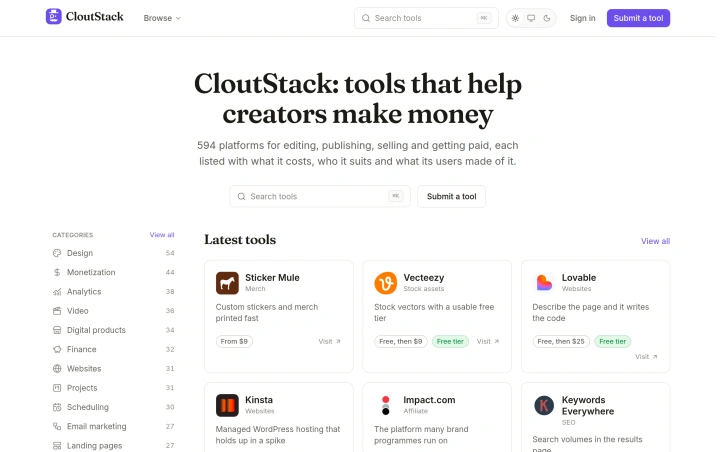
Creators building an audience spend considerable time researching and comparing tools for everything from video editing to newsletter platforms to affiliate networks. CloutStack consolidates this research into a single directory of 594 platforms organized across 49 categories, covering the entire creator economy stack from design and editing through publishing, analytics, monetization, and financial management. The directory's structure reflects real creator workflows. Rather than generic categorization, it groups tools by function and use case: design tools, video platforms, email marketing services, project management software, payment processors, and specialized creator-focused services like UGC work platforms and merch vendors. Each tool listing includes transparent pricing, target audience information, and user reviews, reducing the guesswork in tool selection. What distinguishes CloutStack is its coverage of the less glamorous but essential parts of creator business. Beyond the obvious video editing and publishing tools, the directory includes sections for accounting, legal, hiring, and brand deals—the administrative and commercial infrastructure creators often discover only through expensive trial and error. The inclusion of free tiers and pricing starting points, ranging from free with paid upgrades to one-time purchases like Procreate's $12.99, helps creators at different revenue stages find appropriate solutions. The platform functions as a browsable reference rather than a sales platform. A search function and categorized views make systematic exploration possible, while the inclusion of alternatives within each category prevents single-option thinking. Tool listings focus on functionality and cost rather than marketing language. CloutStack addresses a real friction point in creator workflows—the time spent evaluating tools is time not spent creating or building an audience. By aggregating pricing, reviews, and functionality in one place, it reduces the cognitive load of tool discovery. The directory proves particularly valuable for newer creators who lack networks for tool recommendations and for established creators filling gaps in their workflow. The breadth of coverage means creators at various stages and in different niches will find relevant options rather than defaulting to whatever tools rank highest in generic software reviews.

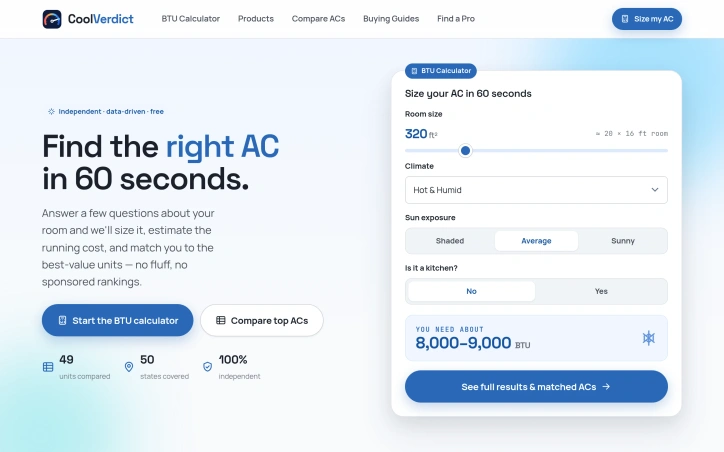
Navigating the air conditioning market leaves most homeowners confused by conflicting reviews and marked-up pricing. CoolVerdict addresses this fundamental problem by combining an automated BTU calculator with unbiased product comparison, helping consumers determine their exact cooling needs and find appropriately-sized units without sponsored rankings clouding the results. The service targets the typical homeowner facing an AC purchase decision. In roughly 60 seconds, users answer questions about room dimensions, local climate patterns, sun exposure, and whether the space is a kitchen. The tool then calculates the required BTU range and presents matching units from a database of 49 models across 50 states. The company emphasizes full independence—none of the recommendations carry paid placement or affiliate bias. What sets CoolVerdict apart is its focus on sizing accuracy. Rather than steering buyers toward expensive over-sized units or undersized bargains that fail to cool effectively, the calculator accounts for real variables: a 320-square-foot room in a cool climate requires different cooling capacity than the same space in a hot, humid region. This specificity reduces buyer's remorse and prevents wasted investment. The platform extends beyond the calculator itself. It connects homeowners with vetted local HVAC professionals to handle installation, converting the digital recommendation into an actual completed transaction. The site also curates an "HVAC Pulse" feed of industry news covering heat pump adoption trends, district-level cooling infrastructure decisions, and market forecasts, giving users broader context beyond their immediate purchase consideration. The problem CoolVerdict solves is real and widespread: consumers currently choose between trust and independence when evaluating AC units, and pricing remains opaque across the industry. By removing financial incentives from the recommendation engine, the company eliminates a central source of buyer confusion and manipulation. For homeowners in the market for a new AC unit, CoolVerdict cuts through noise and sizing confusion with data-driven recommendations. Its emphasis on climate-specific calculations and independence from sponsored placement addresses a genuine gap in how cooling systems are currently marketed and selected.

Cutting through the overwhelming selection of AI and creative tools requires more than a search engine. Yooiu tackles this problem head-on as a curated directory designed specifically for creators and developers who need to evaluate and adopt new products quickly. Rather than surfacing everything the internet has to offer, the platform filters products through a handpicked lens, emphasizing tools that address genuine problems. The directory spans a wide range of categories: image generation, writing assistance, code generation, and various AI-powered applications. Recent products include academic tools like StudyX and TeachQuill, creative utilities like digibouquet and a PNG-to-SVG converter, assessment tools like the ADHD Test and facial analysis apps, and niche applications such as Destinininja, a life-sim game, and Suivi Feu Medoc, which tracks wildfire data in real time. This breadth reflects both the sprawling nature of the AI and creative tools market and the platform's ambition to be genuinely comprehensive. What distinguishes Yooiu is its organizational structure. The platform organizes products into Featured, Premium, and Newest sections, allowing users to navigate by either hand-picked quality or recency. Featured products get prominent placement with descriptions that emphasize privacy and functionality—Love Meter shares results through an unguessable token and noindex directive, while Bento Page enforces architectural privacy with no telemetry. This attention to privacy-preserving details indicates the platform curates not just for functionality but also for responsible design practices. The platform's monetization includes a premium placement tier. Creators can opt for faster approval and greater visibility by listing products on paid plans, establishing a revenue stream from product makers seeking promotion alongside free, organically-discovered listings. The platform's discovery interface prioritizes browsing over searching, with ranking lists and category-based navigation that encourage exploration. For creators and developers fatigued by endless tool evaluation, this curation offers real value. The curated approach, however, inherently limits breadth—any product not in Yooiu's collection remains undiscovered through this platform, and the curation criteria, while emphasizing quality and real-world utility, remain largely implicit.


For indie makers and SaaS founders struggling to gain visibility in a crowded market, BacklinkLog positions itself as a shortcut—a curated directory designed to connect emerging products with discovery-minded audiences. Rather than betting on organic search or paid ads alone, the service offers a dedicated listing page that aggregates the key information potential customers need: product descriptions, screenshots, category tags, and direct links. The directory's value proposition rests on three operational claims. First, listings reach search engine indexes within 24 hours, suggesting visibility acceleration beyond typical website indexing timelines. Second, placements remain permanent as long as the subscription holds, eliminating the rotating feature carousel common in other directories. Third, each listing gets structured markup and keyword optimization to improve discoverability through both search engines and the directory's internal taxonomy. The product emerges at an interesting inflection point. Marketplace directories for indie products have proliferated—ProductHunt, Indie Hackers, and various niche aggregators all compete for founder attention. BacklinkLog's differentiation hinges on permanence and search integration rather than the social ranking or community voting mechanisms that dominate competitors. This reflects a deliberate bet that founders care more about sustained, indexable visibility than viral launch moments. The approval process advertises instant turnaround and a seven-day refund window, removing friction from the onboarding path. The absence of hidden fees is mentioned explicitly, suggesting prior frustration in the category warranted this emphasis. Beyond the standard listing tier, Premium and Sponsor options exist, with sponsors receiving featured badges and priority placement—a tiered model that mirrors conventional directory economics. The directory itself showcases products across various categories: travel compliance trackers, philosophy apps, file management tools, cash flow forecasting software, AI receptionists, and AI automation assistants. This heterogeneity suggests either broad acceptance criteria or effective long-tail positioning. The core tension: whether permanent listings and 24-hour indexing sufficiently justify subscription costs when free alternatives and social platforms already serve founder discovery. BacklinkLog's answer is that lasting visibility, earned through structured data rather than viral luck, matters more than novelty. Whether that resonates depends on individual founder priorities.

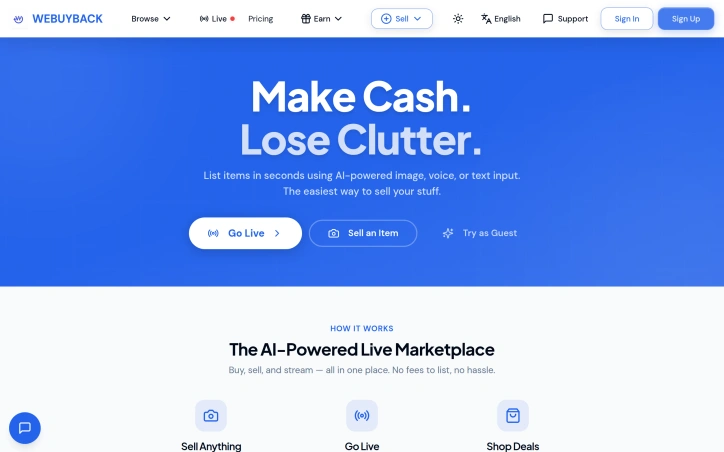
Simplifying the secondhand resale experience has become a critical gap in the marketplace as Gen Z seeks friction-free ways to monetize possessions they no longer need. WeBuyBack confronts this challenge by stripping away the complexity that plagues traditional resale platforms, where lengthy listings, unclear pricing, and cumbersome processes actively deter sellers despite significant demand for these goods. The core insight is straightforward: younger sellers prioritize speed and convenience above all other factors. Rather than requiring detailed product descriptions, multiple images, and buyer negotiations, WeBuyBack collapses the selling process into its essence—snap a photo, post it, receive payment. This friction reduction represents the platform's primary competitive advantage and the rationale behind its positioning as the antidote to modern digital clutter management. The target demographic is explicit and precise: Gen Z users drowning in unwanted items who view accumulation not as legacy goods to carefully price but as potential quick cash. For this audience, the traditional marketplace experience isn't merely slow—it's fundamentally misaligned with their expectations and ingrained behavioral patterns. WeBuyBack operates on the thesis that many sellers would gladly accept lower prices in exchange for saved time and simplified processes, a value exchange that resonates deeply within this generation. The platform emphasizes accessibility and speed as its defining advantages. The ability to participate without navigating complex product categorization or managing individual buyer interactions appeals to a generation raised on application experiences centered around single-action workflows and instant gratification. By automating or eliminating intermediate steps, WeBuyBack removes psychological friction that prevents participation. The available public information does not address pricing mechanisms, commission structures, or specific feature capabilities beyond the core selling workflow. The founder's framing prioritizes ease of use and market alignment over technological innovation, indicating the business model depends on transaction volume and velocity rather than premium features or advanced seller tools. The critical question for WeBuyBack is whether the promised simplification of resale can sustain user engagement and transaction frequency beyond initial novelty, and whether the unit economics of quick, low-friction transactions support a sustainable business long-term. The insight is sound and the positioning is clear, but execution at scale in a crowded resale market remains unproven.

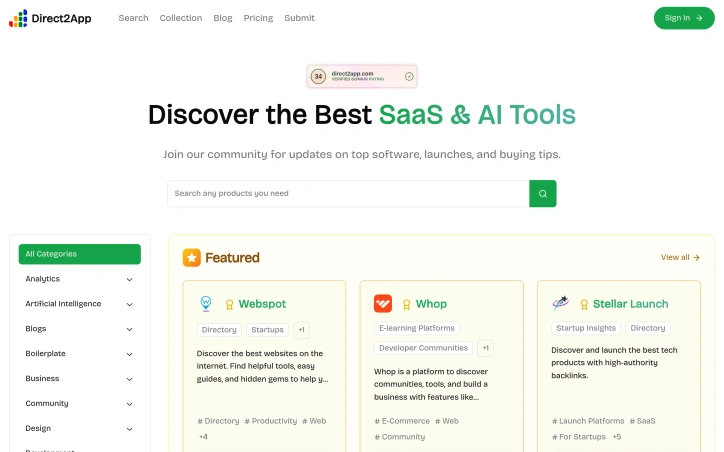
Finding the right software solution in a crowded marketplace has become its own problem. Direct2App tackles this by functioning as a curated directory and discovery platform for SaaS and AI tools, aimed at both technology buyers overwhelmed by options and startup founders struggling for visibility. The platform organizes tools across numerous categories—from Analytics and Artificial Intelligence to Marketing and Software as a Service—allowing users to browse, compare, and discover solutions rather than relying solely on generic search results or paid advertising. The community component encourages ongoing engagement, positioning it as more than a static directory; members receive updates on new launches and purchasing guidance. What distinguishes Direct2App is its dual-market approach. While the platform serves end users seeking vetted software solutions, it simultaneously operates as a distribution channel for SaaS companies and early-stage startups. The "Sell With Boost" marketplace feature enables founders to showcase their products alongside carefully curated listings, gaining exposure to an audience actively searching for new tools. This creates natural incentive alignment—the platform succeeds when it attracts serious tool-seekers, which in turn draws quality submissions from builders. The emphasis on curation appears central to its value proposition. Rather than functioning as an open submission dump like some directories, Direct2App surfaces featured products, suggesting editorial judgment about what belongs at the top. This curation helps users avoid decision paralysis and makes a listing more meaningful—a featured spot carries weight precisely because it isn't automatically granted to everything submitted. The platform also appears to recognize the importance of technical visibility for startups. The mention of "dofollow backlinks" indicates that Direct2App positions itself as a channel not just for discovery but for search engine optimization, where a listing provides both direct traffic and domain authority benefits for featured products. This is particularly relevant for bootstrapped founders who cannot afford premium advertising but understand the compounding value of backlinks. The categorization strategy spans a wide range of software types rather than narrowing to a single niche, which increases the platform's relevance across different professional contexts. A designer can discover productivity tools alongside a finance professional seeking analytics solutions. For technology buyers, Direct2App simplifies the research phase of vendor selection. For startup founders, it offers an accessible venue for distribution and authority building without requiring paid marketing spend—though the platform itself monetizes through its marketplace positioning.

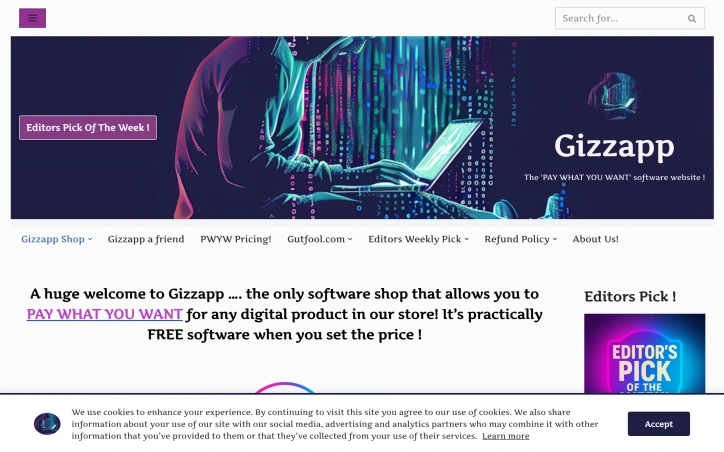
The fundamental tension between software creators and users over pricing finds an unconventional answer in this digital product marketplace. By letting customers set their own price for any software download, the platform directly addresses a persistent frustration: the climbing cost of digital tools that regularly exceed $50, $100, or more per license. Gizzapp targets anyone priced out of traditional software markets—freelancers on tight budgets, students, small business owners, and privacy-conscious users who want tools without premium pricing barriers. The model itself is the primary differentiator. Rather than fixed pricing tiers or subscription models, purchasers name their own price at checkout, creating a direct relationship between perceived value and actual payment. The current catalog emphasizes security and privacy tools alongside practical utilities. Encryption software like CipherVault offers military-grade AES-GCM protection for sensitive files. IP masking tools and proxy finders help users manage their digital footprint. Email management solutions address list cleaning and deduplication. Video and audio conversion tools round out the technical capabilities, while WordPress plugins and SEO utilities serve the website-building audience. YouTube downloading functionality is also available. The breadth of categories—spanning encryption, downloaders, email tools, proxy checkers, and conversion software—positions the marketplace as a generalist store rather than a niche-focused platform. This diversity appeals to users seeking a single destination for varied software needs, though the wide range of products raises questions about curation and quality consistency across different categories. The "pay what you want" model creates inherent tension. For customers, it's liberating: users might download premium tools for minimal cost or freely evaluate software before deciding its worth. For creators, the model depends entirely on customer goodwill and honesty. The platform mentions donations for some products, signaling that voluntary contributions likely won't sustain all offerings indefinitely. Whether this pricing approach achieves sustainable scale remains uncertain, but the concept challenges conventional software distribution by prioritizing accessibility over profit margin—a positioning that fundamentally reorders expectations around what digital tools should cost.