uploadthefile.com
Sharing files and publishing static content has long required friction: account creation, platform navigation, or comman...

CrabTap
Small businesses have long struggled to implement loyalty programs without massive overhead. CrabTap addresses this gap...

Catalyst Healthspan Audit
Personal trainers typically sell training sessions. This startup reversed the equation by building assessment first, mak...
Best Messaging apps Startups & Tools
Apps for real-time chat, calls, and collaboration.
Recently Listed
2 launches
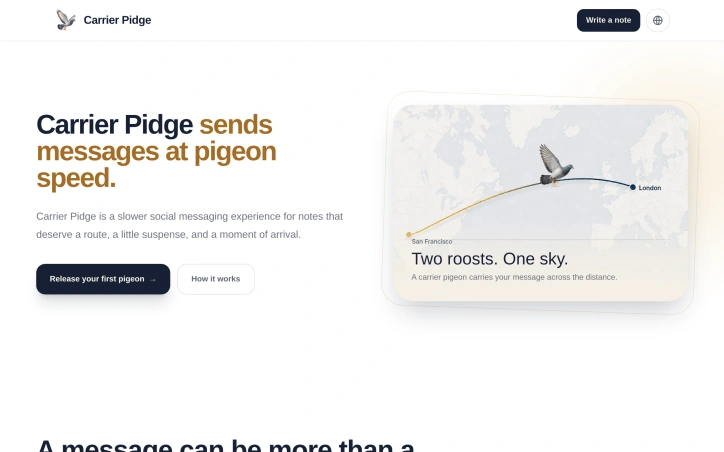
In an era of instant notifications and performance-driven messaging, Carrier Pidge inverts the urgency. It solves the problem of meaningful messages getting lost in the noise of constant connectivity by introducing deliberate delay as a feature, not a limitation. The platform targets anyone seeking to reclaim the lost art of correspondence—people who want their written thoughts to be read as something worth receiving rather than something to respond to immediately. The core concept rests on an elegant metaphor: messages travel between friends as digital carrier pigeons following a visible route across a map. This transforms waiting from a frustration into part of the experience. When you compose a note, you designate one confirmed friend as the recipient, release your pigeon, and watch its progress in real time. The system calculates an estimated arrival based on the distance between approximate roost locations—regions rather than exact addresses—allowing you to track the journey without compromising privacy. What makes Carrier Pidge distinctive is how it removes the psychological burden of instant messaging. There are no read receipts, no expectation of immediate response. A message lands at its destination and finally gets a moment of genuine attention. This philosophy extends to the interaction model itself: one-to-one exchanges with confirmed friends only, eschewing the broadcast nature of most modern platforms. The feature set supports this slower tempo thoughtfully. Users write a note, select a recipient, and release it. The flight path appears on a map with real-time tracking and changing ETAs, giving the distance between friends narrative weight rather than treating it as an obstacle. The approximate location system preserves meaningful geography—you see broad regions where friends are based—without exposing precise coordinates or enabling live tracking. The product operates globally with multi-language support and integrates friend discovery through existing social platforms or username lookups. Once someone requests to connect, the sending friend must confirm, establishing a mutual relationship before messages can flow in either direction. Carrier Pidge addresses a specific human need overlooked by the urgency economy: the desire to write something personal and have it genuinely received rather than merely consumed. Whether it resonates depends on whether users embrace slowness as a feature worth their time.

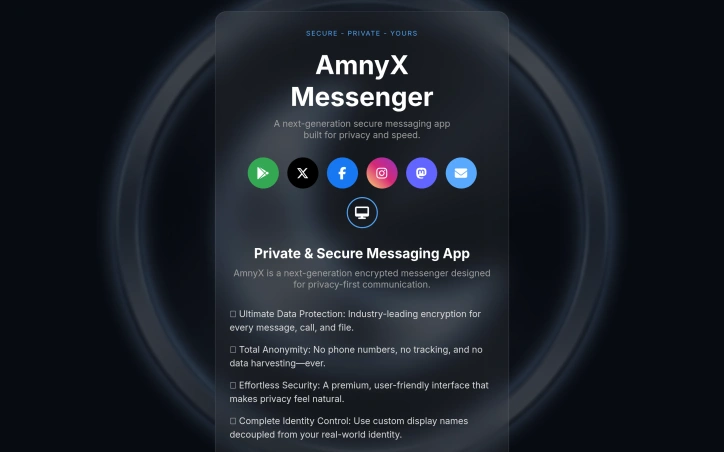
Privacy-conscious users seeking an alternative to mainstream messaging platforms will find AmnyX Messenger positioned as a comprehensive solution for encrypted communication. The product targets individuals and groups who prioritize confidentiality over convenience, offering a messaging and calling service built around end-to-end encryption across all message types, voice calls, and file transfers. What distinguishes AmnyX from a crowded market of privacy-focused messaging apps is its deliberate approach to user anonymity. The platform operates without requiring phone numbers for registration, eliminating one of the most common identifiers used to track users across services. More significantly, it decouples display names from real-world identity, allowing users to maintain complete control over how they present themselves to contacts. This design choice directly addresses a fundamental privacy concern: that authentication mechanisms themselves often become vectors for surveillance or data collection. The platform's integration of Tor Network support for metadata masking represents another technical commitment to privacy beyond just message content. While encryption protects what users send, metadata—information about who is communicating with whom, when, and how frequently—can reveal sensitive behavioral patterns. By offering Tor integration, AmnyX extends privacy protections to this often-overlooked layer of digital communication. The user interface is designed to lower the barrier to adopting privacy tools. A common criticism of security-focused software is that robust privacy features create friction or complexity for end users. AmnyX positions strong encryption and security as intuitive and natural rather than cumbersome. This signals targeting not just security enthusiasts but broader audiences who want privacy without developing technical expertise. The company's framing—that the app answers a widespread demand for genuinely secure communication—points to a market opportunity. As data breaches, surveillance concerns, and privacy regulations continue to proliferate, the appeal of tools offering strong technical guarantees around user data becomes increasingly compelling. No pricing information is disclosed in available materials, making it unclear whether AmnyX operates on a freemium model, subscription basis, or alternative monetization approach. This detail would be relevant for prospective users evaluating long-term viability and commitment costs.