Catalyst Healthspan Audit
Personal trainers typically sell training sessions. This startup reversed the equation by building assessment first, mak...

Xtra Hands Family Chore App
Household chore management remains one of parenting's persistent friction points, and Xtra Hands positions itself as the...
Best Predictive AI Startups & Tools
Tools that analyze patterns to forecast outcomes across research, trading, and marketing.
Recently Listed
6 launches
Seeking personal insight through alternative means has gained mainstream acceptance, but most digital offerings in this space either demand lengthy questionnaires or present themselves with unearned certainty. This AI-powered palm reading service takes a different approach by condensing the experience into a single photograph, making self-reflection accessible without requiring existing knowledge of palmistry. The product addresses a genuine gap in the wellness and self-discovery market. People curious about exploring their patterns through palmistry traditionally faced barriers: finding a practitioner, paying professional rates, or learning the symbolic language from scratch. This service removes friction by automating the interpretation of four primary palm lines—life, head, heart, and fate—using artificial intelligence to translate visible patterns into readable, personal narratives. What distinguishes the offering is its restraint. Rather than making definitive claims about destiny, the platform positions itself as a tool for reflection. Users provide a clear palm photo along with their name and birthday, then receive a personalized reading that can be saved or shared. The interface emphasizes clarity with an overall palm score, thematic summaries, and plain-language explanations of what different palm features traditionally signify. An example reading showed categories like energy, action, love, and calm, suggesting the system weaves multiple palm characteristics into a cohesive narrative rather than offering disconnected data points. The core features include automated line tracing, interpretation of traditional palmistry symbols (ring finger length, thumb strength, marriage lines, and finger proportions), and the ability to revisit or download results. The promised one-minute turnaround prioritizes quick gratification over complexity, which aligns with how many people approach wellness applications today—something between curiosity and genuine engagement. The business model remains unexplained in available materials, though the prominent "free" language suggests either a freemium structure, ad-supported model, or future monetization path not yet detailed. The real test of this product lies in whether users find genuine value in AI-interpreted palmistry or treat it as novelty entertainment. The emphasis on making self-discovery approachable and thoughtful indicates sincere intent, though palm reading itself carries inherent skepticism among rationalist audiences. For those genuinely interested in alternative reflection tools or curious about palmistry without commitment, the service removes enough friction to warrant trying.


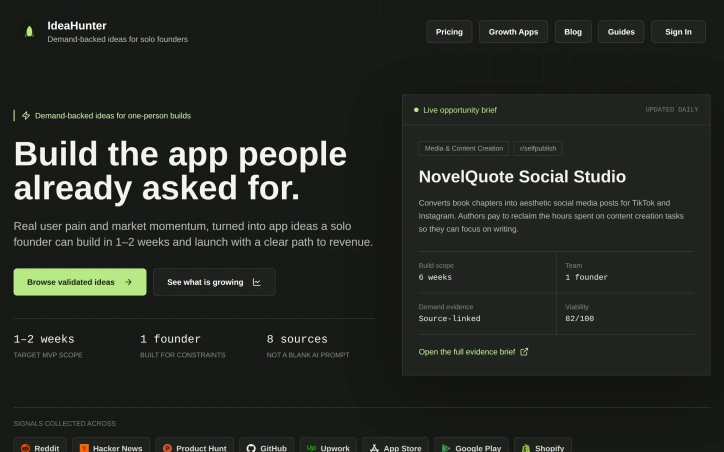
Building a startup idea that won't die after the first two weeks requires both market demand and realistic scope. IdeaHunter addresses a specific need for solo founders and indie hackers: finding app ideas grounded in actual user pain rather than theoretical possibilities. The platform aggregates public signals from eight sources, including Reddit, Hacker News, Product Hunt, GitHub, Upwork, and both major app stores, then synthesizes these signals into structured opportunity briefs. The product's core value proposition centers on constraints rather than limitless possibilities. Most idea databases optimize for novelty and ambition; IdeaHunter filters for what a single person can actually build. Each idea listing specifies a target MVP scope measured in one to two weeks, identifies the specific buyer, articulates the painful job to be solved, and sketches a monetization path. This is not theoretical brainstorming. Each opportunity includes the raw market signals that motivated it, so a founder can inspect the complaints, requests, or job postings that validate demand exists before writing any code. What distinguishes IdeaHunter from broader entrepreneurship content is its insistence on evidence. The platform displays the research trail behind each idea rather than presenting polished conclusions. A founder can see why an opportunity matters by reviewing the source signals that generated it. The daily update cycle means the platform captures emerging trends in near-real time. The product also positions itself against AI-generated idea lists. Rather than offering algorithmic output optimized for novelty, it surfaces patterns from where real people describe their broken workflows and unmet needs. The methodology is transparent: repeated signals across public platforms get distilled into a buildable wedge, then compared against products already showing visible market momentum. Beyond the core idea database, the platform includes guides and checklists aimed at the whole founder journey, from selecting ideas through building and launching. One notable inclusion is guidance on guardrails for AI-assisted code generation, acknowledging that solo builders often rely on AI tools but need frameworks for safe deployment. No pricing information appears in the available content, so the business model remains undisclosed. Regardless, the product solves a genuine problem: founders spend significant time sorting through noise to find ideas worth pursuing. IdeaHunter cuts through that noise by surfacing only opportunities backed by demonstrated demand and buildable within the constraints of one person's time and resources.

Tarot readings traditionally occupied a niche intersection of spirituality and mystique, often requiring in-person sessions with expensive practitioners and demanding significant prior knowledge to interpret results. iTarot addresses this gatekeeping by combining traditional 78-card tarot with AI-powered interpretation, making the practice accessible to beginners and non-English speakers alike. The platform supports 15 languages and offers 25 different card spreads ranging from simple single-card pulls to complex multi-card layouts designed for specific life domains—relationships, career decisions, personal growth, and long-term trajectory. Rather than presenting isolated card meanings, the AI component differentiates itself by explaining how cards relate to one another, analyzing upright and reversed positions, and offering structured, actionable interpretations tailored to the user's specific question. Accessibility extends beyond language support. The site includes a comprehensive help center addressing common misconceptions about tarot's predictive power, explicitly clarifying that readings reflect current energy and possibilities rather than fixed fate. This ethical framing discourages users from employing tarot to circumvent professional advice on medical, legal, or financial matters—a responsible boundary that strengthens rather than weakens the product's credibility. Beginners can start with explanations of all 78 card meanings before diving into complex spreads. The business model uses a freemium approach: basic readings and card meaning lookups are available without payment, while unlocking the AI deep-report analysis requires purchase. Stripe and Alipay are supported, indicating deliberate geographic focus toward global audiences, particularly Asia. What distinguishes iTarot is its positioning at the intersection of ancient divination practice and modern generative AI—a combination that makes subjective interpretation feel more systematic and transparent. Whether users consult tarot for genuine spiritual guidance or self-reflection exercises, the product acknowledges the distinction without judgment. The interface layers structure and clarity over mystique, making it suitable for skeptics and believers alike to explore tarot as a decision-making aid or personal journaling prompt.


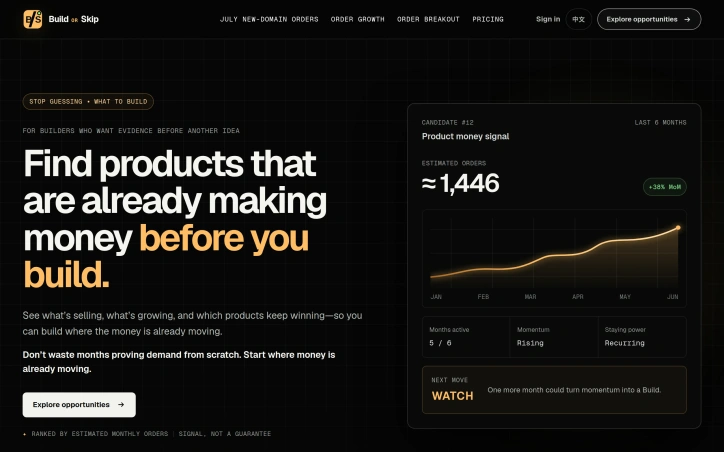
Finding a viable product idea requires more than intuition. Build or Skip addresses a core challenge for independent builders and early-stage SaaS teams: deciding which opportunity merits months of engineering effort versus which should be abandoned. Rather than building in isolation and hoping customers appear, the platform inverts the validation process by identifying products already generating commercial traction. The product works by tracking observable market signals across candidate products, using these indicators to estimate monthly order volume and compare growth patterns over time. This approach acknowledges a fundamental truth: money leaves a trail. Instead of surveying potential users or conducting customer interviews from scratch, builders can tap into real purchasing behavior to validate demand before committing significant resources. The platform's decision framework is its most useful component. Products are categorized into three buckets: Build for opportunities showing strong order volume, accelerating growth, and recurring signals across multiple months; Watch for products with momentum but insufficient baseline data or observation history; and Skip for weak, fading, or inconsistent signals. This three-tier system removes ambiguity and forces prioritization. What distinguishes Build or Skip is its transparency about limitations. The platform explicitly states that estimated orders represent model outputs, not verified revenue or private transaction data. It acknowledges the difference between identifying where payment intent may be building and proving actual revenue and product-market fit. This intellectual honesty is rare in tools claiming to solve discovery problems and suggests realistic expectations. The ranking methodology weighs three dimensions: meaningful order scale, momentum as both percentage and absolute growth, and staying power measured by recurring monthly signals. Rather than chasing one-month spikes, the platform rewards products that demonstrate consistent commercial activity across multiple observation windows. This reduces noise from temporary trends. The core value proposition centers on founders who feel paralyzed by option overload or skeptical of their own market intuition. By showing what money is already moving, the platform shifts validation from pure guesswork to evidence-informed decision making. It won't prove that a specific idea will succeed, but it can redirect energy toward opportunities with demonstrated demand rather than speculative ones. The tool serves a specific audience: builders operating under time and resource constraints who prioritize speed and evidence over certainty. For this group, reducing the number of failed bets matters more than achieving perfect conviction before starting.
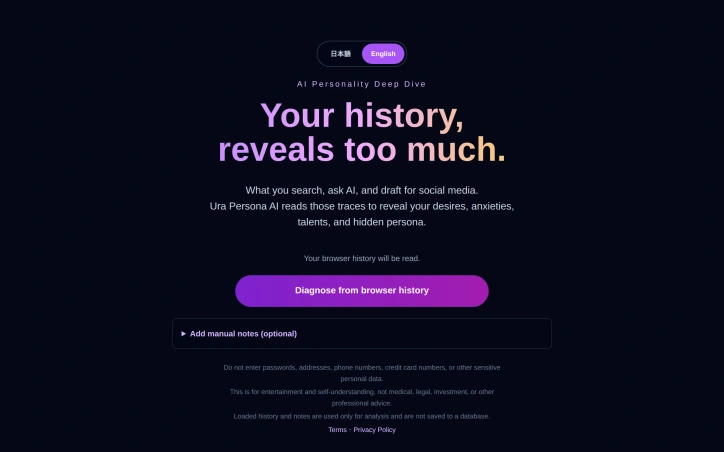
In an era when our digital traces accumulate silently—searches, draft posts, AI conversations—this application offers a different kind of self-reflection: analyzing your own data to understand patterns about desire, anxiety, and hidden interests. The product targets people curious about what their online behavior reveals about their deeper self, positioning itself squarely as entertainment and personal insight rather than any kind of professional guidance. The core offering is straightforward. Users provide their browser history and can optionally add AI chat logs, social media drafts, diary notes, or email excerpts. The application processes these inputs to generate a personality profile based on repeated patterns and behavioral signals. The technology identifies what matters to you through what you choose to search for, explore, and draft—treating your digital footprint as a window into unstated desires and anxieties. What distinguishes this product is its deliberate privacy stance. Rather than storing input data in a server database, the analysis happens client-side, with results cached only temporarily in the browser itself. This addresses a fundamental tension: people want insights into themselves, but hesitate to upload sensitive material to unknown servers. By keeping data local to the user's device, the tool removes that friction without requiring trust in cloud infrastructure. The application is bilingual, available in both English and Japanese. A clear disclaimer appears throughout the interface, specifying that outputs are for entertainment and self-understanding, not medical, legal, or investment advice. The tool explicitly forbids users from entering passwords, addresses, payment information, or other credentials, recognizing the risks of aggregating sensitive data. Result accuracy depends on input quality. The more concrete and specific the material provided, the sharper the analysis. Thin inputs produce thin outputs. This reflects honest positioning about algorithmic capabilities. The pricing structure remains unspecified in available materials. Whether the tool operates as free, freemium, or paid remains unclear. For now, Ura Persona AI occupies a narrow but distinct space: treating your own digital history as a source of self-knowledge, with privacy built into the architecture rather than as an afterthought.

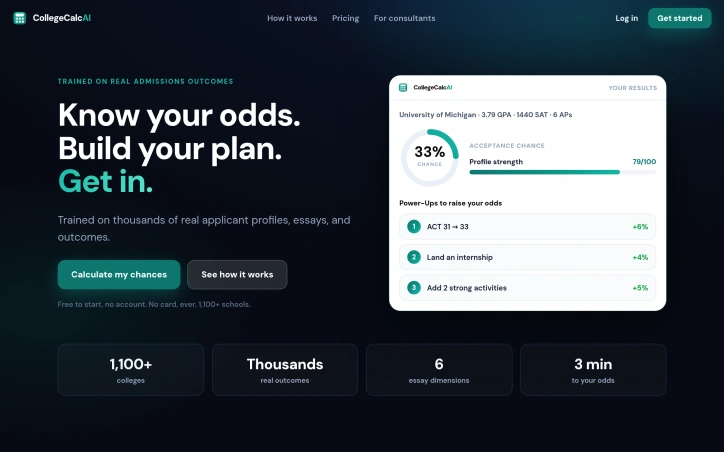
Navigating the complex college admissions landscape can be daunting for students, with numerous factors influencing their chances of acceptance. CollegeCalcAI directly addresses this challenge by providing a data-driven platform that empowers students to understand their odds of getting into specific colleges and universities. The platform is designed for high school students seeking to make informed decisions about their college applications. What stands out about CollegeCalcAI is its use of real admissions outcomes to train its AI models, allowing it to provide personalized and accurate estimates of a student's chances of acceptance. The platform considers a wide range of factors, including academics, test scores, extracurricular activities, awards, and essays, to give students a comprehensive understanding of their profile strength. The platform's key features include a free acceptance calculator that provides instant odds for over 1,100 colleges, along with a profile score and suggested "Power-Ups" to improve their chances. For a deeper analysis, the Advanced AI feature offers school-specific insights, highlighting a student's strengths, gaps, and next moves. Additionally, the platform provides essay review services, scoring essays against the target school's expectations. CollegeCalcAI operates on a freemium model, with the basic acceptance calculator available for free and no account required. Upgrades are available for students seeking more in-depth analysis, with the Advanced AI feature priced at $9.99 per month. The essay review service is available for $19.99 per month or $89.99 per year, with a 7-day free trial offered. Overall, CollegeCalcAI provides a valuable resource for students navigating the college admissions process, offering data-driven insights to inform their application strategies.