Xtra Hands Family Chore App
Household chore management remains one of parenting's persistent friction points, and Xtra Hands positions itself as the...
Catalyst Healthspan Audit
Personal trainers typically sell training sessions. This startup reversed the equation by building assessment first, mak...
Best Safety and Privacy platforms Startups & Tools
Tools that guard data and identities.
Recently Listed
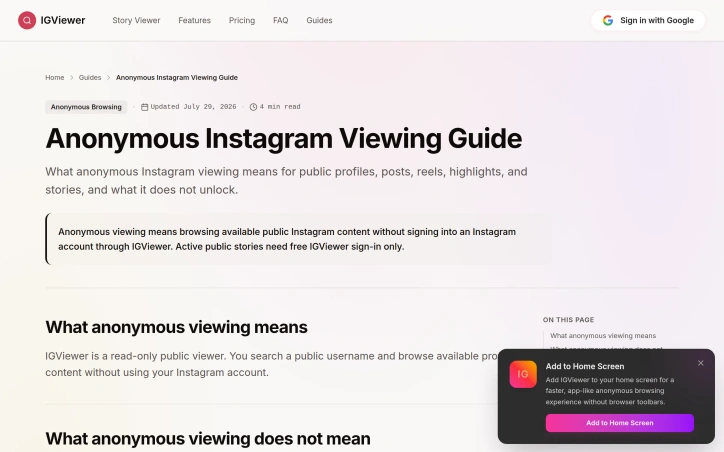
2 launchesAnonymous Instagram browsing has practical applications across research, competitive analysis, and casual content discovery, yet it typically requires logging in to your own account and notifying profile owners. This tool strips away those frictions by offering a read-only web interface that displays publicly available Instagram profiles, posts, reels, highlights, and stories without requiring users to authenticate with Instagram credentials. The product targets several audiences: researchers studying public Instagram data, content creators benchmarking competitor metrics and studying optimal posting times, and casual users who simply want to explore profiles without engagement friction. The core value proposition centers on privacy preservation—users never hand over Instagram passwords, and browsing activity remains unattached to their Instagram account, so profile owners receive no notifications of visits. What distinguishes this offering is its transparent scope limitation. Unlike tools that promise access to private content, IGViewer explicitly acknowledges what it cannot do: unlock private accounts, access hidden stories, view private messages, or bypass Instagram's security. It operates strictly within publicly accessible content, which removes legal and ethical ambiguity. The feature set reflects this focused approach. Users can preview recent public reels, browse highlight collections, and search public profiles. For creators, additional tools help with posting strategy—generating captions with hashtags, identifying optimal posting times, and planning carousel structures. The viewer includes separate interfaces for profiles, reels, stories, and highlights, each tailored to its content type. Monetization relies on a credit-based model layered atop a free tier. Initial browsing carries no cost: the first two pages of posts or reels are free, with older pages consuming one credit each. Highlights introduce a slightly higher barrier—users receive one free unlock daily, then additional unlocks cost two credits per profile. The business model surfaces real constraints on the tool's usage without creating a hard paywall for casual exploration. The positioning emphasizes safety for users compared to tools that harvest login credentials. IGViewer's read-only architecture and reliance on publicly available content align the product with Instagram's terms of service, a critical consideration for tools operating in Instagram's ecosystem.

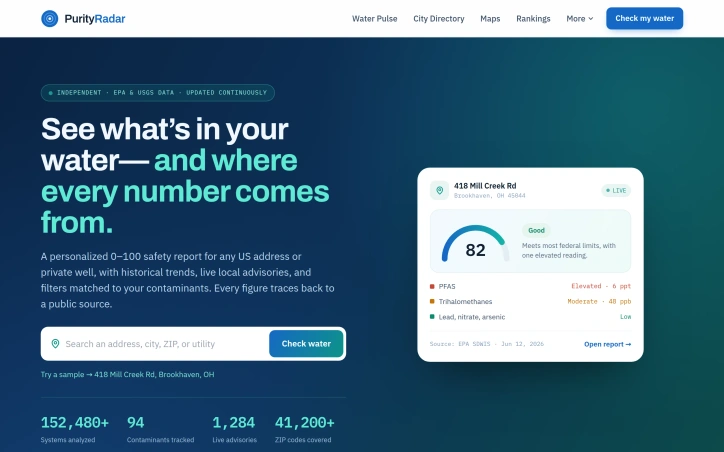
Most water quality checkers reduce the complexity of contamination risk to a single number, leaving residents with incomplete information about what's actually flowing from their taps. PurityRadar addresses this gap by transforming fragmented EPA and USGS data into personalized safety reports that span historical trends, localized advisories, and traceable sourcing. The platform targets homeowners and renters concerned about water quality—particularly those on private wells, where most existing tools provide no data at all. By modeling contamination risk across geographic areas using USGS datasets, PurityRadar extends beyond municipal systems to serve populations typically excluded from water quality monitoring. What distinguishes this product is its fundamental commitment to transparency. Rather than presenting opaque scores, each reported figure links directly to its original EPA or USGS source, stamped with publication dates and expert reviewer attribution. This sourcing architecture removes the black box element that undermines trust in competing tools. For users, this means tracing the chain from their address down to the actual data collection point—no anonymous algorithms, no hidden adjustments. The feature set reflects this philosophy throughout. Historical trend visualization shows how water quality has shifted over years rather than capturing a static snapshot. Live local advisories for boil-water orders and main breaks arrive geographically targeted, avoiding the false certainty of stale information. The 0-100 safety scoring framework remains accessible for quick assessment, but it functions as an entry point rather than the entire answer. Contaminant-specific filters let users focus on substances relevant to their location and risk profile. Coverage spans major US cities—the site samples New York, Los Angeles, Chicago, Houston, and others, breaking down contamination profiles by specific systems and flagged facilities within each region. Private well modeling represents a competitive advantage, as most water quality tools omit this segment entirely. The platform builds on public data sources—EPA Safe Drinking Water Information System records and USGS databases—creating a sustainable foundation that sidesteps the common bottleneck of proprietary testing requirements. Users cannot debate the underlying facts, only their interpretation, which refocuses the conversation toward actionable decision-making rather than score-chasing and brand loyalty.