Xtra Hands Family Chore App
Household chore management remains one of parenting's persistent friction points, and Xtra Hands positions itself as the...
Catalyst Healthspan Audit
Personal trainers typically sell training sessions. This startup reversed the equation by building assessment first, mak...
Best Startup financial planning Startups & Tools
Budget, model revenue, track burn/runway, and prep fundraising.
Recently Listed
2 launches
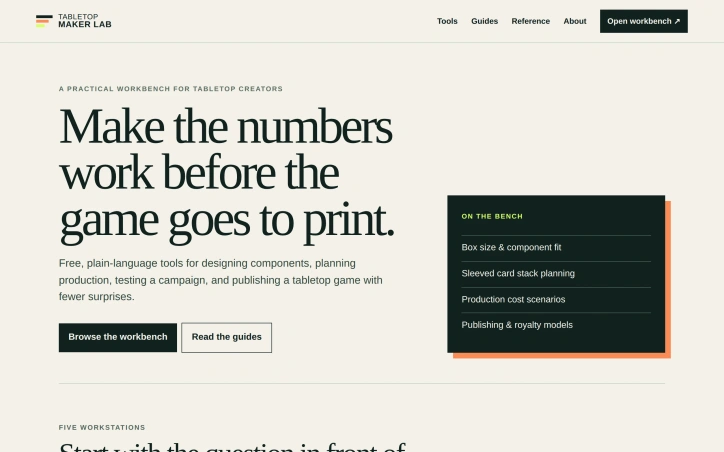
Creators designing board games face a recurring challenge: validating whether their physical designs and economic models make sense before committing to print. Tabletop Maker Lab addresses this friction point by offering free calculators and planning tools built specifically for tabletop creators navigating the decisions between prototype and production. The platform organizes its toolset around five core areas of creator concern: game mechanics testing, component planning, production cost modeling, crowdfunding campaign analysis, and publishing deal structures. Rather than attempting to replace manufacturer quotes or legal contracts, each calculator is anchored in transparent inputs that creators can customize with their own assumptions about manufacturing partners, shipping logistics, and campaign parameters. What distinguishes this offering is its commitment to removing obfuscation. The tools provide no hidden assumptions and no invented scenarios—creators enter their own numbers and see real outputs. This approach reflects a practical understanding that board game economics vary wildly by scale, region, and production method. A launched tool called the Landed Cost Calculator addresses the specific pain of understanding per-copy expenses across manufacturing and logistics. The Box Size Estimator forces creators to think through physical fit before selecting cardboard dimensions. The Board Game Royalty Calculator lets designers compare different publishing deal structures with explicit variables exposed. Beyond the calculators themselves, the platform includes guides and reference materials designed to build creator fluency. These resources teach what metrics matter, what questions to ask manufacturers, and which assumptions warrant deeper scrutiny. This positions the tools not as black boxes but as part of a learning system. The free model is notable. Most game design resources either charge for access or lock advanced features behind paywalls. Making these fundamentals free removes a barrier for independent creators and hobbyists who might otherwise proceed without validated assumptions. For bootstrapped game designers or first-time creators without capital for professional consulting, this represents genuine utility. The positioning avoids the trap of overselling. The lab describes itself as anchoring tools in development—a workbench rather than a complete solution. Creators still need actual manufacturer quotes, legal review of publishing deals, and crowdfunding expertise beyond what any calculator provides. What Tabletop Maker Lab does is collapse the time between having a game idea and having validated assumptions worth building on.
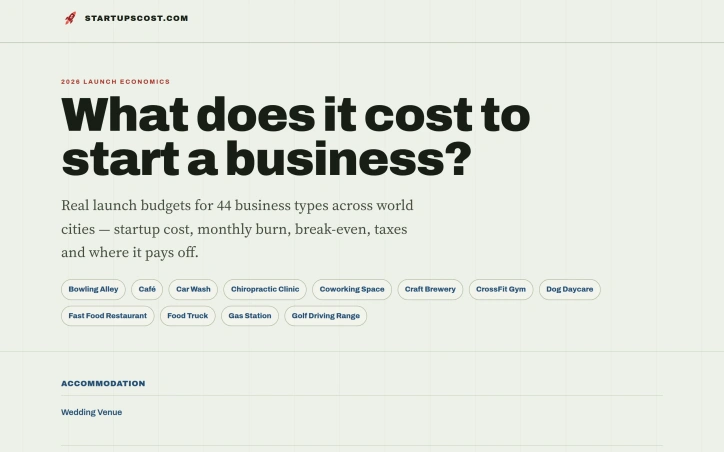
Entrepreneurs and small business owners often struggle to accurately budget and plan financially for their ventures, particularly when it comes to estimating the costs associated with launching a business in a specific city. The founders of Startup Cost have identified this problem and created a resource to help alleviate it. By providing a comprehensive breakdown of the costs associated with launching various types of businesses, Startup Cost aims to empower entrepreneurs with the data they need to make informed decisions. The breadth of industries and business types covered by Startup Cost is impressive, ranging from accommodation and entertainment to financial services and technology. The fact that the website includes costs for such a wide range of businesses, from a bakery to a solar panel installation company, suggests that it is designed to be a one-stop resource for entrepreneurs across multiple sectors. What stands out about Startup Cost is its focus on providing city-specific cost estimates, acknowledging that the costs associated with launching a business can vary significantly depending on the location. The website's categorization of businesses into various industries and sectors makes it easy to navigate and find relevant information. While the pricing model or business model of Startup Cost is not explicitly stated on the website, the fact that it provides detailed cost estimates for a wide range of businesses suggests that it could be a valuable resource for entrepreneurs, either as a free or paid service. The level of detail provided by Startup Cost makes it a useful tool for anyone looking to start a business, and its comprehensive coverage of different industries and business types makes it a standout resource in this space. Overall, Startup Cost is a valuable resource that effectively addresses a key pain point for entrepreneurs and small business owners.