Catalyst Healthspan Audit
Personal trainers typically sell training sessions. This startup reversed the equation by building assessment first, mak...
Launchory
We built Launchory to solve the discoverability problem for startups. Our platform offers instant approval, permanent do...
Best Time tracking apps Startups & Tools
Time tracking apps log work hours and focus to show where time goes—useful for billing, budgeting, and habit improvement.
Recently Listed
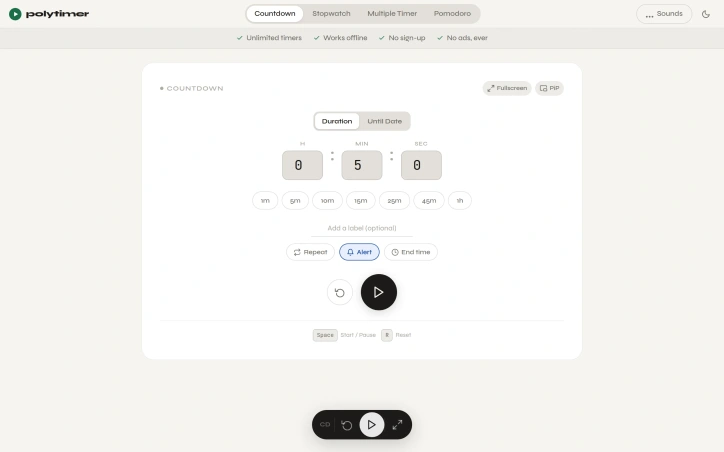
4 launchesFinding the right timer tool online often means wading through cluttered interfaces, intrusive ads, and unnecessary features that distract rather than help. PolyTimer solves this by offering a distraction-free timer that runs entirely in the browser without requiring downloads, account creation, or subscriptions. The product targets anyone who needs reliable timing functionality: students managing study sessions, professionals working on time-blocked tasks, fitness enthusiasts tracking workouts, and anyone practicing productivity techniques like the Pomodoro method. What sets PolyTimer apart is its ruthless commitment to simplicity. The interface prioritizes speed and clarity over feature bloat. Users can start a timer in seconds using one-click preset durations ranging from one minute to one hour, or by entering custom times. The platform supports multiple timer modes: a standard countdown timer with customizable labels and repeat functionality, a digital stopwatch with lap timing and CSV export capabilities, a structured Pomodoro timer with adjustable phase durations, and a grid system for running multiple timers simultaneously. All modes include picture-in-picture and fullscreen options, making the tool adaptable to any workflow. Offline functionality ensures timers continue working without internet connectivity, while the browser-based architecture means immediate access across desktop, tablet, and mobile devices without installation. Users can customize their experience through alert sounds, ambient soundscapes like rain or ocean ambience, and time-until-completion displays showing the exact clock time when a timer will finish. The business model is refreshingly transparent: PolyTimer is entirely free with a firm commitment against advertisements. This approach reflects the founder's stated philosophy that the best tools handle one job exceptionally well rather than attempting to become sprawling productivity platforms. The product addresses a genuine pain point—the difficulty of finding a genuinely clean, fast timer online—with a focused solution that doesn't attempt to monetize through ads, paywalls, or feature gatekeeping. For anyone frustrated by the noise surrounding ordinary web-based tools, PolyTimer delivers exactly what its positioning promises: a functional, accessible timer that remains intentionally simple and perpetually free.

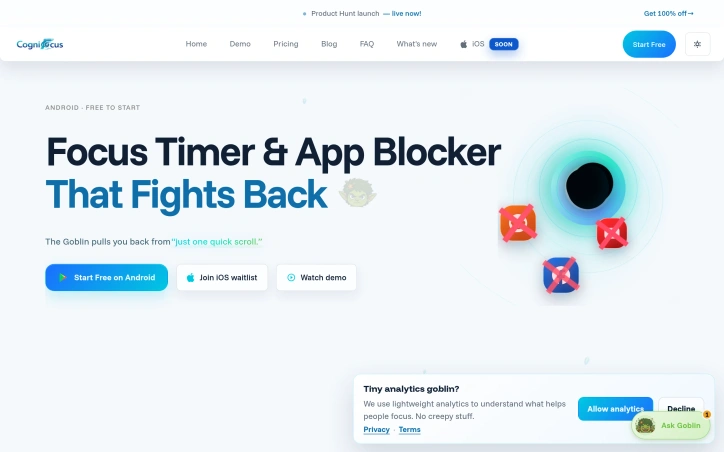
Distraction management has largely been a one-dimensional problem, with app blockers treating phone usage like an on-off switch. CogniFocus reframes the issue for Android users caught in compulsive social media loops, recognizing that technical barriers alone fail to address the psychological habit patterns that keep people scrolling for hours after a "quick check" of Instagram or TikTok. The product pivots around an anthropomorphic accountability system: a Goblin companion that reacts to your behavior during focus sessions. Rather than silently blocking apps, the Goblin responds visibly to distraction attempts, creating social pressure and a layer of real-time feedback. Early access users reported substantial behavioral shifts, moving from multiple distraction breaks per session to one or fewer, with the streak mechanics cited as primary motivation for maintaining clean focus windows. What distinguishes CogniFocus from conventional timer-plus-blocker combinations is its recovery framework. The system acknowledges that slipping back into blocked apps happens and reframes a single lapse as a recovery opportunity rather than session failure. Users earn progression currency—streaks, XP, Focus Shards, and companion affinity—that accumulates across sessions, turning focus maintenance into an ongoing progression loop with visible rewards. This gamification design addresses a core behavioral insight: people respond to measurable progress and social cues more reliably than punitive restrictions. The Shield component handles the technical enforcement, blocking designated apps before "one quick check" stretches into lost hours. A roadmap signals planned escalation through uninstall protection, Ghost Mode, Do Not Disturb integration, and stricter focus modes, suggesting the team is iterating toward making the Goblin's interventions progressively harder to circumvent. The companion expansion roadmap introduces Monk, Buddy, and Wizard variants, hinting that variety in accountability personalities may serve different user psychology or focus contexts. This signals awareness that one accountability archetype won't sustain long-term behavioral change. Pricing details remain sparse—the site advertises free access for Android launch with an iOS waitlist—suggesting either a freemium model or promotional entry pricing. The product is currently Android-only, making it inaccessible to the substantial iOS user base despite parallel demand. CogniFocus targets a specific subset of users: those whose distraction struggles stem from compulsive checking behaviors rather than external interruptions, and who respond to gamification and social accountability mechanics. For that audience, the psychological intervention layer adds meaningful differentiation to an otherwise crowded space.
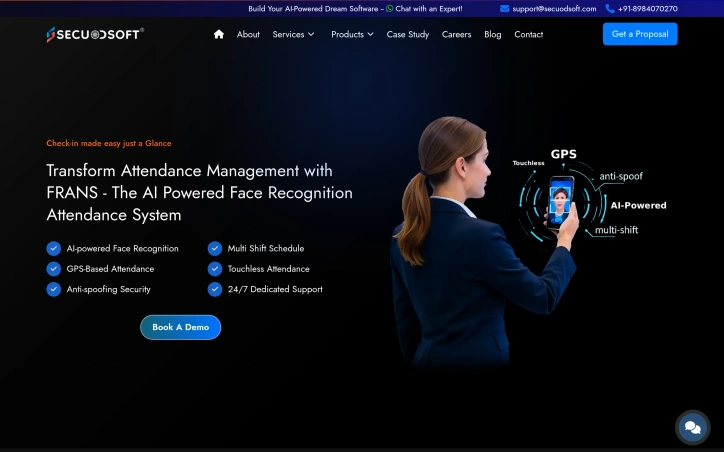
Outdated attendance tracking methods, such as punch cards and manual logs, are being replaced by more modern and secure solutions. FRANS is a solution for businesses looking to streamline their attendance management. It is designed for organizations with multiple locations or teams on the move, as well as those with fixed setups. The product stands out for its AI-powered facial recognition technology, which provides accurate and secure attendance tracking. It eliminates the need for physical contact, enhancing hygiene in environments like offices and hospitals. The system's GPS-based attendance verification feature ensures that attendance is logged only from approved locations, preventing off-site fraud. Key features of FRANS include real-time monitoring and analytics, secure and compliant data storage, and seamless integration with existing HR and payroll systems. The system's gesture control feature allows for intuitive use, making it accessible even in hands-free scenarios. The product is available in two flexible options: Mobile and Camera, catering to different workplace needs. By implementing FRANS, businesses can improve productivity, strengthen compliance, and manage their workforce with greater ease. The system's advanced security protocols protect sensitive biometric data from breaches, and its compliance with data protection regulations provides peace of mind. While the pricing and business model details are not explicitly stated, the company encourages potential customers to "Book A Demo" and "Get A Proposal", suggesting a tailored approach to meeting the needs of different organizations. Overall, FRANS is a robust attendance management solution that addresses the needs of modern workplaces.
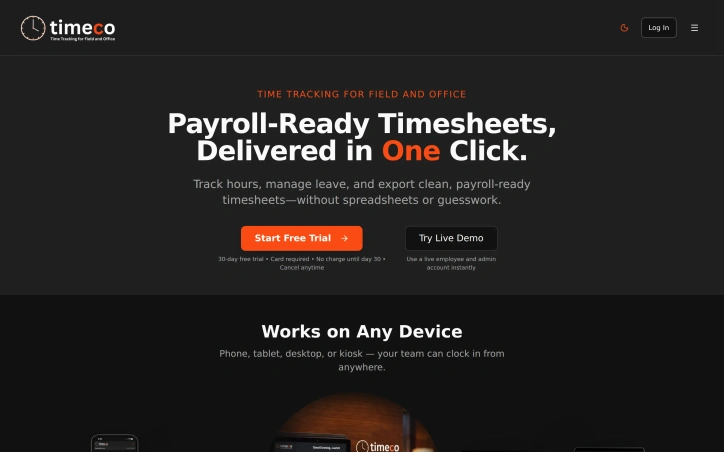
Distributed teams face a genuine operational challenge: accurately tracking hours across multiple locations while minimizing administrative overhead. Timeco targets this gap with time tracking software built explicitly for field and office workforces operating across dispersed locations. The core value proposition centers on operational simplicity. Teams can streamline clock-in and clock-out workflows through a single platform rather than juggling multiple systems or relying on manual entry. Real-time visibility into hours worked across locations directly impacts payroll accuracy and eliminates friction typical in distributed workforce management. What distinguishes Timeco is its targeted focus on field team operations. Many time tracking tools build from office-first assumptions; Timeco grounds itself in the specific constraints of teams operating across physical locations. This specialization—rather than attempting broad feature coverage—signals a product designed around genuine operational needs rather than generic capabilities. The platform emphasizes seamless integration into existing workflows. The founders position the shift from complexity to clarity: teams move from wrestling with fragmented systems to managing hours through a centralized, real-time environment. For businesses scaling distributed operations, this consolidation directly reduces administrative costs and creates a single authoritative source for payroll processing. Timeco positions itself at the intersection of operational simplicity and compliance accuracy. Time tracking isn't a glamorous problem, but it directly affects cash flow, payroll compliance, and labor law adherence. For companies with field operations—construction, logistics, home services, field sales—the promise of accurate, frictionless tracking carries clear business value and operational leverage. The product strategy reflects a purpose-built approach rather than a generic adaptation. Teams operating across multiple locations receive software designed for their specific workflows rather than office templates retrofitted for field use. This specialization can provide differentiation in a crowded market segment. The decisive factor for potential customers remains whether Timeco's feature depth and user experience justify adoption relative to established competitors. The positioning is clear and strategically sound, but the market will ultimately determine whether this specialized approach resonates with distributed workforce operators actively seeking change.