Catalyst Healthspan Audit
Personal trainers typically sell training sessions. This startup reversed the equation by building assessment first, mak...
Launchory
We built Launchory to solve the discoverability problem for startups. Our platform offers instant approval, permanent do...
Best Website analytics Startups & Tools
Measure how people find/use/convert on sites with privacy-friendly tracking and dashboards.
Recently Listed
5 launches
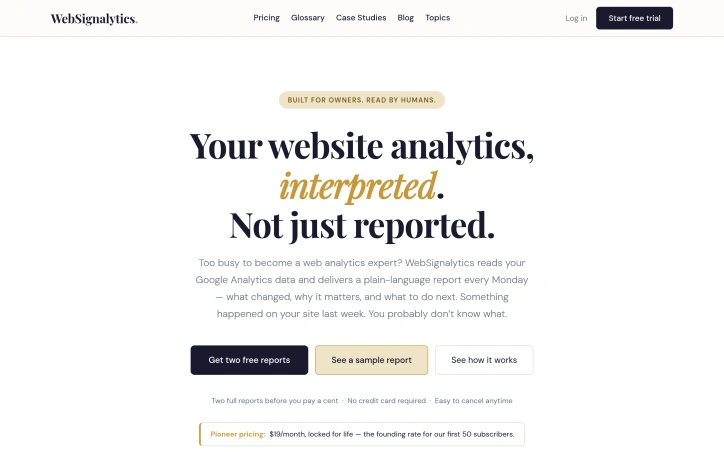
Analytics platforms record everything but rarely explain anything. That's the gap WebSignalytics addresses. Rather than leaving small business owners, consultants, and solo practitioners drowning in metrics and charts, the service connects to Google Analytics and delivers a plain-language summary every Monday—complete with what actually changed on their site, why it matters, and which changes warrant action. The core insight is straightforward: most website owners aren't analytics specialists. They connected Google Analytics because it seemed important, which it is. But GA4 faithfully records data without interpretation. A traffic drop of 40 percent to a top-performing page looks like one data point in a dashboard filled with hundreds. A broken contact form doesn't announce itself; it just quietly stops converting. A surge from an unexpected source stays invisible until the moment passes. WebSignalytics bridges that gap by doing the interpretive work upfront. The weekly report format itself is notable. Rather than inviting users into another dashboard they'll rarely visit, the service brings insight directly—a narrative account of what shifted in the past week, flagged issues like tracking gaps, and concrete next steps. This is built for humans who run businesses, not for people who've chosen analytics as a profession. The founder, who trained in graphic design and marketing before moving into AI-assisted development, brings a user-centric philosophy to the work. That sensibility shows: the product skips the industry jargon and complex menus in favor of clarity. There's no nomenclature to learn, no dashboard to master. The pricing structure reflects early-stage ambitions. At 19 dollars per month, locked in permanently for the first 50 subscribers, it's positioned as founder pricing rather than a standard market rate. New users can request two free reports before committing, with no credit card required. The simplicity extends to cancellation—the copy emphasizes how easy it is to walk away. The most immediate use case is for owners of small to medium websites who've invested in Google Analytics but lack the expertise or bandwidth to monitor it consistently. The weekly cadence assumes they're too busy to check daily but not so disconnected that they'd miss weekly intelligence. For that specific audience, the value proposition is direct: keep your site healthy without becoming an analyst.

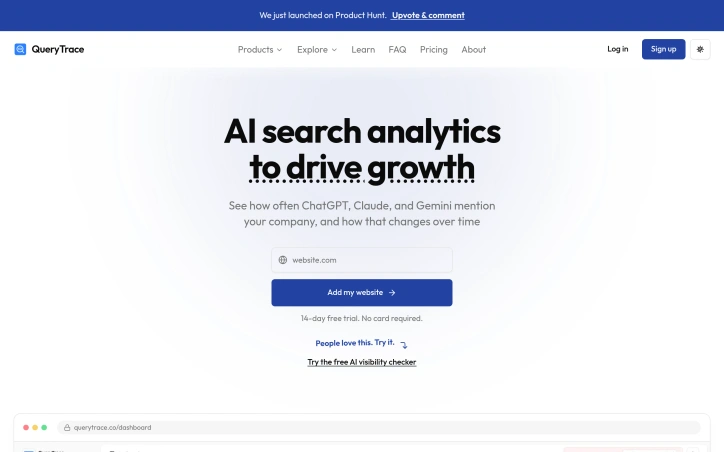
As AI models become primary discovery channels for consumers researching companies, brand visibility within these systems has become a measurable business concern. QueryTrace addresses this emerging need by providing the first platform designed to systematically track how AI mentions specific brands across multiple models. The product tackles a genuine gap in the market. While companies obsess over Google rankings, they have no insight into whether ChatGPT, Claude, Gemini, Perplexity, or other models mention their brand when users ask related questions. QueryTrace closes that gap by running queries against multiple AI models on a schedule, tracking mention rates, and surfacing trends over time. What distinguishes QueryTrace is its multi-model approach and competitive context. Rather than existing in isolation, users can benchmark their mention rate against specific competitors, seeing side-by-side comparisons and weekly trends that reveal whether recent business changes actually moved the needle. The platform adds sentiment and response quality analysis to raw mention counts, providing a more nuanced picture of how AI models frame references to the company. The feature set reflects practical needs. Users start by adding their domain and selecting the specific queries they want tracked—questions people actually ask in ChatGPT or Gemini about their industry. The platform then runs these queries on a schedule and displays results across crawling patterns, mentions in live chats, and referral traffic. For teams wanting deeper integration, QueryTrace connects to Cloudflare, AWS CloudFront, and Google Cloud CDN to track which AI models crawl pages and link to them. The company offers free tools to lower friction: an AI Visibility Checker, an AI Readiness Audit that verifies whether AI crawlers can read your site, and utilities for checking and generating llms.txt files. A 14-day free trial of the full platform requires no credit card. The business model targets companies concerned with AI discoverability but remains vague on pricing tiers or feature gates. The free trial period and no-credit-card requirement lower activation friction, though potential customers will need to contact sales for long-term cost details. QueryTrace fills a real void in brand monitoring tooling. As AI-driven discovery continues to grow, companies will increasingly need to measure and optimize their presence within these systems—making this a timely solution for marketing and product teams who view AI visibility as a material business factor.

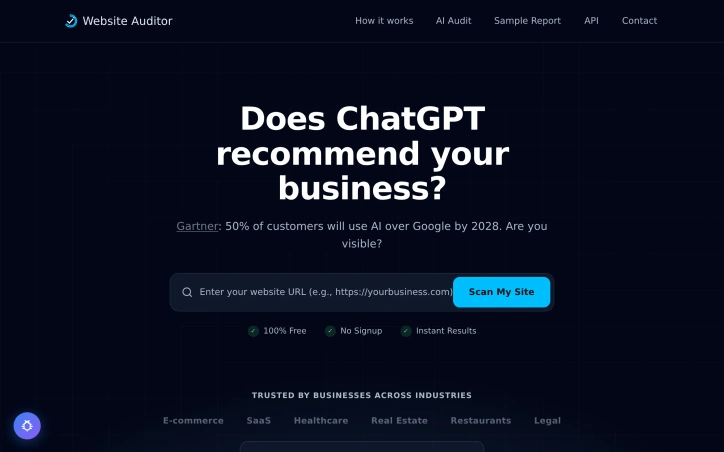
As artificial intelligence increasingly becomes the primary search method for consumers, most businesses remain invisible to these new tools. Website Auditor directly addresses this visibility gap by helping companies understand how they appear when customers use AI assistants like ChatGPT and Perplexity to research products and services. The problem the tool targets is substantive. Gartner's research predicts that half of customers will rely on AI tools rather than traditional search by 2028, creating a critical visibility challenge for businesses that haven't optimized for this shift. Website Auditor positions itself as the solution for small and medium businesses across industries, from e-commerce and SaaS to healthcare, real estate, restaurants, and legal services. What distinguishes the product is its focus on frictionless accessibility. The audit requires only two inputs—a business name and city—and delivers results in under a minute without requiring any signup or account creation. The tool scans how businesses appear in AI tools and local search results, simultaneously checking security and performance metrics. This stripped-down approach removes common barriers that prevent small business owners from adopting new tools. The execution reflects practical thinking about user friction. By eliminating login requirements and keeping the process instant, Website Auditor removes the excuses people cite for not trying new services. The interface is minimal enough that any business owner, regardless of technical sophistication, can run an audit in seconds. The product's reach across industries is notable. The company reports audits spanning 30 different sectors and over 200 websites. This breadth suggests the core problem transcends any single business type and reflects genuine cross-industry demand. Website Auditor operates on a freemium model. The basic audit is entirely free and anonymous, with no hidden paywalls. A paid tier at ten dollars monthly adds API access, allowing businesses to run up to five automated audits daily. This pricing structure makes sense for a discovery tool; it lets users validate the problem exists before committing budget. The tool's relevance will only increase as AI search becomes mainstream. By launching now and building brand awareness before this transition fully matures, Website Auditor positions itself as the obvious choice when businesses finally recognize their invisibility to AI.

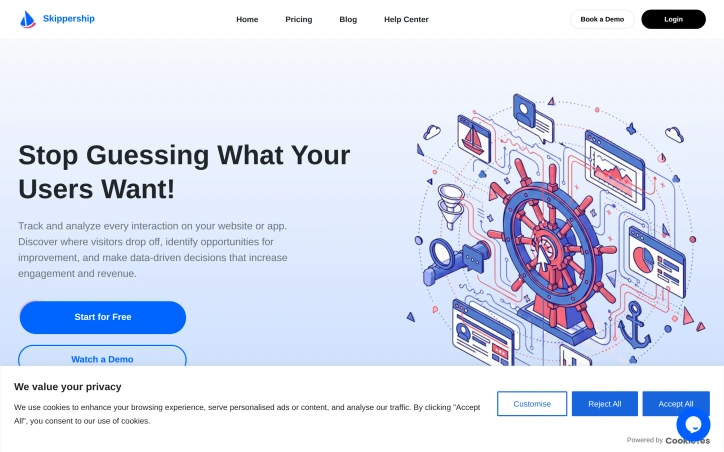
Website analytics and behavior tracking can be a minefield for businesses trying to improve user experience and boost conversions. With the constant influx of data from various sources, it's easy to get lost in the numbers and lose sight of what really matters: understanding how users interact with your site. Skippership appears to be designed specifically with this pain point in mind, offering a comprehensive suite of tools that can help businesses track and analyze every interaction on their website or app. The platform promises complete visibility into user journeys, identifying opportunities for improvement and providing data-driven insights that can inform strategic decisions. What stands out about Skippership is its emphasis on simplicity and ease of use. The founder's claims of no-code fast setup and a user-friendly design suggest that the platform is accessible to businesses of all sizes and technical backgrounds. Additionally, the range of integrations with popular platforms such as Google Analytics, Shopify, and WordPress implies that Skippership can seamlessly fit into existing tech stacks. Key features worth noting include session replays, heatmaps, goal tracking, and AI-powered analytics. These tools promise to provide a clear view of user behavior, highlighting friction points and usability issues that may be hindering conversions. The platform's ability to track console errors and filter data as needed also suggests that it can handle complex and nuanced workflows. While pricing details are not explicitly mentioned in the provided content, the founder's claims of no limits on sites, journeys, or actions suggest a flexible business model. Businesses looking for a comprehensive analytics solution with minimal complexity may find Skippership to be an attractive option, especially given its emphasis on user experience and data-driven decision-making.

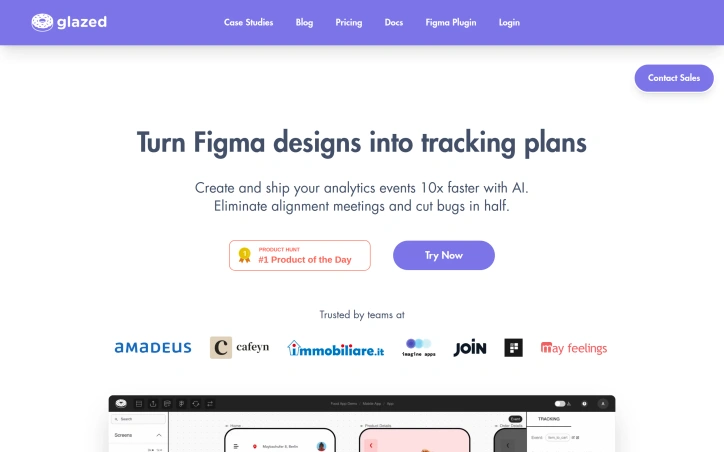
Communication breakdowns between product and engineering teams often stem from a single source: tracking specifications scattered across multiple tools and formats. When a product manager's tracking plan lives in a spreadsheet, a developer's reference is a Markdown file, and a data analyst checks Confluence, alignment becomes impossible. Glazed addresses this fragmentation by anchoring tracking documentation directly to Figma designs—the source of truth that product, design, and engineering already reference. The product works by analyzing Figma screens to automatically suggest tracking events aligned with a team's existing taxonomy, then generating implementation prompts that integrate with AI coding assistants like Cursor and Claude Code. This workflow eliminates the traditional handoff where engineers decipher abstract tracking specifications and make implementation decisions in isolation. By linking each event directly to the UI element that triggers it, developers understand instantly what needs tracking and why. What distinguishes Glazed is its focus on the multi-platform problem. Teams managing iOS, Android, and Web simultaneously face constant risk of tracking inconsistency—different implementations for the same user action across platforms. The tool enforces a single visual source of truth, enabling data, product, and engineering to reference the same specifications without resorting to separate platform-specific interpretations. The platform integrates with major analytics services including Amplitude, Mixpanel, and Segment, positioning it as an overlay on existing data stacks rather than a replacement. It scales from early-stage startups to larger organizations managing dozens of developers, suggesting flexibility across team sizes and complexity levels. The claimed outcomes are specific: one customer reportedly eliminated weekly alignment meetings, reduced tracking implementation bugs by fifty percent, and freed up over a hundred hours per month that would otherwise be spent debugging preventable errors. Whether these results generalize depends on existing team maturity and how closely teams currently adhere to specification standards. For teams currently mired in tracking miscommunication, the value proposition is compelling. For those already running systematic documentation practices, the incremental benefit may be more modest.