
Xtra Hands Family Chore App
Household chore management remains one of parenting's persistent friction points, and Xtra Hands positions itself as the...
Catalyst Healthspan Audit
Personal trainers typically sell training sessions. This startup reversed the equation by building assessment first, mak...
Best AI notetakers Startups & Tools
AI notetakers capture meetings, calls, and voice memos, then transcribe, summarize, and extract tasks for teams, sellers, and learners across tools and languages.
Recently Listed
7 launches
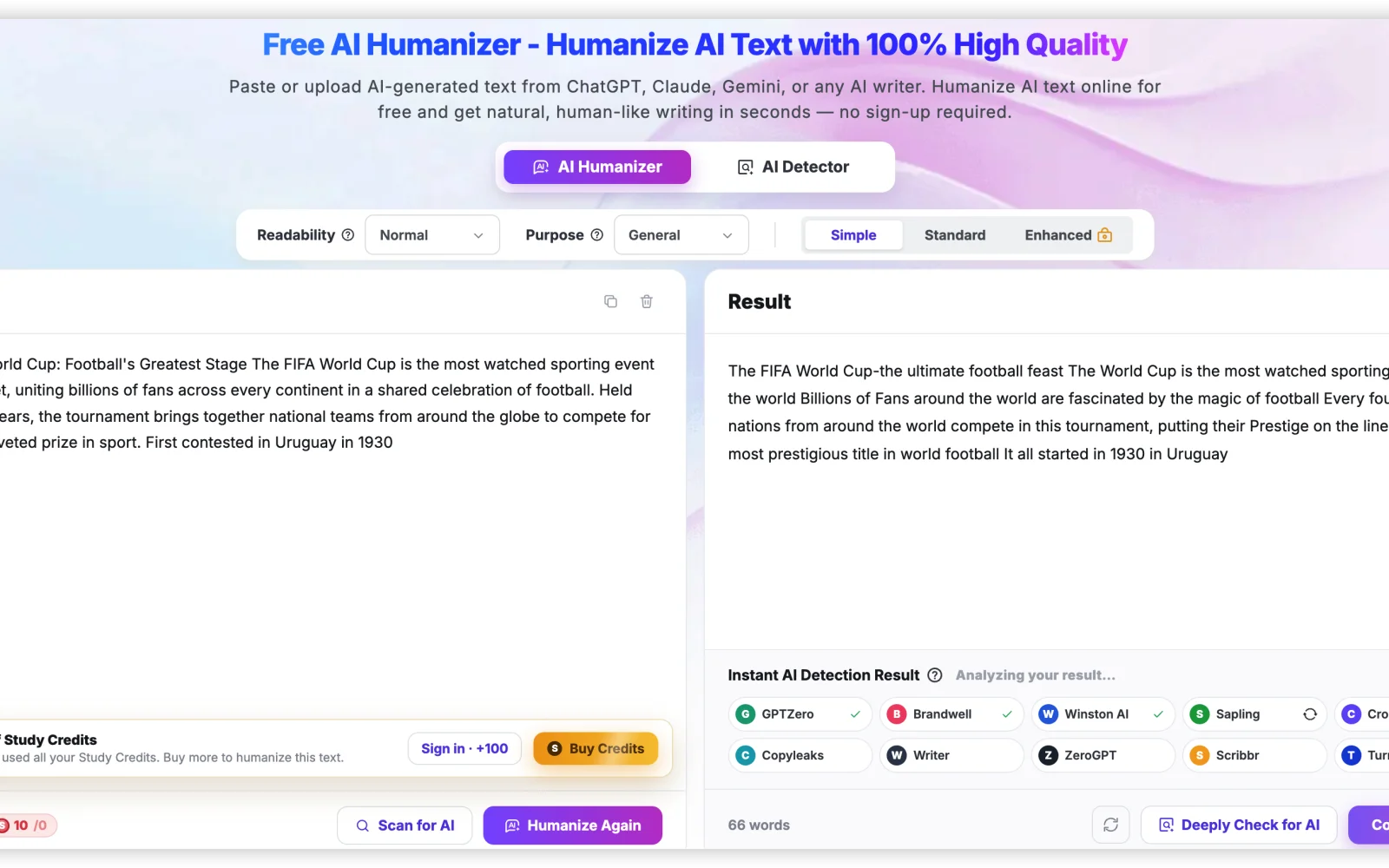
Artificial intelligence writing tools generate content at speed, but often at the cost of natural tone and authenticity. Lynote addresses this friction point by offering a dual-purpose workspace that both humanizes AI-generated text and detects whether content was written by machines. The platform targets a broad audience—students refining essays and applications, content creators optimizing for search, marketers crafting outreach, and researchers polishing publications. Rather than functioning as a simple paraphrasing tool, Lynote operates at the structural level, tackling the patterns that make AI writing sound mechanical. It modifies sentence rhythm, eliminates repetitive transitions, and rebalances the cadence that distinguishes machine-generated prose from human-written work. This dual-detector approach is central to the product's value proposition. While generating writing from AI tools like ChatGPT or Claude has become routine, publishing that text unedited carries reputational risk. Lynote's AI detector provides clear scoring and highlights specific sentences flagged as AI-generated, helping users understand what needs revision before they hit publish or submit. The humanizer then offers adjustable rewrite intensity, allowing users to calibrate how much transformation their content undergoes while preserving the original meaning. Beyond text editing, the platform bundles complementary features for knowledge work: video summarization, YouTube transcripts, audio-to-text conversion, flashcard generation, and PDF compression. This broader toolkit positions Lynote as an all-in-one learning and writing workspace rather than a single-purpose utility. The business model follows a freemium approach, with free access to both the humanizer (up to 300 words) and detector. This removes friction for trial and adoption across student and professional segments. The platform emphasizes that results feel intentional rather than generic, a critical distinction for users in writing-intensive disciplines where voice and authenticity matter. Lynote fills a genuine gap in AI-assisted workflows. Rather than reinforcing the mechanical tone that AI text naturally produces, it provides practical tools to translate AI drafts into publishable work. For anyone relying on generative AI but concerned about output quality or authenticity, this addresses a real pain point.

Clinical documentation has long consumed the evening hours of healthcare providers—time that should belong to them, not to their employer's administrative machinery. Merry AI targets this specific pain point by automating the note-writing process that traditionally happens after patient visits conclude. The product works through ambient AI that listens to conversations during clinical encounters, capturing clinical details without requiring keyboard input or manual data entry from the clinician. This allows providers to remain fully present with patients rather than dividing attention between the patient and their documentation system. The system generates complete progress notes with properly formatted SOAP sections in real-time, meaning clinicians can review and sign off on documentation before leaving the exam room. What distinguishes Merry AI in a crowded clinical AI space is its focus on the complete documentation lifecycle. Beyond ambient capture during visits, the system handles pre-visit work by pre-analyzing patient charts, organizing intake history, and completing chart preparation before the clinician enters the room. This addresses the full spectrum of administrative burden rather than just the note-writing piece. The product also handles billing code mapping, capturing complexity indicators like CPT G2211 that can unlock additional reimbursement revenue for healthcare systems. A 2026 JAMA study is cited as evidence of time savings, though specific figures aren't detailed in available materials. KLAS Research performance data is referenced, positioning it against established healthcare IT evaluation standards. From a compliance perspective, Merry AI explicitly highlights HIPAA compliance and rapid BAA execution, suggesting the company has baked healthcare's regulatory requirements into its go-to-market strategy. This matters because healthcare organizations moving to any new system face significant procurement friction around compliance verification. The business model is a software service aimed at healthcare systems and practices rather than an open-market consumer tool. Pricing isn't disclosed, though the website mentions requesting a demo without requiring credit card information, suggesting an enterprise-focused sales motion. The core value proposition is straightforward: clinicians recover their evenings, healthcare systems improve documentation compliance and capture lost billing revenue simultaneously. Whether the technology performs as demonstrated in promotional materials would require hands-on evaluation, but the problems Merry AI claims to solve are genuinely acute across the healthcare industry.

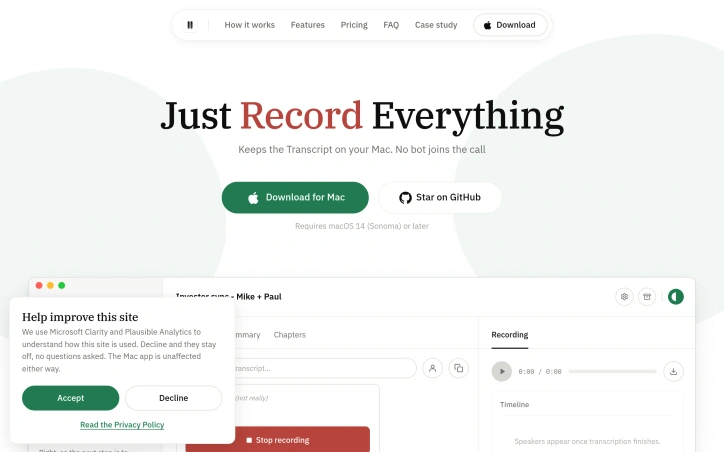
Record any meeting on macOS. Speakers labelled, transcript searchable. No bot joins the call, and your recordings stay on your Mac. No third participant ever joins
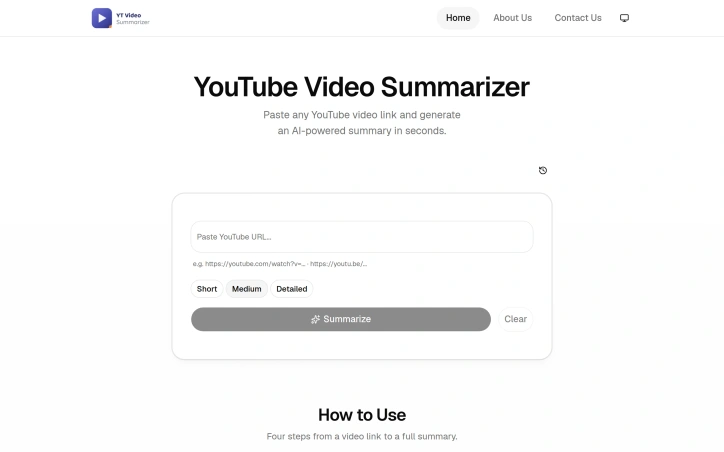
Content summarization tools have proliferated in recent years, yet most focus on text-based articles rather than the video content that increasingly dominates online consumption. YT Video Summarizer addresses this gap by letting users extract key information from YouTube videos without committing to full playbacks. The target audience spans students, researchers, busy professionals, and content curators who need efficient ways to evaluate or reference video material across educational, technical, and entertainment categories. The core functionality is straightforward: users paste any YouTube link, select their preferred summary length—Short, Medium, or Detailed—and receive an AI-generated summary within seconds. The tool accepts standard watch links, shortened youtu.be URLs, Shorts, and even playlist links, suggesting broad compatibility across YouTube's ecosystem. This flexibility removes friction from the workflow; users don't need to adapt their links or worry about unsupported formats. What distinguishes YT Video Summarizer is its multi-format export capability. Beyond reading summaries directly, users can download content as plain text, Markdown, or PDF, or copy individual sections for quick reference. This adaptability to different downstream workflows—pasting into notes, saving to external knowledge systems, or creating formatted documents—adds practical value beyond summarization itself. The tool also handles non-English videos, expanding its utility for international users and multilingual research scenarios. The application demonstrates technical competence in managing YouTube's transcript retrieval, which occasionally triggers verification requirements that the tool acknowledges upfront. This transparency about technical constraints is refreshing; rather than hiding behind a polished facade, the FAQ addresses real friction points users may encounter. The product occupies a niche where demand is demonstrable: video content continues growing faster than most people can watch it, and time-compressed alternatives have proven valuable in education and professional settings. YT Video Summarizer takes a utilitarian approach—no frills, straightforward interface, focus on solving a single problem well. Whether it achieves meaningful scale depends on factors the website doesn't address: how well the AI summaries actually capture video substance, how users discover it among competing tools, and what happens when platforms tighten API access. For now, it offers a working solution to a real problem.

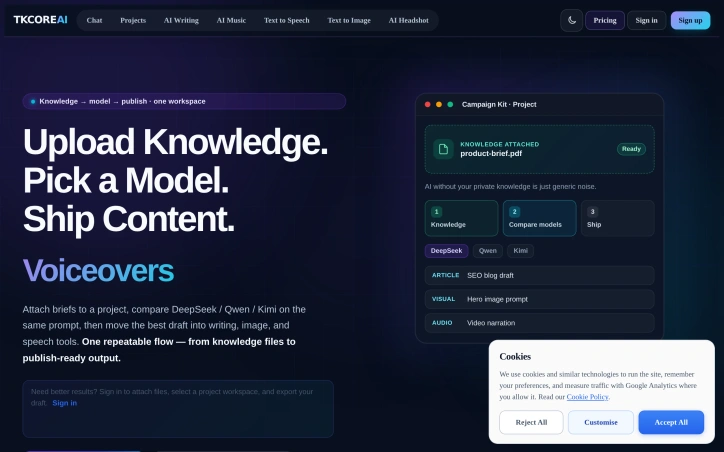
Fragmented AI workflows drain productivity more than the technology itself should. TKCORE AI consolidates what typically demands five browser tabs, three separate subscriptions, and endless copy-pasting into a single workspace—collapsing a two-hour content production cycle into ten minutes. The product targets content teams and marketing departments that produce articles, visuals, and narration from research materials. Rather than shuttling between ChatGPT for writing, a separate image tool, and another service for voiceovers, users attach knowledge files to a project, run prompts across multiple models simultaneously, and route the strongest output into integrated writing, image, and speech tools without ever leaving the platform. What distinguishes TKCORE AI is its explicit commitment to context persistence and privacy. Project knowledge remains attached to a single workspace rather than scattered across disconnected chats. The company promises not to use prompts or outputs for model training, processing content only to deliver service. Data moves over encrypted connections with contractual safeguards. This matters to organizations that cannot risk proprietary briefs or brand guidelines contaminating a training dataset or leaking across competing projects. The multi-model comparison engine stands out operationally. Rather than testing DeepSeek, Qwen, and Kimi sequentially in separate interfaces, users compare outputs from all three against the same prompt on a single screen, then promote the best draft downstream. This transforms model selection from guesswork into deliberate evaluation within a single workflow. The platform supports an expanding roster of models: TkCore-V5.5-Pro, DeepSeek-V4 variants, Qwen models including a vision-enabled version, Kimi K2.5, GLM-5.1, and MiniMax M2.5. This breadth avoids locking users into a single vendor's capabilities. A project generates a research PDF, then produces an SEO blog post, three social posts, and video narration in parallel—all derived from the same knowledge base, all contained within the project boundary. The comparison between traditional fragmented workflows and TKCORE's model is stark: longer, more error-prone, context-bleeding processes versus tighter, single-interface pipelines. For teams currently outsourcing content production or spending disproportionate time on tool switching rather than creation, the efficiency gain is tangible. The product does not claim to replace human editorial judgment, only to eliminate the logistical overhead that prevents teams from reaching content velocity. That's a narrower and more credible promise than most AI publishing tools make.

Handwriting is having a moment, at least in the digital age. One solo founder from Nepal has spotted an unusual niche: the demand for handwritten-looking text in an era when everyone types. Aipen.ink addresses this by converting plain text, ChatGPT responses, mathematical equations, and other written content into realistic handwriting styles, exportable as PDFs or SVG files. The product targets three distinct audiences. Students and educators can transform messy digital answers into clean, legible handwritten notes complete with rendered math and graphs, potentially useful for study materials or assignments. Founders and business professionals can convert written communications—emails, letters, financial projections—into text that reads as authentically human-written. A third segment involves technical audiences: engineers and researchers dealing with complex mathematics, quantum mechanics, and computational fluid dynamics who need these concepts rendered in handwriting rather than standard fonts. What distinguishes aipen.ink is its approach to a problem most would consider solved. While handwriting fonts exist, generating realistic handwriting at scale, especially with technical content, isn't trivial. The product leverages Google's Gemini API to handle the intelligence layer and employs twenty private Unicode variations to produce authentic-looking output. The tool runs entirely in the browser, meaning no user text is stored on servers, addressing privacy concerns. Users can select from existing handwriting styles or upload their own custom font. The feature set is practical. PDF and SVG export options provide flexibility across different workflows. Support for European languages broadens accessibility beyond English-speaking markets. The founder mentions video note generation as a forthcoming feature, suggesting active product development. The free trial removes friction for trying the product, though no explicit pricing model or revenue structure is disclosed. The sole founder status raises questions about sustainability and roadmap execution, but the technical foundation appears sound and the problem, if niche, is clearly defined. Aipen.ink occupies an interesting middle ground: not essential infrastructure but genuinely useful for specific workflows. Whether handwritten-style text becomes a mainstream requirement or remains a novelty depends heavily on adoption, but the product demonstrates that AI-powered writing interfaces can serve aesthetic and practical needs beyond traditional text generation.
Content creation is a crucial aspect of digital marketing, and tools that streamline the process are in high demand. Inkgest has emerged as a potential game-changer for writers and content creators. By leveraging AI-driven technology, the platform aims to simplify the writing process while ensuring that the output is optimized for search engines. The tool's primary function is to assist writers in crafting content that is not only engaging but also rich in relevant backlinks and hyperlinks. This approach is designed to improve the content's visibility and credibility online. By integrating SEO principles into the writing process, Inkgest helps creators produce high-quality content that resonates with their target audience. While exploring the platform, it's clear that Inkgest is designed to be a collaborative tool, rather than a replacement for human writers. The user interface is intuitive, and the features are geared towards supporting the creative process. For content creators looking to enhance their workflow and produce SEO-friendly content, Inkgest is definitely worth exploring. Its potential to become an indispensable asset for writers worldwide is evident, making it a promising addition to the content creation landscape.