Xtra Hands Family Chore App
Household chore management remains one of parenting's persistent friction points, and Xtra Hands positions itself as the...
Catalyst Healthspan Audit
Personal trainers typically sell training sessions. This startup reversed the equation by building assessment first, mak...
Best Payroll software Startups & Tools
Handle payroll calculations, deductions, and employee payments.
Recently Listed
3 launches
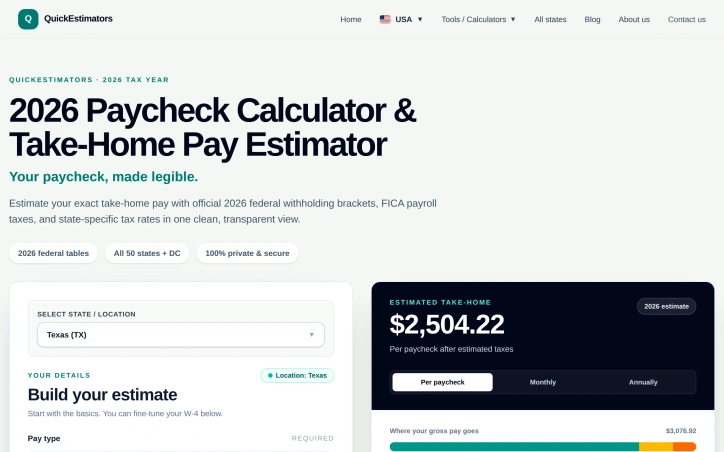
Calculating take-home pay remains a frustrating gap in financial planning for most workers. Employees know their gross salary, but navigating federal withholding tables, FICA calculations, and state-specific tax rules to arrive at an actual paycheck amount requires either specialized knowledge or guesswork. QuickEstimators fills this gap with a straightforward paycheck calculator built around 2026 tax figures. The platform targets employees, freelancers, and professionals who need to understand their net earnings for budgeting, career decisions, or financial planning. The founder describes the problem directly: workers struggle with changing federal brackets, Social Security and Medicare taxes, and the complexity of multi-state tax treatment. QuickEstimators promises fast, transparent calculations covering all 50 states plus D.C., using the latest federal withholding methodology from IRS Publication 15-T. The core experience is clean and methodical. Users input gross pay, frequency, filing status, and location, then refine details like W-4 adjustments, dependent credits, and pre-tax deductions (401(k), health insurance, HSA contributions). The calculator immediately breaks down where each dollar goes: federal income tax, Social Security, Medicare, state tax, and post-tax deductions. A sample Texas estimate shows the math in detail, making the withholding process legible rather than opaque. Several design choices stand out. The calculator handles multi-job scenarios through Step 2 withholding guidance, a detail that matters for married couples and gig workers. The product emphasizes privacy by storing no salary data and maintaining CCPA compliance. Users can download PDF summaries of estimates or embed the calculator on other sites, expanding utility beyond a standalone tool. The state tax engine deserves mention. Tax treatment varies wildly across jurisdictions: graduated rates, flat rates, and states with no income tax. Building this engine correctly requires state-specific logic, and the product claims full 50-state coverage with IRS compliance. Whether that translates to accuracy in edge cases isn't evident from marketing copy alone, but the claim is credible. The product offers no subscription model or premium tier; it functions as a free calculator. This approach makes sense for a financial transparency tool competing partly on accessibility and trust. Revenue model details are absent, but the business likely monetizes through affiliate relationships with payroll or financial planning services, or through embeds on employer websites. QuickEstimators solves a real problem with directness and attention to tax law detail. For anyone uncertain about paycheck math, it beats spreadsheets or mental math.

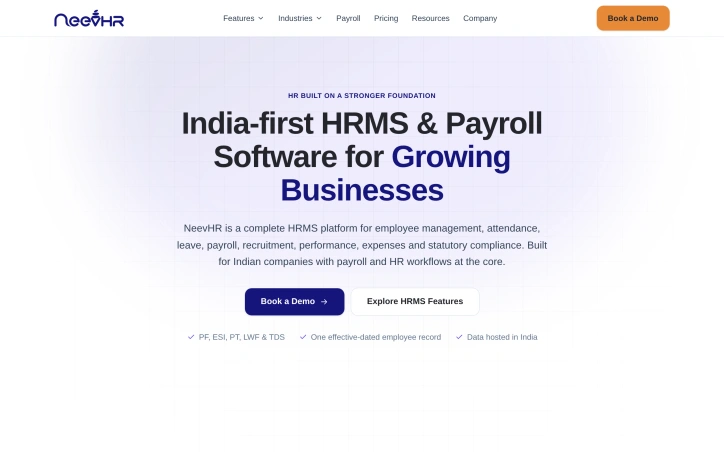
Implementing payroll and HR systems in India presents unique challenges around statutory compliance, regulatory changes, and localized workflows. NeevHR addresses this complexity by building a purpose-built platform for Indian companies that centralizes employee management, payroll processing, and statutory compliance in a single system designed from the ground up for Indian business requirements. The platform manages the complete employee lifecycle from recruitment through exit, connecting hiring, onboarding, attendance tracking, shift rostering, leave management, payroll processing, performance reviews, expense management, and final settlement. What distinguishes NeevHR from generic HR platforms is its India-specific foundation. Rather than treating compliance as an afterthought, statutory requirements like Employee Provident Fund contributions, ESI deductions, professional tax, TDS, LWF calculations, and gratuity provisions are embedded into the core workflows. The system also accounts for regulations specific to Indian employment like POSH compliance and the DPDP Act 2023. A defining feature is the effective-dated employee record that maintains historical accuracy across organizational changes. This single record flows through all HR functions, eliminating data silos. HR administrators can configure leave rules, attendance policies, payroll structures, and appraisal processes through the platform's interface without requiring code or external consulting, which reduces implementation timelines to four to eight weeks compared to six to twelve months for traditional deployments. The platform includes a mobile application that extends self-service capabilities to employees for accessing payslips, submitting leave requests, tracking attendance, and approving workflows. Data residency within India addresses data sovereignty concerns for companies managing sensitive employee information. The dashboard provides visibility into key workforce metrics including headcount trends, attrition by department, recruitment pipeline status, and payroll status. The platform targets growing Indian businesses that operate at sufficient scale to justify dedicated HR infrastructure but seek simpler deployment and configuration than enterprise-grade competitors. The depth of statutory compliance coverage and no-code configurability for HR teams positions NeevHR as a practical alternative to either manual spreadsheet processes or lengthy enterprise implementations. Free HR calculation tools available through the platform provide additional value for businesses evaluating HR and payroll decisions.

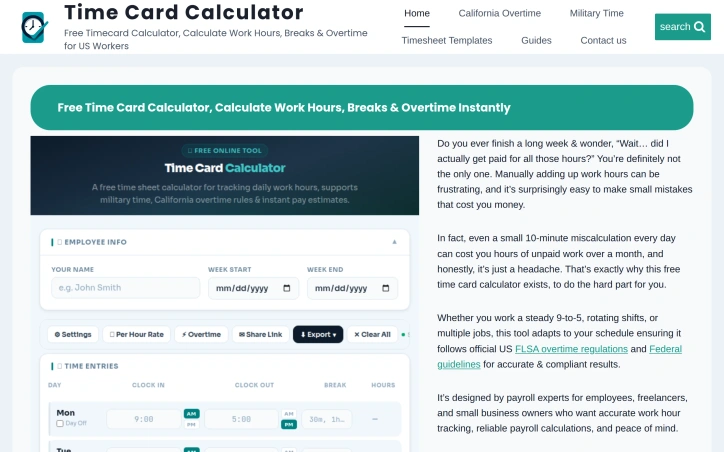
Manual timekeeping creates real financial risk for hourly workers. Small calculation errors—as little as ten minutes daily—compound into hours of uncompensated work each month, yet many still rely on paper or spreadsheets to track their hours. This free calculator addresses that gap by automating the arithmetic that workers and employers need to get payroll right. The tool targets a broad audience: hourly employees verifying their paychecks, freelancers managing multiple jobs, and small business owners handling team timekeeping without enterprise software. Its scope reflects practical priorities. The calculator handles the irregular scheduling patterns that confound simpler tools, processing overnight shifts, split shifts, rotating schedules, and multiple jobs in a single day—the edge cases that make timekeeping complex for shift workers. What distinguishes this offering is its regulatory grounding. Rather than leaving overtime calculations ambiguous, the tool explicitly follows FLSA (Fair Labor Standards Act) standards and California state rules, ensuring results comply with federal labor law. The calculator accepts clock-in and clock-out times along with break durations and immediately returns total hours worked, including overtime categorized according to applicable regulations. The feature set is practical without excess. Input is straightforward—start time, end time, break duration. Output covers what workers actually need: total hours, overtime hours broken out appropriately, and the ability to export timecards to CSV or PDF for records or payroll submission. The interface supports both 12-hour and 24-hour time formats, removing friction for different user preferences. The business model is transparent. The tool is entirely free with no account creation required, lowering any barrier to use. This positioning emphasizes accessibility over monetization. The strongest aspect is regulatory specificity. Time tracking exists in a legally fraught space where mistakes carry financial consequences for both workers and employers. By rooting calculations in actual labor standards rather than generic math, the calculator positions itself as more reliable than improvised approaches or spreadsheets. For workers and small business owners who need proof that hours were calculated correctly, that compliance grounding is meaningful.