Launchory
We built Launchory to solve the discoverability problem for startups. Our platform offers instant approval, permanent do...

Catalyst Healthspan Audit
Personal trainers typically sell training sessions. This startup reversed the equation by building assessment first, mak...
Best Physical Products Startups & Tools
Recently Listed
12 launches
For printed puzzle enthusiasts who want to verify their work without manually solving every clue, Squoku offers a streamlined approach to Sudoku scanning and solving on iOS devices. The app addresses a specific friction point: the gap between completing a puzzle by hand and confirming the solution, while preserving the satisfaction of the achievement itself. The core appeal lies in its privacy-first architecture. Instead of requiring account creation or cloud uploads, Squoku performs all scanning and solving locally on the device. This design choice eliminates a common barrier for users hesitant about privacy or unwilling to create yet another app account. The camera-based scanning feature handles the practical work of recognizing printed puzzle clues, reducing manual entry that would otherwise consume time and introduce errors. What distinguishes Squoku from basic calculator apps is its preservation-focused model. Users can store completed puzzles in local history, with the ability to review both the original scan and the solved result side by side. This transforms the app from a one-off solver into a record-keeping tool that lets users revisit their achievements without leaving the device. The pricing structure avoids common mobile app pitfalls. Rather than defaulting to a subscription model, Squoku offers a transparent choice: the first two solutions are free, then users can either purchase individual solutions for 99 cents or unlock unlimited solving with a one-time 5.99 euro payment. This positions the app as an optional enhancement rather than an essential subscription, respecting users who simply want occasional puzzle verification without long-term commitment. The target audience is narrow but defined: people who regularly solve printed Sudoku puzzles, typically in newspapers or puzzle books. This focus avoids the bloat of features appealing to casual players and keeps the experience straightforward. The app delivers a single job with minimal friction. One implicit strength is the absence of competitive pressure or advertising. By charging directly for functionality rather than relying on ad impressions, Squoku aligns its incentives with user satisfaction rather than engagement metrics. The emphasis on local storage and offline capability further reinforces this philosophy. For its target market, Squoku removes a genuine pain point: confirming solutions without disrupting the satisfaction of having completed a puzzle by hand.


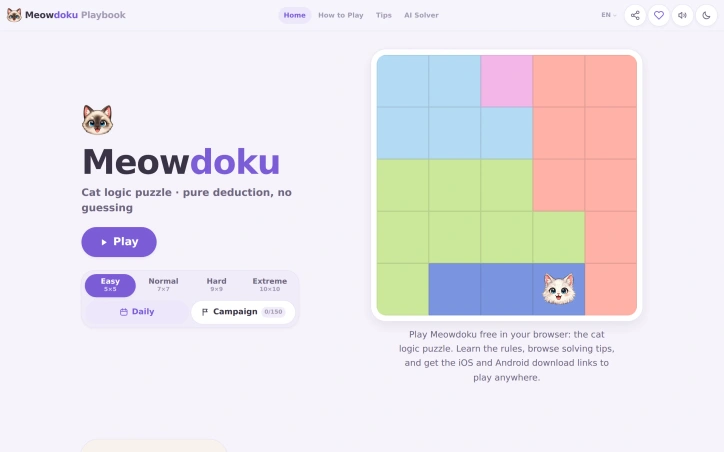
Logic puzzle enthusiasts tired of endless Sudoku variations have found a worthy alternative in this cat-themed deduction game. The product addresses a genuine gap in the puzzle market: the demand for fresh logic challenges that maintain the satisfaction of pure deduction without demanding pen-and-paper play or complex software installations. The core mechanic combines three familiar puzzle principles into something cohesive. Players place exactly one cat in every row, column, and colored region while enforcing a no-touching constraint—cats cannot sit adjacent to each other, even diagonally. Unlike many logic puzzles that force guessing when logic stalls, every puzzle here guarantees a single solution reachable through deduction alone. This elimination of guesswork distinguishes it from more forgiving puzzle games and appeals to purists who want intellectual rigor alongside entertainment. What sets the product apart is its accessibility layer. It requires no account, no installation, and no payment—simply load the browser and start playing immediately. The hand-drawn art style presents cats as charming visual anchors rather than generic grid symbols, making puzzle-solving feel less clinical and more playful. The three-fish-cracker lives system adds gentle pressure without harsh penalties, while the aggressive use of the no-touching rule creates natural cascades of deduction that make progress feel inevitable rather than arbitrary. The controls distill puzzle interaction to essential gestures: tap to mark empty squares with an X, double-tap to place a cat, and tap again to remove it. This simplicity reduces friction between intention and execution. The game generates a live board on page load and begins the puzzle the moment you interact with it, eliminating startup friction that plagues many similar offerings. The product also extends beyond browser play. Free mobile applications for iOS and Android allow players to maintain solving streaks offline and play during commutes. This multi-platform availability transforms the experience from a casual browser time-waster into a genuine substitute for traditional puzzle books. The no-cost model combined with zero friction to entry positions this squarely in the accessible puzzle category, competing against free Sudoku apps and newspaper logic puzzles rather than premium puzzle software. For logic enthusiasts seeking something beyond Sudoku or Queens that respects their deductive reasoning, this fills a concrete need.

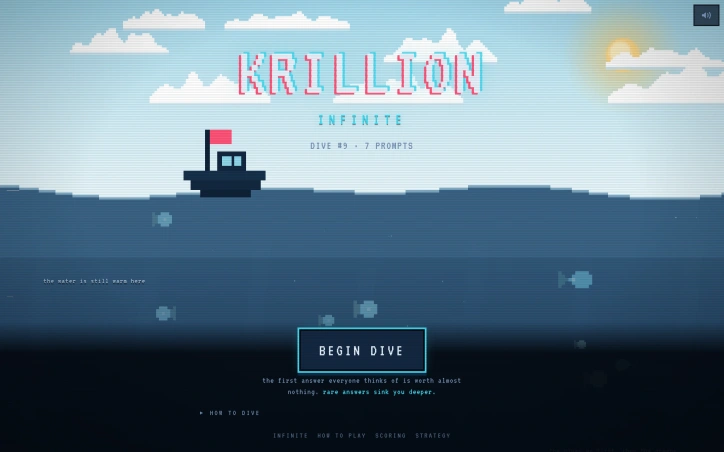
Word games traditionally test how much you know. Krillion Infinite inverts that formula, rewarding players not for recalling correct answers but for finding answers that few others think to type. The game serves a specific audience: people fatigued by vocabulary-based competition who seek a daily mental challenge centered on originality and lateral thinking. The core mechanic sets it apart instantly. Each day at UTC midnight, Krillion presents the same seven prompts to its entire player base. Answer "Cheddar" to "name a cheese" and you score 10 points—a correct answer worth almost nothing. Answer "Taleggio" and you earn 85 points, reflecting that fewer players reached the same conclusion. The spread between common and uncommon correct answers drives the entire game. A player's first dive often yields 70 points from seven correct answers simply because all seven were the answers everyone gives. A complete round takes four minutes. Each prompt appears with a 25-second countdown, creating pressure that prevents overthinking while allowing educated guesses. Missing a prompt doesn't end the round—it merely consumes time, making strategic guessing valid play. The game accepts spelling variations, accent marks, doubled letters, and British-American spelling differences, prioritizing what a player conceived over execution under pressure. The experience requires no installation, no account, and no payment. There is no advertising. Players receive one free dive per day, and practice prompts cost nothing. Results are shareable via emoji strips and depth scores, encouraging community discussion without built-in social infrastructure. What elevates Krillion beyond novelty is the consistency of the central idea. The reverse-scoring mechanic isn't a gimmick layered onto word-game conventions—it is the entire foundation. Every design choice follows from it: the global simultaneity ensures everyone plays from the same answer pool, the timer prevents endless deliberation, the loose matching shifts the challenge from execution to conception. The strategy guidance acknowledges the emotional weight of low opening scores by reframing them as a solvable problem requiring habit change rather than more knowledge. The product succeeds because it asks a genuinely harder question than traditional word games. It doesn't ask what you know. It asks what you thought of.

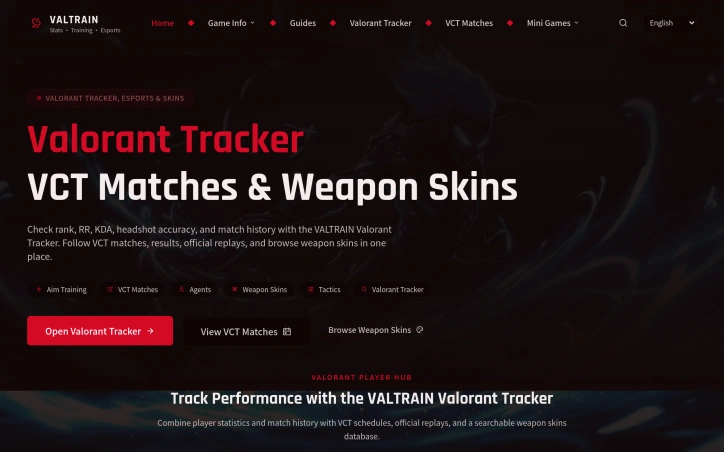
Valorant players who want to track their competitive performance while keeping tabs on professional esports typically face a fragmented experience. Player statistics live on one site, tournament information on another, and cosmetic details scattered across yet another—a friction point that VALTRAIN directly addresses. The platform consolidates the data streams that competitive players and esports enthusiasts check most frequently into a single searchable destination available across desktop and mobile. The core value proposition centers on simplicity: competitive players can search a Riot ID to review their current rank, rating changes, kill-death-assist ratios, headshot accuracy, and recent match history without toggling between multiple tabs. Esports fans gain a central hub for VCT schedules, completed match results, map-level scores, player statistics, and direct access to official replay sources. Beyond performance tracking, the platform includes a browsable weapon skins database organized by collection, rarity, and weapon type, alongside agents, crosshair resources, and tactical guides. This breadth positions VALTRAIN as a more complete information hub than point solutions that focus on one category alone. What distinguishes the product is its commitment to zero cost. The platform operates entirely as a free service with no paid tiers or subscription requirements—a meaningful differentiator in a landscape where many gaming companion tools introduce paywalls for advanced features or faster data refresh rates. The engineering supports multilingual interfaces, removing language barriers for international players and esports viewers outside English-speaking regions. The data is current and grounded, pulling VCT information from VLR.gg, a recognized source for competitive Valorant coverage. Match schedules, results, and standings span all major regions—Americas, EMEA, Pacific, and China—reflecting the truly global scope of professional Valorant competition. The platform's success depends on execution factors like search speed, data freshness, and the completeness of the skins database—qualities the website doesn't fully demonstrate. For competitive players and esports followers frustrated by information scattered across multiple sites, VALTRAIN delivers what these users have lacked: consolidated access to every data category they regularly need in a single free package.

I’m a mom of two young girls, and they’re huge fans of Poople. The game gives them a fun challenge and, honestly, gives me a few peaceful moments too. 😄 But whenever they get stuck on a word ladder, they come running to me for help. The funny truth? I often don’t know the answer either! So I built Poople Answer — a quick and easy way to find solutions when you’re stuck. Now I can keep my little secret and stay a “Poople genius mom” in my daughters’ eyes. 💕


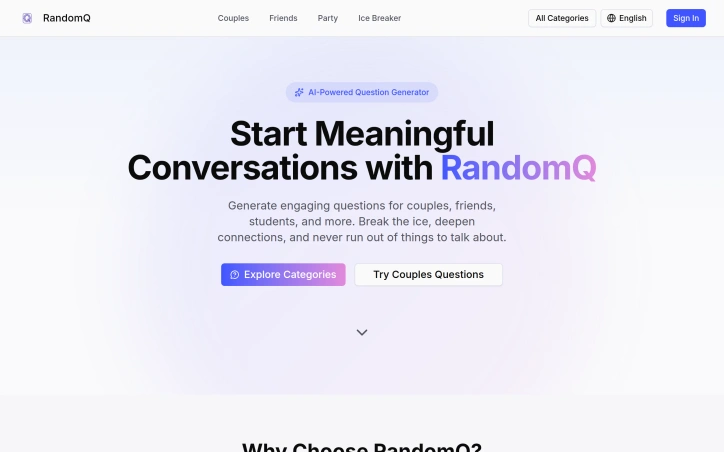
Awkward silences can be a real conversation killer, whether it's on a first date, during a team meeting, or at a family dinner. RandomQ is designed to tackle this problem head-on by providing a platform that generates engaging questions to spark meaningful conversations. The tool is built for a diverse range of users, including couples, friends, students, and teams. What sets RandomQ apart is its use of AI technology to generate context-aware questions that cater to different conversation scenarios. The platform boasts an impressive array of categories, with over 9 curated options that cover various social situations, from deep and meaningful conversations for couples to hilarious questions for party games. The AI-powered question generator is complemented by a robust library of pre-existing questions, with 80 questions available in each category. One of the key features worth noting is the platform's emphasis on privacy, with no login required to start using the service. Additionally, the question generation engine is lightning-fast, providing users with instant results. The platform also offers a range of game modes, including Classic icebreakers, Debate battles, and Truth or Dare, which adds to its versatility. In terms of accessibility, RandomQ is free to use, with AI-generated questions available for purchase through a one-time credit buy, eliminating the need for a subscription. Overall, RandomQ offers a unique solution to breaking the ice and fostering deeper connections, making it a valuable resource for anyone looking to spark meaningful conversations.

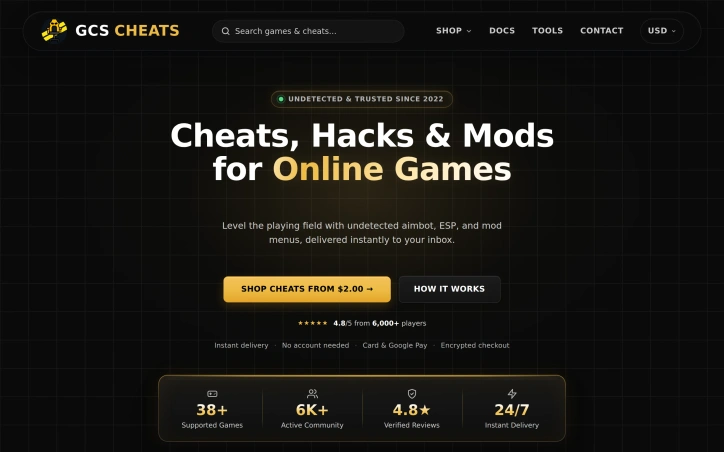
For gamers seeking a competitive edge in online multiplayer games, GCS Cheats offers a solution that promises to level the playing field. The company's product addresses the issue of getting banned or using ineffective hacks, providing instead undetected cheats that give players an advantage. GCS Cheats is geared towards gamers who want to enhance their gaming performance with tools such as aimbot, ESP, and mod menus. What stands out about GCS Cheats is its emphasis on account safety and security. The company prioritizes strict account security, employing unique, advanced kernel-level and driver-based bypass methods to keep accounts safe, even with aggressive settings. This focus on security is complemented by a premium experience, with customizable tools designed to give players an absolute edge in games. The product's key features include instant delivery of cheats directly to the customer's inbox, a simple three-step process from checkout to in-game usage, and a range of supported games, with 38 titles listed on the website. The company's cheats are available for various popular games, including CS2, Valorant, and Rust, with pricing starting from $2.00. The straightforward business model involves customers picking a plan, paying securely, and receiving a key to access the cheat. GCS Cheats has garnered a significant following, with over 6,000 active community members and a 4.8-star rating from verified reviews. The company's commitment to delivering undetected cheats, coupled with its focus on customer safety and satisfaction, sets it apart in the market. Overall, GCS Cheats offers a viable solution for gamers seeking a competitive advantage, with a robust product and a customer-centric approach.

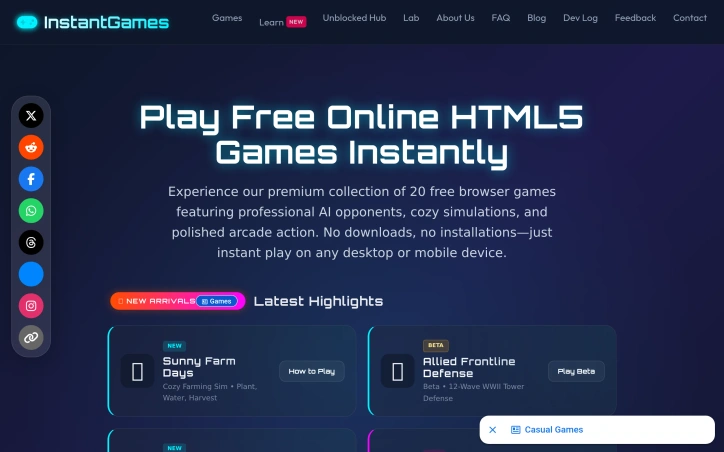
Gaming enthusiasts seeking instant entertainment without the hassle of downloads and installations have found a haven in Instant Games. The website offers a curated collection of 20 free browser games that can be played seamlessly on both desktop and mobile devices. By eliminating the need for tedious downloads, Instant Games provides an accessible and user-friendly experience for gamers on-the-go. What sets Instant Games apart is its diverse range of high-quality HTML5 games, featuring professional AI opponents and polished arcade action. The collection includes cozy simulations, strategy games, and adrenaline-fueled racing experiences, ensuring that there's something for every type of gamer. The games are optimized for cross-platform compatibility, guaranteeing a smooth and enjoyable experience regardless of the device used. Notably, the games on Instant Games boast advanced features such as AI-generated assets, multiple difficulty levels, and immersive sound effects. For instance, the Midnight Poker and Midnight Blackjack games offer deep statistics and AI-driven strategy, while Traffic Rider Extreme features predictive AI traffic and nitro acceleration. The site also showcases new arrivals and beta releases, keeping the content fresh and exciting. The platform's focus on HTML5 games ensures that users can enjoy their favorite titles without worrying about compatibility issues or lengthy downloads. While the website does not explicitly mention its business model or pricing, it is clear that the core offering is free, with 20 games available for instant play. Overall, Instant Games is an excellent destination for gamers seeking a convenient, diverse, and engaging gaming experience.

Learning time concepts can be a daunting task for young children, but a well-designed tool can make all the difference. The product in question is designed for kids aged 2 and above, with the primary goal of teaching them about days, months, seasons, and daily routines in an engaging manner. By introducing these concepts early on, it helps kids develop a sense of structure and understanding of the world around them. What stands out about this product is its interactive approach to learning, making it a fun experience for kids. It's a 9-in-1 activity calendar that covers a range of topics including day, date, year, festivals, time, affirmations, month, weather, season, and feelings. This comprehensive approach ensures that kids are exposed to a broad spectrum of concepts that are essential for their cognitive development. The product is made from non-toxic materials, ensuring the safety of children, which is a critical consideration for parents. The company behind the product, iLearnNGrow, offers a curated range of educational tools, positioning itself as a one-stop shop for parents seeking to support their child's overall development. The calendar is priced at ₹500, which is a discounted rate from its regular price of ₹899. The product's availability and pricing details suggest that it is positioned as an affordable solution for parents in India, with the added benefit of free shipping on orders above ₹999. Overall, this product has the potential to be a valuable resource for parents seeking to introduce their young children to fundamental time concepts in an engaging and interactive way.


Daily sports quizzes targeting passionate fans of football, basketball, and American football, Wordlecup positions itself as a lightweight gaming experience centered on recognizing and guessing professional athletes. The product addresses a straightforward need: engaging sports enthusiasts in a quick, recurring activity that leverages their knowledge of the sport's stars. The core audience comprises dedicated followers of the NFL, NBA, and football (soccer) who enjoy testing their familiarity with player rosters and identities. The founder emphasizes the small-game philosophy—short, repeatable interactions designed to match the cadence of how sports fans consume content throughout their day. Several design decisions suggest intentionality beyond a simple concept. The platform's support for nine languages indicates early thinking about international reach. Given that sports fandom transcends geography, this multi-language approach serves both European football enthusiasts and fans of American sports across non-English-speaking regions. The presence of localized blogs in each language further suggests an attempt to build community and capture organic search traffic, rather than treating language support as a checkbox feature. The format itself—a daily quiz—follows the proven engagement model established by properties like Wordle, which demonstrated that users return for a single, predictable interaction. By anchoring the game to a daily cadence, Wordlecup creates a built-in retention loop: players have a reason to return once per day, and daily active users represent a healthier business metric than sporadic engagement. The choice to focus exclusively on recognizing athletes, rather than offering broader sports trivia, narrows the addressable market but increases defensibility. Casual sports fans may bounce off quickly, but devoted followers—people who watch matches regularly and track player movements—have genuine motivation to engage repeatedly. What remains unclear from the available information is what distinguishes Wordlecup from existing sports trivia experiences. The product's visual design, user interface, and the specific mechanics of how guessing works are absent from public-facing materials. The stripped-down website offers little insight into the user experience itself or what makes the interaction memorable. For sports fans seeking a quick daily ritual, Wordlecup delivers exactly what its creator intends: a small, focused game that respects their passion for recognizing the athletes they follow.


Combining the timeless appeal of tic tac toe with the spectacle of mixed martial arts, this online game targets casual and competitive players seeking lighthearted multiplayer entertainment with a thematic twist. The intersection of simple strategy gaming and fighting culture creates a niche entry point for players who might otherwise overlook traditional board game adaptations. The product distinguishes itself through an uncompromising free-to-play model. Rather than relying on advertisements or pay-to-win mechanics—common pitfalls for browser-based games—MMA XOX commits to no monetization friction. This approach lowers barriers to entry and suggests confidence in user retention through engagement alone. The decision to eliminate ads and competitive purchasing options directly addresses widespread frustration with gaming platforms that prioritize revenue over player experience. What truly sets this offering apart is its ambition toward globalization. Supporting 17 languages including Turkish, Arabic, and Mandarin Chinese signals genuine international reach, not merely English-language gaming with translation buttons. This breadth hints at a development team or publisher thinking beyond English-speaking markets from the outset. The commitment to cross-platform compatibility and mobile responsiveness ensures players access the game regardless of device, a practical necessity in markets where smartphone-first internet usage dominates. The competitive infrastructure reveals sophisticated design expectations. Ranked matchmaking systems paired with global leaderboards transform what could be a throwaway browser game into a persistence layer where player progression matters. The inclusion of seasonal tournaments and private room creation for friends suggests the developers understand that casual games thrive when they balance frictionless pickup play with goals for committed players. Fighter characters allegedly feature unique abilities, implying strategic depth beyond traditional tic tac toe's mathematical exhaustion. The social features—friends systems, private lobbies, and global matchmaking—position this as community-oriented rather than solitary. This architecture benefits both retention and word-of-mouth growth, assuming the execution matches the design intent. The requirement that JavaScript be enabled is unsurprising for real-time multiplayer but worth noting for accessibility considerations. The core tension in the pitch is whether thematic wrapping around tic tac toe generates sufficient novelty to sustain a competitive gaming community. The infrastructure supports such ambitions, but success depends entirely on execution quality and marketing reach—factors the website text cannot reveal. For players tired of monetization dark patterns, the straightforward free model alone warrants investigation.

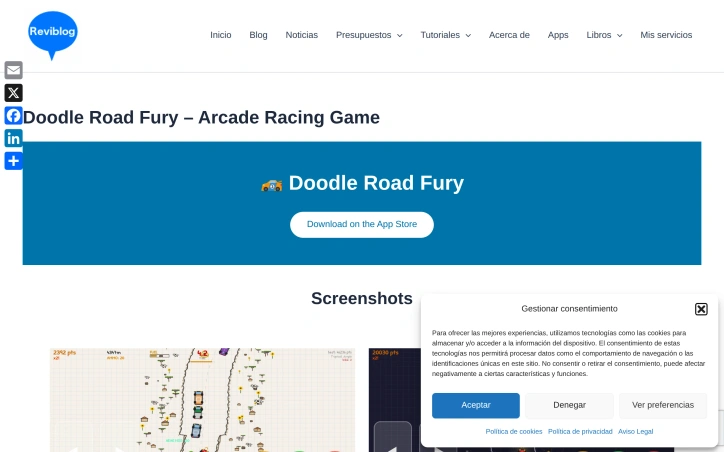
Endless arcade racing meets action-packed combat in this mobile experience that rewards split-second reflexes and chain-kill combos. Doodle Road Fury targets casual gamers who want bite-sized sessions of high-intensity gameplay without narrative bloat, blending familiar racing mechanics with unexpected combat depth. The core appeal lies in procedural generation that ensures no two runs feel identical. Rather than predetermined tracks, the game constructs infinite roads that progressively intensify through tighter curves, denser traffic, and escalating speed. This system sidesteps the stale repetition that often plagues mobile racers, though it places all tension on moment-to-moment reaction over strategic route planning.