uploadthefile.com
Sharing files and publishing static content has long required friction: account creation, platform navigation, or comman...

CrabTap
Small businesses have long struggled to implement loyalty programs without massive overhead. CrabTap addresses this gap...
Catalyst Healthspan Audit
Personal trainers typically sell training sessions. This startup reversed the equation by building assessment first, mak...
Best Product demo Startups & Tools
Product demo tools turn screens and text into interactive tours, videos, and guides for onboarding and conversion.
Recently Listed
2 launches
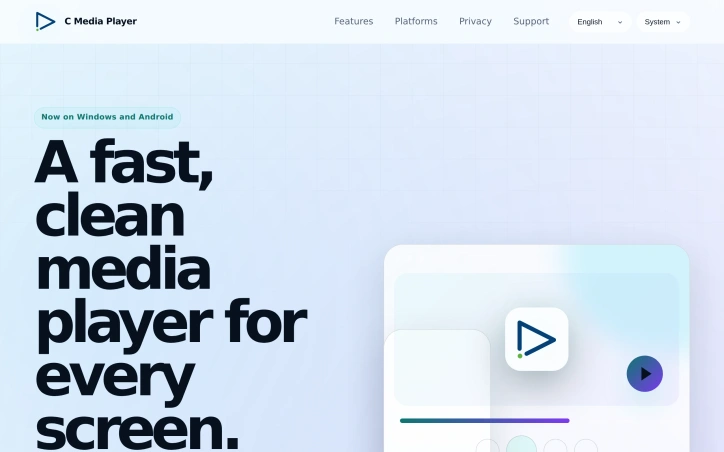
Developers seeking a distraction-free media solution have an increasingly rare option in C Media Player, which sidesteps feature bloat and monetization schemes in favor of straightforward playback. The cross-platform application—available on Windows and Android—delivers essential media capabilities without the advertising and telemetry tracking that encumber many consumer players. The feature set reflects practical design priorities. Users access standard codecs, subtitle handling through both embedded and external sources, multi-track audio selection, and customizable playback controls including variable-speed playback and aspect ratio modification. The inclusion of equalizer controls and video effects distinguishes it from minimalist competitors, while hardware acceleration addresses performance on resource-constrained devices. The philosophy prioritizes user agency over corporate data extraction. Network stream support and playlist functionality accommodate both casual consumption and demanding use cases. The development team explicitly acknowledges user input as a roadmap driver, positioning the project as responsive to community needs. Limitations warrant acknowledgment: platform availability remains restricted to two major operating systems, and the absence of published benchmarks leaves performance claims unverified. Furthermore, standalone media players face structural headwinds from bundled offerings in mainstream operating systems. Still, in a landscape increasingly dominated by surveillance-enabled alternatives, C Media Player's commitment to core functionality without data harvesting represents meaningful differentiation. Whether this positioning sustains commercial viability depends on cultivating sufficient user loyalty to overcome platform incumbency.

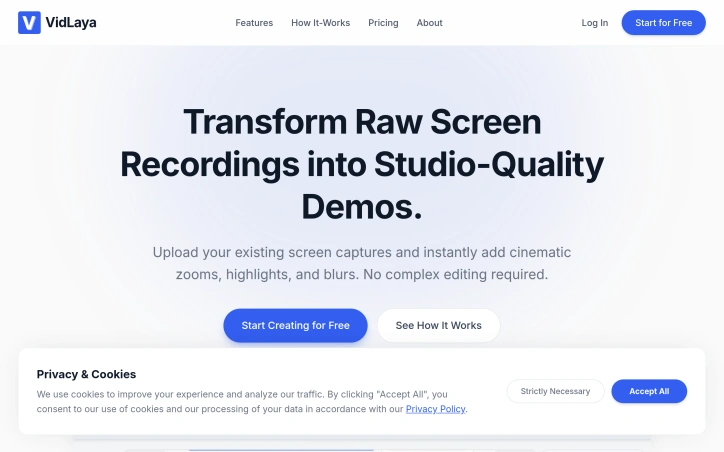
Product demo creation has traditionally demanded either expensive software licenses or video editing expertise that most product teams don't possess. VidLaya addresses this friction point by automating the post-production work that transforms raw screen recordings into polished, shareable walkthroughs. The platform targets SaaS teams and product managers who need to communicate features visually without spending hours in complex editing software. The core appeal is straightforward: upload a screen recording, apply cinematic effects, and export studio-quality output. The workflow compresses what might take an editor hours into a three-step process accessible to anyone without technical training. What distinguishes VidLaya is its focus on automation rather than manual control. Rather than requiring users to keyframe animations frame-by-frame, the platform generates cinematic pan-and-zoom sequences automatically when you point to an area of interest. Highlighting features relies on drawing focal points with high-contrast callouts rather than wrestling with overlay tools. The blur functionality handles privacy concerns with a single click, useful for masking API keys or personal information before sharing with stakeholders. The editing happens in a web browser, removing the friction of desktop software installation. All processing occurs in the cloud, eliminating computational load from users' machines. The company emphasizes that uploads are processed securely, addressing a reasonable concern when dealing with screen recordings containing sensitive product information. The pricing structure reflects a straightforward freemium model. A free tier lets users test the platform without commitment. Monthly subscriptions cost $12, while annual plans drop to $8.25 per month when paid upfront. Both paid tiers include unlimited exports, watermark-free output, priority cloud rendering, and priority support. The annual discount is meaningful but not aggressive, positioning the product as an ongoing tool rather than a one-time purchase. For companies that regularly create product walkthroughs, sales enablement materials, or onboarding videos, VidLaya delivers genuine efficiency gains. The product's value hinges on the quality of its automated visual decisions—whether the algorithm-generated pan, zoom, and highlight choices produce results comparable to professional editing. For teams without dedicated video expertise, the convenience and speed VidLaya offers make it a compelling alternative to traditional editing workflows and the technical barriers they present.