Catalyst Healthspan Audit
Personal trainers typically sell training sessions. This startup reversed the equation by building assessment first, mak...
Launchory
We built Launchory to solve the discoverability problem for startups. Our platform offers instant approval, permanent do...
Best Search Startups & Tools
Search tools collect and rank information across apps, websites, and maps to find files, places, and answers fast.
Recently Listed
12 launches
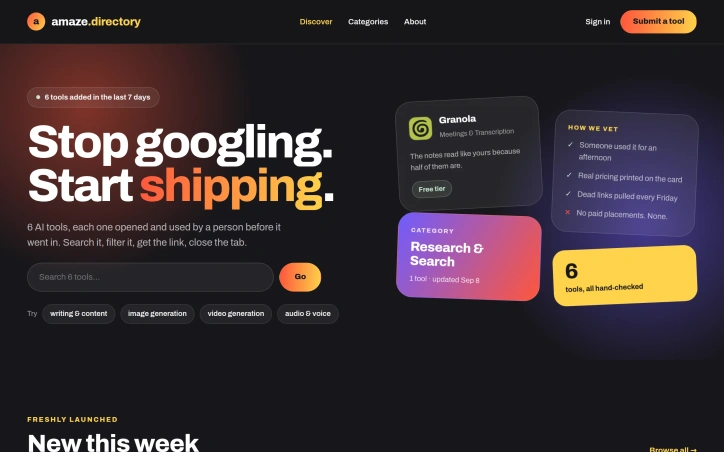
Finding quality AI tools amid a sea of low-quality directories has become a real problem for product builders and creators. Too many tool aggregators prioritize paid placements over actual utility, leaving users to sift through untested offerings. Amaze.directory tackles this by taking a radically simple approach: only list tools that the curator has genuinely used. The difference is immediately apparent. Rather than trying to be comprehensive, the directory restricts itself to a small number of hand-checked products—currently six tools across categories like research, content creation, coding, and audio processing. Each listing includes a candid one-sentence assessment of what makes that tool worth using, stripped of marketing language. Perplexity gets credit for citation behavior over a standard chat interface. ElevenLabs is noted for producing synthetic speech that sounds unremarkable. Cursor receives praise for feeling like an editor that happens to include AI, rather than an AI product forced into an editor. These descriptions reflect genuine usage rather than promotional copy. The vetting process reinforces this commitment to substance. Every tool must be actively used for an extended period before listing. Dead links are purged every Friday. The operator explicitly refuses paid placements, a decision that fundamentally shapes the trust equation. You're not browsing a paid ranking—you're seeing what someone actually uses and recommends. The interface itself is straightforward. Search functionality lets users find tools by job type. Filters handle category and pricing, which amaze.directory presents honestly: some tools operate on freemium models while others require payment. This transparency about cost and access prevents the surprise of discovering a tool's hidden paywall after investing time. What limits the directory is also its strength. With only a handful of listings, this isn't a comprehensive resource for every use case. New categories like video generation appear but show no entries. The directory is growing—six tools were added in the last week—but it remains deliberately sparse. The business model is implicit: curation as editorial service. By maintaining independence and refusing vendor payments, amaze.directory positions itself as a source of genuine opinion rather than a marketplace. This appeals to builders who want tools that work over tools that are well-marketed. For creators and developers tired of hollow tool directories, amaze.directory offers something increasingly rare: honest product assessment backed by actual use.

Buying a car in Europe means navigating fragmented dealer networks, conflicting reviews, and sales pitches designed to prioritize dealer margins over buyer needs. This Greek startup tackles that friction with a structured research tool that pulls from live listings, safety data, and actual running costs to surface recommendations you can trust. The product addresses a genuine gap. While generalist AI chatbots can discuss cars in the abstract, they cannot access current inventory, calculate real total cost of ownership for a specific market, or save your research across sessions. KAR aggregates listings across European dealers, compares trim specifications on fuel consumption and maintenance costs, and cross-references safety ratings from Euro NCAP. The result is a shortlist of one to five vehicles that match your budget and requirements with reasoning attached. The delivery mechanism is straightforward. Users fill out a preference form specifying budget, body type, driving patterns, and must-have features. The system then returns recommendations with estimated pricing, running cost breakdowns, availability, and where to purchase. The founder built this to counter the incentive structure that makes dealers push what maximizes their margins rather than what serves the buyer. The company takes no dealer commissions and publishes no review fees, positioning itself as genuinely neutral. What distinguishes KAR from both traditional automotive review sites and AI assistants is its focus on actionable, structured output. The platform doesn't just talk about cars; it saves your shortlist, garage history, and prior comparisons so your research persists. It also extends beyond car selection into accessories and parts matching, comparing OEM options against quality aftermarket alternatives with fitment verification and pricing from multiple suppliers. Early traction suggests the model resonates. The company has matched over 100 drivers with recommendations and delivered 200-plus car suggestions. It covers 40 brands across Europe and has secured coverage in GOCAR.gr, Greece's leading automotive publication. The narrowest limitation is geographic focus. KAR emphasizes availability and pricing across European listings, making it most useful for buyers in that market. Buyers seeking broader research on vehicle performance will find less value. The platform also requires users to trust that its AI research methodology is sound without transparency into how recommendations are weighted or how it compares against expert automotive reviewers. For European buyers tired of dealer-driven car shopping, KAR offers a genuinely different model grounded in data rather than commission.


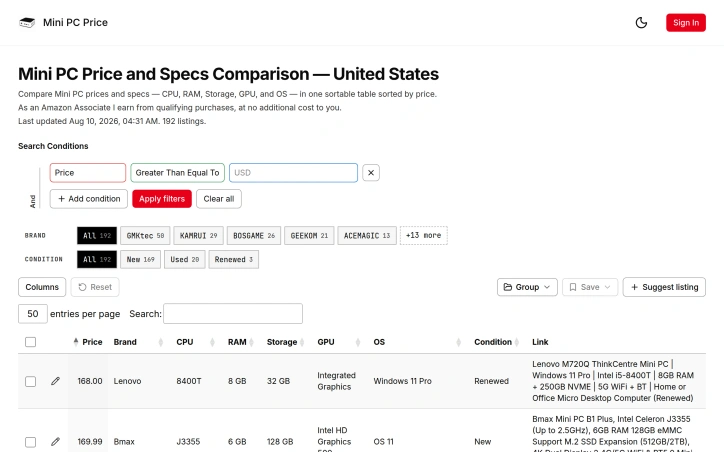
Buying a mini computer typically demands opening dozens of retailer tabs, copying specifications into spreadsheets, and cross-referencing prices across multiple platforms. Mini PC Price eliminates this friction by consolidating every available listing into a single searchable, filterable database where buyers compare specifications and prices without context switching. The tool serves multiple buyer personas with distinct research patterns. Office managers seeking budget systems with specific RAM and storage configurations can layer filters by price and memory specifications. Gamers hunting high-performance compact systems prioritize GPU capabilities and CPU boost clocks. Those interested in upgrading components can compare RAM maximums and storage interfaces. Rather than forcing a universal view, the tool lets each cohort toggle only the columns that matter for their decision. Several design choices distinguish Mini PC Price from conventional price comparison sites. It functions as a comprehensive parameter database rather than a curated top-ten list, capturing the full catalog across brands including Beelink, Minisforum, Intel NUC, ASUS, Lenovo, and HP. Listings source from real marketplace data with daily price refreshes. Specifications undergo manual verification where it matters—RAM type, GPU classification, OS bundling, and upgrade paths—rather than relying on auto-scraped data prone to inconsistency. The feature set prioritizes rapid discovery and precision. Search operates on type-ahead, accepting brand names, chip identifiers like 7840HS or N100, port counts, or product title fragments. Structured filters stack together, enabling queries like "mini computer under $600 with discrete GPU" without requiring review aggregator browsing. Sorting defaults to price but pivots to RAM, storage capacity, or processor speed on demand. Condition filtering toggles between new, used, renewed, and refurbished inventory without disrupting the filtered view. A sharing mechanism enables users to save groups and distribute links, particularly useful for forum recommendations or team purchasing scenarios. The emphasis on customization—column selection, filter stacking, search precision—reflects a product built around actual buyer workflows rather than editorial taste-making. The free model removes acquisition barriers for individual shoppers and procurement professionals alike. Without explicit monetization details in available materials, the zero-cost entry positions Mini PC Price as a utility resource for anyone shopping mini computers.

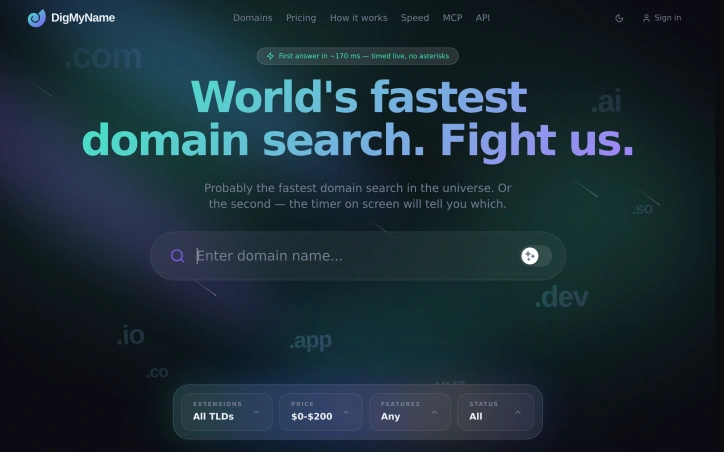
Domain acquisition remains a friction point for anyone launching a startup or brand. DigMyName targets the inefficiency that emerges when searchers need to check availability across multiple domain extensions and registrars simultaneously. Rather than bouncing between registrar websites or using disconnected tools, the platform consolidates the process by querying over 50 top-level domains and comparing pricing across multiple registration services in a single interface. The core value proposition hinges on speed. The site explicitly claims to offer the fastest domain search the company has measured, suggesting a direct response to the tedium of manual lookups. For someone trying to lock down a domain name quickly—whether for a business launch, personal brand, or creative project—this acceleration matters. The ability to see both availability and price variations across registrars and TLDs simultaneously eliminates the need for multiple searches and manual price tracking. The feature set focuses on breadth and comparison. By indexing 50+ TLDs rather than restricting users to the handful of most common extensions, the platform opens possibilities for finding available alternatives when a .com or .net is already taken. The instant price comparison across registrars addresses a real pain point: registrar pricing can vary significantly for the same domain, and discovering the best deal typically requires switching between sites. DigMyName consolidates this competitive pricing into a single view. The positioning suggests an audience spanning individual founders and small businesses who need to move quickly without getting bogged down in registrar navigation. The emphasis on speed and ease indicates the founders recognized that domain acquisition should be a solved problem—a quick decision rather than an hours-long research session. The company's narrative about simplifying domain discovery identifies a clear market frustration with existing workflows. The product spots a genuine gap between the importance of finding the right domain and the poor experience of actually doing so. Whether the search speed claim withstands comparison against dedicated registrar searches, and whether the tool integrates smoothly into actual purchase workflows, would shape real-world utility. But the core premise stands: domain hunting deserves better tools than the fragmented landscape currently offers.

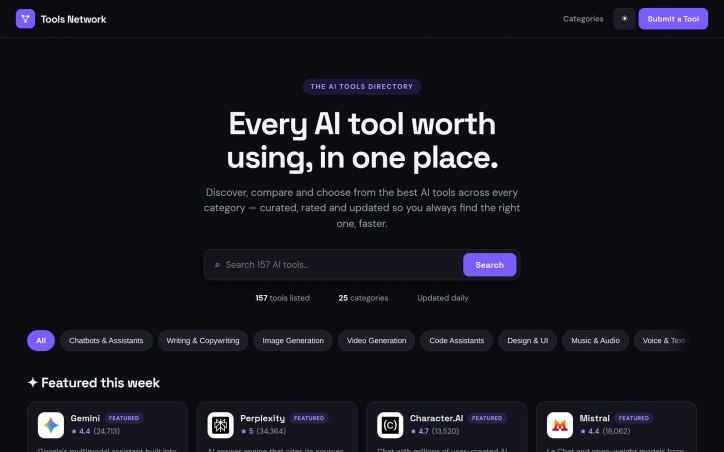
Finding the right AI tool has become genuinely difficult. With hundreds of options launching monthly, researchers and business teams waste considerable time evaluating scattered reviews, outdated comparisons, and fragmented recommendations across multiple sources. Tools Network consolidates the AI tool landscape into a searchable, regularly updated directory designed for rapid discovery and comparison. The product indexes 157 tools across 25 categories, spanning chatbots and code assistants to video generation and SEO platforms. What distinguishes Tools Network from a static list is its commitment to daily updates and user-generated ratings. Each tool carries star ratings alongside vote counts from thousands of reviews, creating both numerical assessment and market consensus signals. The featured and trending sections help users identify momentum in product development without needing to independently predict or evaluate emerging options. This curation layer saves time for teams overwhelmed by the sheer volume of launches. The interface emphasizes practical comparison. Users browse by category, search the directory, and review multiple tools side by side. Rating data across thousands of reviews per tool creates a filtering mechanism that surfaces genuinely popular options rather than marketing-driven positioning. Daily updates address a core pain point: the AI tools landscape shifts remarkably quickly as new capabilities launch and incumbent products evolve their positioning. Yesterday's cutting-edge becomes outdated within weeks. The business model remains unspecified in available materials, though users encounter no apparent paywall browsing tools or filtering by category. This accessibility reduces friction for discovery, particularly valuable for teams and creators evaluating tools for the first time. The primary trade-off is one of scale and curation. With 157 tools across 25 categories, the directory remains selective rather than exhaustive. This is arguably deliberate, since comprehensive coverage of every AI tool released daily would recreate the very discovery problem the product addresses. Teams seeking obscure or highly specialized tools may need to look elsewhere. Tools Network targets anyone experiencing decision fatigue in the AI tools market. For teams tired of scattered reviews and outdated comparisons, the consolidated, regularly updated directory offers a more efficient path to finding the right choice.

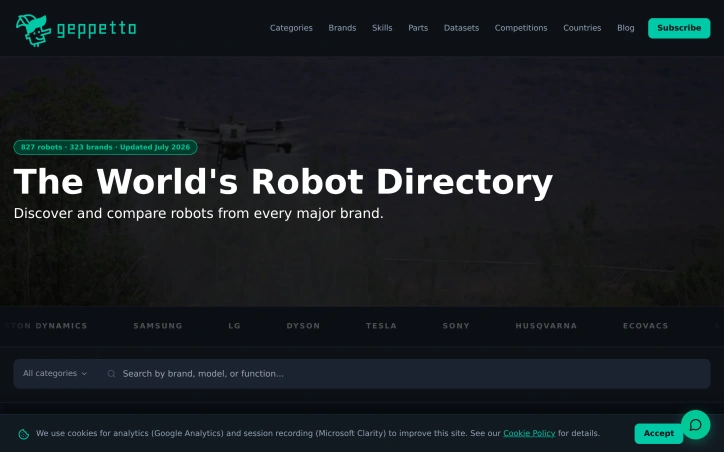
Navigating the robotics market has long been a fragmented experience, with specifications, pricing, and performance data scattered across manufacturer websites and trade publications. Geppetto addresses this fragmentation by consolidating information on over 800 robot models spanning 30+ categories into a single discovery platform. The service targets both commercial buyers evaluating robotic solutions and researchers mapping the landscape of available automation technology. The core value proposition centers on comparison and discovery. Rather than cobbling together information from multiple sources, users can access standardized specifications and pricing data across a broad range of robots. This centralization eliminates the manual research burden that typically precedes robotic procurement decisions. The platform's coverage across dozens of categories reflects an effort to serve diverse segments of the robotics market, from manufacturing and logistics to service and research applications. What distinguishes Geppetto from a simple product listing is its explicit focus on comparison functionality. The platform positions itself not merely as a directory but as an active research tool where users can meaningfully evaluate options side by side. This approach recognizes that robotic systems purchasing decisions involve complex technical tradeoffs and that buyers need structured data to compare performance characteristics and costs effectively. Rather than relying on isolated product pages, the platform enables systematic evaluation across multiple dimensions. The breadth of the catalog—800+ robots across 30+ categories—represents substantial curation work. Maintaining current specifications and pricing across such a range requires ongoing relationships with manufacturers and regular data verification. The platform must navigate the continuous product cycles that characterize robotics, where new models and capabilities emerge regularly. Staying current is essential to maintaining user value. The consolidation strategy addresses a genuine market need. Fragmentation currently forces buyers and researchers to conduct labor-intensive searches across disparate sources, consuming time and increasing the risk of incomplete evaluation. For anyone in the robotics procurement workflow, Geppetto offers a centralized alternative. In a market expanding rapidly with new entrants and capabilities, a unified reference point carries particular value.

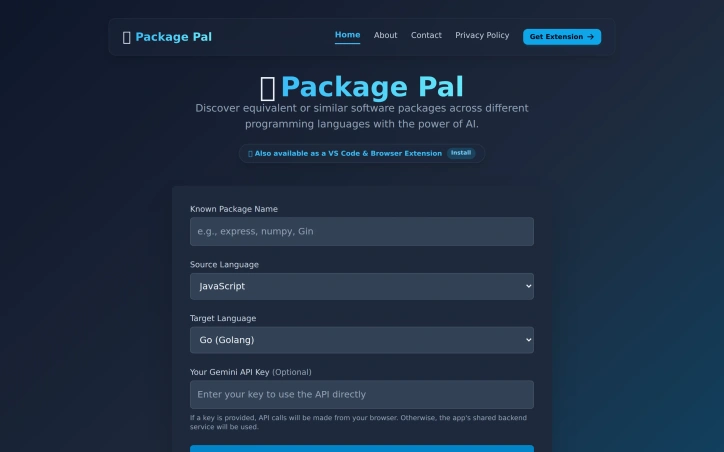
Developers frequently face a significant hurdle when switching between programming languages, namely finding equivalent libraries and packages. Package Pal addresses this challenge by providing a platform that instantly suggests alternatives across multiple languages. The tool is specifically designed for developers who need to migrate projects, refactor legacy services, or learn new frameworks. What stands out about Package Pal is its use of state-of-the-art AI to bridge the gap between different package ecosystems. By leveraging this technology, it enables developers to map their existing knowledge from one language to another seamlessly. The tool's ability to provide instant translations, complete with documentation URLs, installation commands, and usage examples, is particularly noteworthy. The key features of Package Pal include cross-language support for over 15 popular languages, an IDE extension that allows for in-editor package discovery, and the option to run queries client-side using a user's own Gemini API key. This last feature is especially useful for users who require higher rate limits. Additionally, the tool provides a sidebar explorer that automatically scans the active file and lists all dependencies and their alternatives in a clean tree view. Package Pal is available as a free VS Code extension, with a clear emphasis on privacy. The tool is committed to protecting user data and provides transparent information about its data collection practices and use of third-party cookies. Users have control over their data, and the option to opt out of personalized advertising is available through Google Ad Settings or aboutads.info. Overall, Package Pal is a valuable resource for developers navigating the complexities of cross-language development.
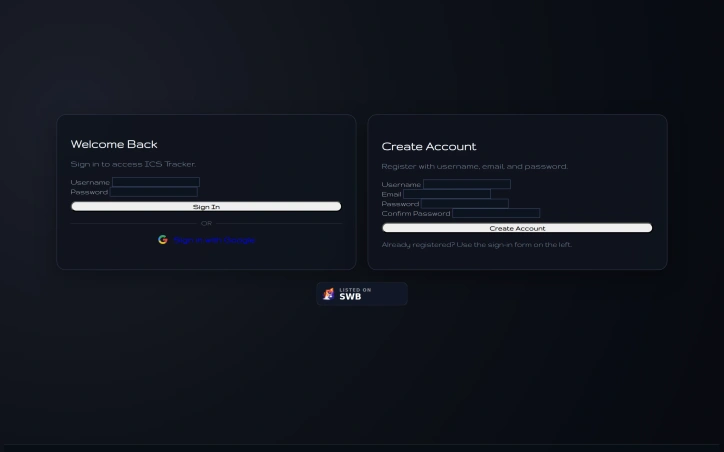
Organizations operating industrial control systems and operational technology infrastructure face a pressing concern: identifying and monitoring internet-exposed devices that could be vulnerable to cyber threats. ICS Tracker's solution directly addresses this issue by scanning the internet for exposed ICS and OT devices, effectively creating a digital fingerprint of these assets. This intelligence is crucial for entities responsible for securing critical infrastructure, as it enables them to pinpoint potential entry points for attackers. What distinguishes ICS Tracker is its methodical approach to detecting industrial protocols and subsequently examining web applications associated with these devices. By doing so, it provides a detailed insight into the online presence of ICS and OT infrastructure, a critical step in managing and mitigating associated risks. The product's capability to identify specific industrial protocol responses and then comprehensively scan associated web applications stands out as a key feature. This level of scrutiny suggests a thorough understanding of the complexities involved in securing industrial infrastructure, where the stakes are high due to the potential for significant disruption or damage. Unfortunately, the available information does not detail the pricing or business model adopted by ICS Tracker, making it difficult to assess its accessibility to potential users. Nonetheless, the focus on delivering actionable intelligence on internet-exposed ICS and OT devices positions ICS Tracker as a valuable resource for those tasked with safeguarding critical infrastructure against cyber threats. Its unique scanning and monitoring capabilities make it a noteworthy solution in the industrial cybersecurity landscape.

Navigating the rapidly expanding landscape of artificial intelligence tools is a daunting task for both practitioners and founders. AIToolsRecap addresses this challenge by serving as a central hub for discovery, comparison, and review of AI tools. The platform is geared towards two primary audiences: AI founders looking to showcase their tools and practitioners seeking to evaluate and stay updated on the latest AI technologies. What stands out about AIToolsRecap is its commitment to independence, in-depth analysis, and practitioner-tested reviews. The platform claims over 2 million Google impressions, underscoring its visibility and influence within the AI community. Its citation by prominent AI search platforms like ChatGPT, Copilot, and Grok further solidifies its credibility. The website showcases a diverse array of AI tools across various categories, with a notable emphasis on newly launched tools. AIToolsRecap's key features include a comprehensive directory of AI tools, detailed comparison guides, and editorial coverage. The platform allows AI founders to list their tools for free, making it an accessible resource for emerging technologies. For reviewers, it offers incentives such as credits for contributing reviews. The content is rich in insights, as demonstrated by in-depth guides comparing specific AI models and tools, providing readers with nuanced understanding and practical information. While the platform's business model isn't explicitly detailed, the presence of sponsored content and premium services for subscribers (as indicated by the "X Premium+" mention in one of the guides) suggests a multi-faceted approach to revenue generation. The specific guide comparing free and paid versions of Grok provides a clear example of the platform's nuanced analysis, highlighting the value proposition of paid upgrades and demonstrating its capability to deliver actionable insights to its readers. Overall, AIToolsRecap is a valuable resource for both AI practitioners and founders, offering a well-curated and insightful exploration of the AI tool landscape.


Finding a Japanese name with the right meaning, sound, and cultural weight has traditionally meant juggling multiple resources or relying on family knowledge. Japanese Name Finder consolidates this fragmented search into a single directory designed for people naming babies, developing fictional characters, or exploring Japanese naming traditions. The product's core strength lies in its multi-path discovery model. Rather than forcing users into a single search funnel, the platform offers parallel routes: a 3,000-entry directory searchable by meaning (fire, water, moon), an A-Z browsing system across 26 filtered categories, a name generator with use-case presets, and thematic landing pages built around semantic queries. This approach acknowledges that someone seeking a baby name approaches the task differently than someone creating an anime character or naming a pet. The generator is the product's most distinctive feature, letting users input their English name for personalized suggestions and then customize results by gender, thematic elements, and intended use. The preset categories—Baby, Anime Character, Cat, Dog, Warrior, and Elegant—signal that the tool is built from observation of actual naming patterns rather than generic filters. Users can draw from nine thematic filters (Nature, Strength, Beauty, Love, Wisdom, Fire, Water, Moon, Flower) and control output volume, accommodating both quick decisions and comprehensive exploration. The directory includes kanji, pronunciation guidance, and cultural meaning for each entry, addressing a real barrier for non-native speakers or those unfamiliar with character selection conventions. The internal linking architecture transforms what could be a static list into a topic cluster, where users encountering a name can navigate to related entries by theme or gender rather than hitting dead ends. What's notably absent is any attempt to position the product as a generative AI tool. In an era where LLM-based alternatives proliferate, Japanese Name Finder's commitment to a curated database with structural navigation feels almost contrarian—and pragmatic. A 3,000-name directory can be browsed, internalized, and reasoned about in ways that procedurally generated alternatives struggle to match. The product targets a distinct niche, separate from general baby-name directories. Its competitive advantage lies in search visibility for high-intent queries (fire names, moon kanji, beauty themes) rather than broad brand recognition.


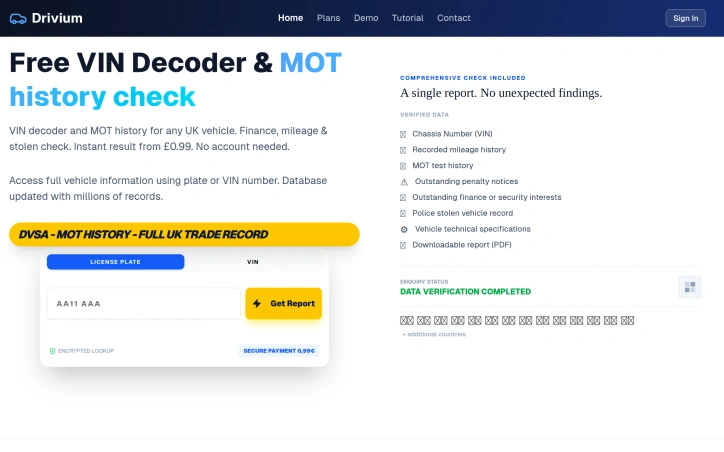
Used car buyers face a critical problem: without access to verified history, they risk purchasing vehicles with hidden mileage tampering, outstanding finance claims, or theft records. Drivium addresses this by offering instant vehicle history reports through a simple plate or VIN lookup. The service operates as a streamlined B2C and B2B offering. Individual buyers get comprehensive verification for £0.99 per report with no account creation required, while dealers, brokers, and insurers access bulk checking through an API that integrates with their existing systems. The platform covers over 20 countries and supports all UK plate formats, both current and legacy. What distinguishes Drivium is its combination of simplicity and depth. A single report retrieves MOT history with recorded mileage at each inspection, outstanding finance or liens, stolen vehicle records, emissions ratings, technical specifications including engine size and fuel consumption, and outstanding manufacturer recalls. Users download results as PDF reports, while API customers export in JSON, CSV, or TXT formats. The service encrypts lookups with AES-256 SSL and processes payments via Visa, Mastercard, or PayPal. The platform's credibility indicators suggest genuine traction. It shows 2,560 reports issued, a 4.7 out of 5 rating across 1,296 reviews, and operates with verified data pulled from official UK Trade Records and DVSA MOT databases. The positioning acknowledges distinct user segments—consumers checking a single purchase, dealerships running batch verifications, and insurance assessors detecting fraud through VIN cross-referencing. One practical strength is the mileage tampering detection workflow. Rather than trusting odometer readings, buyers can review mileage at each MOT inspection to identify discrepancies. For fleet operators and dealers, the API removes manual lookup friction across hundreds of checks. The £0.99 entry point removes friction for one-time buyers, though the business model appears oriented toward API plans for commercial users. The lack of mandatory signup and subscription lock-in positions the service as a utility rather than requiring long-term commitment. Whether the volume of B2C impulse checks sustains the operation remains uncertain, but the commercial tier serving dealerships and insurers likely represents the core revenue driver.

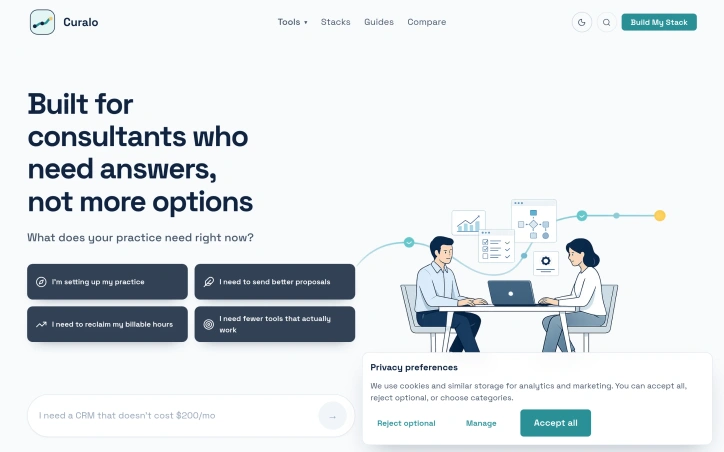
Planning tool overload has become a genuine problem for solo consultants and growing firms. With hundreds of software solutions vying for attention and wallet space, the decision fatigue of choosing between CRM platforms that cost $200 monthly, automation tools, scheduling apps, and analytics software can consume valuable billable hours. Curalo addresses this friction head-on by functioning as a curated directory and recommendation engine specifically built for the consulting industry. The platform positions itself as the antidote to tool sprawl. Rather than presenting an exhaustive catalog of options, Curalo takes a curation stance, reviewing and scoring 126+ tools while packaging them into pre-built "stacks" — bundled workflows designed to solve specific consultant pain points. The Day One Stack guides new practitioners through initial setup with tools like Calendly, Bonsai, and Notion AI. The Proposal-to-Payment Stack combines Bonsai and QuickBooks to streamline deal closure. Those drowning in administrative overhead can adopt the Billable Hours Stack, which integrates scheduling, time tracking, accounting, and workflow automation into a unified system. What differentiates Curalo from a simple tool review site is this stack-centric approach. Each bundle isn't just a collection of vetted tools but a pre-thought workflow designed to be implemented in minutes. The platform also publishes 19+ playbooks and guides — including a noteworthy resource titled "From Solo to Firm: Scaling Your Consulting Practice" that acknowledges how technology needs shift across growth stages. A 60-second quiz helps consultants identify their immediate needs, making discovery frictionless. The review component is straightforward. Tools receive numerical scores (Calendly earns 89/100) alongside brief, plainspoken descriptions. For Calendly, Curalo emphasizes the core value proposition: eliminating scheduling back-and-forth through shared availability links. Pricing details are sparse in the available content, with only Calendly's $10/month baseline mentioned alongside its five-minute setup claim. The platform's positioning against expensive CRM solutions suggests the broader philosophy: recommend effective tools at reasonable cost rather than enterprise software with premium price tags. Curalo serves consultants at all practice stages who value their time over exploring every available option. It's most relevant for practitioners making their first technology decisions or those seeking to replace expensive, bloated platforms with focused, affordable alternatives.