Catalyst Healthspan Audit
Personal trainers typically sell training sessions. This startup reversed the equation by building assessment first, mak...
Launchory
We built Launchory to solve the discoverability problem for startups. Our platform offers instant approval, permanent do...
Best Stock trading platforms Startups & Tools
Buy and analyze markets with real-time data, social features, and journals.
Recently Listed
5 launches
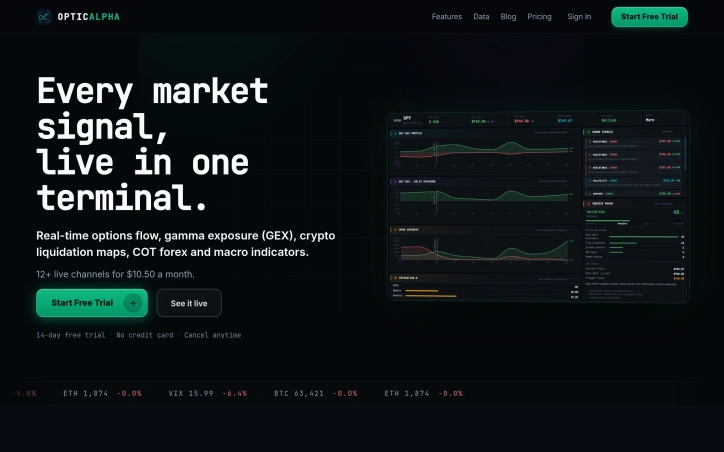
Consolidating market data into a single dashboard has long been a pain point for active traders juggling multiple subscriptions and browser tabs. OpticAlpha tackles this fragmentation by bundling options flow analysis, gamma exposure tracking, cryptocurrency liquidation monitoring, and macroeconomic indicators into one workspace at $10.50 per month. The product targets a specific niche: traders who need real-time insight across options, crypto, foreign exchange, and macro markets without the friction of platform switching. The company positions itself not as a comprehensive all-in-one terminal but as a specialized consolidation layer that pulls the most actionable signals into a unified interface. Several design choices stand out. The options flow module surfaces unusual option prints filtered by size and premium, then ranks tickers by actual flow activity rather than raw volume—a meaningful distinction for traders separating signal from noise. The gamma exposure section maps call and put walls and flags where dealer hedging becomes forced, a feature appealing to volatility traders. On the crypto side, liquidation heatmaps overlay exchange-level leverage data alongside BTC and ETH pricing, with whale alert notifications for large prints. Features extend beyond directional trading. The forex module includes CFTC Commitment of Traders data and a correlation matrix updating weekly, letting traders spot crowded positioning before reversals. Macro traders get a one-minute refresh on the full US Treasury curve plus eighteen FRED economic indicators covering growth, inflation, employment and rates. An analyst ratings feed streams upgrades and downgrades with price-target moves attached. For equities, a Conviction Radar surfaces tickers only after multiple independent signals align. The pricing model is straightforward: a 14-day trial followed by $10.50 monthly. The company claims 12+ live channels and 25+ data streams refresh in real time using the same feeds that power institutional terminals rather than delayed data. The core value proposition rests on consolidation and signal filtering rather than raw feature count. For traders constantly tab-switching between specialized tools, the unified workspace and cross-asset correlation features address a genuine workflow pain. Whether execution delivers on that promise requires hands-on testing, but the product's opinionated feature set and direct pricing point to a focused roadmap.

Simplifying complex financial processes is a formidable task, and Treeova tackles one such challenge by automating options trading without requiring users to have coding knowledge. The platform is designed for individuals who want to leverage automation in their trading activities but lack the technical expertise to develop their own systems. By providing a no-code solution, Treeova opens up options trading automation to a broader audience. This is a significant advantage, as it eliminates the barrier that often prevents non-technical individuals from implementing automated trading strategies. The fact that Treeova is described as an AI workspace suggests that it incorporates advanced technologies to support its automation capabilities. One of the standout aspects of Treeova is its focus on making a sophisticated financial tool accessible to users without a programming background. This indicates a clear understanding of the needs of its target market and a commitment to addressing those needs. The platform's AI-driven approach to options trading automation is also noteworthy, as it implies a high degree of sophistication and adaptability. Key features of Treeova include its no-code automation and AI workspace capabilities. These features are central to the platform's value proposition and are likely to be of significant interest to potential users. Unfortunately, the available information does not include details about Treeova's pricing or business model, leaving questions about its cost and revenue structure unanswered. Overall, Treeova presents itself as a powerful tool for automating options trading, leveraging AI to simplify a complex process and make it more accessible. Its focus on a no-code solution is a significant selling point, and its AI-driven approach suggests a high level of capability.

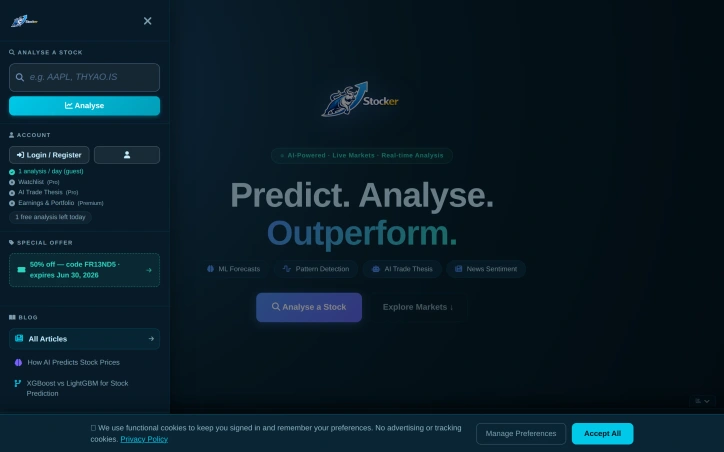
Investors seeking to make data-driven decisions can now leverage a cutting-edge AI-powered stock prediction and analysis tool. Stocker is designed for individuals looking to gain a deeper understanding of the stock market and identify potential investment opportunities. The platform is particularly suited for those who want to harness the power of machine learning to inform their investment strategies. What stands out about Stocker is its ability to provide live analysis and real-time insights, utilizing a robust AI analysis engine that can detect patterns, generate forecasts, and analyze news sentiment. The platform's focus on financial education and its commitment to simplifying complex company fundamentals make it an attractive option for investors of various skill levels. The tool's key features include AI-driven stock analysis, technical indicators, and ensemble ML models that work together to provide a comprehensive view of the market. Users can also create a watchlist to save and track tickers, and access additional features such as AI Trade Thesis and Earnings Summarizer with a Pro subscription. Stocker offers a freemium model, with a free plan that includes five analyses per day and access to basic features. The Pro plan, priced at £3.99 per month, unlocks unlimited analyses and additional features. A promotional code is available for new users, offering 50% off the first month, valid until June 30, 2026. Overall, Stocker is a valuable resource for investors seeking to stay ahead of the curve with data-driven insights and AI-powered analysis.

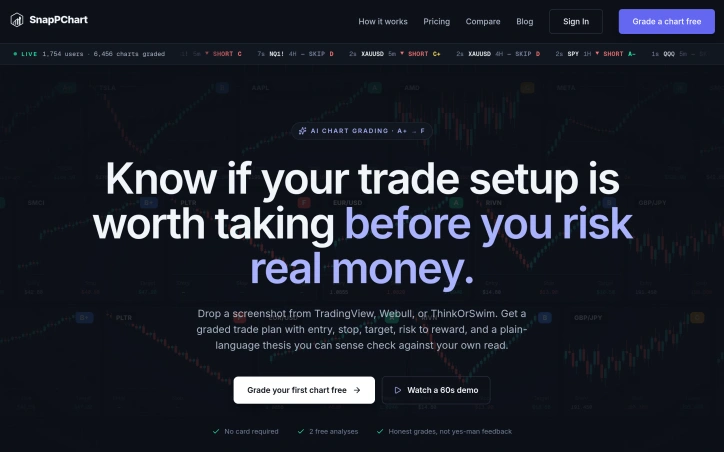
For traders seeking to refine their trading strategy and curb impulsive decisions, SnapPChart offers a unique solution. At its core, the platform addresses the issue of uncertainty and self-doubt that often accompanies trading, particularly when done alone. The problem it tackles is the tendency to question one's own interpretation of a trade setup, and whether it aligns with predefined rules. What stands out about SnapPChart is its reliance on AI-driven analysis to provide an objective review of a trader's setup. By uploading a chart screenshot from popular platforms like TradingView or ThinkOrSwim, users receive a graded trade plan complete with entry, stop, and target prices, risk-to-reward ratio, and a concise rationale. This analysis is designed to help traders verify their own assessments and avoid costly mistakes. The platform's key feature is its ability to provide an honest, unbiased evaluation of a trade setup. This is supported by an AI Trading Coach and Trading Profile, which enable users to identify patterns in their trading behavior, such as chasing entries or neglecting risk management. By doing so, SnapPChart aims to foster more disciplined and self-aware trading practices. Notably, users can try the service for free, with the first analysis offered at no cost and no credit card required. This allows potential users to test the platform's capabilities before committing to further analyses. Overall, SnapPChart presents a compelling solution for traders seeking to enhance their decision-making process and trading outcomes.

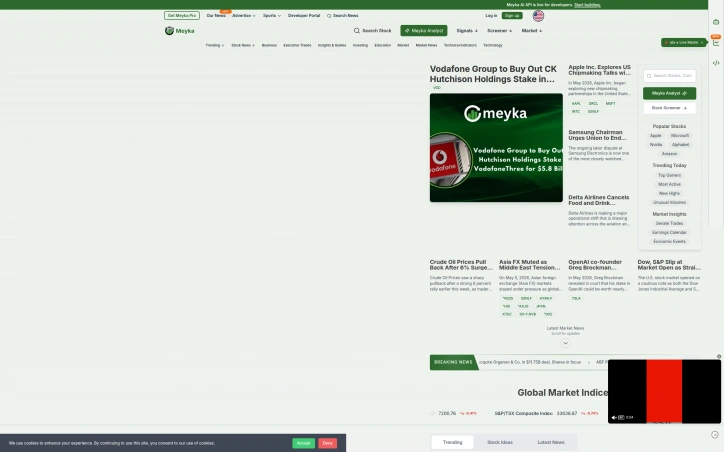
For investors juggling multiple information streams across equities and digital assets, staying informed requires monitoring diverse news sources and market data throughout the day. Meyka addresses this fragmentation by consolidating real-time financial news and market updates in a single interface powered by AI technology. The platform targets active traders and investors who need timely market intelligence to inform trading decisions and portfolio adjustments. The core value proposition centers on AI-driven news aggregation combined with a conversational stock screener. Rather than passively consuming headlines, users can query the system directly through an AI chat interface to filter and analyze stocks based on their criteria and interests. This represents a shift from traditional news consumption toward a more interactive, on-demand approach to market intelligence. The platform appears to track a broad spectrum of assets—from major technology stocks and semiconductor companies to cryptocurrencies like Bitcoin and international markets—delivering coverage that reflects both macro trends and individual security movements. What distinguishes Meyka is the integration of natural language interaction into financial research. Users aren't limited to scrolling feeds; they can ask the AI screener questions about market conditions, sector performance, or specific assets and receive contextual responses. This approach acknowledges that investors have different information needs minute to minute and benefit from a system that adapts to their queries rather than forcing them through rigid category filters. The platform leverages real-time data, evident from headlines covering breaking developments like geopolitical tensions affecting oil prices, earnings announcements, and M&A activity. This emphasis on immediacy matters for a user base where news timing can meaningfully impact position decisions. The combination of breadth (stocks, crypto, commodities context) with depth (the ability to drill down through AI-assisted screening) positions the tool for traders managing diversified portfolios. Without explicit pricing details in the available materials, the business model remains opaque, though AI chat features increasingly signal premium-tier monetization in the fintech space. The product's reliance on proprietary news aggregation and data infrastructure suggests potential subscription-based revenue, though this remains speculation. Meyka tackles a legitimate pain point in modern investing: information overload. By automating news curation and embedding conversational analysis, it streamlines what would otherwise require tabs across multiple financial sites and news outlets.