Catalyst Healthspan Audit
Personal trainers typically sell training sessions. This startup reversed the equation by building assessment first, mak...
Launchory
We built Launchory to solve the discoverability problem for startups. Our platform offers instant approval, permanent do...
Best Team collaboration software Startups & Tools
Digital workspaces for team communication, collaboration, and productivity with messaging, docs, and coordination.
Recently Listed
3 launches
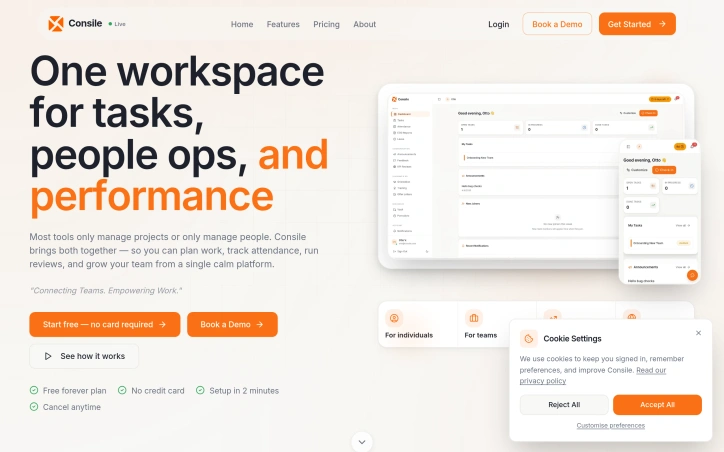
Growing companies waste enormous time coordinating operations through email, spreadsheets, and fragmented tools that rarely communicate with each other. Consile consolidates this sprawl into a single workspace, handling everything from task management and daily attendance tracking to leave approvals, payroll generation, and recruitment pipelines. The product targets expanding teams and individual professionals who have outgrown the chaos of ad-hoc coordination but haven't necessarily justified custom enterprise systems. It replaces the typical pattern where HR lives in one platform, tasks in another, attendance in a spreadsheet, and approvals happen via WhatsApp threads. Consile's architecture spans multiple operational domains. The task module offers Kanban and list views with recurring schedules and co-assignees. Attendance captures one-click check-ins with custom holiday calendars and exportable timesheets. Leave management handles delegation, half-day requests, and hierarchical approval flows. Beyond that, it includes KPI review cycles, onboarding workflows with verifiable certificates, an ATS for recruitment, and automated payslip generation. Otto, a role-aware AI assistant, sits across the platform alongside public APIs and MCP integrations for customization. What distinguishes Consile is its integrated approach to problems that typically require point solutions. Most companies string together a payroll tool, an HR system, a task tracker, and a time-tracking app, then manually thread data between them. Consile attempts to eliminate those handoffs. The blog content signals ambition beyond basic task management, covering employee self-service portals, performance improvement plans, job specifications, and compliance considerations for specific markets like South Africa and Nigeria. This suggests the team is thinking about deep operational workflows, not just surface-level coordination. On security, Consile emphasizes multi-tenant isolation, row-level security, TOTP MFA, IP allowlists, signed webhooks, and immutable audit logs. It offers SCIM provisioning for enterprise deployments, indicating it's designed to scale beyond small teams. The company offers a 14-day free trial with full feature access and no credit card required, though specific pricing details aren't exposed upfront. Multiple plan tiers exist, but pricing remains hidden until signup, a common pattern for vertically integrated platforms where configuration varies significantly across customer size. The core value proposition is consolidation: reducing tool fatigue and manual coordination. Whether Consile executes deeply enough across all these domains to truly replace specialized tools depends on implementation depth, but the scope is comprehensive.

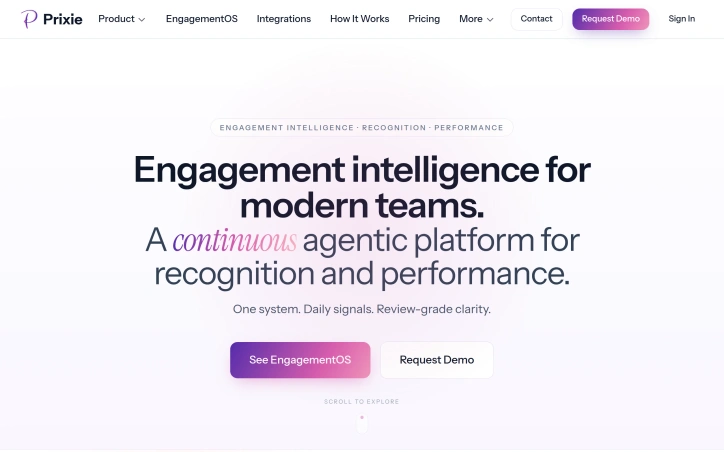
Recognition happens everywhere in modern workplaces—in Slack channels, passing conversations, emails from partner teams—but performance reviews happen once a year in a form that flattens all that context into a narrow evaluation. The gap between continuous visibility and periodic assessment creates a fairness problem: contributions fade from memory, work outside a manager's direct oversight disappears, and employees end up reconstructing a paper trail for impact they've already delivered. Prixie addresses this disconnect head-on. The platform consists of two connected suites: Recognise handles daily recognition, rewards, analytics, and leaderboards in the flow of work, while Perform manages goals, performance reviews, engagement surveys, and 1:1s with structured feedback. Both feed into an engine called EngagementOS that turns recognition signals into actionable intelligence. The core insight is compelling: if you continuously capture who's being recognized, who's thriving, and where contributions cluster, you can surface disengagement early and make performance reviews resonate with actual work patterns rather than faded manager recollection. The system automates moments that matter—anniversaries, milestones, and recognition prompts—so visibility stays intentional rather than accidental. Integration appears central to the value proposition. Prixie connects to Slack, Teams, HRIS platforms like Workday, and SSO providers, positioning itself as an overlay on tools teams already use rather than a parallel system requiring new authentication. The platform surfaces insights proactively instead of burying them in reports managers must manually excavate. The feature set maps the narrative well: recognition feeds and analytics ladder up to measurable outcomes; engagement metrics connect to ROI claims for HR and leadership; continuous feedback channels sit alongside traditional review cycles. Automation handles administrative friction by prompting managers when recognition moments arise. Pricing follows a per-user model, with separate plans for Recognise alone and a fuller platform bundling Perform and EngagementOS together. The company emphasizes transparent, modular pricing without hidden fees on standard plans, with enterprise options available. For organizations where the performance-recognition gap creates visible culture friction, the unified approach to continuous signals and episodic reviews offers a direct answer. The product essentially rebuilds the annual review to remember what actually happened.

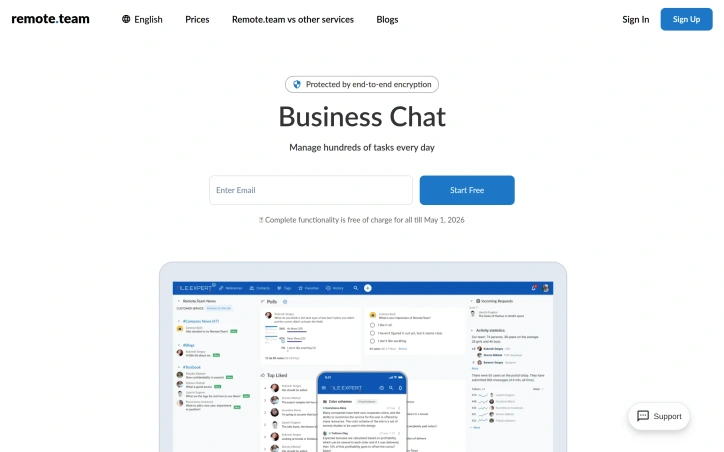
Positioned as a stripped-down alternative to heavier platforms like Basecamp and Bitrix, this secure chat and task management tool targets small-to-medium remote teams seeking simplicity over feature richness. The product's defining feature is end-to-end encryption for all communications—an unusual emphasis in the team chat space that directly addresses organizations handling sensitive information. Finance, legal, and healthcare firms can discuss confidential matters without concern that internal administrators might access message content. Operationally, the platform centers on three core capabilities: asynchronous chat, task assignment, and comment-based collaboration. Users assign work to specific team members, request urgent responses, and thread discussions directly within tasks. The interface is consistently praised as intuitive and non-technical-friendly, suggesting thoughtful UX design that avoids overwhelming users with excessive options. Multiple reviewers specifically highlight the absence of unnecessary features—a deliberate trade-off prioritizing speed and simplicity over breadth. Adoption appears strongest in Eastern European markets based on review languages and company references. User feedback clusters around productivity gains and practical reliability. One company reports a 20–25 percent productivity increase following implementation. The platform has accumulated 58 reviews with an "Excellent" rating, indicating solid satisfaction among early adopters, though this reflects a relatively modest user base compared to mainstream competitors. The most significant business model detail is the current pricing strategy: all functionality is free through May 1, 2026. This appears to be a launch-phase offer rather than a permanent free tier, indicating the company plans to introduce paid tiers after the promotional period. For prospects evaluating the platform, this deadline creates genuine urgency to test features before pricing changes take effect. Remote.Team succeeds as a focused product for teams with specific needs: organizations that prioritize security and simplicity over integrations and advanced features. It's neither attempting to be an enterprise platform nor reinventing team communication from first principles. The deliberate restraint in scope, combined with strong end-to-end encryption and demonstrated productivity improvements, makes it a credible option for organizations whose actual needs align with its design philosophy rather than aspirational enterprise requirements.