Catalyst Healthspan Audit
Personal trainers typically sell training sessions. This startup reversed the equation by building assessment first, mak...
Launchory
We built Launchory to solve the discoverability problem for startups. Our platform offers instant approval, permanent do...
Best AI Generative Media Startups & Tools
Generate images/videos from prompts, edit photos, and power creative workflows.
Recently Listed
57 launches
In the realm of beauty analysis, concerns about privacy often hinder users from exploring their features in-depth. To address this, a novel solution has emerged, prioritizing user privacy while providing a suite of AI-powered beauty tools. The driving force behind this innovation is the need for a secure and confidential platform where users can analyze their facial features without compromising their personal data. By ensuring that all analyses run locally within the user's browser, the solution effectively eliminates the risk of sensitive information being shared or stored. What stands out about this product is its commitment to maintaining user privacy while delivering a comprehensive range of beauty analysis tools. The absence of server uploads and data collection mechanisms underscores this commitment. Notably, the AI-driven tools are diverse, encompassing facial symmetry scoring, celebrity look-alikes, face shape detection, and color analysis, among others. Key features worth highlighting include the ability to analyze 468 facial landmarks for precise assessments and the availability of personalized style tips and recommendations based on the analysis. The product offers nine distinct tools, each designed to cater to different aspects of beauty analysis, from determining face shape and eye shape to estimating age and identifying the most flattering colors. The product is touted as being free forever, with no hidden costs or account requirements, making it accessible to a wide range of users. By forgoing a traditional revenue model that relies on user data or subscription fees, the developers have successfully created a unique value proposition centered around privacy and accessibility.

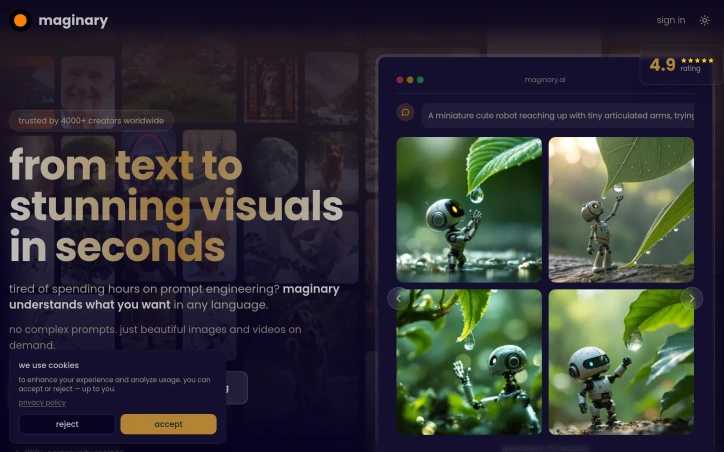
Creating stunning visuals from text prompts just got a lot easier, thanks to a innovative AI-powered solution designed specifically for creators. The problem it tackles is the tedious and time-consuming process of crafting complex prompts to achieve desired results, freeing up artists to focus on their craft. What stands out about this product is its ability to understand intent in any language, allowing users to simply write in plain language and receive high-quality images and videos on demand. The AI engine is capable of delivering diverse and unique outputs, making it an ideal tool for those who need rapid iterations and varied results. Notably, the product boasts a range of key features, including the ability to generate four variations in seconds, making it perfect for tight deadlines. It also offers style references, video generation, and more, built right in. Additionally, users can integrate the product into their workflow via a full REST API with comprehensive documentation and examples. The pricing model is straightforward, with a pay-as-you-go approach that eliminates forced subscriptions. Users can choose from a range of plans, including a novice pack with no commitment, or higher-tier plans with varying levels of support and credits. All plans include full commercial rights, with no hidden fees, and users can cancel anytime. With over 600 creators worldwide already trusting this product, it's clear that it's making a significant impact in the creative community. By simplifying the process of creating stunning visuals, this AI-powered solution is empowering artists to bring their ideas to life quickly and easily.

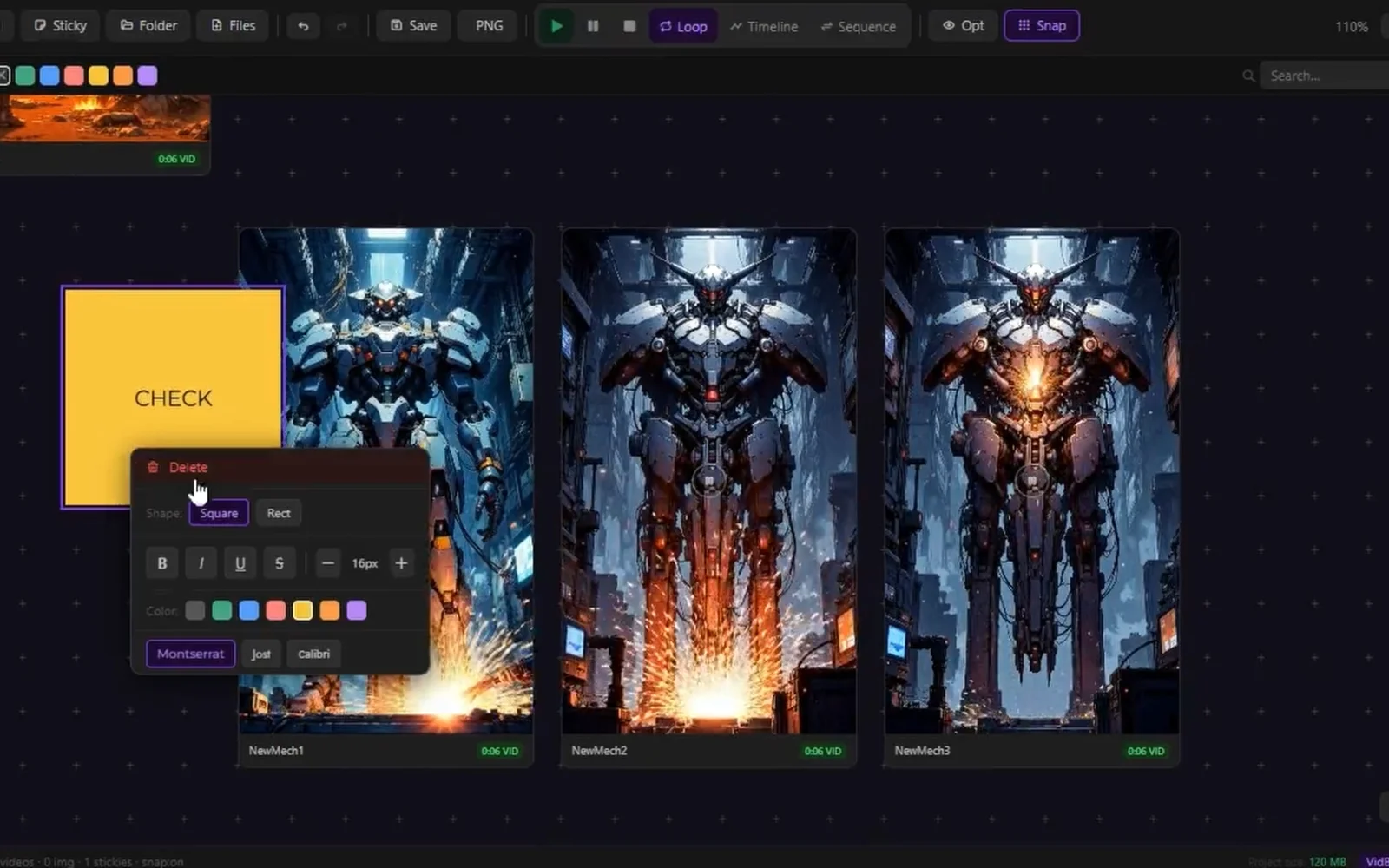
Creators working with AI-generated media face a fragmented workflow. After spending time generating images and videos across various AI tools, they must jump between multiple applications to organize, compare, and present their results. VidBoards consolidates this repetitive context-switching into a single, focused application designed specifically for reviewing and presenting generated batches. The product targets AI creators actively using generation tools like ComfyUI, Automatic1111, Stable Diffusion, and similar platforms. Rather than building yet another creation tool, VidBoards solves the problem that comes after generation: managing outputs efficiently, comparing results systematically, and presenting sequences without leaving the application. What distinguishes VidBoards is its philosophical foundation. The application operates entirely locally without subscriptions, accounts, or cloud services. It reads embedded metadata directly from generated files, eliminating manual documentation burden. This approach appeals to creators who prioritize privacy and control over their workflow. The interface centers on an infinite canvas where users arrange videos and images freely using standard gestures: middle-mouse panning, scroll-wheel zooming, and optional snap-to-grid alignment. Multiple boards support unlimited cards per project, saved as lightweight .vdb files. The architecture remains deliberately simple, keeping users focused on their media rather than fighting interface complexity. The shared timeline feature represents the core innovation. A single scrubber syncs all videos to the exact same frame simultaneously, enabling instant comparison across dozens of clips. Rather than opening multiple players and mentally tracking differences, creators see frame-by-frame variations across all takes at once. This directly addresses the time spent hunting for optimal shots. Sequence Mode transforms the application into a presentation tool. Users activate a full-screen overlay, arrange clips in order, and play them back-to-back like a showreel. Auto-advance between items and keyboard controls eliminate the need to export to external presentation software. Supporting tools include batch operations through multi-select, quick media controls for simultaneous playback or looping, and support for PNG, JPEG, WebP, MP4, and MKV formats. The application also handles metadata from multiple AI generation tools seamlessly. The pricing model is unambiguous: free, forever, with no subscription, no account requirement, and no cloud dependency. For a creator-focused tool addressing a specific workflow bottleneck, VidBoards demonstrates disciplined product design aligned with its audience's actual needs.

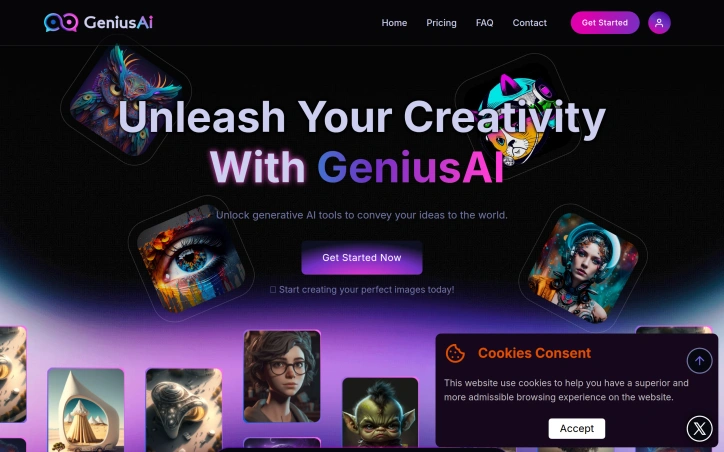
Creative professionals and businesses struggling to generate high-quality visual content at scale now have access to a streamlined AI image generation platform that prioritizes both speed and ease of use. GeniusAI targets content creators managing production timelines, marketing teams running campaigns, and developers building AI-powered applications, offering a tiered approach that accommodates different user needs and budgets. The platform distinguishes itself through deliberate simplicity. Rather than overwhelming users with endless customization options, GeniusAI presents a three-step workflow: select from preset AI models and styles, describe what you want in natural language, and generate the image. This straightforward approach appeals to users without technical AI expertise while providing enough control for professionals seeking consistency across projects. The product features image generation with multiple model variants, photo editing tools, and image upscaling capabilities. Prompt enhancement automatically improves user descriptions before generation, reducing the friction of crafting perfect prompts. Teams can collaborate within a shared workspace, and all tiers include commercial licensing, removing legal uncertainty around using AI-generated content for business purposes. For developers, an API enables integration with existing workflows and the ability to enforce brand guidelines programmatically. GeniusAI's pricing structure reflects its market positioning. The entry-level Genius Creator tier at ten dollars monthly offers 700 monthly credits sufficient for casual creators, with images up to 896 by 896 pixels and access to eight preset styles. The Genius Studio tier at thirty-five dollars monthly jumps to 3,000 credits and increases resolution to 1024 by 1024 pixels while unlocking all 21 available styles. The Genius Pro tier at forty-five dollars monthly adds 5,000 monthly credits, extends creation history to unlimited, and includes twenty-four hour priority support. Each tier supports instant regeneration and full-size downloads. The generation process emphasizes speed; the platform can produce images in seconds rather than minutes, a meaningful advantage for professionals with tight deadlines. The inclusion of multiple generation modes allows users to balance output speed against visual polish depending on project requirements. The platform's positioning emphasizes both accessibility and professional capability, suggesting it serves as a bridge between casual users discovering AI-generated imagery and teams deploying it as part of their production workflows. The combination of competitive pricing, commercial licensing, and team features positions GeniusAI as a practical choice for businesses integrating generative AI into existing creative operations.

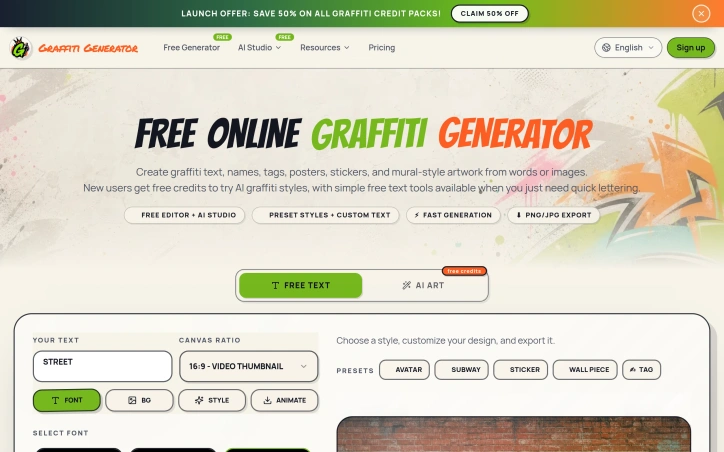
Graffiti Generator is built for creators, designers, students, content makers, small brands, street-art fans, and anyone who wants to turn words, names, tags, or prompts into graffiti-style visuals without learning complex design software. The platform combines free browser-based graffiti tools with AI-powered graffiti image generation. Users can create graffiti text designs, explore name and tag styles, browse graffiti letter pages, generate AI graffiti artwork from prompts, and download results for personal projects, social graphics, posters, stickers, moodboards, profile images, and creative concept work. Unlike a generic AI image generator, Graffiti Generator is focused specifically on graffiti and street-art workflows. It supports different creative entry points: a word, a name, a tag, a single letter, a full prompt, or a source image. This makes it useful whether someone needs a quick graffiti text preview or a more detailed AI-generated mural-style image. Graffiti Generator is designed for fast exploration and visual ideation. It helps users test graffiti styles, compare creative directions, generate readable lettering, and create urban-inspired visuals. The platform includes free tools, free starter credits for new users, and one-time paid credit packs for users who need more AI generations or higher-resolution output.

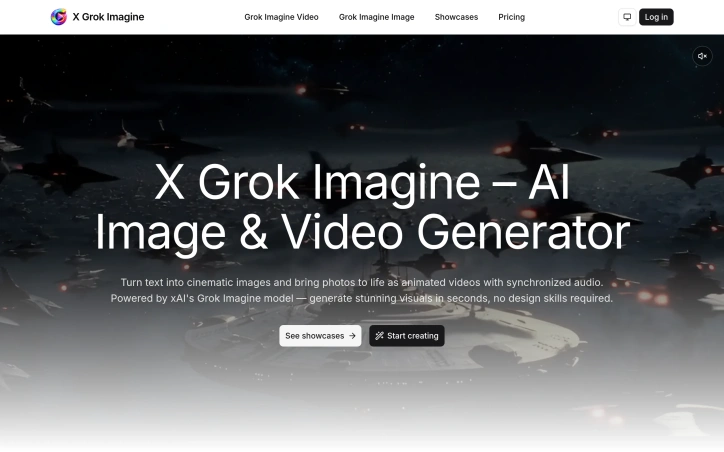
Streamlining visual content creation for non-designers has become a genuine market need, and Grok Imagine addresses it by combining text-to-video and image-to-video generation in a single interface. The tool targets creators, small production teams, and anyone who needs professional-grade visuals without mastering complex design software or waiting through long rendering times. The product's core value proposition centers on speed and accessibility. Generation happens in seconds rather than hours, with synchronized audio built into the workflow. The underlying xAI model produces what the company describes as cinematic results—expressive lighting, character consistency, realistic motion, and style fidelity. These aren't trivial accomplishments in generative media; competitors often struggle with temporal coherence in video or maintaining visual coherence across a sequence. Several features distinguish this offering in a crowded space. Commercial use rights come standard across all pricing tiers, removing a significant friction point for businesses that want to deploy generated content immediately. Privacy is positioned as a default; prompts and assets remain private and aren't shared with third parties, which appeals to creators handling sensitive or proprietary work. The generation history window scales with subscription level—90 days at the Pro tier, up to a full year for Max subscribers—giving users practical access to past work. The pricing structure uses a credit system rather than a pure subscription model, which allows flexibility. Monthly plans range from Plus at $9.90 to Max at $39.90, with credit allocations from 1,000 to 6,000 per month. One-time credit packs offer entry points for trial users or supplemental bursts. The per-credit cost improves with tier; Max subscribers pay $6.65 per thousand credits versus $9.96 for one-time purchases, incentivizing commitment. Pro tier—labeled as the popular option—sits at $19.90 with 2,500 monthly credits and priority processing, suggesting that's where the company expects mainstream adoption. What's notably absent from the marketing material are specific performance benchmarks, model architecture details, or comparative testing against competitors. The feature set is presented clearly but without quantitative validation. The pricing is transparent but unconventional enough that a potential customer would need hands-on experimentation to understand value per credit across different content types. For creators managing tight deadlines and those pricing out of enterprise tools, Grok Imagine delivers on its core promise: turning inspiration into finished visual content with minimal technical friction.

An AI-powered mobile application for personal beauty assessment and skincare planning, Beauty Score targets users who want instant feedback on their facial appearance and actionable steps toward improved skin health. The platform transforms selfies into multidimensional beauty insights, filling a gap between casual beauty curiosity and the friction of professional dermatology consultations. The core offering combines three interdependent functions. First, it generates a numerical beauty score from zero to one hundred, providing immediate quantifiable feedback. Second, it delivers face and skin analysis covering symmetry, emotional expression, age estimation, and specific skin conditions including blemishes, acne, and dark circles. Third, it constructs personalized skincare routines derived from the scan results. This layered approach moves beyond vanity metrics toward practical guidance. What distinguishes Beauty Score is its emphasis on usability and shareability. The analysis translates into step-by-step skincare recommendations rather than abstract commentary. Users can export findings as PDF reports or share aesthetic cards in six visual formats ranging from classic to Y2K styled, treating results as both personal tools and shareable social content. This dual positioning as entertainment and skincare reference broadens its appeal across demographics and use cases. The application leverages mobile convenience as a core differentiator. Available through both Google Play and the App Store, it requires only a smartphone camera and delivers results in seconds. The emphasis on speed and accessibility contrasts with traditional beauty consultations requiring time, cost, and geographic proximity to specialists. The product exercises appropriate restraint in its positioning. The published disclaimer clarifies that AI-generated recommendations constitute skincare inspiration rather than medical guidance, explicitly stating they should not replace professional care. This framing acknowledges the tool's entertainment value while establishing boundaries around health claims. Pricing information remains absent from publicly available materials, limiting assessment of the business model. The availability across both major mobile platforms suggests either freemium distribution or paid download, though specific monetization details require further investigation. Beauty Score targets beauty enthusiasts, skincare-curious consumers, and individuals seeking confidence through personalized appearance feedback. It functions simultaneously as a self-reflection tool, a skincare planning device, and social content generator. The product's core strength lies in packaging AI analysis into both accessible assessment and actionable routine, delivered at mobile scale.


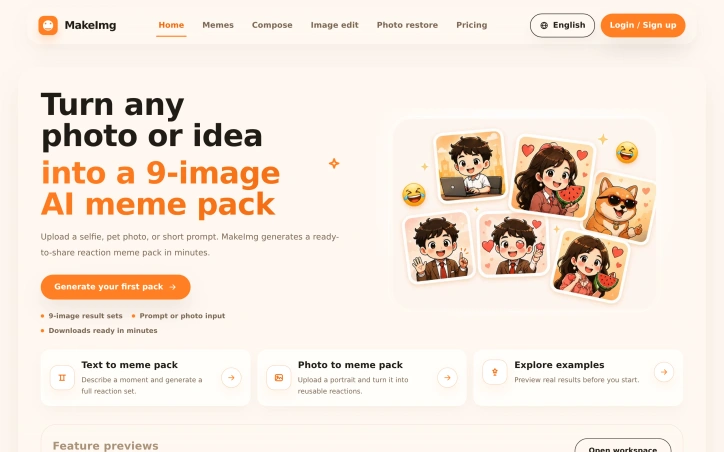
Transforming casual photos and idle ideas into polished visual content typically demands design skills, software expertise, and hours of editing time. MakeImg streamlines this process for creators who want fast turnaround on shareable meme packs without the friction. The core offering is straightforward: upload a portrait or describe a scene, and the platform generates a cohesive nine-image reaction set ready to download within minutes. This addresses a real gap for content creators, social media enthusiasts, and anyone who wants to produce on-brand visual assets without learning specialized tools. The service works across two main input modes—text prompts for conceptual meme packs and photo uploads for personal reaction sets—making it accessible regardless of whether a user starts with an idea or existing imagery. Beyond the headline meme-pack feature, the platform extends into adjacent creative workflows: image composition layers multiple reference photos into a single output, image editing lets users refine shots with text instructions, and photo restoration repairs old or damaged images. This breadth gives creators flexibility to complete different project types within one interface rather than toggling between specialized apps. The product philosophy appears centered on quick iteration and exploration. The platform includes a gallery of real generated outputs, positioning users to preview results before committing time, and emphasizes minute-level generation speeds. This matters for creators managing content calendars or capitalizing on trending moments. Pricing follows a familiar creator-tool playbook: a free starter tier for exploring the full workflow, a $9.99 monthly subscription pitched to regular generators, and a one-time $5 single-pack purchase for occasional users. The credit-based model allows scaling without forced subscription commitment, though the pricing page references credits without detailing exact generation costs per feature. What remains underexplored in the marketing materials is the consistency quality of output, particularly whether multi-image sets maintain visual cohesion across poses and expressions. Given the technical challenge of generating nine related images that function as true reaction options, this is worth validating before deciding if the tool fits professional creator workflows versus casual meme sharing. The positioning is solid for the target user: someone who values speed and ease over granular creative control. MakeImg occupies sensible territory between demand and execution, offering enough workflow options to feel like a complete toolkit while keeping the interface simple enough for non-technical users to generate results immediately.
For anyone curious about an animal spotted in nature, a wildlife photo found online, or simply wondering about a creature in their yard, this browser-based identification tool fills a straightforward need. The product targets a broad audience spanning students researching wildlife, parents answering children's questions about animals, nature enthusiasts documenting sightings, and pet owners identifying unfamiliar creatures. The distinctive angle here centers on responsible wildlife interaction. Rather than simply naming animals, the platform pairs identification results with explicit safety guidance, reminding users not to approach, touch, feed, or capture animals based on photo recognition alone. This emphasis recurs throughout the interface and represents a thoughtful addition in an educational context where misidentification could lead to dangerous behavior. The core workflow is straightforward: upload an image in PNG, JPG, or WEBP format and receive the likely species identification along with supporting visual evidence. Beyond the name, users get habitat information, diet details, behavioral characteristics, regional context, and interesting facts. The platform indicates confidence levels in its guesses, an important transparency feature when stakes involve human safety around wildlife. The product addresses a common search behavior by organizing around specific user questions: "What animal is this," "Identify an animal by picture," and "What kind of animal is this." Rather than forcing all queries into a single form, these focused pages acknowledge how people actually ask these questions while maintaining the same upload-based identification mechanism. This mirrors how real search behavior works and makes the tool feel aligned with user intent rather than rigid. The decision to operate entirely in the browser eliminates friction present in traditional app-based identification tools, removing download requirements and installation steps. This approach democratizes access and positions the platform as a quick reference rather than a commitment download. The emphasis on visual explanation distinguishes this from simpler name-guessing alternatives. By showing what clues the model detected, the tool educates alongside identifying, useful for learning-focused users. The safety guidance strips away the novelty of AI identification and anchors the interaction to practical, responsible behavior. Pricing or monetization strategy receives no mention in available materials, leaving the business model unclear. The feature set and positioning suggest education and wildlife safety as core values, which shapes how the product positions itself even if commercial viability remains unstated.

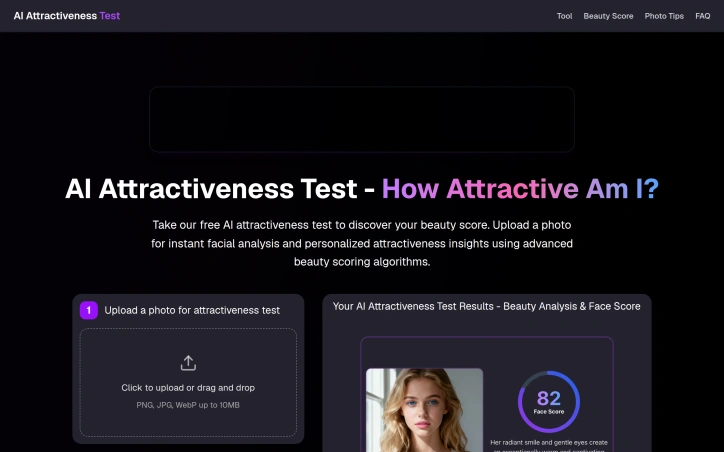
A browser-based tool that scores facial attractiveness using AI, this service appeals to the growing cohort of internet users curious about how machine learning perceives human features. The product serves dual purposes: it offers entertainment and quick visual feedback, while simultaneously demonstrating how AI models trained on large facial datasets respond to photographic variation. The core offering is straightforward. Users upload a photo, and the system analyzes multiple dimensions beyond raw attractiveness—including smartness, confidence, trustworthiness, fun, and approachability. Results arrive within seconds, accompanied by explanations of which facial attributes influenced the scoring. The interface requires no account creation or login, lowering friction for casual experimentation. What distinguishes this product is its transparency around its own limitations and variables. The site explicitly acknowledges that results fluctuate based on image quality, lighting, angle, and expression, positioning the tool as an educational instrument for understanding AI behavior rather than an authoritative beauty assessment. This framing mitigates some of the reputational risk inherent in any attractiveness-rating product. The accompanying guidance on photo selection—emphasizing clear, front-facing shots under good lighting—reinforces the educational angle and manages user expectations effectively. Privacy appears to be a selling point. The site claims photos are neither stored nor shared, addressing the obvious concern that facial data uploaded to a web service could be harvested or retained for model retraining. Whether this promise holds up to external audit is unclear, but it's presented prominently. The product leverages claims of sophisticated facial analysis trained on millions of images, examining symmetry, proportions, and skin quality. These claims align with capabilities available in commercial computer vision APIs but lack third-party validation or technical specificity on the site itself. From a business model perspective, the service is entirely free with no subscription tiers or upsells mentioned. Revenue generation remains unstated, leaving questions about sustainability and monetization strategy. Whether the business model relies on attention, data collection, affiliate arrangements, or another mechanism is not revealed. The product succeeds most clearly as a novelty tool that scratches an itch—what would an AI think?—while incidentally teaching users about how machine learning responds to visual input. It occupies an unusual position between entertainment and education, making it accessible to curious users without demanding serious engagement or personal investment.
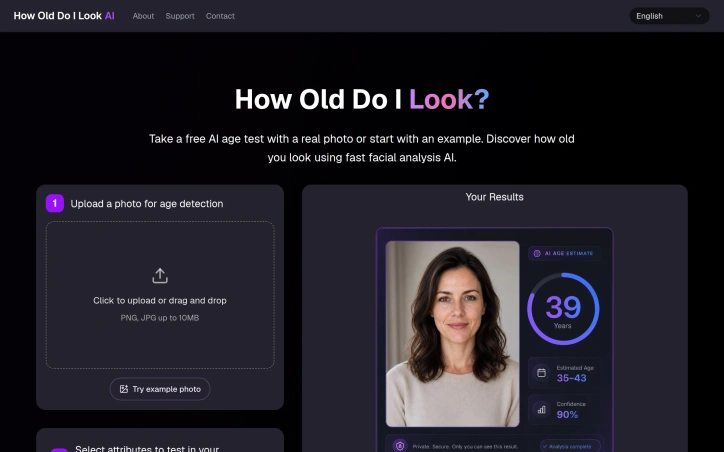
Facial analysis tools have long promised to read age from appearance, but most come wrapped in complexity or concern about data handling. This free browser-based age estimator strips away both, offering a lightweight entry point for anyone curious about how AI perceives facial age markers. The core appeal targets a broad spectrum: casual users wanting an entertaining experiment, people interested in understanding computer vision limitations, and those exploring how presentation factors influence machine perception. The tool requires nothing beyond a photo and delivers results instantly without demanding account creation or email registration. What differentiates this offering is its transparency about the mechanics and limitations of AI age estimation. The interface doesn't pretend to scientific precision; it frames the output as entertainment-oriented and explicitly acknowledges that lighting, camera angle, expression, makeup, and image quality all shape the result. This directness extends to privacy handling. The platform commits to not storing or sharing uploaded photos, addressing a common hesitation around facial analysis services. Beyond age estimation, the tool analyzes five trait attributes: smartness, confidence, trustworthiness, attractiveness, and approachability. This expands the offering from a single-metric feature into a broader personality perception experiment, adding layers to how users interpret the model's outputs. The product workflow demonstrates efficiency. Users upload a clear front-facing photo, select which traits interest them, and receive face-based scores within seconds. The browser-native experience eliminates download friction, and the inclusion of example predictions helps calibrate expectations before uploading personal images. The educational component stands out as particularly valuable. Rather than hiding how image variables affect results, the FAQ section walks through why apparent age shifts across different photos of the same person, what creates misleading outputs, and how to read scores responsibly. This approach acknowledges that engaging with AI perception demands literacy about the tool's constraints. Pricing is straightforward: the service is free with no premium tier mentioned. This positions it as genuine exploration software rather than a freemium funnel. The main limitation is inherent to the category. AI age estimation will always reflect training data bias and visible image characteristics rather than actual age. The tool handles this candidly, but users should enter with realistic expectations about accuracy and fairness. For entertainment, curiosity-driven exploration, and lightweight AI experimentation, the product delivers what it promises.
Fragmentation plagues the AI creative tools landscape. Rather than mastering dozens of standalone platforms, visual creators face constant friction: jumping between subscriptions, learning new interfaces, and managing project context across disconnected applications. HubVanta AI addresses this consolidation problem head-on by housing multiple leading image and video generation models under one roof. The platform packages access to industry models including Midjourney, Flux AI, GPT-4o, and Stable Diffusion alongside a proprietary set of AI capabilities. This breadth matters. Instead of subscribing to separate services for text-to-video, image-to-video, background removal, upscaling, voice cloning, and face analysis, creators maintain a single workspace with clear organization across workflows. The positioning targets visual professionals: content creators, marketers, founders, and product teams who value time over perfection, particularly those who prototype often. What distinguishes HubVanta AI from simple model aggregation is the emphasis on creative continuity. The interface treats the workspace as persistent context rather than disconnected tasks, allowing users to generate an asset, edit it, then seamlessly transition to repurposing it into a different format without re-explaining the project state. This reduces cognitive overhead, a real pain point for working professionals managing rapid iteration cycles. The capability roster is comprehensive. Video tools include text-to-video and image-to-video generation with reported processing times between one and five minutes for standard outputs. Image tools span generation, editing, enhancement, restoration, and specialized workflows like floor plan analysis and room decoration. Audio capabilities include voice cloning and text-to-speech. Supplementary features address practical needs: video background removal, image watermark detection, and object removal. Access begins with limited free previews on individual tools, with a paid upgrade path when users want to generate without per-tool restrictions. This freemium structure removes the commitment barrier for exploration. The core insight underlying HubVanta AI is sound: creative professionals waste efficiency on tool switching. By centralizing discovery and providing seamless transitions between visual formats, the platform attacks a genuine friction point in AI-assisted content creation.

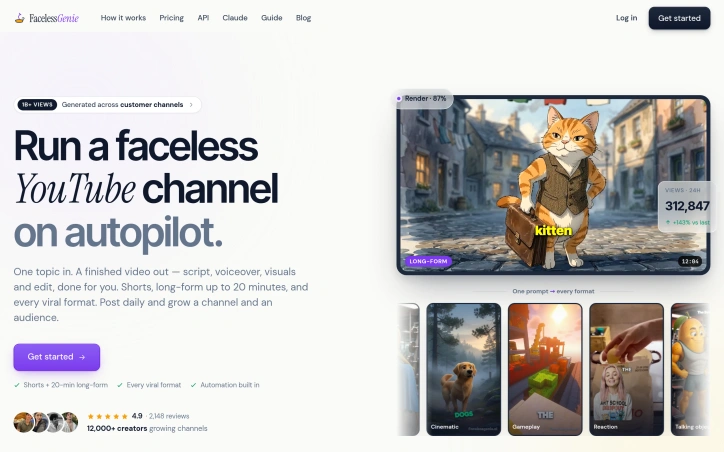
Automated video generation is reshaping how independent creators scale their output. FacelessGenie addresses a real constraint in that workflow: the gap between having a content idea and possessing the technical skills, equipment, and hours required to produce it professionally. The platform takes a creator's topic or brief and handles the entire pipeline—scriptwriting, voiceover generation, visual composition, music selection, and final editing—delivering a finished video ready to upload. The product targets creators operating across YouTube, Instagram, and TikTok. Rather than focusing on a single format, FacelessGenie covers multiple content archetypes: character-driven narratives, talking objects, explainer videos, reaction content, gameplay captures, and AI-generated visuals. It supports both short-form content and long-form pieces up to twenty minutes, allowing creators to experiment across platform-native formats rather than repurposing a single video. What distinguishes FacelessGenie in a crowded field is its breadth of pre-built templates and its claimed consistency in output quality. The site showcases example channels in specific niches—stoicism, history, science, finance, pet care, and self-improvement—each designed to demonstrate that the AI-generated videos can approximate the visual and narrative style of established, successful channels. This signals both capability and deliberate positioning toward profitable niches rather than arbitrary content. The platform has accumulated measurable traction. Its user base includes over twelve thousand creators, with four hundred of them reaching audiences beyond one hundred thousand subscribers. Videos produced through FacelessGenie claim to have generated more than one billion cumulative views. The product carries a 4.9-star rating across over two thousand reviews, suggesting consistent user satisfaction. One gap in the available information is transparency around pricing and business model. The site mentions getting started but does not disclose whether FacelessGenie operates on a subscription model, usage-based pricing, or another structure—a material detail for creators evaluating whether the tool fits their economics. The core value proposition is clear: compress the production cycle from hours or days to a single afternoon. For creators managing multiple niches or chasing trending formats, that compression has direct business impact. Whether the efficiency gains justify adoption depends on whether creators prioritize the tool's automation over hands-on creative control.

Mornings filled with wardrobe indecision represent a daily friction point for many. AI Wardrobe addresses this fundamental styling challenge by leveraging artificial intelligence to recommend outfits drawn directly from a user's existing closet. Rather than shopping for new pieces or scrolling endlessly through styling inspiration, the platform works within the reality of what users already own. The core value proposition rests on personalization grounded in three practical factors: current weather conditions, the occasion at hand, and the individual's established style preferences. This combination moves beyond generic fashion advice and into territory tailored to specific contexts and tastes. The approach reflects a pragmatic understanding that effective styling decisions require situational awareness and personal knowledge. The product operates within the confines of a user's own wardrobe, which represents a meaningful distinction from many fashion-tech solutions. Rather than functioning as a shopping assistant or recommendation engine for new purchases, it treats existing clothing inventory as the canvas for styling solutions. This positions the tool as useful to anyone with a functional closet and the desire for more intentional daily outfit choices. The positioning suggests a target audience spanning multiple demographics: professionals juggling multiple occasions and dress codes, individuals seeking to make more conscious fashion choices, or anyone who experiences friction in their morning routine around clothing decisions. The framework could appeal to people interested in maximizing their existing wardrobe or reducing decision fatigue through automation. The platform essentially automates the mental process experienced by successful personal stylists—understanding both the constraints of what someone owns and the nuances of their taste and lifestyle. By encoding this logic into an AI system, it democratizes a service traditionally available only to those with budgets for professional consultation. What remains unclear from the available information are the specific mechanics of how the system works, the breadth of integrations or data inputs, and what infrastructure is required to get started. The founding vision is clear: simplify a recurring daily decision by making it faster and more intentional.


Creating immersive experiences for virtual reality, gaming, and real-estate listings often requires high-quality 360° panoramas, but generating these can be time-consuming and labor-intensive. PanoPulse addresses this challenge by providing a free AI-powered panorama generator that can produce equirectangular panoramas in seconds. The tool is designed for developers, VR content creators, and businesses looking to create virtual tours and immersive experiences. What stands out about PanoPulse is its ability to generate high-resolution 360° panoramas from either text prompts or reference images. The AI-driven process handles complex tasks such as projection, seam-matching, and tonemapping, ensuring a seamless spherical result without visible distortions. Users can input a simple text description or upload one to four reference photos to anchor the mood, palette, or composition of the generated panorama. The platform offers a range of features that make it versatile and user-friendly. Users can tune the generated sphere by adjusting resolution, style, time of day, and projection type. The tool also includes a built-in 360° viewer for previewing results and allows for downloads in various formats, including equirectangular and cubemap. Additionally, PanoPulse can extrapolate a flat image into a seamless 360° sphere, making it a valuable tool for expanding limited visual content. PanoPulse is currently offered for free, making it an attractive solution for individuals and businesses looking to create high-quality 360° panoramas without significant upfront costs. The tool's outputs are compatible with popular game engines such as Unity and Unreal, further enhancing its utility for developers. Overall, PanoPulse simplifies the process of creating 360° panoramas, making it an valuable resource for those in the VR, gaming, and real-estate industries.


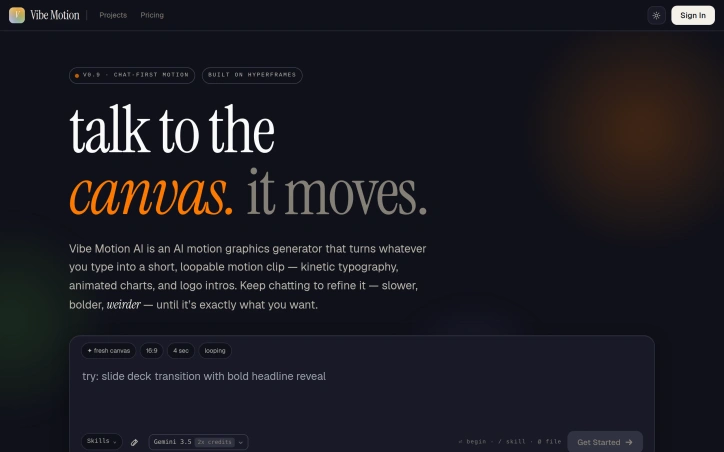
Motion graphics creation can be a tedious and time-consuming process, requiring extensive video editing skills. Vibe Motion AI addresses this problem by providing an AI-powered solution that generates polished motion videos from text prompts. The target audience is likely content creators, marketers, and businesses seeking to produce high-quality motion graphics without the need for extensive technical expertise. What stands out about Vibe Motion AI is its chat-first approach, allowing users to refine their motion graphics through a conversational interface. This interactive process enables users to tweak their creations, adjusting aspects such as speed, style, and complexity to achieve the desired outcome. The platform's use of HyperFrames technology is also noteworthy, as it underpins the generation of motion graphics. The platform offers a range of capabilities, including the creation of kinetic typography, animated charts, and logo intros. Users can explore different templates and examples, such as animated bar charts, presentation slide intros, and explainer animations, to inspire their own creations. The ability to remix and customize these examples is a valuable feature, allowing users to put their own stamp on the generated content. While pricing details are not explicitly stated, the platform does mention a credit system, with users receiving 2x credits when using Gemini 3.5. This suggests that the business model is based on a credit or token system, where users can purchase or earn credits to generate motion graphics. Users can get started with the platform by signing up and exploring the available features and templates. Overall, Vibe Motion AI offers a compelling solution for those seeking to simplify the motion graphics creation process.
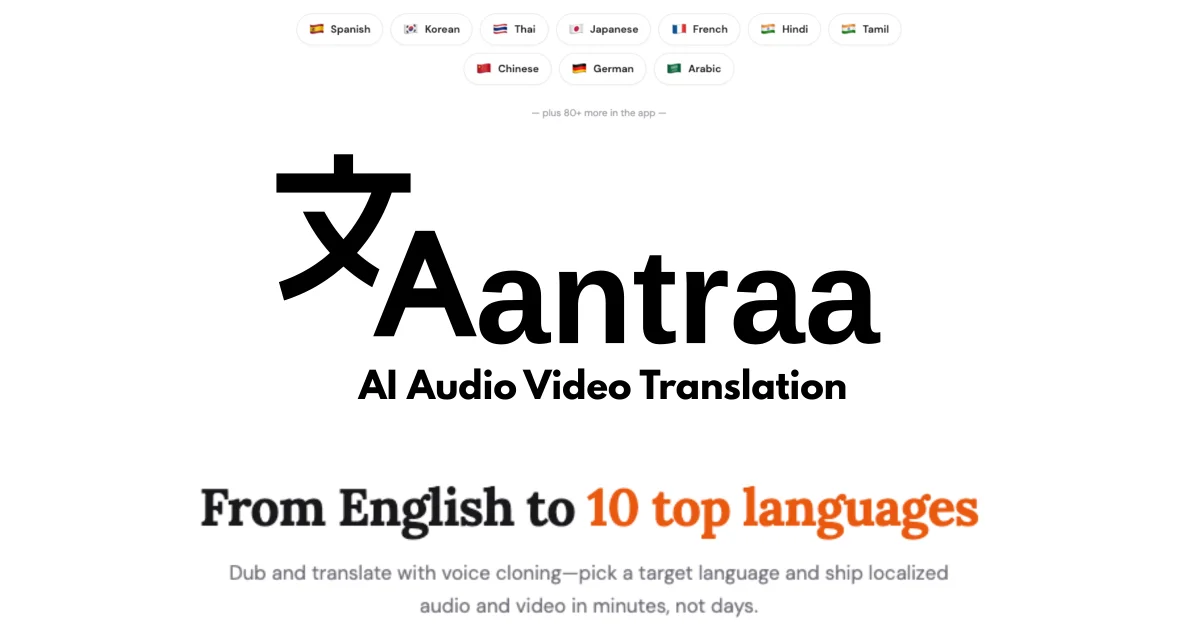
The world is becoming increasingly interconnected, and language barriers are a significant obstacle to effective communication. Aantraa is tackling this issue by providing AI-powered video and voice translation, breaking down linguistic boundaries for content creators and consumers alike. The primary target audience for this technology includes content creators, educators, and businesses seeking to expand their global reach. What distinguishes aantraa is its innovative application of AI to video and voice translation. By leveraging artificial intelligence, the platform enables users to seamlessly dub videos or translate audio and text into multiple languages. This capability is crucial in today's globalized world, where content is consumed across linguistic and geographical boundaries. The key feature of aantraa is its ability to facilitate multilingual support for video content, making it an invaluable tool for creators seeking to cater to diverse audiences. The platform's AI-powered translation capabilities allow for efficient and accurate translation of audio and text, thereby enhancing the overall viewing experience. Unfortunately, the current website does not provide detailed information on the pricing or business model adopted by aantraa. However, based on the information available, it is clear that the platform is designed to address a specific pain point in the content creation and consumption ecosystem. By providing an effective solution to language barriers, aantraa is poised to make a significant impact in the global content landscape. Overall, aantraa's focus on AI-powered video and voice translation offers a compelling solution for content creators and businesses seeking to expand their global footprint.

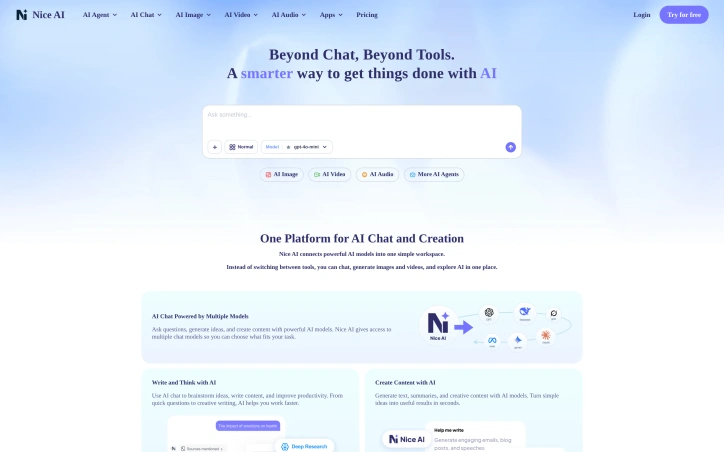
The proliferation of AI tools has led to a fragmented landscape where creators, professionals, and teams must juggle multiple subscriptions to access various capabilities. Nice AI addresses this issue by providing a unified multimodal AI platform that brings together leading models for text chat, image generation, video creation, and audio synthesis. The platform is designed for users who require diverse AI functionalities, such as drafting articles, designing marketing visuals, prototyping product videos, or producing multilingual podcasts. What stands out about Nice AI is its comprehensive approach to integrating multiple AI models within a single workspace. Users can engage in multi-model conversations with AI chatbots like GPT-4, Claude, and Gemini, generate images with models like Midjourney and Stable Diffusion, produce videos with Sora, Kling, and Runway, and create podcasts and music with state-of-the-art audio models. This breadth of capabilities positions Nice AI as a one-stop-shop for users seeking to leverage AI across different creative and professional tasks. The platform's core capabilities span AI chat, image, video, and audio generation, offering users a wide range of tools to support their work. By consolidating these functionalities, Nice AI simplifies the process of working with AI, eliminating the need to manage multiple subscriptions and navigate disparate interfaces. Users can explore the full range of features and sign up for a subscription plan that suits their needs, with the platform supporting multiple languages. Nice AI offers various subscription plans, allowing users to compare and choose the one that fits their requirements. The availability of different plans suggests that the platform is designed to accommodate a range of users, from individuals to teams and professionals.

Ecommerce businesses often struggle to create high-quality, sales-ready content quickly and affordably. The process of producing visually appealing product images and videos can be time-consuming and costly, involving expensive studio rentals, model hiring, and reshoots. My UGC Studio addresses this challenge by providing an AI-powered solution that transforms existing product images into compelling, on-model content. What stands out about this product is its ability to understand the product category and create outputs that resemble conversion assets rather than random AI experiments. This is particularly useful for ecommerce brands selling apparel, cosmetics, and other products that require high-quality visuals to drive sales. The platform allows users to create premium product scenes, adapt visuals for different audiences and regions, and produce more assets per product without multiplying production costs. Key features of My UGC Studio include its capacity to automatically frame and angle product images, reduce wasted credits on unusable outputs, and generate both product photos and UGC-style video content from a single source image. The platform also enables users to test new products before investing in expensive shoots and localize creatives for international campaigns with ease. The solution is designed to cater to various ecommerce business models, including Shopify brands, dropshipping stores, Amazon businesses, and social-commerce funnels. By providing better visuals, My UGC Studio helps ecommerce businesses test faster, present products more effectively, and compete more aggressively in their respective markets. While pricing details are not explicitly mentioned, the platform's value proposition lies in its ability to reduce the costs associated with traditional content creation methods.


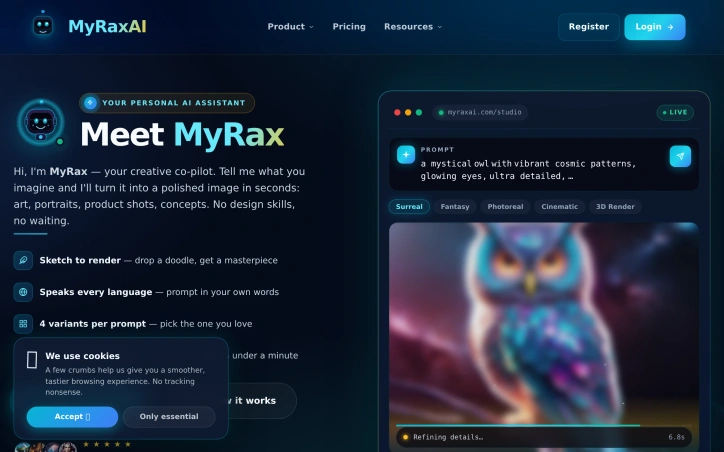
Creators and businesses often struggle with producing high-quality visual content due to the time-consuming nature of design work and the requirement for specialized skills. MyRaxAI addresses this challenge by providing an AI-powered image generation solution that can produce stunning art and images instantly. The platform is designed for individuals who need to create professional-looking visuals quickly, without requiring extensive design experience. What stands out about MyRaxAI is its ability to understand natural language prompts and generate high-quality images in a variety of styles, including photorealistic, anime, and 3D. The platform's AI model, MyRax, can refine and upscale generated images to production-ready quality in under a minute. The studio interface is designed to facilitate a smooth workflow, allowing users to generate, edit, and upscale images within a single canvas. Key features of MyRaxAI include its ability to generate four variants per prompt, in-canvas refinement capabilities, and one-click upscaling to print-ready resolution. The platform also maintains a complete history of user prompts and iterations, enabling users to branch off from any point in their creative process. With support for over 200 styles and models, MyRaxAI offers a high degree of versatility and creative flexibility. MyRaxAI is trusted by 120K+ creators worldwide, indicating a strong user base and potential for community-driven inspiration and support. While the platform's pricing details are not explicitly stated on the website, users can get started with a free trial to explore its capabilities. Overall, MyRaxAI is a powerful tool for creators and businesses seeking to generate high-quality visual content quickly and efficiently.