Xtra Hands Family Chore App
Household chore management remains one of parenting's persistent friction points, and Xtra Hands positions itself as the...

Catalyst Healthspan Audit
Personal trainers typically sell training sessions. This startup reversed the equation by building assessment first, mak...
Best Code editors Startups & Tools
IDEs and editors for writing, editing, debugging, and navigating source code efficiently.
Recently Listed
4 launches
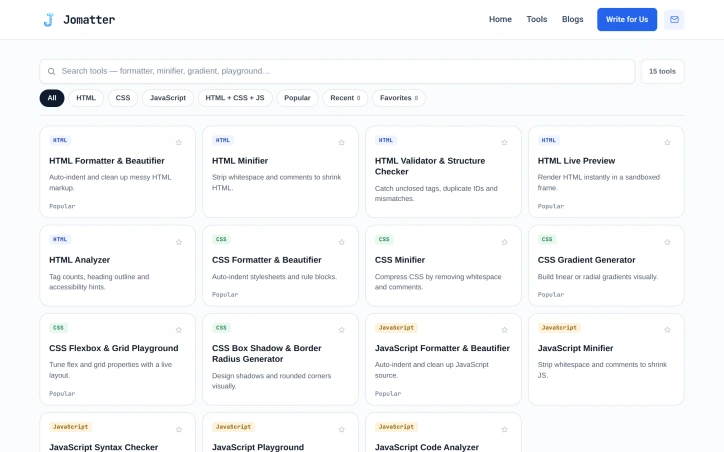
Friction in web development tooling remains surprisingly persistent. Developers regularly need to format code, minify assets, validate syntax, and test snippets during their workflows, yet many existing solutions demand signup credentials, software installations, or paid subscriptions before delivering even basic functionality. This gatekeeping creates workflow interruptions and forces developers to choose between context-switching overhead and suboptimal workarounds. Jomatter addresses this directly by providing a collection of free, browser-based utilities built specifically for HTML, CSS, and JavaScript work. The product strips away friction by requiring no authentication, no local installation, and no payment. Instead, it operates entirely in the browser, making tools accessible to any developer with a web connection and a few seconds to spare. The core offering focuses on fundamental developer tasks: formatting messy code into readable structure, minifying assets to reduce file size, validating code against standards, and testing JavaScript execution. These capabilities address genuine pain points in daily development work. A developer debugging CSS issues no longer needs to leave their workflow to find a validator. Someone optimizing bundle size can minify and compare results without installing additional dependencies. The browser-native approach means the tool works everywhere—on personal machines, shared workstations, or contractor environments where software installation rights are restricted. What distinguishes Jomatter is its commitment to removal rather than addition. Many developer tools have evolved into feature-rich platforms with extensive configuration options, learning curves, and complexity. Jomatter inverts this approach by prioritizing immediate usability. The implicit philosophy holds that a simple, free tool used frequently proves more valuable than a powerful tool that's never accessed due to setup friction. The product operates on a pure free model with no premium tiers or hidden limitations mentioned. This positioning makes it particularly attractive to freelancers, students, and small teams where tool costs accumulate quickly. For enterprises, the no-installation requirement sidesteps procurement and security review processes that often delay adoption of developer utilities. Jomatter targets a straightforward audience: web developers who value speed and simplicity over feature depth. For developers tired of onboarding friction or seeking lightweight alternatives to installed IDEs and build tools, the offering delivers genuine utility. The question of sustainable revenue remains unanswered in available materials, but as a free browser-based utility, Jomatter removes all barriers between developers and the tools they need.

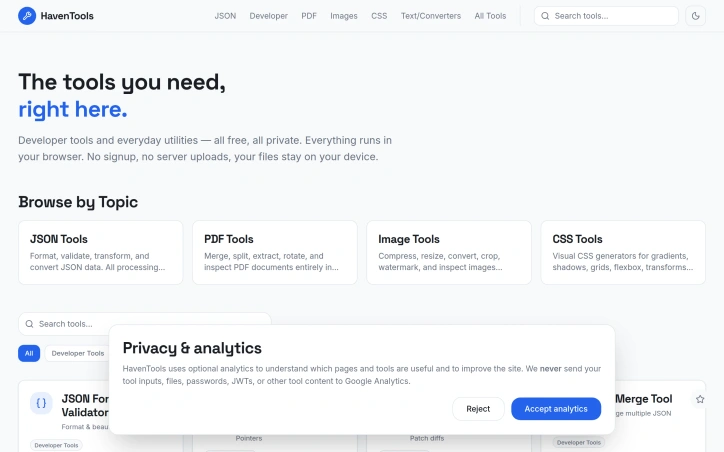
Developers spending hours tracking down the right utility tool for quick data transformations now have a consolidated alternative. HavenTools consolidates dozens of commonly-needed utilities into a single browser-based platform, eliminating the friction of finding specialized tools scattered across the internet. The core value proposition centers on privacy and convenience. Every operation processes entirely within the user's browser, with no data transmitted to servers or requiring account creation. This architectural choice addresses a legitimate concern in developer workflows: the hesitation to upload sensitive configuration files, API responses, or internal data to unfamiliar online services, even nominally reputable ones. By running computationally in the browser itself rather than on remote infrastructure, HavenTools removes that friction point for routine tasks. The feature breadth is substantial. The platform spans JSON processing including format validation, schema generation, and RFC-standard operations like JSON Pointer evaluation and JSON Patch generation. PDF capabilities handle merging, splitting, extraction, and rotation. Image tools cover compression, resizing, conversion, and color extraction. CSS generation tools produce production-ready output for gradients, shadows, flexbox layouts, transforms, and border-radius specifications. Beyond these categories, the platform includes utilities for GraphQL query building and formatting, HTTP request construction and inspection, XML validation and XPath testing, URL query string encoding, and SQL IN clause generation. The breadth suggests the creator identified common repetitive tasks in development workflows and built targeted solutions for each. The positioning emphasizes eliminating friction from everyday development activities. Rather than marketing as a comprehensive platform, it positions individual tools as replacements for fragmentary web searches. Each utility handles a specific transformation or validation task without the overhead of authentication, file upload dialogs, or waiting for server-side processing. The business model centers on free access, with no mention of premium tiers, paywalls, or subscription options in available materials. This positions HavenTools against both free tools scattered across the web and paid SaaS utilities, betting that consolidated access and privacy-first architecture create sufficient value that users won't seek alternatives. The execution appears focused on completeness within chosen categories rather than attempting total tool coverage. The JSON and developer-centric tools are particularly comprehensive, while file manipulation and visual generators fill practical secondary needs. This narrower scope potentially makes the platform more coherent than attempting to be everything.
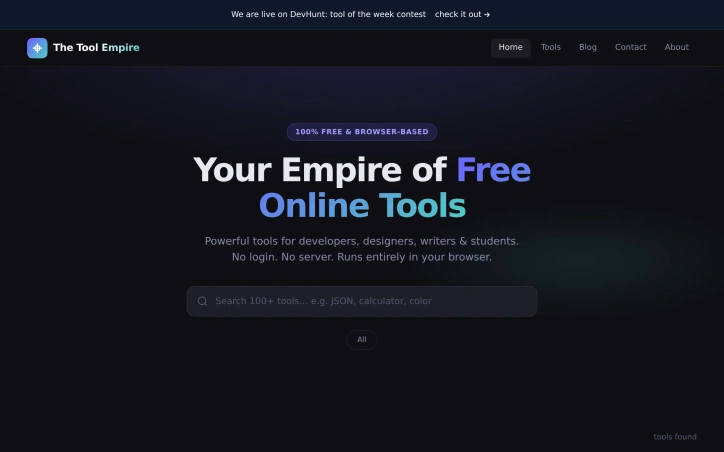
In a digital landscape cluttered with online tools that come with caveats, The Tool Empire stands out for its uncompromising commitment to providing free, private, and accessible utilities for a diverse range of users, including developers, designers, writers, and students. Its creator set out to address the shortcomings of existing tools that often required users to create accounts, tolerate usage limits, or compromise on data privacy. The Tool Empire delivers on its promise by offering a suite of over 100 browser-based tools that run entirely locally on the user's device, ensuring that sensitive data remains secure and private. What distinguishes The Tool Empire is its unwavering adherence to a core principle: every tool must function without relying on a server, account creation, or any form of cost. This design constraint has yielded a platform that is not only highly private but also remarkably responsive, with output updating in real-time as users input data. The absence of login requirements, usage limits, and tiered pricing models means that users can access fully unlocked tools without any restrictions. The platform's adaptability across different devices and screen sizes further enhances its usability. The Tool Empire is continually expanding its offerings, with new tools being added every week in response to user suggestions. The platform's focus on simplicity and ease of use is evident in its minimalist approach to user interaction, dispensing with unnecessary features like cookie consent prompts and email confirmations. While the platform is free to use, with no catch or tiered pricing, it is clear that its sustainability is not explicitly tied to a specific business model mentioned on the site. Overall, The Tool Empire has established itself as a valuable resource for individuals seeking reliable, private, and free online tools.

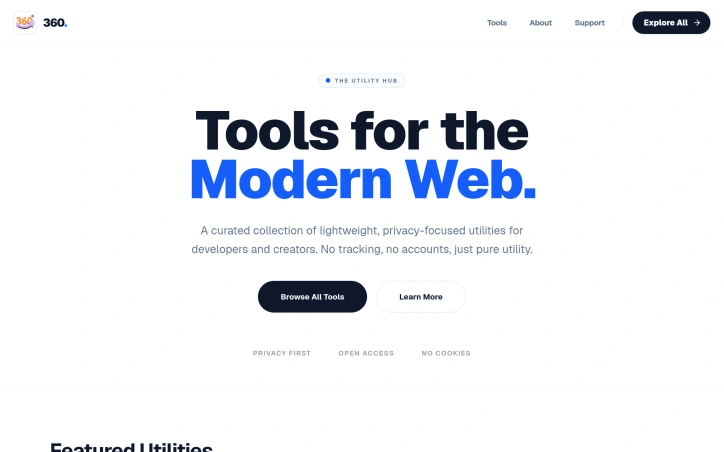
The modern web development landscape is cluttered with bloated software that prioritizes revenue over user needs. In response, a suite of online tools has emerged to cater to the needs of developers and business professionals. 360 Solution is a curated collection of utilities designed to be lightweight and privacy-focused, addressing the issue of inaccessible and cumbersome software. At its core, 360 Solution is built around the philosophy that software should be accessible, transparent, and respectful of the user's intent. This is evident in the design and functionality of its tools, which are geared towards solving specific problems without unnecessary features. The tools are browser-based, ensuring that data remains on the user's machine, and there is no requirement to create an account or provide an email address to access them. Notable tools include an Image Slug Generator for SEO-friendly image renaming, an Expo App Icon Generator for React Native app assets, and a CSV Viewer & Editor for analyzing and manipulating data files. These tools react quickly, with no loading screens or spinners, and are designed with a clean and tactical interface focused on productivity. The absence of tracking, cookies, and advertisements underscores the commitment to user privacy, making it an attractive option for those seeking straightforward, effective solutions. By being completely free and open-source, 360 Solution positions itself as a developer-centric resource, aligning with its mission to empower the next generation of web builders. With its emphasis on instant usability and zero ads, 360 Solution presents a compelling alternative to traditional software models.