uploadthefile.com
Sharing files and publishing static content has long required friction: account creation, platform navigation, or comman...

CrabTap
Small businesses have long struggled to implement loyalty programs without massive overhead. CrabTap addresses this gap...
Catalyst Healthspan Audit
Personal trainers typically sell training sessions. This startup reversed the equation by building assessment first, mak...
Best Content Management Systems Startups & Tools
Tools that create, organize, and publish website content. From headless APIs to no‑code site builders and docs engines, they serve developers, editors, and teams.
Recently Listed
3 launches
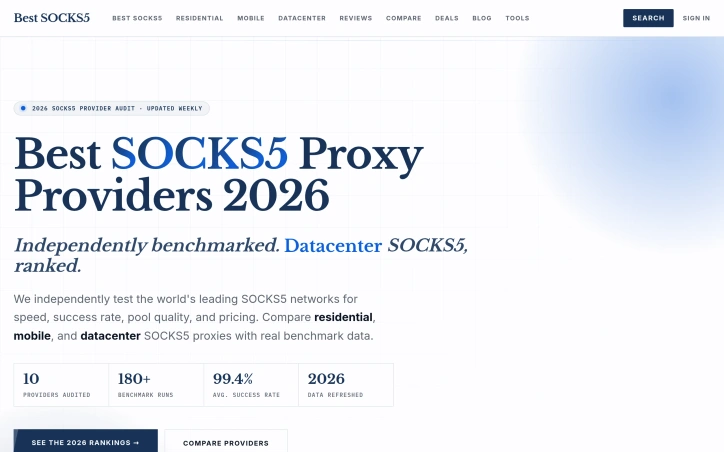
Organizations selecting SOCKS5 proxy infrastructure face a fragmented market where vendor claims often lack independent verification. This comparison site addresses that gap by benchmarking major providers against standardized criteria rather than relying on marketing materials. The platform targets enterprises and mid-market teams conducting web scraping, data collection, or testing operations where proxy selection directly impacts both cost and reliability. It also serves developers and agencies evaluating solutions at various price points, from budget options under $2 per gigabyte to premium services at $8+ per gigabyte. What distinguishes this resource is its commitment to independent testing methodology. Rather than publishing vendor-supplied numbers, the site conducts its own benchmarks across 180 test runs per provider, measuring success rates, latency from multiple geographic probes (Frankfurt, Ashburn, Singapore), and throughput. The scoring framework weights five dimensions—success rate at 35 percent, latency and throughput at 25 percent, cost per IP/GB at 20 percent, pool quality at 12 percent, and support tooling at 8 percent. This transparency allows readers to understand trade-offs between competing priorities. The comparison table presents practical specifications: pool sizes ranging from 2 million to 150 million IPs, latency from 620 milliseconds to 1,300 milliseconds, and supported protocols. Scores cluster between 8.2 and 9.8, suggesting narrow performance differentials at the top tier. Top-ranked providers like Oxylabs and Bright Data offer pools exceeding 100 million IPs with sub-700 millisecond latency, while budget alternatives like IPRoyal deliver comparable SOCKS5 support at 1,100 milliseconds latency for fraction-of-the-price positioning. The site distinguishes datacenter SOCKS5 (for speed and consistency) from residential options, addressing different use cases. Provider reviews are keyed to specific personas—scraping teams needing scale get Oxylabs, agencies requiring granular targeting get Bright Data, and cost-conscious mid-market teams get Smartproxy. One notable gap: the site discloses affiliate relationships but doesn't articulate how those relationships are managed or whether they influence editorial placement. The methodology section mentions measuring HTTP 2xx success rates as-is without context about whether this metric equally applies across providers supporting different protocol stacks. For teams with limited proxy expertise, this resource reduces decision friction through structured comparison. The independent benchmarking claim is substantive, though readers should verify that test scenarios match their specific workload requirements—latency from Frankfurt probes doesn't necessarily predict performance for US-centric operations, for example.

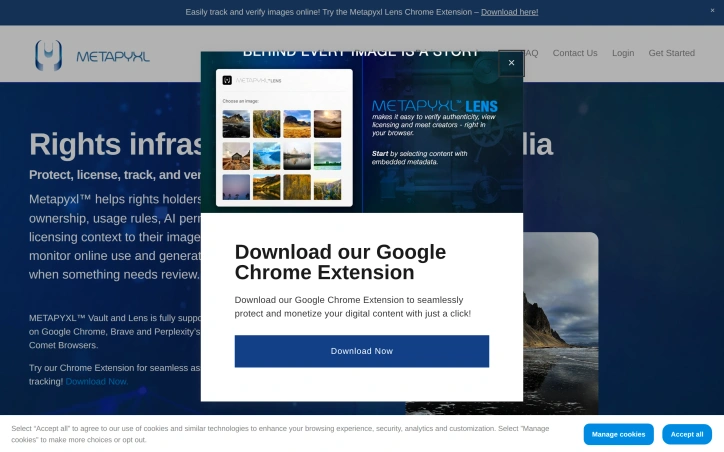
The online proliferation of visual media has created a pressing issue for creators, agencies, publishers, and brands: maintaining control over images as they spread across the internet. As images travel, essential information such as ownership, licensing terms, and usage rules often gets lost, leading to significant time and financial losses when trying to establish provenance and enforce rights. Metapyxl addresses this challenge by providing a comprehensive rights infrastructure for visual media. At its core, the platform ensures that images are protected, tracked, and verified throughout their online journey. What stands out about Metapyxl is its proactive approach to image protection, utilizing a combination of invisible forensic watermarking, metadata, and C2PA/content credentials to preserve ownership and licensing context. Users can register their images in Metapyxl Vault, where they can add licensing terms and apply forensic watermarking, allowing them to monitor online usage effectively. The platform's Lens feature enables viewers to access creator, rights, provenance, and licensing context when protected images appear online, promoting transparency and facilitating legitimate use. Notably, Metapyxl's watermarks are designed to remain detectable even after common image alterations such as cropping, resizing, and compression, with a high success rate of 99% in tested cases. The platform's capabilities are geared towards rights holders seeking to safeguard their visual assets while promoting their legitimate use. By maintaining a connected workflow from ownership record to evidence packet, Metapyxl provides a robust solution for managing image rights. Customers, including photography agencies and individual photographers, praise Metapyxl for its innovative features, such as customizable licensing agreements and a user-friendly Chrome extension that streamlines asset tracking. Overall, Metapyxl offers a vital tool for visual media creators to protect and monetize their work in the digital age.

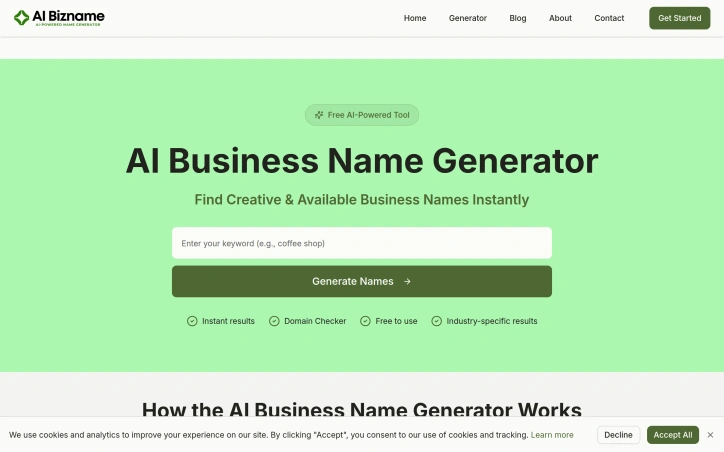
Launching a business demands countless decisions, and choosing a memorable, available name ranks among the most consequential yet time-consuming. AI Bizname tackles this friction point by automating the creative brainstorming phase that typically consumes hours or days of entrepreneurial effort. The tool targets a broad audience: founders launching startups, small business owners seeking professional identity, content creators building blogs, and entrepreneurs who need to move quickly from concept to execution. The problem it solves is straightforward—the early-stage naming bottleneck—but the friction it removes is real. The product's core strength lies in its simplicity and speed. Users input a keyword or business concept, select an industry category and naming style, and receive hundreds of name suggestions instantly. This three-step workflow respects the user's time and acknowledges that early-stage founders operate under resource constraints. The integration of domain availability checking within the generation process adds practical value; a creative name loses its appeal if the domain is unavailable. Industry-specific result filtering distinguishes this tool from generic brainstorming. Rather than receiving names disconnected from context, users get suggestions calibrated to fashion, technology, SaaS, or other sectors. This targeting helps ensure generated names feel relevant rather than arbitrary. The emphasis on generating "brandable and domain-friendly" names shows awareness that founders care less about abstract creativity than about names they can actually build on. The free-to-use model removes a significant barrier to trial, allowing founders to test the tool without financial commitment. This positioning acknowledges that most early-stage companies have minimal budget for auxiliary tools and creates natural opportunity for future monetization if the tool establishes itself as genuinely useful. One notable concern: the website claims the tool is "used by thousands of entrepreneurs and companies worldwide," but provides no third-party validation, user testimonials, or objective metrics. Founder claims of traction without specifics warrant skepticism. The tool's actual utility ultimately depends on whether generated names feel creative and brandable rather than formulaic—a quality assessment requiring hands-on testing rather than website review alone. The fundamental value proposition is straightforward: automate away the blank-page problem in naming. Whether it executes that promise well enough to become a staple in founder toolkits depends on factors the landing page cannot convey.