Catalyst Healthspan Audit
Personal trainers typically sell training sessions. This startup reversed the equation by building assessment first, mak...
Launchory
We built Launchory to solve the discoverability problem for startups. Our platform offers instant approval, permanent do...
Best Platforms Startups & Tools
Recently Listed
41 launchesWe built Launchory to solve the discoverability problem for startups. Our platform offers instant approval, permanent dofollow backlinks from our DR 58 domain, and optimization for AI search engines. We believe every startup deserves high-authority backlinks and a platform to showcase their product to early adopters.


Property agents have long extracted commissions from renters searching for shared housing in the UAE, managing listings that are often outdated or inflated in their representations. A new platform challenges this model by connecting renters directly with verified room owners. Find Rooms operates across Dubai, Sharjah, Abu Dhabi, and Ajman, offering bed spaces, partition rooms, and studios for workers, students, and young professionals. The service maintains a catalog of over 2,400 verified listings and charges zero commission to users. What distinguishes this platform is not just the elimination of fees but the enforcement of quality through weekly verification. Renters browsing property sites in the UAE quickly discover that many listings are for units already rented months prior. By requiring active verification of availability, Find Rooms reduces wasted searches and addresses a genuine friction point in the market. The platform's multilingual interface across 10 languages reflects a deliberate design choice rooted in geography. Blue-collar workers and students—the primary audience for shared housing—do not always search in English or Arabic alone. By offering more language options, the platform removes a barrier to access for a segment of the market that existing platforms have historically overlooked or underserved. The business model is intentionally simple. There are no subscription tiers, hidden fees, or promised features that don't yet exist. The zero-commission model creates clarity for renters but introduces a dependency: the platform's viability rests entirely on attracting sufficient owner participation. Property owners must list their spaces and commit to verifying availability weekly. This requirement serves renters well but imposes an ongoing cost on owners—time spent confirming that beds remain available. The platform succeeds by addressing a specific problem without overcomplicating the solution. It eliminates an unnecessary intermediary and the associated commission structure. Unlike many startups in the housing market, Find Rooms avoids growth narratives that prioritize scale over unit economics or platform integrity. Whether the platform can sustain owner participation at scale is the critical question. A zero-commission model works only if supply remains sufficient to attract renters and if owners view weekly verification as a reasonable investment in reaching pre-filtered customers. For now, the 2,400 verified listings across four emirates demonstrate the model has gained initial traction. The test ahead is not innovation or feature complexity but consistent execution and retention of the owners who power the network.


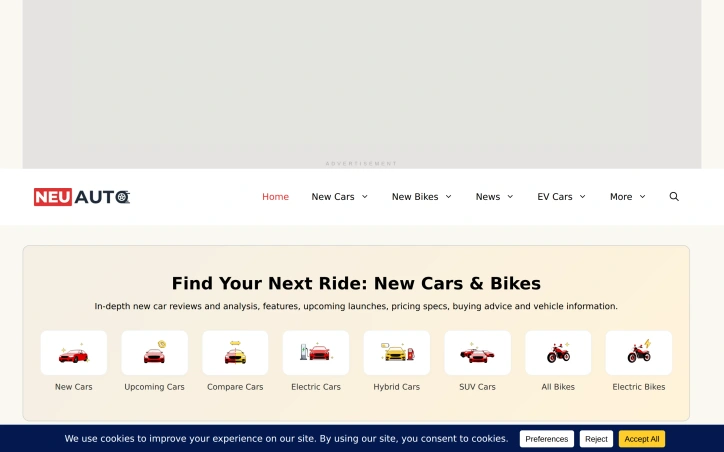
Indian car and motorcycle buyers navigating the crowded automotive market face a genuine challenge: synthesizing reliable information about new vehicles, comparing models across price points, and understanding the true cost of ownership. Neu Auto addresses this friction by centralizing vehicle research, reviews, and practical tools into a single platform designed specifically for the Indian buyer. The platform distinguishes itself through consistent content updates and breadth of coverage. Recent articles span established segments like the Toyota Innova Crysta and emerging categories like budget electric SUVs under 15 lakh rupees, indicating an editorial strategy that serves both mainstream and early-adopter audiences. The site tracks upcoming launches, giving prospective buyers forward-looking information rather than just historical reviews. Beyond editorial content, Neu Auto includes comparative tools and buying resources that move beyond passive reading. Side-by-side scooter comparisons, electric vehicle range breakdowns, and loan calculators transform the platform from a content repository into a decision-support system. This positions it as a practical utility during active purchasing, not just exploratory browsing. The scope spans new and used vehicles, motorcycles and scooters, combustion and electric powertrains, and entry-level to premium segments. This horizontal breadth reflects an ambition to become a comprehensive reference rather than a niche reviewer. The emphasis on electric vehicles as a dedicated category reflects India's automotive market evolution, even as the platform continues covering traditional segments. The contact email and disclosed social media presence indicate a focused team operating at modest scale. This leanness shapes the platform's likely economics: high-quality content at scale requires either significant funding or a sustainable monetization model. Neither is explicitly stated, though automotive content properties typically explore advertising partnerships, affiliate commissions on loan products or dealer referrals, or premium subscription tiers. For buyers who find existing automotive resources either too regional, too broad, or too sales-oriented, Neu Auto occupies a meaningful middle ground: Indian-specific information delivered through editorial authority rather than dealer networks, paired with practical calculation tools. Success depends on maintaining editorial quality and update frequency as the platform scales.
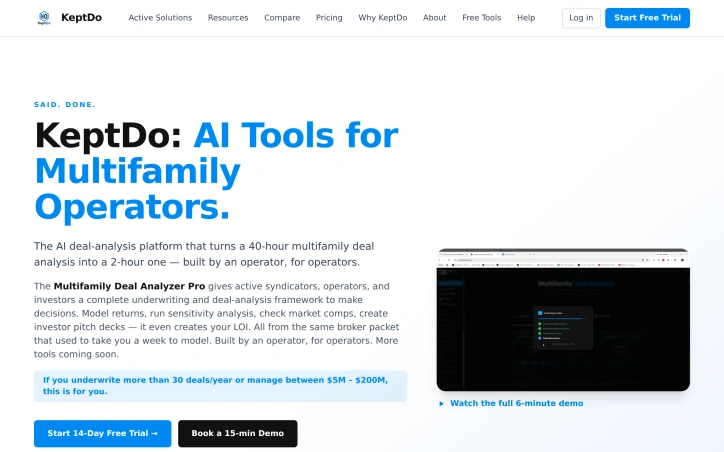
Multifamily deal analysis has a speed problem. Syndicators managing active pipelines routinely invest 40 hours normalizing broker packets, cleaning rent rolls, and building underwriting models for a single deal. KeptDo Multifamily Deal Analyzer Pro attacks this bottleneck by automating the grunt work and compressing that analysis into a two-hour workflow. The platform targets syndicators and operators underwriting more than 30 deals annually and managing between $5 million and $200 million in assets. The value proposition is straightforward: take a broker offering memorandum, T-12, T-3, and rent roll, upload them, and receive a production-ready underwriting package including returns models, sensitivity analysis, market comparables, and even a drafted letter of intent. What distinguishes KeptDo is that it was built by Manny Del Val, a syndicator and IT professional with 25 years of technology experience, rather than by software engineers unfamiliar with multifamily operations. This pedigree shows in the product's workflow. It normalizes data across disparate sources, flags inconsistencies and discrepancies, generates five-year projections, and produces investor pitch decks—the entire stack of deliverables deal sponsors need. The system recognizes that speed matters in competitive deal environments. When twenty operators are reviewing the same offering memorandum, the ones who can present a defensible LOI Wednesday afternoon outmaneuver those still formatting tabs Thursday night. The platform is already in use by operators across Arizona, California, Florida, Tennessee, Kentucky, South Carolina, and Texas. Pricing starts at $99 monthly, with a 14-day free trial available to prospective customers. The company, founded in 2026 and based in Satellite Beach, Florida, plans to expand its offering with additional tools for multifamily operators. KeptDo addresses a real pain point in commercial real estate—the conversion of raw broker data into actionable underwriting. By automating data normalization and model construction, it removes a major friction point from the deal pipeline, freeing operators to focus on strategic decision-making rather than spreadsheet hygiene.

Measuring soft skills within organizations remains a persistent challenge, typically relying on cumbersome self-assessments and surveys that drain time and rarely capture authentic behavioral patterns. Helix targets both individual professionals seeking personal development and organizations trying to understand and improve team capabilities through data-backed insights rather than subjective evaluation. What sets this offering apart is its passive measurement approach. Rather than requiring employees to complete questionnaires, Helix joins video meetings on Microsoft Teams, Zoom, and Google Meet to analyze behavioral signals in real time. Using a combination of OpenAI's capabilities and a proprietary scoring engine, the tool identifies patterns in soft skills—communication, collaboration, leadership, and others from a set of nine core competencies—then delivers personalized insights within minutes of a call ending. The product's feature set addresses a gap in existing talent development workflows. Weekly summaries aggregate trends over time, visual dashboards let individuals track their own progress, and a built-in AI coaching tool recommends targeted learning resources based on identified growth areas. For HR and L&D leaders, a company-wide dashboard surfaces skills gaps across teams and measures the return on learning investments, providing strategic visibility into organizational capability. The non-intrusive design stands out as particularly valuable. By operating silently within existing communication tools rather than asking employees to adopt new platforms or complete additional surveys, Helix reduces friction that typically limits engagement with development initiatives. The inclusion of actual meeting transcript snippets alongside recommendations adds specificity that generic coaching often lacks. One consideration worth noting: the product's effectiveness depends on the accuracy of its behavioral analysis engine. The marketing materials emphasize that the 3Q Engine weighs quantitative signals, qualitative patterns, and sentiment analysis, yet independent validation of these scoring mechanisms remains unavailable from the information provided. For organizations serious about moving beyond vanity metrics in talent development and individuals looking for objective feedback on professional growth, Helix presents a compelling shift toward behavioral measurement over self-reported assessment.


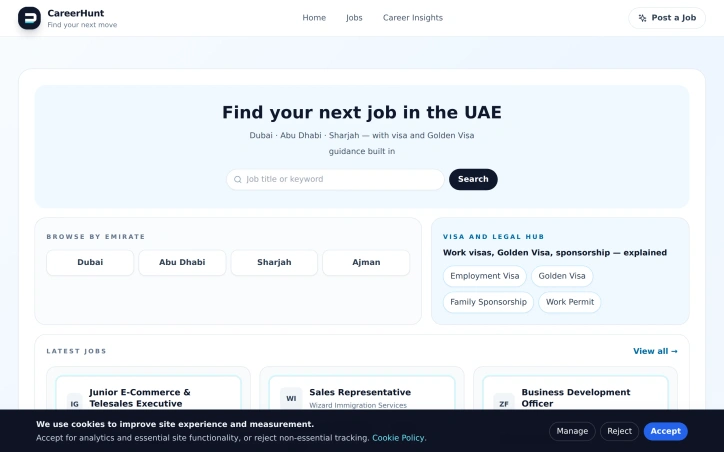
Navigating the UAE job market presents a unique set of challenges that most traditional job boards fail to address. Professionals seeking positions across the emirates contend with a fragmented search experience, visa sponsorship confusion, and inconsistent salary transparency. CareerHunt consolidates these pain points into a single platform designed specifically for the UAE labor market. The platform aggregates job listings across the major employment hubs—Dubai, Abu Dhabi, Sharjah, and Ajman—while layering in visa guidance that explains the distinctions between employment visas, golden visas, family sponsorship, and work permits. This dual focus on job discovery and regulatory navigation directly addresses the core friction point for professionals relocating to or working in the UAE: the need to understand both opportunity and immigration mechanics simultaneously. Beyond basic job posting, CareerHunt structures its offering around salary transparency and career development. The platform includes a salary guide with emirate-by-emirate comparisons and role-specific benchmarks, reducing the information asymmetry that disadvantages job seekers. Featured company pages for major employers like DHL, Noon, and Emirates Group provide deeper organizational context alongside available positions. Current postings span industries from e-commerce and telesales to construction and financial services, indicating real employer participation across sectors. The resource section extends the platform's utility beyond simple job matching. Resume checklists, interview preparation guides, and networking advice position CareerHunt as an end-to-end career navigation tool. Career guides addressing resume strategy, interview technique, and professional networking acknowledge that successful job placement in the UAE requires more than applying to openings—it demands cultural and procedural literacy that candidates often lack. For professionals serious about UAE employment, the platform solves a genuine coordination problem. It consolidates labor market data with the regulatory knowledge required to work in the region. The execution emphasizes practical utility—salary ranges, visa explanations, and curated employer profiles—over aspirational marketing, which aligns well with an audience seeking clarity and efficiency. The emirate-based organization and transparent salary comparisons reflect an understanding of how UAE employment actually works, rather than forcing candidates into generic global job board workflows.

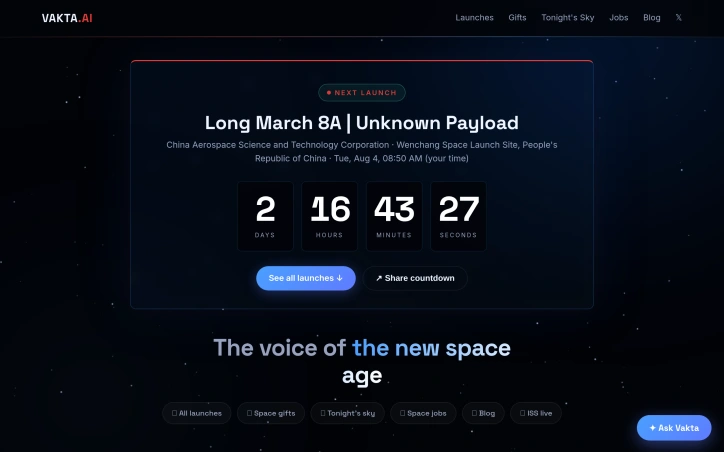
Space enthusiasts have long fragmented their attention across multiple websites and apps to track rocket launches, monitor the International Space Station, and stay current on space industry developments. Vakta consolidates these interests into a unified platform that serves both casual stargazers and professionals engaged in the space economy. The core offering centers on real-time data presented in an accessible format. A live launch manifest displays upcoming orbital launches worldwide with times automatically adjusted to the user's local timezone, addressing the perennial frustration of timezone conversions. The ISS tracker provides continuous position updates refreshing every five seconds, showing current altitude, velocity, and crew aboard, along with the ability to locate the station's next visible pass from a given location. Space weather monitoring pulls live data from NOAA's Space Weather Prediction Center, displaying solar wind speeds, aurora forecasts via the Kp Index, and current solar flare activity. What distinguishes Vakta beyond raw data feeds is its editorial integration. The platform aggregates breaking space news from leading spaceflight newsrooms in a continuously updated feed, and features a launch leaderboard tracking success rates and mission counts among competing providers. A calendar of major astronomical events helps users plan observing sessions, while an "Ask Vakta" Q&A feature positions the platform as an interactive information source rather than a passive dashboard. The platform extends beyond data to commerce, offering curated space-themed merchandise through an affiliated storefront. As an Amazon Associate and eBay Partner, Vakta earns commissions from qualifying purchases while directing profits back to platform development. The inclusion of space industry job listings points toward additional value capture by serving as a hub for recruitment within the aerospace sector. The design philosophy prioritizes live data and urgency. Nearly every interface element emphasizes real-time updates—solar data refreshing every five minutes, launch times localized to users' timezones, ISS position live-updated by the second. This approach resonates with an audience that views space as an unfolding story rather than static reference material. Vakta addresses a genuine gap for space-interested users who currently juggle multiple specialized services. By positioning itself as the unified entry point for launches, real-time space weather, news, and community around commercial spaceflight, it creates a compelling destination for an audience with genuine enthusiasm and recurring engagement patterns.

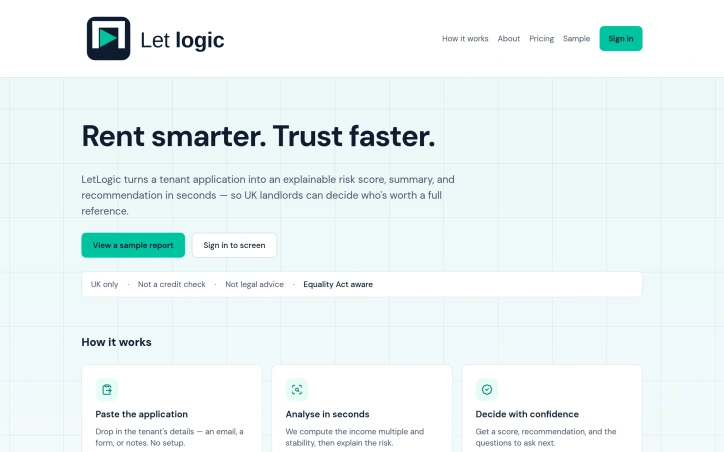
UK landlords often face a daunting task when dealing with multiple tenant applications, as the traditional referencing process is not only time-consuming but also costly. LetLogic addresses this issue by providing a streamlined solution that enables landlords to quickly and confidently assess potential tenants. The core problem LetLogic solves is the need for a fast and reliable way to screen tenant applications before deciding who is worth a full reference. By doing so, it saves landlords time and money that would be spent on unnecessary credit checks and referencing reports. What stands out about LetLogic is its ability to analyze tenant applications in seconds, providing an explainable risk score, summary, and recommendation. This is achieved through a simple process where landlords paste the applicant's details into the system, which then computes the income multiple and stability to explain the associated risk. Notably, LetLogic is designed with transparency and compliance in mind, being built with UK-focused data handling and minimal data collection, making it GDPR-aware. Additionally, it is Equality Act aware, focusing on affordability and stability while avoiding automated decisions about individuals. Key features of LetLogic include its ability to generate a score and recommendation in plain English, along with suggesting questions to ask next. It is also worth noting that LetLogic is not a credit check, nor does it provide legal advice, positioning itself as an aid to support landlords' decision-making. LetLogic offers a straightforward pricing model, with screenings starting from £4.99 or a 'Pro' option for 15 screenings a month. Overall, LetLogic offers a valuable solution for UK landlords, enhancing the tenant screening process with efficiency, transparency, and compliance.

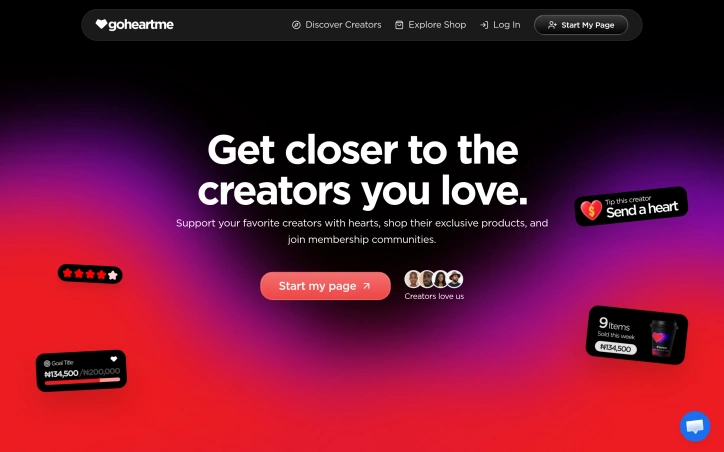
Audience-backed funding for creators remains an underserved market in many regions, particularly in Africa where traditional payment infrastructure and global platforms create barriers to monetization. This creator support platform directly addresses that gap by offering a unified solution for individuals and communities to receive financial backing from their audiences. The platform consolidates several monetization mechanisms into one ecosystem. Creators can establish personalized pages, accept one-time contributions from supporters, or build recurring revenue through membership offerings. The addition of digital product sales extends utility beyond simple patronage, allowing creators to package and distribute content or services alongside direct support. This multi-model approach recognizes that different creators and audiences have different transaction preferences—some favor one-off tipping while others commit to ongoing relationships. What distinguishes this offering is its explicit focus on African markets. Rather than assuming global payment solutions serve all regions equally, the platform prioritizes secure payment infrastructure tailored to local contexts and economic realities. The emphasis on ease of use reflects recognition that not all creators possess technical sophistication or familiarity with complex funding platforms. The public support links feature enables easy sharing across social channels and messaging platforms, reducing friction in the discovery and conversion funnel. This addresses a real challenge: even creators with engaged audiences often lack straightforward ways to direct that engagement into revenue. The positioning centers on simplification—both of the payment process and the user experience. The platform focuses creators on a core workflow: set up, share, receive funds. Rather than overwhelming users with analytics dashboards or complex configuration options, it prioritizes directness. The website itself offers limited operational details about pricing, transaction fees, or specific payment methods supported, making competitive positioning on cost and full feature set difficult to assess. The duplicate phrasing in the founder's description indicates the company is still refining its messaging. For creators seeking an alternative to global platforms, particularly those based in Africa or serving African audiences, this represents a focused solution. The combination of multiple revenue models and geographic specificity reflects a product built with particular user needs in mind rather than as a generic clone of existing solutions.

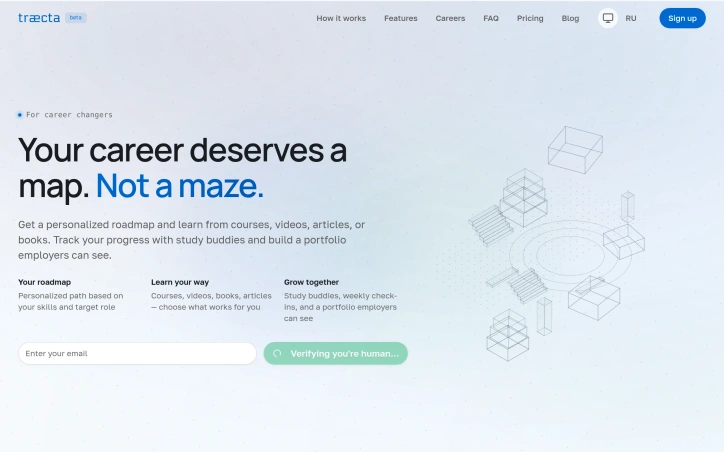
Career changers typically encounter a universal problem: most learning platforms treat all students the same, forcing them through content they've already mastered while ignoring their existing foundation. Traecta addresses this friction by building personalized learning roadmaps designed specifically for professionals transitioning between industries. The platform targets career switchers moving from roles like design to frontend development, accounting to data analysis, or teaching to technical writing. Rather than presenting exhaustive course libraries, Traecta constructs adaptive learning paths that skip redundant material and focus exclusively on skill gaps. This respect for prior experience cuts through the cognitive overload that plagues traditional online learning. What distinguishes Traecta centers on its three-stage framework. Users spend two minutes answering questions about their current skills and target role, receive an instant personalized roadmap, then track progress through concrete milestones. The platform emphasizes practical work—learners complete projects, upload portfolios, and build demonstrable proof of competency that employers can evaluate directly. This portfolio-first approach directly challenges the certificate-heavy model dominating the industry. The platform incorporates several features that reinforce this philosophy. Users select from multiple learning formats—courses, videos, books, articles—rather than following a prescribed sequence. This flexibility acknowledges that different professionals absorb knowledge differently. A skill profile maps abilities across multiple dimensions, giving learners visibility into exactly where they stand and what to prioritize next. Community elements add another layer. Study buddies and weekly check-ins connect learners pursuing the same career transitions, replacing the isolation of self-directed online education with peer accountability and feedback. This acknowledges an often-overlooked factor: career changes succeed more reliably when accompanied by social reinforcement. The underlying proposition cuts against convenience and completeness, two temptations in digital education. Traecta deliberately excludes irrelevant material and emphasizes depth over breadth, betting that professionals changing careers want precision over choice paralysis. Whether this translates to measurable results—faster transitions, higher retention, better employment outcomes—remains to be demonstrated in practice. But the fundamental insight driving the product resonates: career development, especially across industries, demands customization, not commodification.

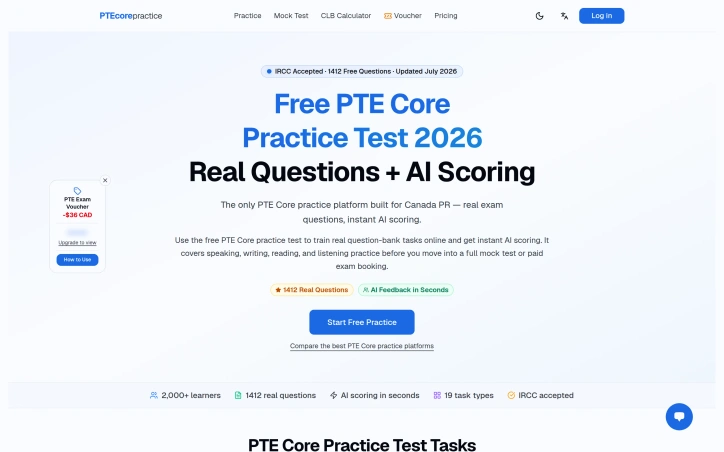
Affordable test preparation for Canada's immigration pathway has long been a gap, particularly for the PTE Core English exam now accepted by Immigration, Refugees and Citizenship Canada (IRCC). This platform fills that gap by offering 1,412 real exam questions with instant AI-powered scoring—entirely free for daily practice without requiring a credit card. The service targets Express Entry applicants and skilled workers navigating Canadian immigration requirements, where English proficiency directly impacts Comprehensive Ranking System points and eligibility. The platform's core strength lies in its use of authentic exam questions sourced from real PTE tests, combined with AI scoring that delivers instant feedback on pronunciation and fluency. This matters because applicants face significant financial barriers and preparation gaps; traditional exam prep can be expensive, and affordable alternatives have been scarce. What differentiates this offering is its specificity. Rather than generic English learning, every task mirrors the official exam structure: Read Aloud, Repeat Sentence, Describe Image, Write Email, and others spanning all 19 PTE Core task types. Users can focus on their weakest skills rather than preparing across all four domains simultaneously, an approach validated by the testimonials provided—one user raised their Listening score by 12 points in two weeks, another achieved CLB 9 across all skills in six weeks. The interface is built for practical learner constraints: mobile-ready design accommodates users practicing between shifts, detailed analytics track progress in specific competencies, and the daily free practice model removes financial barriers to getting started. The stated commitment to privacy—audio data processed securely and never sold—addresses a reasonable concern for users recording voice samples. The platform serves 2,000+ learners and incorporates community-contributed exam questions, expanding its real-question bank over time. For Canada PR applicants with limited preparation budgets, genuine exam familiarity needs, or specific skill gaps, this addresses a legitimate pain point in the immigration preparation ecosystem. The combination of real questions, task-focused practice, and free daily access creates a compelling alternative to traditional test-prep models.
Choosing the right professor shapes the entire college experience, yet students typically make this decision with incomplete information. Rate My Professor addresses this knowledge gap by aggregating candid assessments from actual students to help learners identify instructors whose teaching styles and classroom dynamics align with their needs. The platform targets undergraduate and graduate students navigating course selection. By collecting anonymous peer reviews without requiring an account, it lowers barriers to both contributing and accessing honest feedback. Students understand institutional incentives to remain quiet, so anonymity becomes the prerequisite for truth-telling. Their evaluations accumulate toward shaping others' decisions. What distinguishes Rate My Professor is its multi-faceted rating system. Rather than collapsing professor quality into a single score, the platform captures nuanced dimensions: teaching quality, course difficulty, personality, treatment of students, subject mastery, and research guidance capacity. This granularity acknowledges that great teaching takes different forms and matters differently across disciplines and learning preferences. A student seeking rigorous methodology critiques values a professor differently than one prioritizing accessible mentorship. The submission process emphasizes verification without friction. Respondents complete a simple verification check to prove familiarity with the professor, blocking spam while preserving anonymity. The form guides constructive feedback and explicitly discourages personal information sharing, encouraging substantive critique over character attacks. Rate My Professor operates across multiple countries and represents thousands of universities worldwide. The platform reports fifty thousand professors rated globally, over five hundred thousand reviews collected, and influence on more than one million course decisions. This breadth suggests network effects: the more students contribute, the more valuable the resource becomes for future enrollees. The product's restraint is notable. It sticks to its core function—professor reviews—without feature creep toward social networking, grade distribution, or tangential additions. This focus strengthens its utility as a decision-making tool rather than a time sink. The absence of a paywall or account requirement removes friction during registration periods when students most need this information. Rate My Professor fills a genuine void in course planning by systematizing peer knowledge and making it accessible, shifting professor selection from guesswork to informed choice.


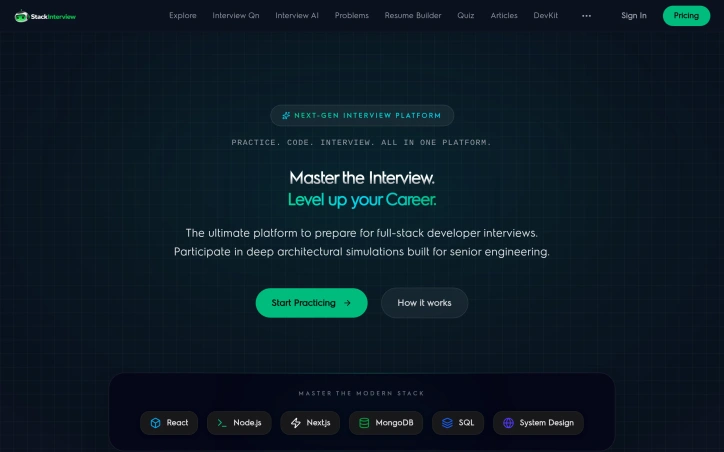
Preparing for technical interviews typically forces candidates into exhausting fragmentation: hunting for relevant questions across scattered blog posts, switching to separate coding platforms for DSA practice, and hoping they can communicate their thinking clearly during the actual interview. Stack Interview consolidates this workflow into a unified, free platform targeting developers aiming for senior-level roles. The platform tackles three specific pain points head-on. Its question bank of 1,000+ scenarios focuses on modern stack technologies—React, Node.js, Next.js, MongoDB, SQL, and system design—rather than generic definitions. These are architected around realistic problems candidates encounter in interviews at top companies. The second pillar, 215+ data structures and algorithms problems, comes with live code execution directly in the browser, eliminating the friction of local setup. Rather than leaving communication to chance, the platform includes an AI-driven mock interview feature that accepts voice input, scores responses across technical depth and communication clarity, and tailors questions to a candidate's selected target company. What distinguishes Stack Interview from existing interview prep resources is its scope consolidation. Most platforms optimize for one dimension—question banks, coding environments, or interview simulation. By integrating all three with supporting analytics like weakness tracking and company-specific readiness scoring, the tool reduces context switching and cognitive load during preparation. The business model reflects an unusual commitment to accessibility: everything is available for free with no paywall. The founder, a solo developer, built this after struggling with the exact inefficiencies the platform now solves. That origin story carries weight because the product solves real friction rather than imagined problems. The platform does target a specific audience. Candidates preparing for mid-to-senior roles in full-stack development will find the most value; those pursuing other specialties or junior-level positions may find the content overscoped. The voice-based AI interview feature, while innovative, lacks published data on performance across different accents, speech patterns, or technical communication styles. For developers serious about cracking interviews at competitive companies and tired of juggling multiple preparation tools, Stack Interview represents a meaningful consolidation. Its free-forever model removes friction to trying it, and its focus on architectural thinking over trivia aligns with how serious companies actually interview senior engineers.
For serious Christians seeking a deeper understanding of the Bible without the complexity of seminary-level study, a new web app offers a comprehensive and user-friendly solution. Formation Bible Study addresses the need for a Bible study experience that is both in-depth and accessible, providing a platform where users can engage with scripture in a meaningful way. What stands out about Formation Bible Study is its commitment to creating a safe and judgment-free environment where users can explore the Bible. The app is built around the classical inductive method, a centuries-old approach used by serious scholars, but presents it in a straightforward and faithful manner. This approach involves three steps: observing the text, interpreting its meaning through access to over 2,400 years of orthodox scholarship, and applying the insights gained to one's life. The app's features are geared towards facilitating a rich and interactive study experience. Users can access a distraction-free Bible reading environment, utilize a scholarly research tool to ask complex theological questions, and participate in synchronous study groups to share insights and prayers. Additionally, the app offers curated reading plans, inductive markup tools, and progress tracking, all designed to support a deepening understanding of scripture. Notably, Formation Bible Study offers a free tier with substantial features, including access to the BSB translation and basic highlighting, as well as one study group. For those seeking more, the Standard and Plus Academic plans are available for $7 and $12 per month, respectively, offering additional features such as unlimited groups, advanced research tools, and original language lexicons. The transparent pricing model supports the app's mission of facilitating independent biblical research. Overall, Formation Bible Study is a robust and inviting platform for Christians to engage with the Bible in a meaningful and community-driven way.


Navigating France's residential rental market can be a daunting task, with numerous factors to consider before making a decision. VerifHabitat addresses this challenge by providing a platform for individuals to share and access reviews and information about residential properties. The site is geared towards prospective renters, buyers, and occupants, offering a valuable resource for those seeking to make informed decisions. What stands out about VerifHabitat is its comprehensive approach to providing insights into a property's condition and surroundings. The site aggregates reviews from previous occupants, alongside publicly available data on factors such as energy efficiency, environmental risks, and local amenities. This information is presented in a clear and concise manner, allowing users to quickly gauge the pros and cons of a particular property. Key features of the platform include its moderation process, which ensures that reviews are vetted before publication, and the ability for users to report on various aspects of their experience, such as noise levels, humidity, and property management. The site also draws on a range of public sources, including government databases and urban planning records, to provide additional context. VerifHabitat is entirely free for all users, with no indication of any tiered pricing or premium features. The site's commitment to transparency and moderation helps to establish trust with its users, who can contribute reviews without fear of their identity being disclosed. Overall, VerifHabitat offers a valuable service to those navigating France's residential rental market, providing a unique combination of user-generated reviews and publicly available data to inform their decisions.

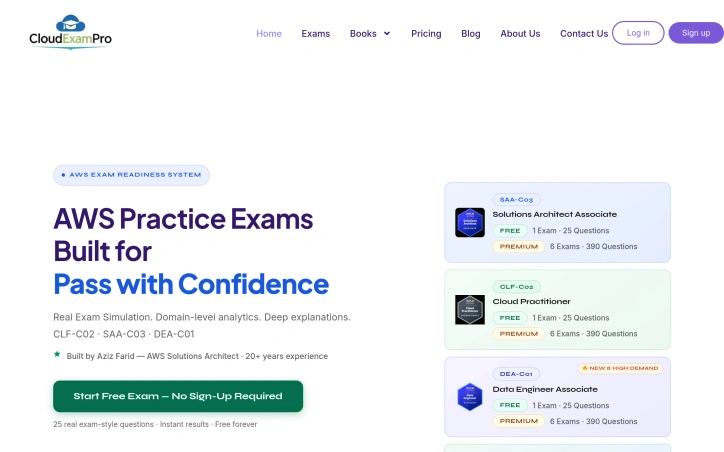
Aspiring AWS certification holders often struggle to find high-quality, affordable practice exams that accurately reflect the actual test experience. CloudExamPro addresses this need by providing realistic exam-style practice tests and study resources tailored to AWS certification candidates. The platform is specifically designed for individuals seeking to pass AWS certifications, including the Cloud Practitioner, Solutions Architect Associate, and Data Engineer Associate exams. What stands out about CloudExamPro is its focus on delivering a genuine exam simulation experience, complete with real exam-style questions and detailed explanations to help learners understand their mistakes. The platform's creator, an AWS Solutions Architect with over 20 years of experience, brings valuable expertise to the table. The site's emphasis on domain-level analytics allows users to identify knowledge gaps and target their studying effectively. Key features of CloudExamPro include its free tier, which offers 25 questions per certification without requiring a credit card, and its premium packages, which provide six months of access to multiple full exams and priority support for $29 per certification. The platform's questions are updated weekly to ensure they remain relevant and accurate, with a verified 98% pass rate among its users. Overall, CloudExamPro is a valuable resource for AWS certification candidates seeking to gain confidence and pass their exams on the first attempt. By offering a focused, affordable, and effective study solution, CloudExamPro helps learners achieve their certification goals.
The online landscape is filled with platforms catering to diverse interests, and one such destination is designed for individuals seeking information and inspiration on trending topics. WhatsBuzzn.com solves the problem of scattered and hard-to-find information on various subjects, including freelancing, digital marketing, and remote work, by aggregating it in one place. The platform is geared towards curious individuals, freelancers, and aspiring digital nomads looking to stay informed and entertained. What stands out about this platform is its diverse range of topics, from freelancing and digital marketing to technology and remote work. The content is presented in a magazine-style blog format, making it easily digestible for visitors. The articles are categorized into clear sections, allowing readers to quickly find relevant information. The platform also invites contributors to share their insights, fostering a community of innovators and experts. A key feature of the platform is its newsletter subscription service, which delivers the latest stories directly to readers' inboxes. The site also uses cookies to enhance user experience, indicating a focus on personalization. The content is comprehensive and includes guides, tutorials, and assessments, demonstrating a commitment to providing valuable resources to its audience. While the business model is not explicitly stated, the presence of a newsletter and the invitation to contribute suggest that the platform may be exploring revenue streams related to content creation and community engagement. Overall, the platform offers a valuable resource for those seeking information on trending topics and is well-suited to its target audience.


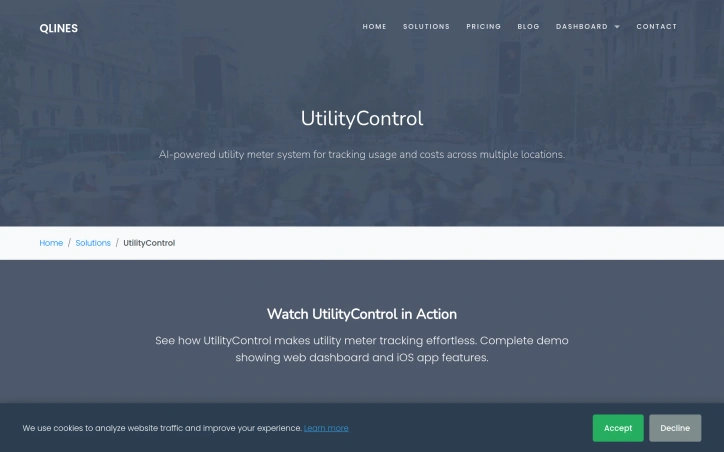
Managing multiple utility meters across various properties can be a daunting task, especially when it comes to tracking consumption patterns and verifying billing accuracy. UtilityControl addresses this challenge head-on by providing a comprehensive meter monitoring and consumption tracking software. The platform is designed for property managers, facility administrators, and businesses with multiple locations seeking to streamline their utility management processes. What stands out about UtilityControl is its AI-powered assistant, which enables users to ask questions about their consumption in plain language and receive instant, intelligent answers. The platform's ability to analyze consumption patterns and provide actionable recommendations is a significant differentiator. The organized dashboard allows users to manage all their utility meters from a single interface, organizing them by location and tracking multiple properties with ease. The platform's key features include visual consumption analytics, smart insights on demand, and smart bill management. The visual consumption analytics feature provides interactive charts that reveal consumption patterns, while the smart insights feature offers personalized recommendations based on the user's consumption trends. The smart bill management feature allows users to upload utility bills and automatically compare them with their meter readings, catching discrepancies and verifying billing accuracy. UtilityControl offers a free trial, allowing potential customers to test the platform before committing to a purchase. While pricing details are not explicitly stated, the availability of a free trial suggests a flexible pricing model that can accommodate different business needs. Overall, UtilityControl is a robust solution for businesses seeking to optimize their utility management processes, and its innovative use of AI technology makes it an attractive option in the market.

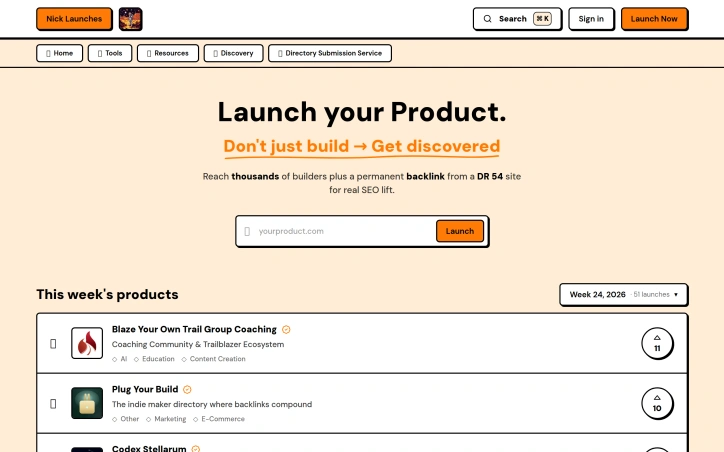
For developers and indie makers looking to launch their products and get discovered, Nick Launches offers a suite of tools and resources to help them succeed. The platform is designed to support those building AI products, providing practical guidance and strategic support to accelerate their launch. What stands out about Nick Launches is its focus on the AI product development community, catering to a specific niche within the broader tech landscape. The website highlights a curated list of recent product launches, showcasing a diverse range of tools and applications across categories like AI, education, content creation, and more. This suggests that the platform not only supports product launches but also fosters a community around emerging technologies. The key features of Nick Launches include its product launch services, which promise to get products in front of thousands of builders and provide a permanent backlink from a high-authority site for SEO benefits. The platform also offers a directory submission service, implying that it helps products gain visibility through targeted listings. Additionally, the website features a collection of tools and resources, including tutorials and reviews, aimed at helping developers build and launch their products more effectively. While the pricing or business model details are not explicitly stated, the platform's revenue streams can be inferred from its services. The directory submission service and product launch offerings suggest that Nick Launches generates revenue through these paid services, potentially catering to a range of budgets and needs within the developer and indie maker community. Overall, Nick Launches positions itself as a valuable resource for those looking to launch and grow their AI products, providing a combination of visibility, community, and practical support.

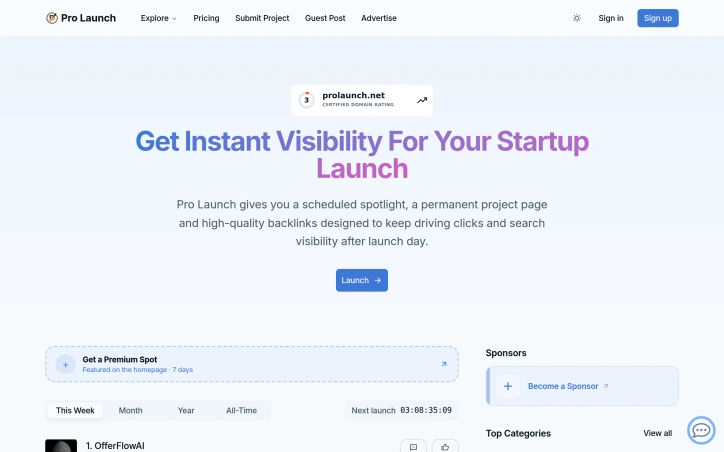
Startups often struggle to gain lasting visibility after launching a product, with initial traction often giving way to obscurity. Pro Launch is designed to address this issue, providing a platform for early-stage companies to get featured and stay discoverable. The site is geared towards startups and indie hackers looking to get their products in front of real users. What stands out about Pro Launch is its focus on delivering sustained visibility, rather than just a fleeting spike in traffic. By offering a scheduled spotlight, permanent project page, and high-quality backlinks, it helps founders achieve ongoing discoverability. The permanent project pages are particularly noteworthy, as they provide a lasting presence for products and help drive clicks and search visibility long after the initial launch. The platform features a curated list of startups across various categories, including SaaS, Artificial Intelligence, and Marketing. The site also includes a blog with in-depth guides on product launch strategies and alternative platforms for showcasing startups. Top founders are showcased, highlighting successful projects and products. While pricing details are not explicitly stated, the site does mention a "Premium Spot" for featured startups, suggesting a tiered model. The presence of sponsors and a blog with relevant content also implies a potentially diverse revenue stream. Overall, Pro Launch is well-suited for startups seeking to amplify their launch and maintain a visible presence. Its emphasis on sustained discoverability and SEO-driven project pages sets it apart from other launch platforms.