Catalyst Healthspan Audit
Personal trainers typically sell training sessions. This startup reversed the equation by building assessment first, mak...
Launchory
We built Launchory to solve the discoverability problem for startups. Our platform offers instant approval, permanent do...
Best Prompt Engineering Tools Startups & Tools
Design, test, and refine prompts for predictable, aligned outputs.
Recently Listed
3 launches
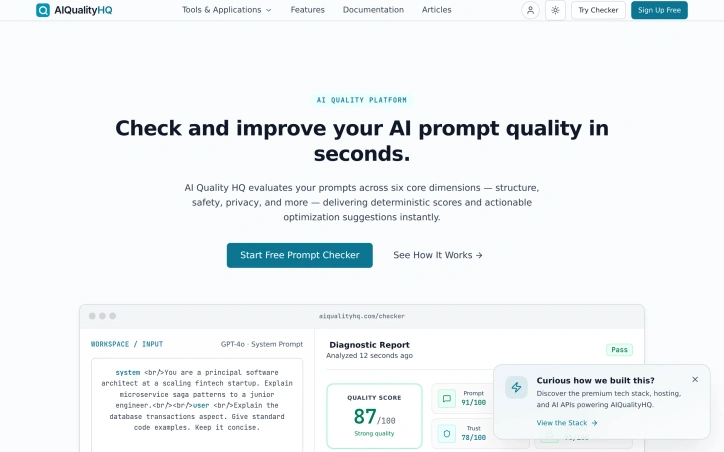
Teams that rely on AI models face a consistent risk: the quality of outputs depends directly on prompt quality. Poor prompts introduce hallucinations, leave systems vulnerable to injection attacks, and can inadvertently expose sensitive information. AIQualityHQ tackles this problem by providing instant validation for AI prompts before they reach production. The product is designed for developers and technical teams building AI-powered applications who need to ensure prompt safety and consistency without additional API costs or complexity. Its primary appeal is speed and transparency—the analysis engine runs locally in the browser within milliseconds, using deterministic structural rules rather than calling out to additional AI services. What distinguishes this product is its emphasis on deterministic analysis. Rather than relying on machine learning models or external APIs, AIQualityHQ uses rule-based heuristics and syntax checking to evaluate prompts across six dimensions: structure, memory, context, trust, privacy, and security. This approach means faster analysis (under 10 milliseconds), no privacy concerns from uploading prompts elsewhere, and results that do not depend on third-party API availability. The core workflow is straightforward: paste a prompt, run analysis, and receive both a quality score and specific recommendations for improvement. The platform flags common failure modes—prompt injection vectors, missing output constraints, exposed PII variables, and absent system instruction locks. For each issue detected, the tool provides actionable optimization suggestions rather than just reporting problems. Key capabilities include a diff view for comparing before-and-after versions of prompts and the ability to export results. The platform requires no signup and charges no fees, making experimentation low-friction. The product ships with example prompts to help users understand the analysis format. The main limitation appears to be scope: the tool focuses specifically on prompt quality rather than broader concerns like model selection, fine-tuning, or inference optimization. Users seeking comprehensive AI system auditing would need additional tools. Additionally, while browser-based analysis ensures privacy, it also means analysis is confined to what static rules can detect—issues that emerge only at runtime or in specific model behaviors may not surface. For teams managing multiple AI prompts in production or developing new AI features, this fills a genuine gap. The combination of zero cost, instant results, and focus on preventable failures makes it a practical addition to an AI development workflow.
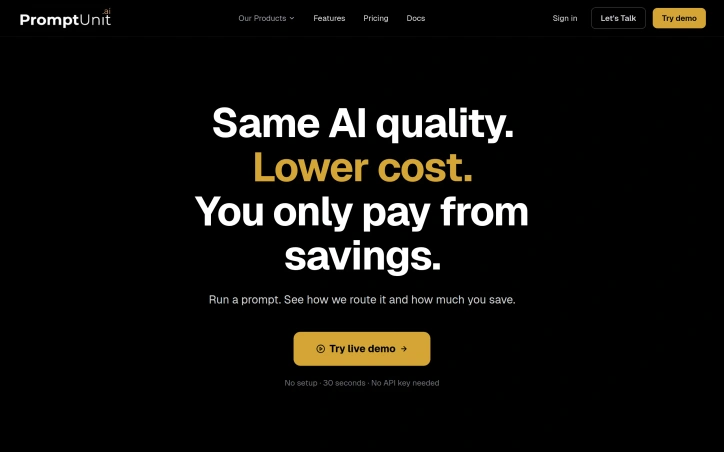
Budget hemorrhage is the silent killer of every AI initiative that grew faster than the finance spreadsheet. PromptUnit attacks that problem head-on: it shows engineering teams exactly where their tokens bleed cash and then patches the wound without touching a line of code. Seed-stage startups accruing five-figure OpenAI bills and mid-market companies trying to rein in a mosaic of LLM providers finally have a single valve to turn. The product deploys like an analytics layer that refuses to stay passive. Once you swap one environment variable—yes, truly one—the proxy begins logging every request in “shadow mode,” generating real-time dashboards that break cost, latency and usage down by model, feature and even individual prompt type. After a couple of weeks it presents an itemized forecast: keep current behavior and pay $12,400 next month, or let PromptUnit route intelligently and pay $6,960 instead. Enablement happens with a toggle, revertible just as fast. Routing decisions are explained in English next to every call rather than buried in an inscrutable algorithm. If GPT-4o-mini can hit the quality bar for a routine summarization task, the dashboard explicitly credits the $0.07 saved; if a complex code-generation request stays on GPT-4o, the rationale is right there. Automatic failover means the proxy never becomes a single point of failure—it steps aside the moment it stumbles. GDPR residency controls and guarantees that your prompts never feed anyone else’s training set complete the enterprise hygiene checklist. PromptUnit is chargeable only on verified savings, skimmed at a flat 20% of the delta. No savings, no invoice; turning it off permanently is always one click away. That alignment of profit motive and customer thrift turns loose change into an obvious install, not another procurement debate.

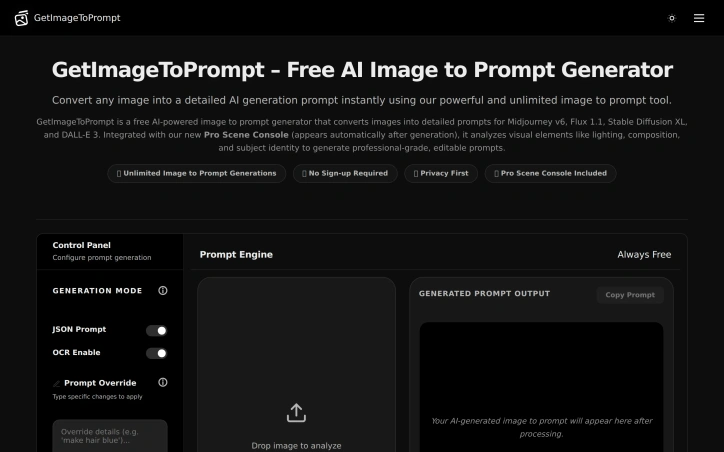
Reverse image-to-prompt conversion is becoming a critical workflow for AI artists, and GetImageToPrompt addresses this directly. The tool analyzes uploaded images and generates detailed text prompts optimized for popular generative AI models like Midjourney, Flux, DALL-E 3, and Stable Diffusion. For creators working across multiple AI platforms, this eliminates the friction of manually describing visual references or reverse-engineering prompts from images. The product targets four distinct user segments. AI artists and character designers use it to create reusable, consistent prompts across different models. Visual designers convert reference images into structured prompts for creative workflows. Marketing teams extract visual descriptions for campaigns and social media. Developers and researchers leverage the tool's JSON output for programmatic access and analysis. What sets GetImageToPrompt apart is its privacy-first positioning. Images are processed in real-time but never stored on servers, addressing the primary concern creators have when uploading visual assets to online tools. The free, unlimited access model removes friction entirely—no credits system, no sign-up requirement, no usage caps. This approach prioritizes accessibility over monetization. The feature set reflects practical needs in prompt engineering. Beyond basic image analysis, the tool extracts subject details, compositional elements, lighting effects, and artistic style tags. An OCR feature flags text elements within images, useful for designs containing typography. The prompt override functionality lets users modify outputs with natural language instructions like "make the dress yellow" or "add cinematic lighting," enabling quick iterations without re-uploading. Output flexibility matters for different workflows. The JSON prompt mode delivers structured data suitable for developers and advanced workflows, while standard text output serves artists working directly with image generators. The product also showcases gallery examples across anime, cinematic, and photorealistic styles, demonstrating consistency across output types. The website mentions optimization for specific model versions like Midjourney v6.1 and Flux 1.1 Pro, suggesting the tool maintains awareness of evolving model strengths and syntax preferences. This targeted optimization reduces the trial-and-error cycle many creators face when adapting prompts between platforms. The core value proposition is straightforward: accelerate the creative reference-to-prompt conversion process while protecting user privacy. For a market where AI-generated content creation is becoming commonplace, a free tool that removes both technical and trust barriers fills a genuine gap.