Xtra Hands Family Chore App
Household chore management remains one of parenting's persistent friction points, and Xtra Hands positions itself as the...
Catalyst Healthspan Audit
Personal trainers typically sell training sessions. This startup reversed the equation by building assessment first, mak...
Best Social audio apps Startups & Tools
Platforms for audio discussions, podcasts, interviews, and live sessions.
Recently Listed
3 launches
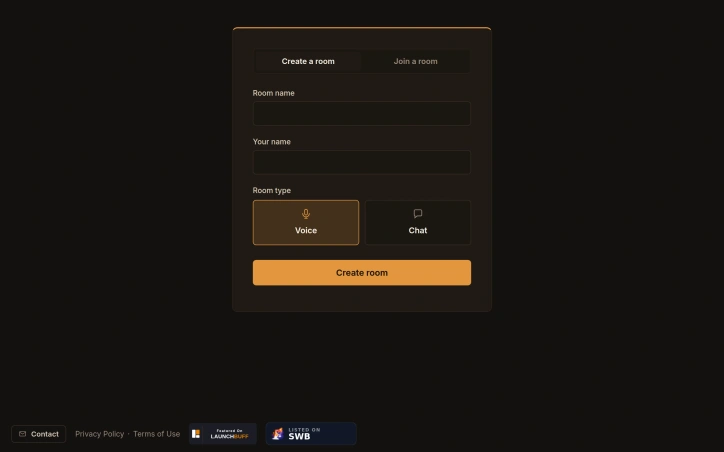
Meetings where a handful of voices dominate while others struggle to contribute represent a persistent problem in remote and in-person collaboration. Talking Stick addresses this dynamic by reimplementing a traditional facilitation technique in a digital voice chat environment. The application enforces a structured speaking model where only one person can actively broadcast at a time. Rather than relying on social dynamics or moderator intervention, the platform's architecture ensures turn-based conversation. This prevents the common scenario where faster talkers, higher-status participants, or louder personalities monopolize discussion time while quieter team members remain sidelined. The product targets teams and organizations frustrated with inefficient meetings. Workplace groups conducting brainstorming sessions, decision-making discussions, or any meeting where balanced input matters represent the primary use case. Educational settings, community groups, and any collaborative context where equitable participation improves outcomes could benefit from the structure Talking Stick enforces. The core features revolve around simplicity. Users create a named room, enter their name, and join voice conversations. The interface assumes minimal setup friction. Room codes enable straightforward participant management. The voice chat foundation provides real-time audio communication while the turn-taking mechanism handles the facilitation layer. What distinguishes Talking Stick from standard video conferencing platforms is its singular focus on solving one specific meeting problem rather than offering comprehensive communication features. It does not attempt to replace Zoom, Teams, or other all-in-one collaboration suites. Instead, it positions itself as a specialized tool for contexts where meeting equity directly impacts productivity and participant satisfaction. The talking stick principle itself carries cultural and historical weight, suggesting intentional design rooted in proven facilitation practices rather than arbitrary feature choices. This positioning signals that the founder understands not just the technical problem but the organizational behavior underlying poor meeting dynamics. The stripped-down web interface and contact email suggest an early-stage project still refining its core value proposition. No pricing information appears publicly, indicating either a free model or pre-launch monetization strategy. The simplicity of the core interaction model suggests the product aims for rapid adoption in contexts where meeting quality matters most, though broader organizational adoption would depend on integration capabilities and team management features not evident from the current presentation.
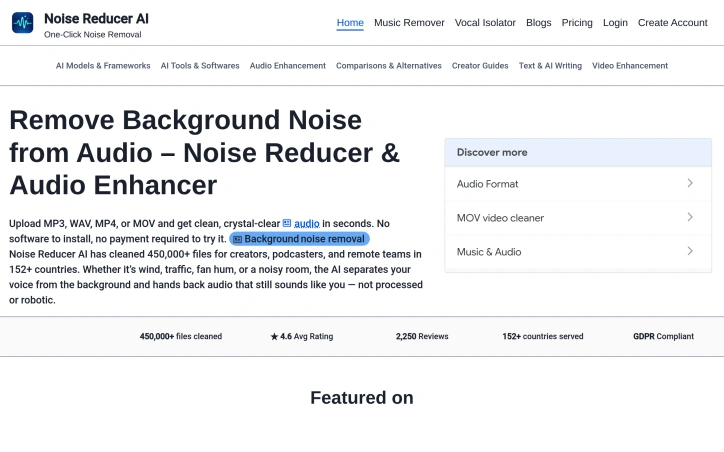
Background noise derails audio quality for content creators, podcasters, and remote workers who need professional sound without expensive equipment or software. Noise Reducer AI attacks this problem head-on by offering browser-based audio and video processing that removes unwanted background sounds in seconds. The platform operates on a freemium model, allowing users to upload and denoise files without paying upfront. The technical foundation relies on DeepFilterNet, a deep-learning framework designed for real-time noise separation. Rather than leaving audio sounding processed or robotic, the tool preserves the natural characteristics of the primary audio—typically the speaker's voice—while stripping away hum, traffic, wind, crowd noise, and echo. The product's appeal extends beyond noise removal. It offers three specialized tools: a general noise reducer for various background sounds, a music remover that isolates or extracts vocals independently, and a vocal isolator for complex environments with layered noise. This modular approach addresses the reality that different recording scenarios demand different solutions. The interface embraces simplicity with drag-and-drop uploads, real-time waveform visualization, and adjustable denoise intensity levels. Multi-format support—MP3, WAV, MP4, MOV, and more—eliminates the friction of audio extraction before processing. Users can upload video directly, with the tool handling both audio and video files seamlessly. A recording feature adds flexibility for those working directly within the platform, with immediate playback for before-and-after comparison. The platform's track record demonstrates practical viability. Across 152 countries, it has processed 450,000 files with an average user rating of 4.6 out of 5 based on 2,250 reviews. The service maintains GDPR compliance, addressing privacy concerns for European users and regulated industries. No software installation requirement lowers the barrier to entry, positioning the tool as immediately accessible from any browser. The core tension remains between free trial usage and monetization. While the site references purchasing options for additional processing minutes, explicit pricing details remain absent from the marketing materials, leaving cost comparison and long-term economics unclear for prospective users.
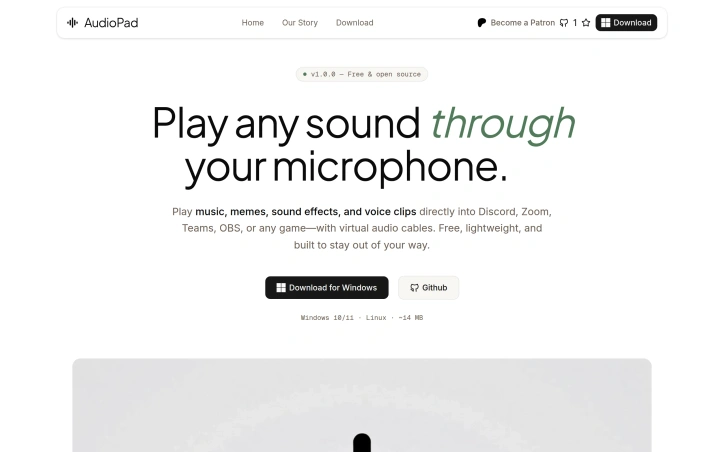
Solving a genuine gap in the market, AudioPad is a free, open-source soundboard that injects audio into your microphone feed for use across Discord, Zoom, Teams, OBS, and similar applications. The product targets gamers, streamers, content creators, and remote workers who want to layer sound effects, music, or voice clips into their communication streams without the friction of expensive, closed-source alternatives. The standout elements lie in its no-compromise philosophy. The application installs under 15 MB, consumes minimal RAM at idle, and deliberately avoids the bloat plaguing commercial soundboards. Setup requires no driver wrestling or lengthy configuration—the installer handles virtual audio device creation automatically, and users simply select AudioPad as their microphone input within the target application. The process genuinely takes minutes, not hours. Performance matters here, and AudioPad delivers. Sub-20ms latency ensures sounds trigger when the key is pressed, not with the lag that undermines real-time user experience. The interface accepts drag-and-drop audio files in MP3, WAV, OGG, FLAC, and M4A formats, skipping the conversion busywork of lesser tools. Global hotkeys work even mid-game, with custom bindings that avoid conflicts—a critical feature for streamers juggling multiple applications simultaneously. Perhaps most compelling is the privacy posture. AudioPad runs entirely locally with zero telemetry, no cloud infrastructure, and no mandatory account creation. This differentiates it sharply from subscription-based competitors that monetize user data or lock features behind paywalls. The open-source MIT license means users can inspect the code, report issues, and contribute patches directly. The business model reflects this ethos. AudioPad remains free indefinitely, sustained through Patreon sponsorships rather than extraction-based monetization. This alignment between developer and user incentives—developers improve the tool because they use it—positions it as a genuinely community-driven project without the churn of enterprise feature bloat. The product comparison claims feature parity with paid alternatives on capabilities that matter, while eliminating telemetry and watermarks. While the software remains in active development, it delivers on its core promise: a soundboard that simply works, requires no subscription, and respects user privacy. For the intended audience, that clarity of purpose translates to a product that doesn't waste time or resources on features that don't belong.