
Catalyst Healthspan Audit
Personal trainers typically sell training sessions. This startup reversed the equation by building assessment first, mak...
Launchory
We built Launchory to solve the discoverability problem for startups. Our platform offers instant approval, permanent do...
Best Financial planning Startups & Tools
Plan, track, and optimize budgets, investing, taxes, and scenarios.
Recently Listed
11 launches
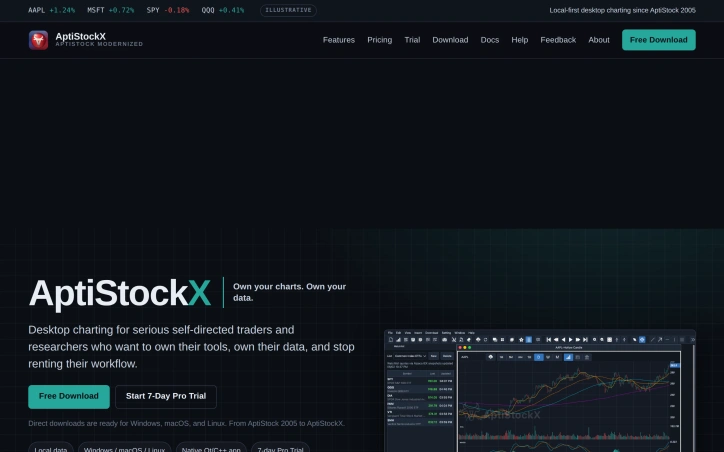
For self-directed traders and researchers tired of renting their trading research environment through browser-based subscription tools, AptiStockX offers a pragmatic alternative built on a simple premise: serious technical analysis deserves dedicated software that runs on your computer, stores your data locally, and doesn't depend on cloud connectivity. The product represents a modernization of AptiStock, which served individual traders for more than two decades beginning in 2005. The new version is engineered as a native desktop application for Windows, macOS, and Linux, targeting investors who prioritize speed, customization, and ownership over convenience bundled with monthly fees. What distinguishes AptiStockX is its uncompromising commitment to local-first operation. Chart files, downloaded market data, watchlists, workspaces, and user credentials never leave the user's computer. The absence of cloud synchronization is by design, not a limitation—it resolves privacy concerns and removes dependency on company infrastructure for core functionality. This approach appeals directly to a segment of traders who distrust centralized platforms and view data control as non-negotiable. The feature set reflects this positioning. AptiStockX delivers customizable technical indicators, drawing tools, multiple chart windows, multi-monitor support, flexible workspaces, and an AI Assistant in its Pro tier. These capabilities are standard across professional charting platforms, but the local desktop implementation means they perform at the responsiveness users expect from workstation software rather than web applications running in browser tabs. AptiStockX follows a freemium model with a Basic edition available at no cost and additional capabilities in Pro. New users can test Pro features through a seven-day trial triggered directly in the app via email verification—no credit card required upfront. Extension requests are handled by support. This trial structure removes friction from initial adoption while preserving genuine product evaluation. The company's explicit positioning around privacy, ownership, and technical rigor sets realistic expectations. AptiStockX does not attempt to be a broker-integrated trading platform or claim real-time data feeds unless its providers genuinely supply them. This restraint in marketing claims differentiates it from products that oversell capabilities and subsequently disappoint. For traders who have outgrown spreadsheets and reject browser-based SaaS, AptiStockX provides a viable path forward with recognizable legacy and clear technical tradeoffs.

Students navigating college planning encounter fragmentation. High schoolers preparing applications need test score calculators. Those already enrolled need GPA tracking. Students of all stages need financial planning tools for costs and loans. Historically, this has required registering with multiple services and learning different interfaces for each. GPA Vault consolidates this entire workflow into one free platform requiring no signup. The service bundles over 21 calculators across three core domains: academic GPA tracking, student financial planning and loans, and standardized test scores. This breadth supports the student journey from high school admissions through college graduation and repayment. The academic calculator suite is comprehensive. Standard GPA calculators coexist with weighted GPA tools, specialized calculators for high school versus college, and dedicated versions for IB and AP course scales. Additional tools help students determine what final exam scores they need to hit target grades, calculate how many As would raise their cumulative GPA to a target, and track semester GPAs separately from their full record. A grade converter translates between GPA numbers and letter grades across the full 4.0 scale. Financial tools address both costs and debt. Students can estimate four-year total college expenses, calculate monthly loan payments across standard and income-driven repayment plans, see how scholarships reduce lifetime interest, and decode financial aid award letters to distinguish grants from loans. These calculators translate opaque numbers into concrete monthly figures and lifetime totals. Test score components handle SAT and ACT conversion, translating raw scores into scaled scores with percentile rankings that vary by college competitiveness tier. The business model relies on Google AdSense advertising, indicating ad-supported rather than subscription or transaction-based monetization. Users access all tools without payment or account creation. What distinguishes GPA Vault is its refusal to fragment essential student tools. Rather than asking students to maintain multiple accounts, learn separate interfaces, and toggle between apps, it consolidates answers into one coherent platform emphasizing speed and instant access. For students simultaneously navigating college decisions, course performance, and financial realities, this integration delivers tangible efficiency.


When prospective car buyers sit down to make one of the largest purchases of their lives, they face a complexity problem. A vehicle decision isn't simply about the sticker price—it encompasses loan terms, depreciation curves, insurance premiums, fuel consumption, maintenance budgets, and financing alternatives that interact in non-obvious ways. AutoCalcHub addresses this fragmentation by consolidating 24 automotive financial calculators into a single, immediately accessible resource. The platform's core strength lies in its pragmatic approach to removing friction. There's no registration wall, no paywall, and no hidden fees to discover later. Users arrive at the site and can run any of the available calculators within seconds. This unobstructed access stands out in an era when personal finance tools typically demand email addresses or subscription commitments before delivering value. The calculator collection covers the full lifecycle of car ownership. On the purchase side, tools address loan payments, affordability thresholds using the 20/4/10 budgeting rule, down payment scenarios, lease-versus-buy comparisons, and cash-versus-finance trade-offs. A sales tax calculator factors in state-specific rates and trade-in deductions—a detail that many buyers overlook until payment time. For existing owners, the platform offers maintenance cost estimates, trade-in value assessments, refinance scenarios, and early payoff analysis. For the EV-curious, dedicated tools compare total cost of ownership between gas and electric vehicles and estimate charging expenses at home or public stations. Less commonly featured are some of the specialized calculators: a GAP insurance advisor that determines whether underwater loan coverage is worthwhile, a real-world MPG tracker for drivers who want to measure actual efficiency, and a road trip planner that bundles fuel, food, and lodging into a single estimate. These reflect thought about the actual decisions car owners need to make, not just the headline metrics. The business model is straightforward. The site operates on Google AdSense advertising, which the team acknowledges directly. This positioning—free tools supported by advertising rather than extracting user data or premium tiers—creates transparent incentives. The company profits when users find value in returning, not by upselling financial products or harvesting personal information. AutoCalcHub targets drivers who want math-driven decision-making without the sales pitch. It succeeds by avoiding the complexity tax that many fintech platforms impose: no accounts to create, no data to surrender, no friction between question and answer.


Insurance can feel overwhelming. Most people struggle to determine how much coverage they actually need, whether they're shopping for life insurance to protect their family or calculating disability coverage to safeguard their income. My Insurance Calc addresses this friction with a collection of over 20 free calculators designed to demystify insurance requirements across dozens of coverage types. The product serves a broad audience, from renters and homeowners to self-employed professionals and specialty vehicle owners. Each calculator walks users through relevant variables—income, dependents, assets, vehicle specifics, travel destinations—to generate personalized coverage recommendations and premium estimates. The platform covers expected categories like life, home, and car insurance, but also tackles niche needs such as EV insurance impacts, SR-22 requirements after driving violations, and business insurance for entrepreneurs. The specificity of these calculators suggests recognition of how insurance needs vary dramatically based on individual circumstances. What sets this offering apart is its commitment to accessibility. The entire platform is completely free with no account creation requirement, removing barriers that typically exist in insurance research. Results appear instantly, and the emphasis is on straightforward answers without hidden fees or signup obligations. This low-friction approach makes it practical for people making quick decisions or conducting preliminary research before consulting an agent. The breadth of coverage is notable. Beyond standalone calculators, the platform includes comparative tools, such as a term versus whole life comparison, helping users understand cost tradeoffs across insurance products. The addition of newer calculators for health insurance subsidies and EV-specific premiums suggests the tool evolves to address emerging insurance concerns. This responsiveness to market needs indicates active development and an understanding of shifting insurance priorities. For consumers tired of insurance confusion, My Insurance Calc delivers immediate utility without friction. The breadth of calculators and the explicit focus on removing signup barriers make it a practical starting point for anyone trying to understand their coverage needs.


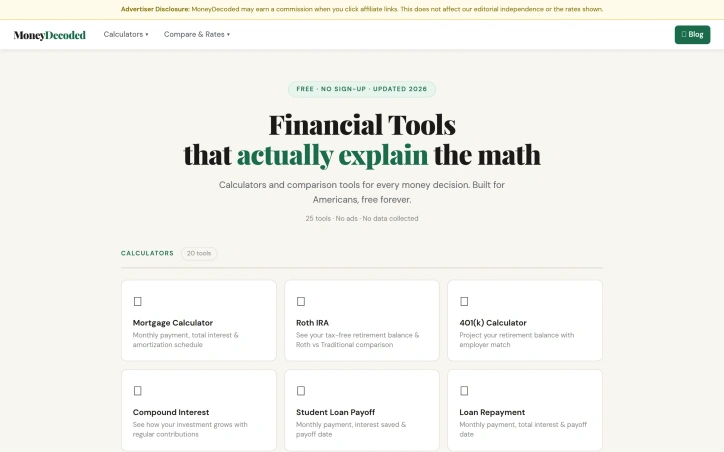
American financial planning often forces an uncomfortable choice: use free calculators that obscure their methodology and monetize through data harvesting, or pay for tools that respect privacy. MoneyDecoded breaks this false binary by offering 25 free financial calculators and comparison tools with no signup required, no ads, and no data collection. The platform directly addresses a real friction point in personal finance: most calculators hide their assumptions and math behind black boxes. MoneyDecoded's commitment to mathematical transparency means users can understand not just the answers they get but why those answers emerge from their inputs. For Americans managing mortgages, retirement accounts, debt payoff strategies, or investment decisions, this pedagogical approach transforms calculators from simple utilities into learning tools. The calculator suite spans the full financial lifecycle. Retirement planning tools cover 401(k) projections with employer match scenarios, Roth IRA analysis, and Social Security benefit estimation across claiming ages. Debt management includes dedicated calculators for mortgages, student loans, personal loans, and car loans, each showing amortization schedules and true borrowing costs. The platform also includes less common but valuable utilities: a Rent vs. Buy calculator with break-even analysis, a FIRE calculator for financial independence tracking, and comparisons between debt payoff strategies like the avalanche versus snowball methods. The comparison section supplements calculators with rates and accounts data, helping users benchmark high-yield savings accounts, certificate of deposit terms, checking accounts, and ETF performance. A Send Money Abroad tool compares fees across Wise, traditional banks, and fintech options. What distinguishes MoneyDecoded from competitors is not feature quantity but accessibility and philosophy. Free tools for personal finance already exist, yet the service's explicit rejection of data monetization and advertising removes common friction. The no-data-collection commitment suggests a creator prioritizing user trust over growth metrics. All tools carry an updated date, signaling ongoing maintenance rather than abandonware. The site's URL indicates this calculator suite sits within a broader financial education ecosystem. For individuals seeking quick, transparent calculations without compromising privacy, the platform delivers. For financial educators or advisors recommending tools to clients, the free-with-explanation model eliminates gatekeeping. The primary limitation is that calculators alone don't constitute comprehensive financial advice, though the transparency-first approach sets a better foundation for independent decision-making than opaque alternatives.
For homeowners embarking on DIY projects, estimating materials needed can be a daunting task, often leading to costly errors or unnecessary trips to the hardware store. HomeCalcPro addresses this challenge by offering a suite of free calculators designed to provide accurate material estimates for a variety of home improvement tasks. What stands out about HomeCalcPro is its commitment to simplicity and accessibility. The website boasts a clean and straightforward design, making it easy for users to quickly find and utilize the calculators they need. With over 20 tools available, homeowners can estimate materials for projects ranging from painting and flooring to tiling, concrete work, and landscaping. The calculators themselves are robust, taking into account various factors that can impact material needs, such as room dimensions, waste factors, and material types. For instance, the flooring calculator allows users to input room dimensions and select from various flooring types, providing an estimate of square footage and cost. Similarly, the paint coverage calculator considers factors like ceiling height, number of doors and windows, and number of coats. Notably, HomeCalcPro is entirely free to use, with no sign-up required and instant results provided. The website is also ad-supported, but the ads are kept out of the way of the calculator results, ensuring a seamless user experience. As an Amazon Associate, the company behind HomeCalcPro earns revenue from qualifying purchases, providing a sustainable business model that doesn't rely on user sign-ups or subscription fees. Overall, HomeCalcPro is a valuable resource for homeowners looking to plan and budget their DIY projects with confidence.


Financial calculations and business tasks often require specialized tools, but accessing these can be cumbersome due to paywalls, registration requirements, and data privacy concerns. AnyServ addresses this issue by offering a suite of calculators and business tools directly in the user's browser, eliminating the need for downloads, sign-ups, or server-side data processing. The platform is geared towards individuals and businesses seeking straightforward, accurate financial and business calculations without the hassle of traditional software or online services. What stands out about AnyServ is its commitment to user privacy and simplicity. By processing all calculations locally within the browser, AnyServ ensures that user data never leaves their device, providing a high level of security and compliance with data protection regulations like GDPR. The service also boasts a clutter-free experience, allowing users to pick a tool, input their data, and receive instant results without any friction. The range of tools available on AnyServ is diverse, covering financial, tax, and business needs. Users can access a VAT calculator, mortgage calculator, salary calculator, and percentage calculator, among others, all of which are designed with transparency and accuracy in mind. The formulas behind these calculators are based on official tax and banking standards, ensuring reliability. AnyServ operates on a completely free model with no hidden costs, accounts, or paywalls. The absence of registration requirements and the local processing of data contribute to a seamless user experience. The service supports multiple languages and is accessible on mobile devices, enhancing its utility across different user bases. With new tools being added regularly, AnyServ is continually expanding its capabilities to meet a wide range of user needs.


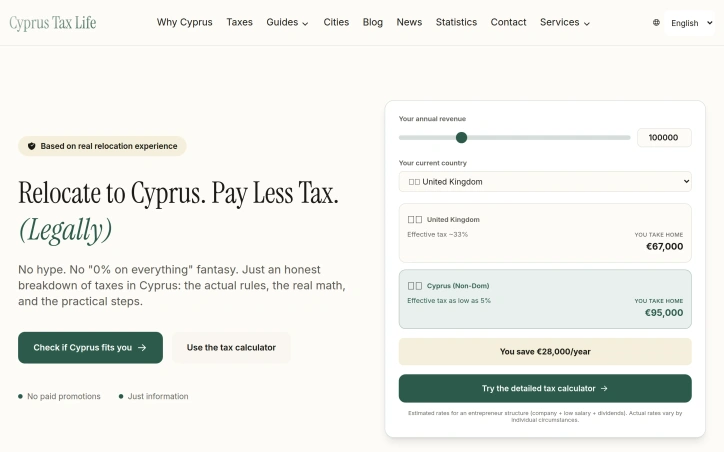
For expats seriously weighing relocation to Cyprus, finding reliable tax information has historically meant navigating vague consultancy websites designed to funnel readers into paid calls, or wading through forum discussions with contradictory advice. Cyprus Tax Life cuts directly into that problem by offering transparent, scenario-based tax guidance without the promotional overlay typical of the space. The site targets a specific audience—remote workers, business owners, and high-income professionals—who can legitimately benefit from Cyprus's tax structure. Its core value proposition is immediate: a calculator showing how much take-home income shifts when relocating, with a concrete example showing a UK earner keeping €28,000 more annually. The tool accepts basic inputs (annual revenue, current country) and outputs comparison scenarios, grounding abstract tax concepts in personal financial outcomes. What distinguishes this from typical tax optimization marketing is its rigorous honesty. The site explicitly reframes Cyprus not as a tax haven but as a jurisdiction with real taxes, real audit risk, and real substance requirements. It names specific rules (15% corporate tax, progressive income up to 35%, 183-day physical presence requirements) and acknowledges what won't work (weekend visits, shell addresses, structured non-compliance). This approach builds credibility by being upfront about limitations rather than overselling outcomes. The resource spans multiple formats—a tax calculator, scenario breakdowns, guides in English and Spanish, and city-specific information—addressing both the calculation question ("how much will I save?") and the practical one ("what does moving there actually involve?"). The founder positions this explicitly as documentation born from lived experience rather than theoretical tax strategy, which carries weight when someone has executed the relocation firsthand. The site is free with no embedded sales machinery or hidden consultancy fees. This alignment—where the creator's incentive is to inform rather than convert to a paid service—stands out in a sector dominated by information gatekeeping. The monetization strategy is unclear from the current presentation; sponsorships or affiliate arrangements may emerge, but the resource currently operates as straightforward information. For its target audience—people fact-checking whether Cyprus makes financial sense—the site delivers on a specific, well-defined problem: cutting through marketing noise to provide real numbers and real requirements in plain language.

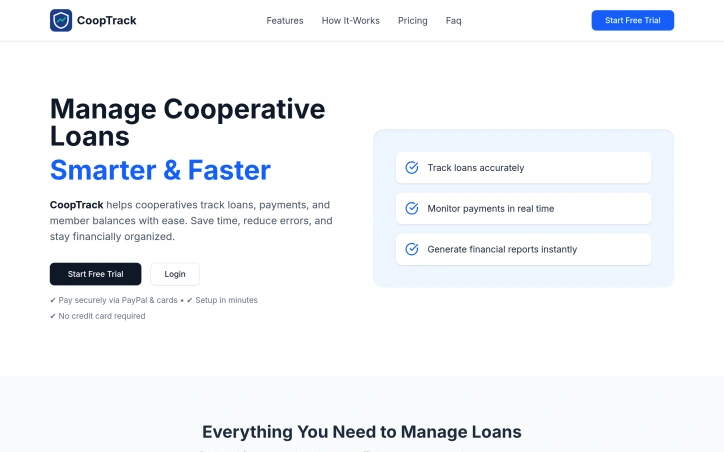
Loan management in cooperative organizations typically requires juggling multiple spreadsheets, manual reconciliation, and constant back-and-forth communication. CoopTrack addresses this operational friction by providing a centralized platform designed specifically for how cooperatives function, eliminating the tedious administrative burden of tracking member balances, loan disbursements, and payment histories. The platform targets cooperatives of all sizes, from small community-based organizations to larger networks with hundreds of members. Its core strength lies in simplicity—the company emphasizes setup in under ten minutes, and the interface prioritizes ease of use over complex feature density. This focus on accessibility is deliberate; the tool is managed by cooperative staff rather than requiring member participation, meaning adoption friction is minimal. Key capabilities include real-time loan balance monitoring, member record management, automated payment tracking with balance updates, and financial reporting for decision-making. The platform also handles payment collection directly through PayPal and card processing, integrating a revenue mechanism into the same interface where cooperatives manage their operations. This consolidation reduces context-switching and data entry errors—a significant pain point for organizations relying on manual systems. Data security is a central design consideration, with the company emphasizing encryption and private storage of member financial information, which is critical for organizations handling sensitive cooperative finances. The absence of any requirement for members to install software or access the system directly further simplifies the operational model. Pricing is structured around cooperative size. The Starter tier at five dollars monthly supports up to fifty members with basic reporting; the Standard plan at ten dollars accommodates up to three hundred members and adds email notifications and priority support; the Premium offering at twenty-five dollars removes member limits and includes advanced analytics and export capabilities. All tiers include secure payment processing, and the requirement of no credit card for the free trial removes a common barrier to evaluation. The messaging positions CoopTrack as a replacement for error-prone manual processes rather than a comprehensive financial management system. For cooperatives managing loan portfolios without existing software infrastructure, the combination of low cost, quick implementation, and straightforward feature set represents a pragmatic alternative to spreadsheet-based workflows or expensive enterprise platforms designed for other organizational types.
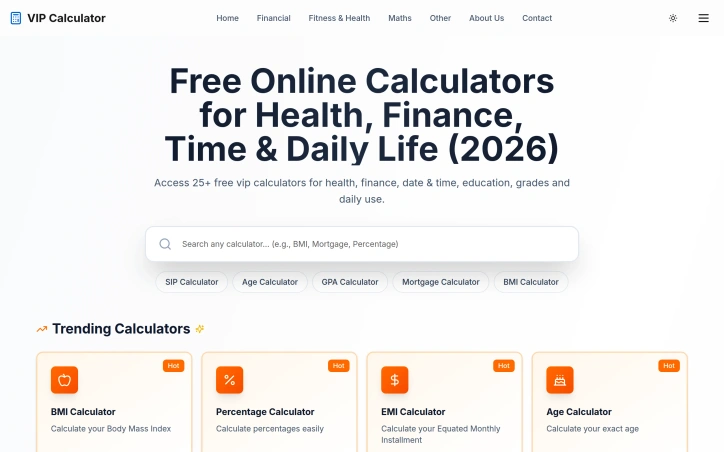
A comprehensive suite of digital calculators addresses the gap for users seeking fast, straightforward solutions to everyday mathematical problems without navigating complex spreadsheets or specialized software. VIP Calculator serves a broad demographic spanning students, professionals, investors, and individuals managing personal finances or health metrics. The platform distinguishes itself through its breadth of coverage rather than depth in any single category. With over 25 calculators spanning health, finance, time and date operations, education, construction, and general mathematics, it functions as a utility library for varied use cases. The health section covers conventional metrics like BMI and calorie estimation alongside more specialized tools for pregnancy tracking and ovulation prediction. The financial calculators address both consumer lending and investment planning—covering mortgage and auto loan calculations, salary conversions, and sophisticated investment instruments including SIP growth projections, CAGR calculations, and compound interest scenarios. What stands out most is the inclusion of niche-specific tools that reveal understanding of specific user segments. The Google AdSense earnings calculator targets content creators; the GST calculator indicates focus on Indian and international markets with consumption tax requirements; the bra size calculator acknowledges underserved use cases in personal wellness. The mortgage and EMI calculators provide essential tools for major life financial decisions, while the GPA and grade calculators directly serve educational contexts where quick calculations matter for academic planning. The product appears designed for accessibility and speed of use—each calculator presumably offers minimal friction to reach results. There is no friction from authentication requirements or paywall mechanics; the platform operates entirely on a free model. This removes barriers to adoption for casual users performing occasional calculations, though the business model underlying a 25+ calculator platform isn't detailed in the available materials. From a user experience perspective, organizing calculators by life domain (health, finance, time, education, construction) suggests thoughtful information architecture. The emphasis on "trending" calculators on the homepage indicates usage analytics drive feature prominence, suggesting the platform learns which tools users actually need. The platform's strength lies in comprehensiveness and the absence of friction. For users needing occasional calculations across multiple domains, consolidation into a single web destination eliminates the effort of finding and vetting individual tools. The trade-off is likely that each calculator, given the breadth of the offering, may lack the depth or advanced options that specialized tools provide.

Privacy-conscious individuals and budget-conscious planners now have an alternative to both expensive financial advisors and data-harvesting calculator websites. CalcIQ addresses a genuine tension in financial technology: most free calculators monetize through surveillance, while professional advice remains prohibitively expensive for everyday decisions. This platform sits at the intersection by offering 19 calculators across financial, lifestyle, health, and regional categories without requiring registration or tracking user behavior. The product's core differentiator is genuine privacy protection. Where competitors rely on Google Analytics, Facebook pixels, and third-party data sharing, CalcIQ processes all calculations locally on the user's device and stores nothing remotely. The platform works offline as a progressive web app, making it genuinely inaccessible to any tracking infrastructure. This isn't a marketing claim—users can verify it through network inspection or simply by observing the absence of traditional analytics code. The no-registration approach removes friction while reinforcing the privacy posture. Feature-wise, CalcIQ covers the practical calculators people actually use: loan EMI calculations, systematic investment planning, fixed deposit returns, rent-versus-buy comparisons, and lender comparison tools. The lifestyle category addresses everyday financial implications, like calculating the true cost of daily coffee habits. Regional variants for eight countries including the US, UK, India, Canada, and others incorporate local tax regimes and market data rather than one-size-fits-all assumptions. The ability to embed calculators on external websites through iframe code represents useful flexibility for bloggers and educators. The free tier allows three daily calculations on financial tools, creating a reasonable conversion incentive toward paid tiers without making core functionality unusable. The Pro subscription costs $9.99 monthly or $79 annually, positioning itself as a minor expense relative to hourly financial advisor fees or monthly planning software subscriptions. Pro users gain unlimited calculations and watermark-free PDF reports suitable for sharing with actual advisors or lenders. The business model reflects the privacy positioning: instead of monetizing data, the company captures willingness-to-pay from users seeking professional-grade analysis without surveillance. This alignment between product values and revenue mechanism is increasingly rare in fintech. The platform's limitations aren't detailed here, but the core offering—straightforward, private financial calculations with regional customization—solves a real problem for people tired of being data products themselves.