
Best Health & Fitness Startups & Tools

Recently Listed

25 launches
Sort
ND Hive

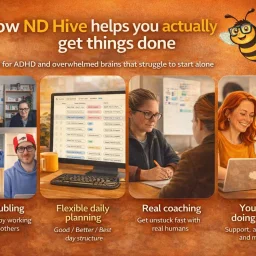
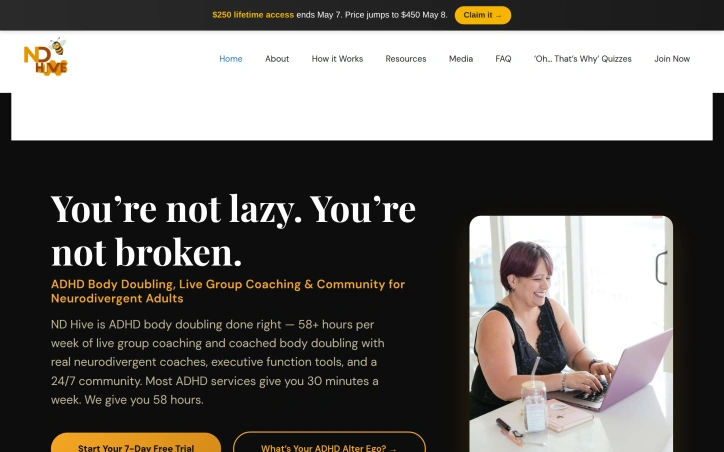
Burnout and task paralysis plague millions of adults with ADHD and autism spectrum traits, yet most productivity solutions ignore the neurodivergent brain entirely. ND Hive addresses this gap by centering on a deceptively simple mechanism: body doubling—the measurable boost in focus and task completion that comes from working alongside others in real time. The platform operates as a daily coworking community with live sessions led by human coaches. Members join drop-in sessions, pick a task to complete, and work through it with accountability from both coaches and fellow participants. No complex app tutorials, no 47-step setup process. The simplicity is intentional. ADHD and autism often coexist with executive dysfunction that makes navigating byzantine software interfaces itself a barrier to use. What distinguishes ND Hive is its explicit design for neurodivergent needs rather than neurotypical defaults. The accompanying "Hub" provides structured tools—capacity planners, task breakdowns, emotion check-ins, and a completion tracker—built around how divergent brains actually operate. Sessions accommodate 58 hours per week of access, but participation is fluid. Members can attend one session or many, with no penalty for inconsistency. The company makes a specific empirical claim worth noting: its own data shows meaningful behavioral shifts by day three for most users, with larger transformations reported by day seven. Testimonials from the site reflect this pattern. A therapist reported reduced burnout within 72 hours. A college student moved from feeling paralyzed by workload to managing coursework effectively. A working parent progressed from chronic task avoidance to career advancement. These aren't outlier claims—body doubling is an established phenomenon in ADHD literature, and the company leverages it directly. The target audience is clear: working professionals, students, parents, and founders who recognize their difficulty isn't laziness or broken executive function, but rather isolation and lack of accountability structures suited to their neurology. For this cohort, the friction of traditional goal-setting apps or generic coworking spaces is real. ND Hive eliminates that friction by removing onboarding complexity and designing every interaction around neurodivergent cognition. The model includes a seven-day free trial, suggesting a subscription foundation, though specific pricing isn't disclosed in the available materials.

Mental-health
D
Danielle Ralston

Burnout and task paralysis plague millions of adults with ADHD and autism spectrum traits, yet most productivity solutions ignore the neurodivergent brain entirely. ND Hive addresses this gap by centering on a deceptively simple mechanism: body doubling—the measurable boost in focus and task completion that comes from working alongside others in real time. The platform operates as a daily coworking community with live sessions led by human coaches. Members join drop-in sessions, pick a task to complete, and work through it with accountability from both coaches and fellow participants. No complex app tutorials, no 47-step setup process. The simplicity is intentional. ADHD and autism often coexist with executive dysfunction that makes navigating byzantine software interfaces itself a barrier to use. What distinguishes ND Hive is its explicit design for neurodivergent needs rather than neurotypical defaults. The accompanying "Hub" provides structured tools—capacity planners, task breakdowns, emotion check-ins, and a completion tracker—built around how divergent brains actually operate. Sessions accommodate 58 hours per week of access, but participation is fluid. Members can attend one session or many, with no penalty for inconsistency. The company makes a specific empirical claim worth noting: its own data shows meaningful behavioral shifts by day three for most users, with larger transformations reported by day seven. Testimonials from the site reflect this pattern. A therapist reported reduced burnout within 72 hours. A college student moved from feeling paralyzed by workload to managing coursework effectively. A working parent progressed from chronic task avoidance to career advancement. These aren't outlier claims—body doubling is an established phenomenon in ADHD literature, and the company leverages it directly. The target audience is clear: working professionals, students, parents, and founders who recognize their difficulty isn't laziness or broken executive function, but rather isolation and lack of accountability structures suited to their neurology. For this cohort, the friction of traditional goal-setting apps or generic coworking spaces is real. ND Hive eliminates that friction by removing onboarding complexity and designing every interaction around neurodivergent cognition. The model includes a seven-day free trial, suggesting a subscription foundation, though specific pricing isn't disclosed in the available materials.

ND Hive preview

Key features

  • Body Doubling Sessions: Drop-in coworking with human coaches providing real-time accountability and focus support
  • Structured Support Tools: Hub features including capacity planners, task breakdowns, emotion check-ins, and completion tracking
See full listing
NutriTracker - Your AI Coach

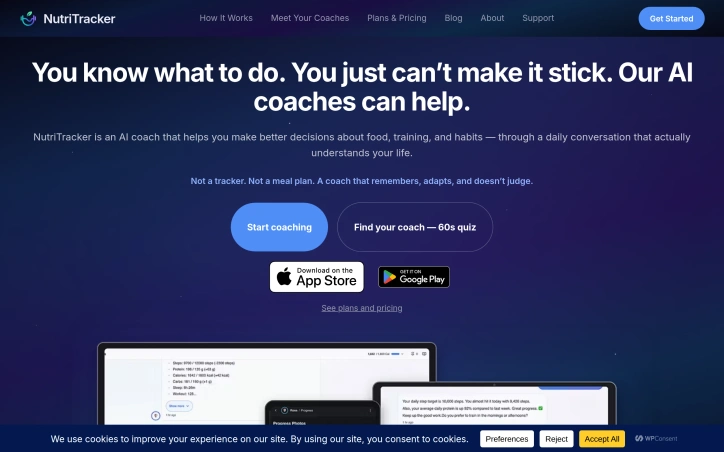
Consistency in fitness and nutrition is notoriously difficult. Most people know what they should do—eat better, exercise regularly, build sustainable habits—but fail at the execution. Willpower crumbles by midweek, life circumstances disrupt plans, and one slip-up becomes a total restart. NutriTracker positions itself as a solution to this endemic problem, offering an AI coach designed to help users navigate the gap between intention and practice. The product targets people who have already tried conventional approaches—fitness trackers, calorie counters, spreadsheets, even personal trainers—without achieving lasting change. The pitch is straightforward: rather than logging meals and hitting numerical targets, users engage in ongoing conversations with a customizable AI coach that learns their individual constraints and helps them recover from inevitable lapses instead of abandoning efforts altogether. What distinguishes NutriTracker from traditional fitness apps is its emphasis on adaptability and psychological resilience. The core insight is that most coaching fails when life interferes, so the system is designed to recognize disruptions and help users salvage a week rather than write it off entirely. The app integrates with health data platforms like Apple Health and MyFitnessPal, allowing the coach to reference actual activity, sleep, and nutrition data when offering advice tailored to the user's real circumstances rather than generic recommendations. The product also emphasizes user control and safety boundaries. The coach operates within explicit guardrails: it won't attempt diagnosis, prescribe treatments, or assume medical authority. Users can pause the coach's memory, delete shared information, and customize communication style and frequency. Data is encrypted and the company is GDPR compliant, catering to privacy-conscious users. A testimonial on the site claims one user found the app more effective than previous attempts at habit change, though such anecdotal evidence is inherently limited. The main limitation of the available information is opacity around pricing and business model. The site mentions pricing tiers exist but provides no details on cost, free trial availability, or subscription structure—crucial factors for potential customers evaluating whether the product is accessible to them. This gap makes it difficult to assess whether NutriTracker is positioned as a premium coaching alternative or a mass-market app.

Workout-platforms
J
Jacob Eells

Consistency in fitness and nutrition is notoriously difficult. Most people know what they should do—eat better, exercise regularly, build sustainable habits—but fail at the execution. Willpower crumbles by midweek, life circumstances disrupt plans, and one slip-up becomes a total restart. NutriTracker positions itself as a solution to this endemic problem, offering an AI coach designed to help users navigate the gap between intention and practice. The product targets people who have already tried conventional approaches—fitness trackers, calorie counters, spreadsheets, even personal trainers—without achieving lasting change. The pitch is straightforward: rather than logging meals and hitting numerical targets, users engage in ongoing conversations with a customizable AI coach that learns their individual constraints and helps them recover from inevitable lapses instead of abandoning efforts altogether. What distinguishes NutriTracker from traditional fitness apps is its emphasis on adaptability and psychological resilience. The core insight is that most coaching fails when life interferes, so the system is designed to recognize disruptions and help users salvage a week rather than write it off entirely. The app integrates with health data platforms like Apple Health and MyFitnessPal, allowing the coach to reference actual activity, sleep, and nutrition data when offering advice tailored to the user's real circumstances rather than generic recommendations. The product also emphasizes user control and safety boundaries. The coach operates within explicit guardrails: it won't attempt diagnosis, prescribe treatments, or assume medical authority. Users can pause the coach's memory, delete shared information, and customize communication style and frequency. Data is encrypted and the company is GDPR compliant, catering to privacy-conscious users. A testimonial on the site claims one user found the app more effective than previous attempts at habit change, though such anecdotal evidence is inherently limited. The main limitation of the available information is opacity around pricing and business model. The site mentions pricing tiers exist but provides no details on cost, free trial availability, or subscription structure—crucial factors for potential customers evaluating whether the product is accessible to them. This gap makes it difficult to assess whether NutriTracker is positioned as a premium coaching alternative or a mass-market app.

NutriTracker - Your AI Coach preview

Key features

  • AI Coach Integration: Provides ongoing conversations with a customizable AI coach that learns individual constraints and helps users recover from lapses
  • Health Data Integration: Integrates with Apple Health and MyFitnessPal to reference actual activity, sleep, and nutrition data for personalized advice
See full listing
Preceptor.Network

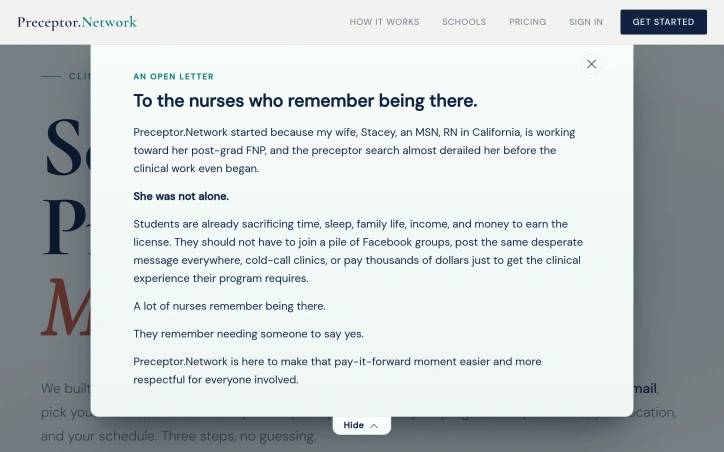
Clinical placement matching represents one of healthcare education's persistent friction points, and Preceptor.Network proposes a direct solution to an unnecessarily manual problem. The platform targets students pursuing advanced nursing and physician assistant credentials—FNP, PMHNP, PA, DNP, and similar programs—who traditionally navigate preceptor recruitment through spreadsheets, department lists, and personal networking. Faculty coordinators simultaneously shoulder the burden of troubleshooting mismatched placements that fail to meet program requirements. The company's core insight is straightforward: institutional requirements can be codified into matching logic. Rather than treating preceptor directories as glorified listings, Preceptor.Network integrates directly with each school's clinical rules—specialty requirements, minimum hours, accepted credentials—and weights candidate preceptors against those parameters. The matching engine also factors in geographic availability and student location, producing ranked results sorted by fit score rather than undifferentiated lists. The onboarding flow underscores this automation philosophy. A student provides their school email address; the system recognizes the domain and retrieves their program enrollment automatically. This eliminates form filling and roster uploads. After selecting their course rotation, they receive preceptor recommendations ordered by relevance to their specific requirements. The three-step design feels deliberately friction-minimized, a direct counterpoint to the opaque, coordinator-dependent processes it displaces. For schools, the value proposition centers on reducing placement fulfillment burden at scale. Once program requirements are configured, the system handles cohorts ranging from twenty to thousands of students without adding administrative overhead. The platform claims to improve through repeated use—each completed match trains recommendations for future cycles. Pricing for students is direct: ten dollars per confirmed match with no subscription component. The school and preceptor business models remain less explicit, though the architecture suggests a two-sided marketplace where schools configure requirements and preceptors receive filtered requests ordered by relevance. What's notably absent is data on matching accuracy, program coverage breadth, or current adoption rates. For a product solving a coordination problem in a relatively niche market, these specifics would strengthen confidence in its claims. The email-domain auto-detection is genuinely useful, but the true value depends entirely on whether the matching algorithm actually reduces friction or simply reorders the guesswork it promises to eliminate. That gap between concept and execution remains the critical unknown.

Medical
R
R. Davis

Clinical placement matching represents one of healthcare education's persistent friction points, and Preceptor.Network proposes a direct solution to an unnecessarily manual problem. The platform targets students pursuing advanced nursing and physician assistant credentials—FNP, PMHNP, PA, DNP, and similar programs—who traditionally navigate preceptor recruitment through spreadsheets, department lists, and personal networking. Faculty coordinators simultaneously shoulder the burden of troubleshooting mismatched placements that fail to meet program requirements. The company's core insight is straightforward: institutional requirements can be codified into matching logic. Rather than treating preceptor directories as glorified listings, Preceptor.Network integrates directly with each school's clinical rules—specialty requirements, minimum hours, accepted credentials—and weights candidate preceptors against those parameters. The matching engine also factors in geographic availability and student location, producing ranked results sorted by fit score rather than undifferentiated lists. The onboarding flow underscores this automation philosophy. A student provides their school email address; the system recognizes the domain and retrieves their program enrollment automatically. This eliminates form filling and roster uploads. After selecting their course rotation, they receive preceptor recommendations ordered by relevance to their specific requirements. The three-step design feels deliberately friction-minimized, a direct counterpoint to the opaque, coordinator-dependent processes it displaces. For schools, the value proposition centers on reducing placement fulfillment burden at scale. Once program requirements are configured, the system handles cohorts ranging from twenty to thousands of students without adding administrative overhead. The platform claims to improve through repeated use—each completed match trains recommendations for future cycles. Pricing for students is direct: ten dollars per confirmed match with no subscription component. The school and preceptor business models remain less explicit, though the architecture suggests a two-sided marketplace where schools configure requirements and preceptors receive filtered requests ordered by relevance. What's notably absent is data on matching accuracy, program coverage breadth, or current adoption rates. For a product solving a coordination problem in a relatively niche market, these specifics would strengthen confidence in its claims. The email-domain auto-detection is genuinely useful, but the true value depends entirely on whether the matching algorithm actually reduces friction or simply reorders the guesswork it promises to eliminate. That gap between concept and execution remains the critical unknown.

Preceptor.Network preview

Key features

  • Automated Matching Engine: Integrates with each school's clinical rules and weights candidate preceptors against institutional requirements
  • School Domain Recognition: Auto-detects student enrollment using school email domain, eliminating form filling
See full listing
SetHabits

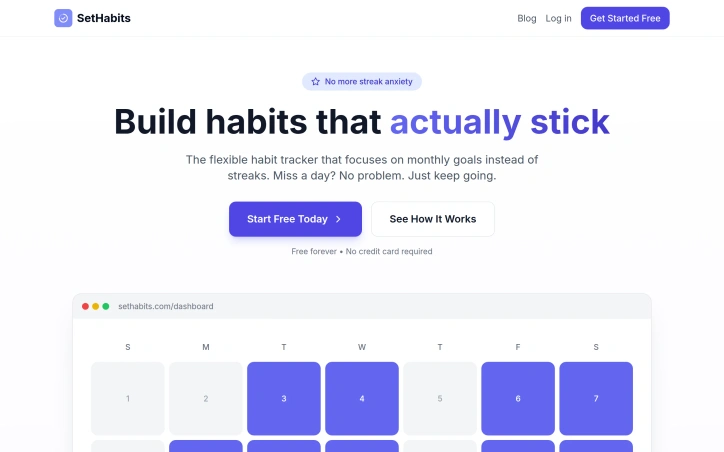
Modern habit-tracking apps have created an unexpected problem: the anxiety of maintaining perfect daily streaks. A new entrant in the productivity space takes direct aim at this phenomenon by replacing the all-or-nothing streak model with a more forgiving monthly framework. The product is designed for people who want to build genuine habits but get discouraged when life inevitably gets in the way—missing a day shouldn't derail months of progress. SetHabits positions itself explicitly around psychological sustainability rather than gamification. Where traditional trackers emphasize consecutive-day chains, this tool sets monthly targets (like completing a habit 20 out of 30 days) and visualizes progress through a clean calendar interface. The approach reflects a fundamental understanding of behavior change: consistency matters more than perfectionism, and shame typically undermines long-term progress rather than motivating it. The product philosophy centers on aggressive simplicity. Habits can be added and logged in seconds, and the interface resists the feature bloat that plagues most productivity software. Users see their monthly progress at a glance through visual calendar data without navigating graphs or reports. The free tier supports up to five habits alongside monthly calendar views, basic statistics, and daily reminders. A weekly habit-tips email is included across all plans. The business model employs a straightforward freemium structure. The Premium tier costs $3.99 monthly or $29.99 annually and adds unlimited habits, AI-powered insights, weekly summary emails, detailed statistics, and custom habit colors. A lifetime access option at $59.99 exists with supply intentionally capped at 100 licenses—a transparent scarcity strategy targeting early adopters. The pricing is genuinely accessible for individual users while providing credible upgrade incentives. What distinguishes this product most sharply is its counter-cultural positioning. Rather than amplifying the perfectionism baked into most habit software, it explicitly rejects streak anxiety in favor of a more realistic, sustainable approach. The execution matches the philosophy: minimal interface, limited features, and transparent pricing all signal that the team grasps what struggling habit-builders actually need. For people burned out on guilt-driven productivity tools, this represents a genuinely different value proposition grounded in behavioral realism rather than motivational hype.

Mental-health
N
Nick Peterson

Modern habit-tracking apps have created an unexpected problem: the anxiety of maintaining perfect daily streaks. A new entrant in the productivity space takes direct aim at this phenomenon by replacing the all-or-nothing streak model with a more forgiving monthly framework. The product is designed for people who want to build genuine habits but get discouraged when life inevitably gets in the way—missing a day shouldn't derail months of progress. SetHabits positions itself explicitly around psychological sustainability rather than gamification. Where traditional trackers emphasize consecutive-day chains, this tool sets monthly targets (like completing a habit 20 out of 30 days) and visualizes progress through a clean calendar interface. The approach reflects a fundamental understanding of behavior change: consistency matters more than perfectionism, and shame typically undermines long-term progress rather than motivating it. The product philosophy centers on aggressive simplicity. Habits can be added and logged in seconds, and the interface resists the feature bloat that plagues most productivity software. Users see their monthly progress at a glance through visual calendar data without navigating graphs or reports. The free tier supports up to five habits alongside monthly calendar views, basic statistics, and daily reminders. A weekly habit-tips email is included across all plans. The business model employs a straightforward freemium structure. The Premium tier costs $3.99 monthly or $29.99 annually and adds unlimited habits, AI-powered insights, weekly summary emails, detailed statistics, and custom habit colors. A lifetime access option at $59.99 exists with supply intentionally capped at 100 licenses—a transparent scarcity strategy targeting early adopters. The pricing is genuinely accessible for individual users while providing credible upgrade incentives. What distinguishes this product most sharply is its counter-cultural positioning. Rather than amplifying the perfectionism baked into most habit software, it explicitly rejects streak anxiety in favor of a more realistic, sustainable approach. The execution matches the philosophy: minimal interface, limited features, and transparent pricing all signal that the team grasps what struggling habit-builders actually need. For people burned out on guilt-driven productivity tools, this represents a genuinely different value proposition grounded in behavioral realism rather than motivational hype.

SetHabits preview

Key features

  • Monthly Targets: Replaces daily streaks with monthly completion targets like 20 out of 30 days.
  • Calendar Interface: Progress is visualized through a clean calendar interface for at-a-glance overview.
See full listing
FitComrade

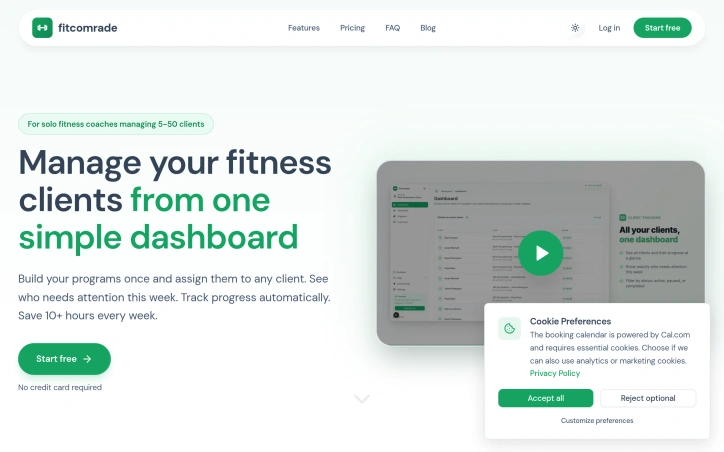
Solo fitness coaches juggling multiple client programs face a familiar administrative burden: rebuilding the same workout templates for different clients, tracking progress across a scattered client base, and managing the friction of app downloads and password resets. FitComrade targets this pain point directly, positioning itself as a lightweight coaching management platform for trainers managing between five and fifty clients. The product centers on three core functions. Its program builder lets coaches create templates once and deploy them to multiple clients without duplication. A dashboard consolidates client tracking into a single view, categorizing clients by their current status to highlight who needs attention. The client-sharing feature removes adoption friction by generating shareable links that load directly in any web browser—no app installation or account setup required. What distinguishes FitComrade in a crowded market is its pricing approach. Unlike competitors Trainerize and TrueCoach, which charge per-client fees that compound as a coach's roster grows, FitComrade decouples its pricing from client count. The free tier supports one active client indefinitely with unlimited program templates and core tracking features. The paid tier costs thirty dollars monthly, discounted to one dollar for the first month, and unlocks multiple active clients, shareable program links, and additional content categories including yoga and nutrition. This structure removes one obstacle to growth—coaches can expand their client base without proportional increases to software costs. The platform emphasizes simplicity in its design language, claiming that coaches without technical expertise can navigate it intuitively. The program builder takes a visual, day-based approach rather than forcing users into complex data entry. Support for workouts, meals, yoga, and habits suggests flexibility across different coaching disciplines. Whether FitComrade delivers on its claim to restore ten or more hours weekly depends on how substantially it streamlines a coach's actual workflow. The emphasis on template reuse and consolidated tracking addresses real friction points. The platform targets smaller coaching operations; coaches managing fifty clients across multiple disciplines or those needing advanced automation will exhaust its capabilities. For solo trainers in the five-to-fifty-client range seeking to reduce administrative overhead without substantial software costs, the value proposition is clear.
Workout-platforms
A
Adeel Imran

Solo fitness coaches juggling multiple client programs face a familiar administrative burden: rebuilding the same workout templates for different clients, tracking progress across a scattered client base, and managing the friction of app downloads and password resets. FitComrade targets this pain point directly, positioning itself as a lightweight coaching management platform for trainers managing between five and fifty clients. The product centers on three core functions. Its program builder lets coaches create templates once and deploy them to multiple clients without duplication. A dashboard consolidates client tracking into a single view, categorizing clients by their current status to highlight who needs attention. The client-sharing feature removes adoption friction by generating shareable links that load directly in any web browser—no app installation or account setup required. What distinguishes FitComrade in a crowded market is its pricing approach. Unlike competitors Trainerize and TrueCoach, which charge per-client fees that compound as a coach's roster grows, FitComrade decouples its pricing from client count. The free tier supports one active client indefinitely with unlimited program templates and core tracking features. The paid tier costs thirty dollars monthly, discounted to one dollar for the first month, and unlocks multiple active clients, shareable program links, and additional content categories including yoga and nutrition. This structure removes one obstacle to growth—coaches can expand their client base without proportional increases to software costs. The platform emphasizes simplicity in its design language, claiming that coaches without technical expertise can navigate it intuitively. The program builder takes a visual, day-based approach rather than forcing users into complex data entry. Support for workouts, meals, yoga, and habits suggests flexibility across different coaching disciplines. Whether FitComrade delivers on its claim to restore ten or more hours weekly depends on how substantially it streamlines a coach's actual workflow. The emphasis on template reuse and consolidated tracking addresses real friction points. The platform targets smaller coaching operations; coaches managing fifty clients across multiple disciplines or those needing advanced automation will exhaust its capabilities. For solo trainers in the five-to-fifty-client range seeking to reduce administrative overhead without substantial software costs, the value proposition is clear.

FitComrade preview

Key features

  • Program Builder: Create templates once and deploy them to multiple clients without rebuilding.
  • Client Dashboard: View all clients in one place, organized by status to highlight who needs attention.
See full listing