Catalyst Healthspan Audit
Personal trainers typically sell training sessions. This startup reversed the equation by building assessment first, mak...
Launchory
We built Launchory to solve the discoverability problem for startups. Our platform offers instant approval, permanent do...
Best SEO tools Startups & Tools
Optimize sites for search rankings and visibility.
Recently Listed
24 launches
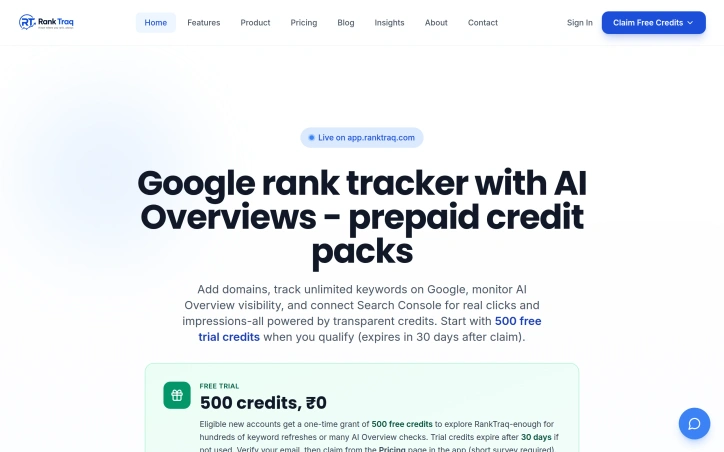
For SEO professionals in India, managing keyword positions and tracking visibility on Google has just gotten more straightforward. RankTraq addresses the issue of rigid subscription models and opaque pricing that often accompanies rank tracking tools. The platform is geared towards SEO teams who require a more flexible and transparent solution, particularly those dealing with fluctuating workloads or multiple client domains. What sets RankTraq apart is its prepaid credit system, allowing users to pay only for the services they need. This model is specifically tailored to the needs of Indian SEO agencies, freelancers, and in-house teams, who can top up their credits as required, avoiding unnecessary expenses during periods of low activity. The tool also integrates with Search Console, providing a more comprehensive view of keyword performance by pairing rank tracking with actual clicks and impressions. The platform's key features include the ability to track unlimited keywords across multiple domains from a single workspace, with a shared credit balance. Users can also monitor their visibility in Google's AI Overviews, a feature that is becoming increasingly important as Google's generative summaries alter how visibility is measured. Additionally, the transparent credit economics ensure that users are only charged for successful refreshes, with clear costs displayed before each run. New users can start with a one-time grant of 500 free trial credits, which is valid for 30 days. After that, they can purchase credit packs as needed, with the option to pay in rupees via Razorpay. The cost per credit varies, with keyword position checks using one credit per track and AI Overview checks using two credits per run. Overall, RankTraq offers a flexible and cost-effective solution for SEO teams seeking to manage their keyword tracking and visibility monitoring without the burden of inflexible subscription plans.

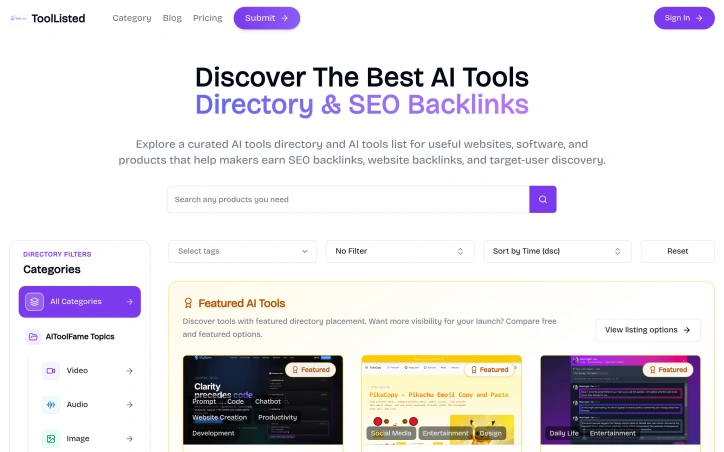
Independent developers and SaaS teams often struggle to get their products discovered by the right audience, and to improve their SEO visibility. ToolListed addresses this challenge by providing a curated directory for AI tools, web tools, and SaaS products, where makers can list their offerings and reach high-intent users. The platform is designed to help products stand out through structured listings that facilitate discovery and earn credible backlinks to support SEO growth. What sets ToolListed apart is its focus on creating a useful directory that is both human-friendly and optimized for search engines. By organizing listings into clear categories and tags, the platform enables users to browse and compare products with ease. The directory is not just a repository of links; it's a carefully curated collection of products that are presented in a way that complements the makers' own content and supports their SEO efforts. The platform offers features such as category-first navigation, which ensures that product pages and SEO backlinks remain aligned with search queries. Makers can submit their products once and refine their listings to reach the right users. The directory is particularly useful for indie maker tools, SaaS directory traffic, and AI tools list placement, as it provides a launch surface for early teams and supports startup directory storytelling. While the pricing details are not explicitly stated, eligible plans on the platform can earn contextual links that support off-page SEO signals. Overall, ToolListed provides a valuable resource for makers looking to increase their product's visibility and reach their target audience. By combining a directory experience with practical benefits for SEO visibility, ToolListed is a go-to platform for those seeking to get their products discovered.

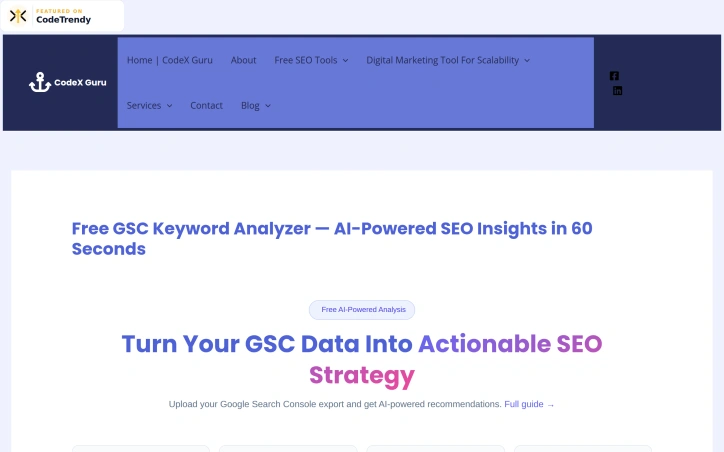
SEO practitioners drowning in raw Google Search Console data now have a way to extract actionable insights without manual analysis. CodeX Guru's free keyword analyzer transforms GSC exports into structured intelligence, using GPT-4o to recommend specific optimizations based on each site's actual search performance. The problem this solves is obvious: GSC gives you the data, but interpreting what to do with it requires expertise. Most site owners can see they rank for keywords in positions 4–20, but lack a systematic way to prioritize which ones to optimize. This tool automates that triage, categorizing keywords into "Quick Wins" (near-top-3 rankings requiring minimal effort), "Content Gaps" (high impression keywords with poor click-through rates), and other strategic buckets. The AI-generated strategy report then ties recommendations back to the actual keyword data rather than offering generic advice. What stands out is the privacy-first approach. Uploaded files are processed in memory and deleted immediately—there's no data retention, logging, or third-party sharing. For an SEO tool handling competitive search metrics, this transparency is uncommon and valuable. The tool also handles multiple file formats (CSV, XLSX, XLS) and caps file size at 10MB, making it accessible to businesses of all sizes. The interface emphasizes speed and visual clarity. Analysis completes in 30–60 seconds, and results display across six charts covering position distribution, CTR buckets, competitor benchmarks, and the relationship between rankings and click-through rates. This visual breakdown gives users the context they need to decide which keywords deserve content investment. The business model stacks a free tier (two analyses per day) against a Pro upgrade for unlimited analyses, team access, and automated weekly reporting. This is a straightforward freemium approach that lets users validate the tool's value before paying. The founder positions this as part of a broader initiative to democratize SEO expertise and help practitioners access specialized knowledge. The main limitation is the free tier's daily cap—serious SEO teams analyzing multiple sites would likely need Pro access quickly. Still, for individual site owners or small agencies testing keyword strategies, the free offering is substantial enough to determine whether the tool fits their workflow. The combination of privacy, speed, and GPT-4o-powered analysis makes this a practical addition to most SEO stacks.

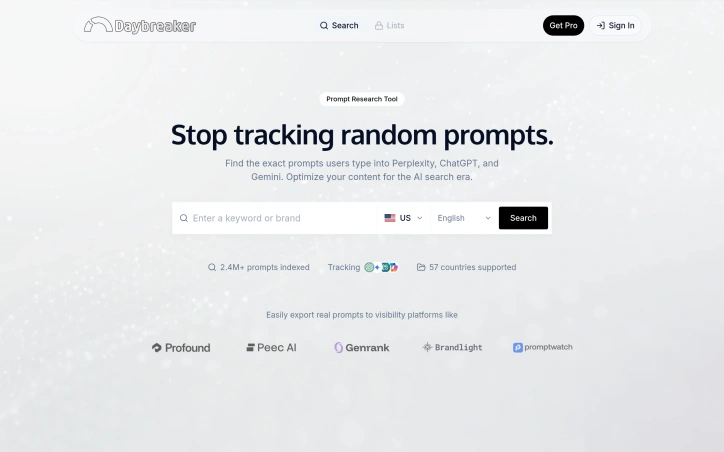
Understanding what users ask AI search engines is becoming critical for content creators and businesses navigating the rise of conversational AI. Daybreaker tackles this problem directly by aggregating and analyzing the actual prompts people enter into Perplexity, ChatGPT, and Gemini—providing visibility into search behavior that was previously hidden from most organizations. The core insight is straightforward but valuable: if content and products are to be discoverable in an AI-first world, creators need to know how people phrase their searches in these new interfaces. Traditional search engine optimization focused on keyword analysis and ranking factors. Daybreaker shifts that lens to conversational queries, revealing the natural language patterns that drive AI search results. This data becomes particularly useful for companies trying to optimize their content strategy for discovery within AI systems rather than just traditional search rankings. The target audience is content marketing teams, SEOs transitioning to AI search optimization, product teams, and publishers seeking to understand how their audience formulates questions. Rather than guessing how to position content, these users can work from actual user behavior data. The tool addresses a real gap: while keyword research tools have long served traditional search, few solutions exist for understanding the conversational dynamics of AI search engines. What distinguishes Daybreaker is its specificity. Rather than offering a generalized analytics platform, it concentrates narrowly on a single, increasingly important problem—prompt discovery. This focus is both its strength and its limitation. The tool doesn't claim to optimize AI search results or rank content; it provides the foundational data for doing so. Users will need to synthesize these insights themselves. The product arrives at a logical inflection point in internet history. As Perplexity, ChatGPT, and Gemini capture an increasing share of informational queries that once went to Google, understanding that shift becomes essential for anyone trying to reach audiences through search. Daybreaker essentially provides the research layer for the AI search era—allowing organizations to move beyond assumption-based content strategy to one grounded in actual user behavior.