Catalyst Healthspan Audit
Personal trainers typically sell training sessions. This startup reversed the equation by building assessment first, mak...
Launchory
We built Launchory to solve the discoverability problem for startups. Our platform offers instant approval, permanent do...
Best Space design apps Startups & Tools
Plan rooms and workplaces using 3D, AR, and AI.
Recently Listed
3 launches
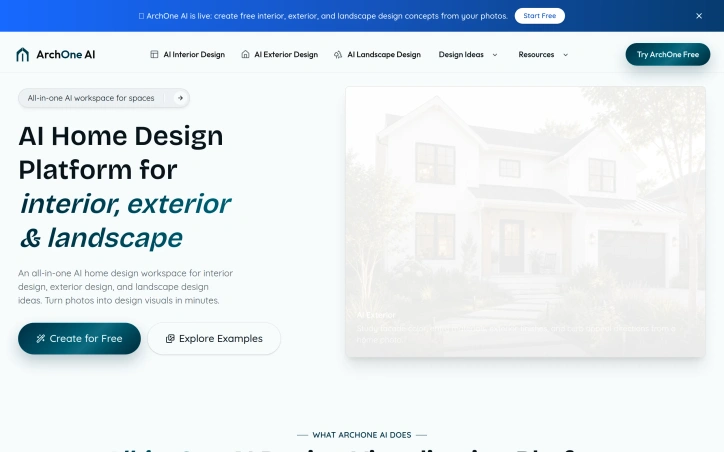
Design exploration traditionally consumes time and money through multiple revision cycles. Whether adapting a kitchen palette, exploring exterior finishes, or conceptualizing landscape layouts, professionals and homeowners have historically chosen between expensive professional renderings or rough sketches that fail to communicate the full vision. ArchOne AI addresses this friction by offering a specialized visualization engine that converts reference photos into design variation studies across interior, exterior, and landscape domains. The platform targets interior designers, architects, landscape professionals, and design-conscious homeowners—anyone who needs to explore directional options before committing resources to execution. What distinguishes ArchOne from generic image-generation tools is its deliberate focus: it generates variations tied to specific design disciplines rather than attempting to be an all-in-one creative tool. Users can examine material palettes, lighting conditions, furniture arrangements, facade colors, planting schemes, and hardscape concepts all sourced from the same project image. The company is explicit about its boundaries. ArchOne is not CAD software, not BIM, not construction documentation, and not a replacement for structural or code review. This positioning is refreshingly honest—it occupies the ideation and communication layer, not the technical delivery layer. A designer can use it to show three different material directions to a client before investing time in detailed specifications or renderings. The feature set spans three integrated modules. The interior tool handles room concepts, layouts, materials, and ambiance. The exterior module focuses on facades, entry treatments, trim, and curb appeal. The landscape tool generates planting ideas, hardscape options, outdoor room concepts, and lighting. Each operates from the same input—a photo, sketch, or reference image—and produces client-ready visual options without requiring users to operate multiple platforms. The platform offers a free tier alongside paid options, lowering the barrier to trial. The gallery demonstrates realistic outputs across residential spaces: patios, kitchens, living rooms, garden concepts, and facade studies. Visually, these show competent AI image generation anchored to specific design constraints rather than unconstrained creative generation. For design professionals managing client communication cycles or homeowners testing ideas before hiring contractors, ArchOne compresses exploration phases that typically unfold over days or weeks of revision requests into minutes of iteration.

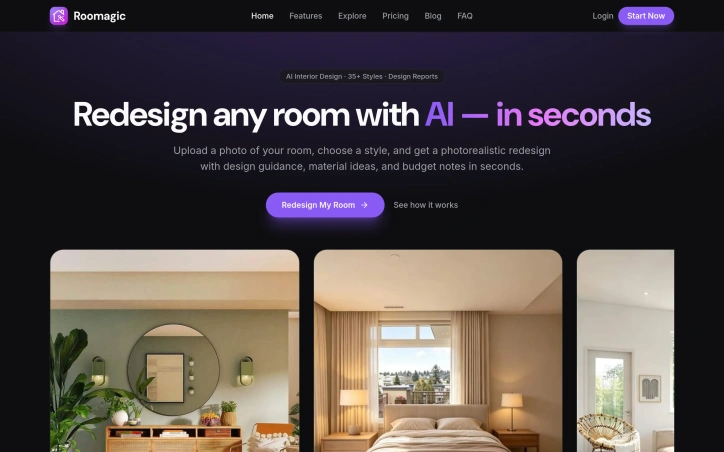
Redesigning a room can be a daunting task, often requiring the expertise of an interior designer and a significant investment of time and money. Roomagic tackles this challenge head-on by harnessing the power of artificial intelligence to transform any room in seconds. The target audience is homeowners and individuals looking to revamp their living or working spaces without the hassle and expense of traditional design methods. What stands out about Roomagic is its ability to generate photorealistic redesigns based on a single uploaded photo of the room. Users can choose from 35+ styles, including Scandinavian, Minimalist, and Industrial, to name a few. The AI engine then produces up to four distinct design directions, complete with design guidance, material ideas, and budget notes. This level of detail and customization is impressive, allowing users to explore different aesthetics and make informed decisions about their redesign. The key features driving Roomagic's capabilities include its guided room setup, which helps tailor the redesign to the user's space and preferences. The multiple design directions and accompanying design reports further enhance the user experience, providing a comprehensive foundation for their redesign project. For those interested in trying Roomagic, the service offers a free starting point with 30 credits upon sign-up. This allows users to experiment with up to three standard renders, complete with AI design reports and standard quality output. For users requiring more renders or higher quality output, Roomagic offers a paid upgrade with fresh monthly credits and additional features.

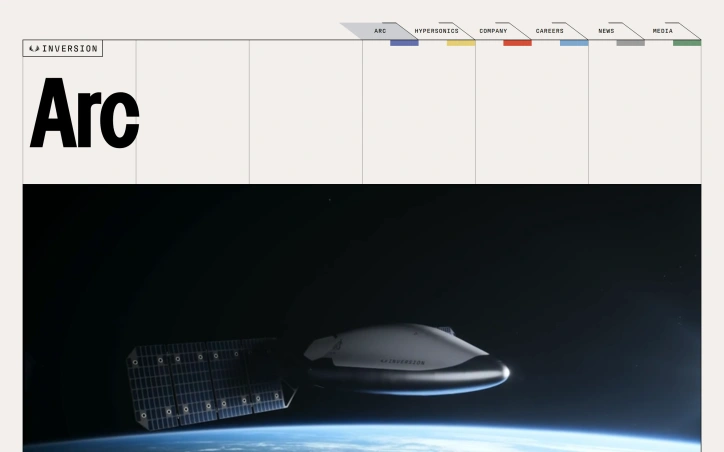
Inversion's Arc solves a critical problem for governments and organizations that require rapid delivery of mission-critical cargo to remote or austere environments. The company's solution enables precise, on-demand logistics from space, leveraging a constellation of pre-positioned spacecraft to achieve global access in under an hour. What stands out about Arc is its ambitious scope and Inversion's confidence in executing it. With a reusable, autonomous design and low-cost approach, the company aims to unlock space as a new logistics domain. This vision is backed by the success of Ray, their first in-house developed spacecraft, which demonstrated the feasibility of building advanced systems at scale. Key features of Arc include its ability to deliver cargo across 1000 km or more with high precision, making it ideal for mission-critical applications. The vehicle's hypersonic capabilities also enable realistic testing of next-generation threat trajectories, a valuable asset for national security and defense organizations. Additionally, Arc functions as a reusable satellite, capable of capturing and deploying assets, rendezvousing with other spacecraft, and operating on orbit for up to five years. Inversion has not disclosed pricing or business model details beyond stating that thousands of Arcs will operate in orbit over time. However, the company's focus on low-cost development and reusable design suggests a scalable approach that could make space-based logistics more accessible to organizations worldwide.