#marketing Startups & Tools
Discover the best marketing startups, tools, and products on SellWithBoost.

Repetitive operational work drains resources and costs businesses money. Companies struggle to find AI solutions that don't require extensive technical expertise or enormous budgets, leading many teams to maintain manual workflows even when automation could transform their efficiency. Axdox addresses this gap by positioning itself as a practical AI and automation firm focused on helping businesses adopt intelligent technology without complexity or prohibitive costs. The company operates across three core verticals—voice automation, workflow orchestration, and custom AI development—targeting industries like healthcare, fintech, and SaaS that stand to benefit most from operational transformation. The company's value proposition centers on three differentiators. First, it applies AI as a foundational element rather than a superficial addition, building automation into every solution. Second, it handles the entire journey from initial consultation through deployment and ongoing support, reducing friction for clients unfamiliar with AI implementation. Third, it emphasizes data-driven optimization, using analytics and testing to validate that implementations actually deliver promised results. Axdox's service portfolio spans voice agents that handle customer calls and lead qualification, n8n workflow automation for connecting disparate business tools, custom AI agents built for specific operational needs, alongside web development and digital marketing services. The company claims these solutions drive a 50 percent reduction in operational costs with ROI achievable within 90 days, though the achievability of these metrics depends heavily on client circumstances and implementation scope. What distinguishes Axdox from the crowded automation consulting space is its explicit commitment to customization. Rather than selling packaged software, the founders describe approaching each engagement by deeply understanding client processes first, then building tailored solutions. This bespoke model commands premium pricing but promises better fit than generic platforms. The company's founding narrative—bootstrapped by Shri Siva J and Kavitha L out of frustration with the gap between AI capability and practical affordability—suggests alignment with the problem it claims to solve. The emphasis on making AI empower people rather than replace them frames automation as augmentation rather than workforce displacement, a positioning that resonates with businesses cautious about AI adoption. Axdox serves businesses ready to invest in operational transformation but lacking internal AI expertise. It competes on customization and support depth rather than technology novelty, positioning itself as a strategic partner through implementation rather than a vendor of off-the-shelf tools.

Freelancers and businesses in South Africa now have a dedicated marketplace purpose-built for local talent networks and ZAR-denominated work. Aura Social addresses a genuine friction point in freelance marketwork by enabling transactions entirely in South African Rand through PayFast, sidestepping the currency conversion overhead and international banking delays that characterize competing platforms. For freelancers operating outside major talent hubs, this localization removes barriers to cash flow and makes income more predictable. The platform serves two distinct audiences: service providers offering design, development, writing, and marketing expertise who want steady work without geographic arbitrage pressure, and project owners seeking vetted talent without navigating global platforms designed for different labor markets. The core mechanism is simple—businesses post work free of charge and hire from a verified freelancer pool, while service providers build income and reputation through completed projects. Several design choices distinguish Aura Social from the broader marketplace category. The escrow protection mechanism builds confidence for both sides, particularly important when establishing trust in newer platforms. The verification layer for freelancers creates a quality signal that reduces hiring friction for businesses unfamiliar with portfolio evaluation across borders. The dual approach—accepting both project postings and service listings—accommodates different working styles, whether participants prefer discrete projects or ongoing arrangements. The platform covers necessary marketplace mechanics: project browsing, service discovery, profile building, and portfolio documentation. This breadth keeps the feature set focused without attempting to compete on ancillary services like accounting or contract templates that larger competitors offer. Pricing structure shows product discipline. The free project posting model eliminates activation friction for new businesses testing the platform. The founder emphasizes escrow protection and local currency payment, suggesting the revenue model operates on transaction fees rather than listings or membership tiers, though specific rates remain unstated. Aura Social succeeds by constraining scope to a real market gap rather than trying to be a global competitor. Local currency, domestic verification, and regional payment infrastructure are not marginal features for South African workers—they are often deal-breakers on international platforms. By solving for that specific context, the marketplace creates conditions for sustainable freelance work rather than gig economy extraction, which is a distinct value proposition in emerging markets where earning power and payment reliability matter as much as opportunity volume.

SEO professionals typically spend hours each week preparing data before AI tools can provide meaningful analysis. That SEO Agent directly addresses this inefficiency by eliminating what its creators call the "briefing tax" — the routine task of exporting metrics from Google Search Console, GA4, and PageSpeed, then manually copying and pasting them into conversation prompts. The product targets SEO consultants, particularly those managing multiple client properties. By connecting through the Model Context Protocol, the tool grants Claude, ChatGPT, and Cursor direct read-only access to a user's live Google accounts. This eliminates the need to manually assemble data exports before asking questions about rankings, traffic patterns, and technical site health. The platform distinguishes itself through scope and lack of constraints. It includes 57 native tools distributed across five functional categories: core Search Console queries, advanced GSC analysis, Google Analytics 4 reporting, technical SEO audits, and site management features. Critically, none of these tools hide behind pricing tiers or add-on fees. Users gain full access to the entire toolkit regardless of their plan. Setup requires minimal effort. After granting read-only Google OAuth access, users copy an API key and add a configuration block to their AI tool's settings in less than five minutes. The system then automatically discovers and registers sites by pulling Search Console properties directly. All communication flows through the MCP protocol, and the service never stores user credentials. The read-only architecture keeps the product strictly diagnostic. It retrieves and organizes existing data but cannot modify websites or accounts. This conservative design appeals to professionals managing client properties who need strict boundaries around account access. The core value proposition centers on workflow efficiency. By eliminating the copy-paste cycle, users avoid context-switching overhead and the contextual pollution of stuffing AI conversations with export files. For consultants managing multiple properties, this time savings compounds meaningfully. The platform explicitly promises zero additional costs per site or query, suggesting a straightforward pricing model. The product's appeal ultimately rests on a single thesis: getting live SEO data into AI conversations without manual intermediation.
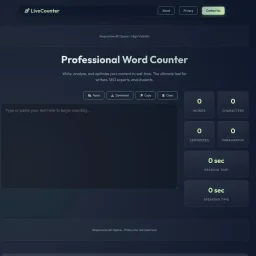
Content analysis tools have become essential for anyone publishing online, whether for search engine optimization, social media, or academic purposes. This word counter addresses a genuine need: writers and creators want instant feedback on their text's metrics without surrendering their privacy to cloud storage. The tool's core strength lies in its comprehensive real-time analysis. It delivers word, character, sentence, and paragraph counts as users type or paste content. Beyond basic metrics, it estimates both reading time using a standard 200 words per minute rate and speaking time at 130 words per minute. This dual-time feature proves particularly valuable for podcasters, presenters, and audiobook creators planning content duration. The readability scoring employs the Flesch-Kincaid scale, helping writers gauge text accessibility on a 0-100 scale where higher scores indicate easier comprehension. Combined with the character-limit tracking for Twitter/X posts, meta descriptions, and meta titles, the tool directly serves SEO practitioners optimizing content for search visibility and social media distribution. The word frequency analysis adds another layer, identifying repeated terms and helping refine content for both readability and keyword targeting. What distinguishes this offering is its commitment to privacy. The application processes all analysis client-side, meaning users' text never touches external servers. For writers working with sensitive material, confidential documents, or simply those concerned about data collection, this approach removes a significant barrier to adoption. The interface includes thoughtfully chosen shortcuts for power users: Ctrl+H for find and replace, Ctrl+Shift+C to copy, and Ctrl+Shift+D to download. The dark and light theme options accommodate different working environments and preferences. Mobile responsiveness ensures the tool functions equally well on phones and tablets, matching how many writers actually compose content today. The product positions itself at the intersection of multiple audiences. Casual Twitter users benefit from character counting. SEO professionals leverage the meta description and title length trackers alongside readability metrics. Students writing essays rely on word count verification. This multi-use approach broadens appeal without diluting focus. No pricing information appears on the site, suggesting the tool operates as a free offering, though the presence of ad space indicates an advertising-supported model rather than a premium subscription approach. For anyone seeking a straightforward, privacy-preserving text analysis solution with solid feature depth, this counter delivers practical value without friction.

Marketing professionals frustrated by subscription sprawl have encountered a familiar pain point: managing separate services for email automation, content creation, image generation, and code assistance. NexiaTools addresses this friction by packaging over 30 specialized AI applications into a single platform designed specifically for agencies and freelancers scaling their operations. The platform targets users who lack technical expertise, offering pre-built workflows for common business tasks rather than requiring complex prompt engineering. Its feature set covers the marketing and sales workflows that agencies typically rely on: SEO-optimized article generation, proposal writing with dynamic sales structures, LinkedIn and Instagram content creation, and cold email campaign automation. Each tool accepts natural language descriptions and delivers outputs in seconds, positioning the software as a practical alternative to manually orchestrating outputs across separate AI services. The value proposition rests on consolidation economics. Rather than paying for ChatGPT Plus, Claude Pro, dedicated image generators, and copywriting specialists individually—a scenario the company quantifies at approximately 85 dollars monthly—the platform bundles these capabilities at a fraction of that cost. For freelancers and small agencies, this consolidation matters: fewer logins, consistent styling controls, and unified workflows reduce operational friction while lowering recurring software expenses. The product's strength lies in its specificity. Unlike general-purpose AI assistants, NexiaTools packages capability into task-oriented tools. A proposal generator includes templates for pricing structures and timelines; the social media tool maintains brand voice across platforms; the email automation tool focuses on high-open-rate subject lines and persuasive calls to action. This pre-structure removes decision fatigue compared to blank-canvas prompting. The marketing positioning emphasizes ease of use, a meaningful differentiator for non-technical founders who may find Claude or ChatGPT intimidating. The platform doesn't require learning prompt frameworks or API integration. Describing your goal in plain language and selecting the appropriate tool remains the primary workflow. Limitations aren't addressed in available materials—feature depth, output quality compared to standalone tools, and platform reliability remain unknowns. For agencies heavily invested in existing workflows or demanding highly specialized customization, NexiaTools' breadth-over-depth approach may not suit deeper needs. The platform represents a sensible option for teams prioritizing efficiency and cost reduction over maximum capability in any single function.

Creators constantly face friction when trying to save videos from social platforms—Instagram watermarks downloads, Facebook adds branding, and YouTube Shorts resists traditional saving. TezVid addresses this with a straightforward web tool that strips watermarks and captures original-quality footage across six major platforms in seconds. The service targets creators, marketers, and researchers who need to work with video content from Instagram, Facebook, YouTube, TikTok, Twitter, and Threads. The experience is frictionless: no extensions, no apps, no complex authentication. Copy a link, paste it, and the download arrives in your folder within 10 seconds. What distinguishes TezVid centers on speed and quality preservation. The platform maintains original HD resolution without re-encoding and processes most requests in under 10 seconds. A bulk-download feature for Pro subscribers handles up to 30 Instagram reels at once, appealing to agencies and archivists working at scale. Privacy stands out as a deliberate design choice. TezVid fetches videos in real time and never stores the actual files, only metadata for user history. This addresses legitimate concerns for creators handling copyrighted or sensitive content. The business model divides between a free tier offering 5 monthly downloads without payment information and a Pro plan starting at ₹299 per month in India, with regional pricing for Southeast Asia and Latin America. This structure targets growth markets where subscription adoption patterns differ from Western markets. The product's competitive moat is simplicity. While other video downloaders exist, the combination of multi-platform support, watermark removal, speed, and low entry friction creates clear value. TezVid reports more than 50,000 daily active users and carries a 4.9-star rating. For creators regularly working with video across multiple platforms, TezVid reduces the alternative: managing six separate tools or fighting platform limitations. The service fills that practical gap effectively.

Professionals managing marketing campaigns and brand presence increasingly need control over their links. Standard URL shorteners offer basic shortening without the infrastructure necessary for sophisticated campaigns, brand consistency, or actionable insight into link performance. NOPQ positions itself as a link management platform rather than a simple shortening tool, targeting teams that require custom branding, detailed analytics, and dynamic routing capabilities. The platform distinguishes itself through three core pillars: brand ownership, traffic control, and transparent analytics. On the branding side, users can attach custom domains with automatic SSL certificate provisioning, ensuring every shortened link reflects their brand rather than a generic shortener domain. The routing engine allows sophisticated traffic distribution—URLs can direct visitors based on language preferences, conduct A/B testing through randomized splitting, or apply weighted priority rules that funnel different audiences to different destinations through a single link. Analytics constitute another primary differentiator. The dashboard tracks visits, unique IP counts, geographic distribution down to city-level granularity, device and browser breakdowns, referrer sources, and temporal trends. This depth of insight goes beyond typical link shortener offerings, enabling campaign teams to understand not just how many people clicked, but who clicked and from where. Feature completeness rounds out the offering. Access controls include password protection, expiration dates, and click limits. Link customization extends to custom suffixes and organizational grouping. The platform supports multiple rules per link, with free users limited to one rule per link. The business model keeps complexity low. A free tier allows 10 short links with basic functionality, suitable for light personal use. The VIP tier, priced at $2 per 30 days, unlocks unlimited links and rules, extended data retention, and three custom domains. An enterprise custom tier addresses team collaboration, independent deployment options, API integration, and SLA guarantees, though specific pricing remains negotiable. NOPQ's positioning reflects a market shift toward link management as infrastructure rather than link shortening as utility. For teams running campaigns, managing multiple brands, or requiring campaign attribution, the platform offers genuine capability. The transparent pricing and clear feature differentiation acknowledge that users have legitimate needs across scales. Whether the feature depth justifies adoption overhead for lighter use cases is a secondary consideration—the platform clearly targets professionals with concrete requirements.

B2B lead generation is a challenging task, especially when relying on outdated databases that often yield stale or irrelevant results. Surfaced tackles this problem head-on by utilizing AI-powered live web searches to deliver targeted, up-to-date leads. This is particularly beneficial for businesses seeking to connect with newer, niche, or regional companies that may not be listed in traditional databases. What sets Surfaced apart is its ability to search the live web in real-time, rather than relying on static databases that can be months out of date. This approach ensures that the leads generated are current and relevant, giving users a significant advantage in their outreach efforts. The AI-driven search process is also refined through a series of clarifying questions, ensuring that the results closely match the user's specific needs. The platform's functionality is streamlined into a three-step process: describing the target market and industry segment, launching an AI-powered search, and receiving a structured list of leads. The resulting list includes essential company information, such as website, contact details, location, and a relevance score, which can be easily exported to a CRM or cold email sequence. Notably, Surfaced's business model includes a fair pricing structure, where unused credits are returned if a search yields no results, and a built-in mail bounce checker to ensure that only valid email addresses are suggested. Overall, Surfaced offers a robust solution for businesses seeking to identify and connect with their target audience in a more efficient and effective manner.
Content creation is a crucial aspect of digital marketing, and tools that streamline the process are in high demand. Inkgest has emerged as a potential game-changer for writers and content creators. By leveraging AI-driven technology, the platform aims to simplify the writing process while ensuring that the output is optimized for search engines. The tool's primary function is to assist writers in crafting content that is not only engaging but also rich in relevant backlinks and hyperlinks. This approach is designed to improve the content's visibility and credibility online. By integrating SEO principles into the writing process, Inkgest helps creators produce high-quality content that resonates with their target audience. While exploring the platform, it's clear that Inkgest is designed to be a collaborative tool, rather than a replacement for human writers. The user interface is intuitive, and the features are geared towards supporting the creative process. For content creators looking to enhance their workflow and produce SEO-friendly content, Inkgest is definitely worth exploring. Its potential to become an indispensable asset for writers worldwide is evident, making it a promising addition to the content creation landscape.

Lean sales teams often struggle with managing high-volume outreach across multiple channels, resulting in manual work, inconsistency, and lost time. Outbound sales efforts are typically fragmented across separate tools, making it challenging to maintain quality and control. ReachRobin's solution addresses this pain point by integrating LinkedIn, email, and WhatsApp outreach into a single workflow. What sets ReachRobin apart is its use of AI-powered personalization to draft messages that incorporate prospect profile data, company signals, and the user's own sales playbook. This enables sales teams to achieve genuine personalization at scale, a crucial aspect of successful outreach. The platform's rate-aware automation ensures that connection requests, messages, and follow-ups are sent in a way that keeps accounts safe, mitigating the risk of being flagged or blocked. The product's key features include automating outreach across multiple channels, tracking conversations, and measuring response rates through built-in analytics. Additionally, CRM sync capabilities allow users to seamlessly move prospects through their pipeline. By streamlining outreach and providing valuable insights, ReachRobin enables sales teams to focus on strategy rather than manual tasks. By bringing multiple outreach channels and AI-assisted personalization together, ReachRobin helps teams execute more effective outbound sales efforts with less manual effort. The platform is designed to maintain quality and control, addressing a critical need for lean sales teams. Unfortunately, the provided information does not detail ReachRobin's pricing or business model, so potential users will need to consult the company's website or sales team for more information on getting started.

Email marketing is a crucial aspect of business growth, and managing it effectively can be a daunting task. MailCannon addresses this challenge by providing a comprehensive platform that enables businesses to launch powerful, personalized email campaigns to thousands of contacts. The platform is designed for businesses looking to streamline their email marketing efforts and leverage AI technology to discover new leads and track performance. What stands out about MailCannon is its robust use of AI-powered technology to simplify and enhance email marketing. The platform's AI agent can automatically extract contact information from multiple sources, including websites, Google Maps, and targeted audience criteria. This intelligent contact discovery capability saves businesses hours of manual work and enables them to focus on crafting effective email campaigns. The platform offers a range of key features that make email marketing effortless and effective. These include bulk email campaigns with advanced template customization and merge fields, contact management with CSV import and intelligent segmentation, and real-time analytics and tracking. Additionally, MailCannon allows users to utilize their own SMTP settings for complete control over email delivery and sender reputation. MailCannon offers a free forever plan with no credit card required, and setup can be completed in just two minutes. The platform also provides a range of other plans, with pricing details available on their website. With 10,000+ active users and over 1 million emails sent, MailCannon has established itself as a trusted solution for businesses worldwide. Overall, MailCannon is a powerful email marketing platform that is well-suited to businesses looking to scale their email campaigns and drive growth through AI-powered technology.

Crafting effective email campaigns can be a significant challenge for businesses, particularly when it comes to creating visually appealing and high-converting templates. EmailTemple addresses this issue by providing a streamlined solution for generating customized email templates that integrate seamlessly with various email service providers. The platform is designed for businesses that want to enhance their email marketing efforts without getting bogged down in the technical details of template creation. What stands out about EmailTemple is its AI-driven studio, which handles the intricacies of template design, including voice, color, images, and subject lines. Users can describe their email goals and audience, and the studio generates a polished template that reflects their brand's tone and style. The platform's ability to export templates in native syntax for popular email platforms like Mailchimp, ActiveCampaign, and MailerLite, as well as clean HTML for other providers, ensures compatibility and ease of use. EmailTemple's key features include a tone of voice setting that allows users to customize the language and style of their emails, a prompt library with pre-written briefs for common email types, and a media library that hosts user-uploaded images. The platform also applies brand colors and styles consistently throughout the template, ensuring a professional finish. By taking care of the technical aspects of template creation, EmailTemple enables businesses to focus on crafting compelling email content that resonates with their audience. The founder's frustration with existing AI email tools that failed to deliver on their promises of ease and compatibility is evident in EmailTemple's design. By rebuilding the pipeline around the specific needs of various email service providers, the platform delivers on its promise of a seamless, one-click export process. While pricing details are not explicitly mentioned, the platform's focus on delivering high-quality, brand-consistent templates that integrate with existing email workflows makes it an attractive solution for businesses looking to elevate their email marketing efforts.

For developers and indie makers looking to launch their products and get discovered, Nick Launches offers a suite of tools and resources to help them succeed. The platform is designed to support those building AI products, providing practical guidance and strategic support to accelerate their launch. What stands out about Nick Launches is its focus on the AI product development community, catering to a specific niche within the broader tech landscape. The website highlights a curated list of recent product launches, showcasing a diverse range of tools and applications across categories like AI, education, content creation, and more. This suggests that the platform not only supports product launches but also fosters a community around emerging technologies. The key features of Nick Launches include its product launch services, which promise to get products in front of thousands of builders and provide a permanent backlink from a high-authority site for SEO benefits. The platform also offers a directory submission service, implying that it helps products gain visibility through targeted listings. Additionally, the website features a collection of tools and resources, including tutorials and reviews, aimed at helping developers build and launch their products more effectively. While the pricing or business model details are not explicitly stated, the platform's revenue streams can be inferred from its services. The directory submission service and product launch offerings suggest that Nick Launches generates revenue through these paid services, potentially catering to a range of budgets and needs within the developer and indie maker community. Overall, Nick Launches positions itself as a valuable resource for those looking to launch and grow their AI products, providing a combination of visibility, community, and practical support.

A centralized marketplace for independent escorts, TrystHub positions itself as a verified directory addressing the fragmentation and trust gaps that characterize the contemporary escort booking landscape. The platform serves both service providers seeking to build client bases and clients seeking vetted companions, operating across major markets in North America and Europe. The core appeal centers on verification. The platform emphasizes authenticated profiles—a notable differentiator in an industry historically plagued by scams and misrepresentation. TrystHub claims to verify profiles with real photos and guarantees service authenticity, a direct answer to client hesitation around fraudulent listings. The directory spans six escort categories: female, male, transgender, BDSM specialists, Asian, and same-day availability options, allowing users to filter by both service type and geographic proximity. Geographic coverage is substantial. Beyond broad regional categorization—USA, Canada, England, Germany—the platform supports local city-level search, with dedicated listings for Houston, Los Angeles, Washington, and multiple UK cities including London, Cambridge, and Manchester, alongside German markets like Berlin, Munich, and Hamburg. This geographic breadth suggests infrastructure designed for multinational operation and user convenience. From a business model perspective, TrystHub monetizes through provider acquisition. New users receive a $100 starter bonus upon joining, an incentive targeting both escorts establishing presence and clients discovering the platform. Beyond this promotional offer, specific pricing tiers and transaction fees remain unstated in available materials. The business model appears oriented toward commission or booking-based revenue, though explicit details are absent. The emphasis on privacy and trust recurs throughout messaging, addressing regulatory and reputational sensitivities central to this market segment. Real-time scheduling capabilities are positioned as a reliability signal, distinguishing active, responsive listings from outdated or non-responsive directories. What remains unclear is TrystHub's regulatory compliance strategy across fragmented jurisdictions. Escort service legality and platform liability vary significantly between the US, Canada, and European markets it serves. The platform's ability to sustain operations while navigating these legal variations will ultimately determine its viability. The verification infrastructure represents genuine technical and operational strength, yet broader platform success depends on regulatory resilience rather than feature set alone.

For web developers, digital marketers, and businesses looking to streamline their online workflows and boost their digital presence, Puspa Chaulagai offers a suite of expertly crafted online tools and applications. As a seasoned web enthusiast turned developer and SEO expert, Chaulagai has channeled his passion into creating solutions that save time and optimize digital processes. What stands out about Chaulagai's offerings is his commitment to delivering value through a blend of creativity, strategy, and technology. His tools and applications are built with a focus on clean UI/UX, SEO best practices, fast performance, and mobile-friendliness, ensuring they are not only useful but also provide a seamless user experience across various devices. Among his notable creations are the Stylish Name Maker and its AI-powered counterpart, designed to generate stylish and fancy text for gaming and social media profiles. Additionally, Chaulagai has developed a range of free online tools, including a character counter and analyzer, and an SEO meta tag generator, which cater to diverse needs such as writing, SEO, and development. Chaulagai's expertise extends beyond tool development to SEO optimization and digital marketing, where he leverages his knowledge of technical SEO, on-page SEO, and content structuring to help brands grow. His proficiency in web and app development using modern frameworks further underscores his capability to deliver robust and reliable solutions. While pricing details are not explicitly mentioned, Chaulagai does indicate his availability for consultation, suggesting a potential revenue stream through service-based offerings. Overall, Puspa Chaulagai's work is a testament to the power of self-directed learning and innovation, providing valuable resources for those navigating the digital landscape.
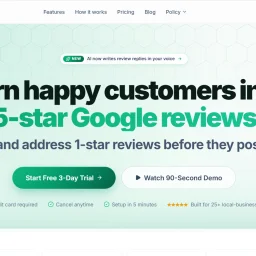
Local businesses struggle to maintain a strong online reputation, often losing customers due to a mismatch between their service quality and online reviews. Reviews Zen is designed to address this issue by automating review management for local businesses across various niches. The platform acts as a reputation autopilot, streamlining the process of generating and managing online reviews. What stands out about Reviews Zen is its use of AI to write review replies in the business owner's voice, significantly reducing the time and effort required to respond to customer feedback. The platform's ability to catch negative reviews privately and respond promptly is particularly valuable, as it helps mitigate the damage caused by unfavorable reviews. The key features of Reviews Zen include its branded email funnels, which send review requests to customers under the business's name and branding, and its negative-review interceptor, which captures low-rated feedback before it appears on Google. The platform also integrates with various business tools, such as Jobber and QuickBooks, to simplify the process of importing customer data and automating review requests. Reviews Zen offers a straightforward pricing model, with a starter plan available for $29 per month for a limited time as part of its founders' launch offer, which normally costs $79. The platform provides a three-day free trial with no credit card required, and customers can cancel their subscription at any time. Overall, Reviews Zen is a compelling solution for local businesses seeking to improve their online reputation and attract more customers through positive reviews.

Creating immersive online experiences is now more accessible than ever, thanks to innovative solutions like Space Tour's 360° virtual tour builder software. The primary challenge this product addresses is the complexity and technical expertise often required to create interactive virtual tours, which has long been a barrier for real estate agents, property developers, and interior designers. What sets Space Tour apart is its commitment to simplicity and a seamless user experience. By allowing users to build and customize 3D tours directly in the browser without needing to code or install software, it democratizes access to high-quality virtual tour creation. The platform's emphasis on design and branding is evident in its array of customization options, including custom fonts, icons, and color themes, ensuring that tours align with users' brand identities. Notable features of Space Tour include its support for high-resolution panoramas up to 32K, multiple navigation types, and integrations with Google Maps and Apple Maps. The software also offers advanced functionalities such as day/night mode, custom interactions, and analytics to track user engagement. The process of creating a tour is streamlined into straightforward steps, from preparing panoramas to publishing the final tour via a shareable link or embedding it on a website. Space Tour operates on a freemium model, with a free plan that includes essential features, allowing users to create a simple tour at no cost. For users requiring more advanced features, the Starter plan is available for $15 per month, offering a range of additional functionalities including white-label tour export, higher resolution support, and analytics integration. Overall, Space Tour presents a compelling solution for professionals seeking to present spaces in an engaging and interactive manner without the need for extensive technical knowledge.

Creating high-quality, polished visuals for product launches, marketing campaigns, and internal presentations can be a time-consuming and complex task. Protato addresses this challenge by providing a straightforward and intuitive solution for generating studio-quality 3D mockups. The tool is designed for a broad range of users, including developers, designers, content creators, and product teams, who need to produce professional-looking visuals without requiring extensive design experience. What stands out about Protato is its emphasis on simplicity and ease of use, making it accessible to users without prior 3D experience. The application's touch-first controls and real-time preview capabilities enable users to quickly adjust lighting, materials, and composition to create high-quality visuals. The ability to import screenshots or videos and instantly render them on real devices is particularly noteworthy, as is the flexibility to export images and videos in up to 4K resolution. Key features of Protato include its animation timeline, which allows users to record camera moves and create cinematic clips with keyframe editing, and its studio lighting presets, which enable users to switch between different lighting styles with a single tap. The application's optimization for mobile workflows is also a significant advantage, allowing users to create high-quality mockups on their iPhone or iPad. In terms of pricing, Protato offers a flexible business model, with options for monthly or annual subscriptions, as well as a lifetime purchase. The pricing tiers are clearly outlined, with costs starting at $4.99 per month. Overall, Protato provides a valuable solution for teams and individuals seeking to create professional-looking visuals without the complexity and steep learning curve associated with traditional design tools.

For professionals who spend their days typing away, a new tool has emerged to streamline their workflow. VoiceTypr is designed for founders, builders, and power users who are glued to their writing surfaces, whether that's ChatGPT, coding tools, or other text-heavy applications. The problem it tackles is two-fold: slow writing and potential data leaks. By leveraging offline AI voice-to-text technology, VoiceTypr enables users to dictate their thoughts and instantly convert them into clean, usable text. What stands out about VoiceTypr is its commitment to privacy and seamless integration. The transcription process runs locally on the user's machine, ensuring that sensitive information remains on the device. Moreover, it works globally across any application, in any text field, and at any time, making it a versatile addition to one's workflow. The process is straightforward: users download and install the app, choose a model based on their needs for speed or accuracy, set a hotkey, and start dictating. The flexibility in model selection is a key feature, allowing users to switch between different models depending on the task at hand. Additionally, the ability to customize hotkeys and formatting options adds to the tool's adaptability. Users can also opt for AI cleanup, which can be configured with their own API key for specific tasks, such as drafting emails. VoiceTypr offers a free download, with a lifetime license available for purchase. The absence of a cloud account requirement or subscription-based model aligns with its focus on local processing and user privacy. By solving the issues of slow typing and data exposure, VoiceTypr positions itself as a valuable asset for those whose work revolves around writing and text manipulation. Its offline capability, ease of use, and customizable features make it an attractive solution for enhancing productivity.
Sales teams and professionals struggling to make meaningful connections on LinkedIn can breathe a sigh of relief with the introduction of AI-powered outreach solutions. LinkSprig is one such innovative tool designed to help businesses, founders, agencies, and sales professionals simplify lead generation and grow their network efficiently. The platform is geared towards individuals tired of spending hours sending cold messages and chasing lukewarm leads, seeking a more streamlined and effective approach to LinkedIn outreach. What sets LinkSprig apart is its focus on results-driven outreach rather than sheer volume. By leveraging AI to analyze industries, roles, and interests, the platform delivers hyper-relevant leads, ensuring that users are targeting the right audience. The AI-powered personalization of messages and auto-reply assistant enable users to scale their outreach efforts without sounding robotic, making interactions feel more human-like and authentic. The platform's capabilities are geared towards making the outreach process more efficient and effective. It offers smart lead targeting, custom AI outreach messages, and an auto-reply assistant that responds to incoming messages naturally. Additionally, LinkSprig's CRM-friendly integration allows users to export leads, track responses, and monitor outreach performance seamlessly. The AI-powered analysis provides valuable insights into what works in outreach efforts, including reply rates, message performance, and conversion insights. LinkSprig is designed for founders, SDRs, and growth professionals, positioning itself as a solution that can help these individuals start real conversations, increase reply rates, and turn cold outreach into pipeline. Although the pricing details are not explicitly mentioned, the platform invites users to try it for free, giving them a chance to experience its capabilities firsthand. Overall, LinkSprig presents a compelling solution for those seeking to transform their LinkedIn outreach into a more natural and efficient business growth process.